Showing posts with label South India. Show all posts

Friday, September 10, 2021

Pastel Artwork: Snuggles and Simple Pleasures

 My latest pastel portrait, "Snuggles and Simple Pleasures." ©2021 Melissa Enderle


After finishing Sunday morning chores and creating a fresh kolam in front of my humble home, I sit down to enjoy a cup of hot filter coffee.  Our alley is filled with the squeals of laughter from young neighborhood children playing together. As the coffee warms my insides, the sun's early rays warm my thin skin. Soft fur brushes against my legs. It's my favorite kitten, coming for a visit. As I snuggle with him, I see what looks like a smile emerging from this contented creature. In this poor Chennai neighborhood, we might not have much, but it's these simple pleasures that keep me happy.

See more of my artwork on my website

Saturday, May 22, 2021

Artwork: Bharatanatyam Dancer-in-Training

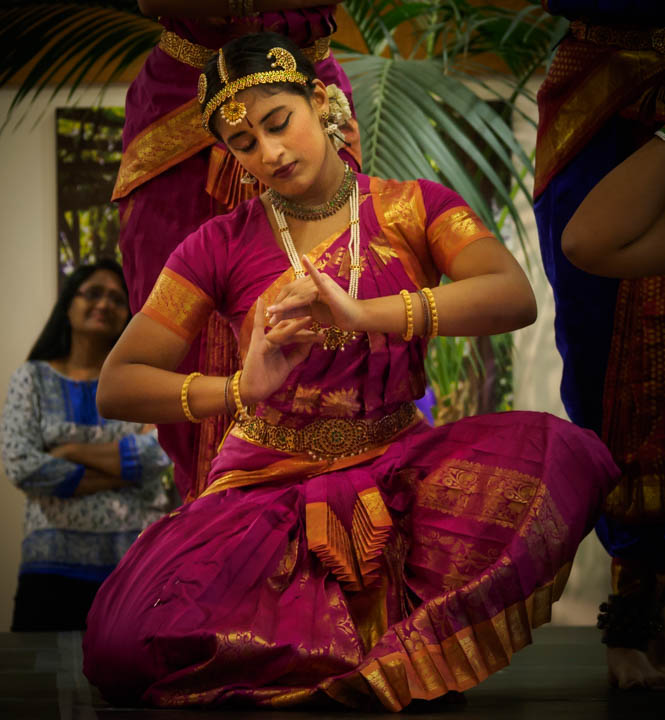
 My latest artwork, a pastel portrait of a young girl performing the Bharatanatyam Dance which originates in Tamil Nadu, India. ©2021 Melissa Enderle


It's the dead of winter in Madison, WI. Along with other teens of South Indian origin, I am performing at the Olbrich Botanical Conservancy. Although the weather is vastly different than that of Tamil Nadu where our ancient dance form of Bharatanatyam originates, this is a great opportunity to showcase a bit of South Indian culture. I take great care to form a complex mudra with my fingers, mindful of its spiritual symbolism. Deep in concentration, I imagine myself performing in a Hindu temple far away in India.


Sunday, February 19, 2017

Bharatanatyam Meets Madison


When I read an announcement that Bharatanatyam Dancers were going to be performing at Olbrich Gardens in Madison, I jumped at the opportunity to see this oldest of classical Indian dances, right in my neighborhood. Although it was not hot and sticky like it often was when I attended the performances in Chennai, the unusual spring-like February temperatures were just fine for me.

I arrived around the same time as some of the younger dancers. Unzipped winter jackets revealed the colorful costumes. A mother quickly "painted on" the finger designs with a colored Sharpie in place of customary henna. Artificial jasmine had to suffice instead of the customary fragrant floral strands adorning the plaited hair.

An instructor of the local Bharatanatyam Dance school introduced the girls (ages 5-16) and gave the audience a brief intro to what they were about to see. She explained how the eyes and hands were a highly integral part of conveying emotions in the expressive dances. Some of the younger students
The sophistication of footwork, hand gestures, and eye/neck movements increased with the age levels. Poses hearkened to the gods celebrated at Hindu temples, such as Krishna and Shiva. An enjoyable Saturday morning in Madison!

Tuesday, March 15, 2016

Wedding Gowns and Dwarapalas

On our way to the UNESCO World Heritage Hindu temple of Prambanan, we stopped at some smaller temples, including Candi Plaosan. Built around 825 AD, this Buddhist temple was gifted by a Hindu prince to his Buddhist princess wife from another dynasty. Although comprised of 174 buildings of varying sizes, many of the structures suffered significant damage during the 2006 earthquake. 
Despite its proximity to Prambanan (about 1 km northwest), it lacked the large crowds, enabling ease of exploration.

Two massive Drawapalas serve as guardian figures in front of the two main temples at Plaosan.
Flanking the outer walls of the main temple are beautiful carvings of Bodhisattvas. Some of the carvings reminded me of those at Tamil Nadu's impressive Thanjavur Hindu temple, except that the color of these stones were much darker than those in India. 

Inside the main temples, portions of sculptures remained, although some were headless. 

During the time I was there, Plaosan became slightly more lively when a wedding party arrived to take a few photos. Although many of the members were dressed in jeans, the bride was dressed in a Western gown and the groom in a white Indonesian outfit. As in other places, several people came up to me, asking if they could have a photo taken with me. 

Having had a chance to explore most of the site, we now were ready for the granddaddy of them all - Prambanan.

Thursday, January 14, 2016

A Hop, Skip and a Jump to Borobudur

For the night before visiting Borobodur UNESCO World Heritage site, I stayed at the Manohara Hotel. It was a more expensive than the other places I would stay at, but the hotel came with some significant benefits. The hotel is the only one that is within the Borobudur park complex and it offers a sunrise tour (discount for those staying at the hotel), granting access to the monument already at 4:30AM - an hour and a half prior to when the site is open to the public. This enabled me to stumble on out of the hotel room and right to the lobby to meet my guide. It also offered guests the opportunity to view an informative video (in English and Indonesian) on the Borobudur temple, providing some background information on what they would be seeing.

The hotel grounds was well-kept and the architecture fit in nicely with the area. The room was spacious and clean. After visiting the Borobudur temple, I came back and enjoyed complimentary breakfast at the open-air pavilion. 


Trees and foliage on the hotel grounds were beautiful; I hadn't seen a sausage tree since I left India.

View of Borobudur from the hotel
If I would have had more time, I could have gone back and re-visited the temple later in the day. Alas, my driver was waiting for me to continue my tour to other local places.

Saturday, September 12, 2015

A Hairy Deal

One of the more unusual "stalls" at the Shaxi Friday market was this one, consisting of two bags of hair and a scale. Quite likely, this purchased hair would be made into wigs. I wonder how much the seller received for the hair. Would she receive a higher price for longer pieces, or did it go simply by the weight?

It made me think of the large amounts of hair that is generated at Hindu temples (most Hindus have their head shaved at least once in their lifetime and some donate it multiple times to show their piety).

Saturday, May 30, 2015

Lotus Lantern Festival - Tibetan Mandalas

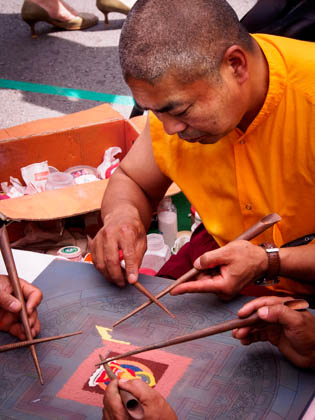
As part of the Lotus Lantern Festival in Seoul, Buddhism from different parts of the world were in attendance. Some Tibetan monks painstakingly collaborated on a mandala. I went back several times to check on their progress. 

Such incredible, temporary art, reminding me of the kolams painted in front of South Indian homes & businesses.


Thursday, February 26, 2015

Indian Breakfast in Georgetown

With Georgetown's large South Indian population, we spent quite a few of our meals enjoying South Indian cuisine. One morning we ate at this small street side stall. For around $2, we had our fill of comfort food such as appams and rotis as well as fresh juice. The stall was a busy one, with many people stopping long enough to order their meal and have it taken "to go," with the sauces packaged in plastic bags. True, the rather strong rainfall made the plastic tarp rather noisy when eating, but we didn't mind. 


Tuesday, February 24, 2015

Kapitan Keling Mosque

Yet another mosque in historical Georgetown is the Kapitan Keling Mosque. It was built in 1801 to serve the area's Muslim South Indian community. Much of its current style was achieved during the mosque's major enlargement in 1916. Indeed, the Moghul-styled architecture felt like the building could easily have been in Agra or Delhi, reminding me of buildings such as Agra's Jami Masjid, the Taj Mahal or the Humayun's Tomb in Delhi. 

The single minaret, which seemed more like a small building, is from where the call to prayer is announced. 
The Kapitan Keling Mosque is located on what is known as Harmony Street, as it contains buildings serving the community's varied faiths including Islam, Taoism, Hinduism, Christianity, Buddhism, and Confucianism. 

Thursday, February 12, 2015

Historical streets of Georgetown


 Over the next several days, we traversed the streets of historical Georgetown on the island of Penang. Designated in 2008 as a UNESCO World Heritage Site, the core zone of Georgetown contains over 1,700 historical buildings. The excellent George Town World Heritage Incorporated organization, housed in a historical building on Lebuh Acheh Street provided some incredibly helpful brochures, walking maps and other information.
Despite the rain, we thoroughly enjoyed our walks through the streets. What a special blend of cultures and communities - particularly the Chinese, Indian, Malay, and Baba-Nyonya. True, I had seen this same mixture in Melaka, but in Georgetown, the scale was much larger. I loved how Georgetown still retained its historical feel and yet was an active residential/commercial hub. It felt "real" - not just a few preserved buildings in an artificial oasis. 

Buildings were in various states of repair, but even the slightly dilapidated ones had a special charm. Some of the colors were quite vivid. Patterns and textures abounded. Architectural buffs would have a field day, observing the historical variances.

Walking down one area, we'd be transported to southern India, as reflected in the shops, stalls, restaurants, smells, and music. 

Walk down another street, and we'd be in China, complete with temples, clan houses, etc. Several mansions of the Baba-Nyonya were converted into spectacular museums. A few mosques of Sumatra style added a little variety, as did the colonial buildings reflecting the British presence (Penang was ceded to the British East India Company in 1786 in exchange for British military protection).

I loved the slightly chaotic nature of the streets and could have spent much longer meandering. Even though we crisscrossed and went through some streets multiple times, I never grew tired of the sights - each time taking in more. 

Monday, February 02, 2015

Up on the Hill


On our way up the stairs to the natural vantage point of Melaka known as St. Paul's Hill, I admired the banyan tree. A white statue of St. Francis Xavier greeted us.  Our guide of South Indian descent proudly explained how this Jesuit priest visited Melaka several times and used Melaka as a base for his missionary visits to Japan and China. In 1553, his incorrupt body was temporarily buried here (later that year he was buried in Goa, India). St. Francis Xavier's open grave (covered with a grate) is still present within the church. The statue was erected in 1952 to commemorate the missionary's 400th anniversary of his travels to Melaka.

St. Paul's Church was originally built by the Portuguese in 1521 and was consecrated to the Virgin Mary. The Dutch then used the enlarged church as its main church for 112 years until the iconic Christ Church was completed in 1753. At that time, it was modified and became part of the fortification. Further deterioration occurred when the British took over in 1824, using the structure for powder magazine. 

During excavations by the Melaka Historical society in 1930, Portuguese gravestones from the hill were affixed to the interior walls of the roof-less structure. 


Friday, January 30, 2015

Melaka Sultanate Palace

With the rain coming down once again, I headed over to one of Melaka's many museums - the Sultanate Palace. A rather stark contrast to the Dutch buildings in the central core of Melaka's UNESCO area, it is actually a replica of the palace of Sultan Mansur Shah (1456-1477). Although built only 30 years ago, its construction methods are traditional, using no nails whatsoever. 
Its galleries depict some aspects of sultanate life and culture and also display rare local artifacts, weaponry, ceramics, brassware, and a royal meeting chamber. I especially liked the display of traditional costumes and jewelry.

The inexpensive entrance ticket also includes access to the beautiful grounds in the style of the "Forbidden Garden" reminiscent of the landscaping of the Sultan's period. My stroll through its quiet but lush grounds reminded me of the many walks I took through tranquil Theosophical Society of otherwise chaotic Chennai, India. If I lived in Melaka, the palace garden would definitely be a place I'd frequent.


Sunday, January 11, 2015

Malaysia Dec 2014

For Christmas break, I decided to get out of the cold and see a bit more of South-East Asia. My destination: Malaysia. I had heard praises from colleagues about the beauty and cultural diversity of this tropical nation, located south of Thailand and also bordered by Singapore. After a direct flight 6 1/2 hours from Seoul, I happily packed away my winter jacket and shed several other layers of clothing. 
The multicultural nature of Malaysia was already apparent at the airport. Saris, salwars, blouse-skirt kebayas and baju kurungs, hijabs, and even a few abayas shared the fashion with Western-style clothing. Skin color and facial structure immediately expanded, including the Malay-Indonesian appearance along with those who looked more Chinese and South Indian. Although the KLIA airport was rather new-looking, it had a slightly chaotic feel vs. the urban chic of Korea's Inchon airport. 

After exchanging some enough money to get me through the next day, I purchased a bus ticket and then enjoyed tasty early dinner of South Indian dosas and fresh juice. In just over two hours, the air-conditioned coach bus conveniently transported me southward to the UNESCO World Heritage town of Malacca (also spelled Melaka). Although the vegetation had some similarity to South India and driving was on the left side of the road, this area was hillier and the roads lacked the ubiquitous honking. 

Wednesday, September 03, 2014

Beauty Shop Gals

Beauty shop signs definitely vary by country. Above are some beauty shop poles in Seoul, South Korea.
A bit of a contrast, this hand-painted sign at a small stall in Velankanni, south India promotes a beauty of a different kind. Photographed during the annual religious pilgrimage, some devotees (both male and female) choose to have their head shaved as a sort of sacrifice.

Thursday, August 21, 2014

Happy Anniversary, Chennai!

Today marks the 375th anniversary of the founding of modern Chennai. On this date, the East India Company was granted a 3-mile strip of land in a fishing village called Madrasapatnam, establishing India's first modern city. It was here that a fort and castle was to be built.
Pictured below is the Secretariat of Fort St. George, which houses the Tamil Nadu legislative assembly.

Tuesday, June 17, 2014

South India and South Korea Beaches

Although both of these beach photos contain similar colors, the contrasts couldn't be larger. Pricey, touristic well-developed beaches in South Korea, vs. the polluted fishing beaches of South India where its residents don't even have access to toilets.
Busan, South Korea
Chennai, south India

Thursday, February 20, 2014

Behind the Layers

Bongwonsa Temple, Seoul
Although I find the highly intricate paintings on temples to be exquisitely beautiful, the faded scenes also attract my attention. What stories do these flecking paints or stained surfaces have to tell us? How do the processes of pigment application vary from when the murals were first created? What devotion the artists must have had, painstakingly rendering each detail. What would they think to see their designs all faded away?
Thanjavur Hindu temple, India

Sunday, January 19, 2014

Weeping Winter and Spring Tree

Although not the exact same angle, these two photos show the willow-like trees in front of Gyeonghoeru Pavilion at Gyeongbokgung Palace in Seoul. Both views have their own tranquil beauty. Having lived in India for the four years prior, it was a while since I saw a frozen body of water. If the pond had been in Wisconsin, there may have been fishermen eager to get their ice fishing gear on the ice. Here in Seoul, the frozen pond was undisturbed, just as the still waters of the spring scene.


Friday, January 17, 2014

Through the Paddy Field

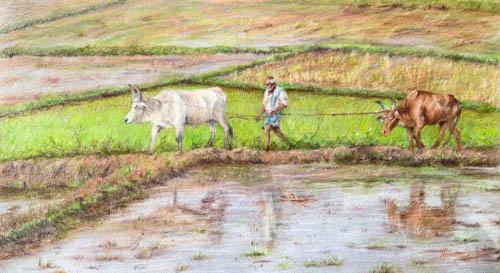
Through the Paddy Field
Color Pencil
by Melissa Enderle

Paddy fields such as this are very common in South India. I loved seeing the brilliant green of a lush field. Each paddy is rather small and is bordered by a raised mound of dirt. In this color pencil drawing, a farmer leads two of his cows on the narrow raised border of a Tamil Nadu field. Distorted, but discernible reflections of each is found in the flooded field in the bottom portion of the drawing. Measuring only about 24x44 cm, this rather small drawing made it a bit more challenging to render the figures. It did fit well into my suitcase back to Korea though!

Thursday, January 02, 2014

Happy New Year - Tamil Style

When teaching in Chennai, the capital city of the southern Indian state of Tamil Nadu, I particularly enjoyed walking the streets during main holidays. On such special occasions,  the daily white rice flour kolams rendered by women In front of homes and some businesses were replaced with colorful designs. On particularly important festivities such as Pongal (harvest festival) and weddings, the particularly large kolam might extend well into the road as well. In the photo above we see a woman working on the kolam she made for New Years.