Showing posts with label Agra. Show all posts

Saturday, March 18, 2017

Arches of Baby Taj

Right now, I've been following some of the travels through India by some of my friends who are on spring break. In addition to the more famous Taj Mahal, one can also visit the also Itmad-ud-Dulah, known as the Baby Taj. Built prior to the Taj Mahal, this highly ornate but smaller mausoleum represents the first phase of monuments built in the Mughal Style. This photo was taken from the archway of the main building and frames the entry gate.

Read my previous post on the Baby Taj.

Thursday, November 10, 2016

A Roadside Shave

Gotta love the convenience of services in India. On the road to Agra (a few years ago), we spotted this man getting a shave.

Saturday, February 06, 2016

Water Castle - a Perfumed Garden No More

Still within the Kraton palace grounds about 2km south, we visited what is known as the Water Castle - Taman Sari. The driver explained that through that white decorative gate was a bathing complex. At one time, it was just a small part of the 59-building palace complex, complete with 18 water gardens, pavilions, mosques, and was surrounded by an artificial lake. Following a devastating earthquake in 1867 as well as destruction by the invading British in 1812, Taman Sari was abandoned by the sultanate. Since then, the complex has become overrun with squatters who settled and constructed buildings on the dry lake bed. 
A naga greeted us at the gate

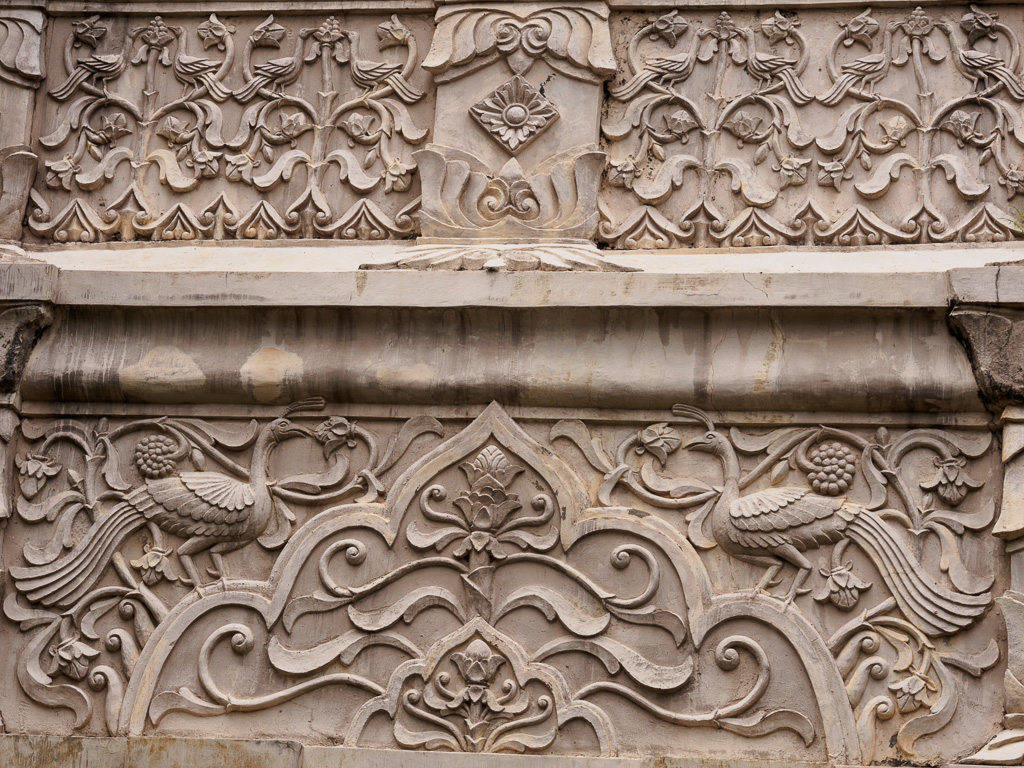
 The floral designs and peacock-like birds brought me back to India, particularly the Taj Mahal in Agra. How splendid this place must have looked at one time, harkening back to the meaning of its name - garden of beautiful flowers.
Once through the gate however, I was saddened to see the state of this partially restored section. The pool, once used by concubines of the sultan, was blackened and dingy. Oh how I wanted to drain the water, scrub the bottom and repaint/tile it. The buildings walls were equally dingy. In 2004, Taman Sari was placed on the World Monuments Watch endangerment list. Another devastating earthquake two years after that further damaged the site and has increased the urgency for preservation of this culturally and historically significant site. Despite the series of natural & man-made disasters that have befallen the complex, it is considered one of the best examples of 18th century Javanese architecture and landscape design. While it is quite doubtful that the complex could ever be restored to its former glory, the WMF would love to see more funding to make some attempts at preservation.
With the guidance of the people I was with, we went past some squatter's homes and found the underground tunnel that led to the Sumur Gumuling, an water mosque. Reminding me of a real-life Escher staircase Relativity artwork, four staircases met on an elevated platform in the middle of the building. On the ground level was a pool (now drained) that once served for ritual ablution.

Although I found it a bit difficult to fathom the grandiosity the Taman Sari complex must have once possessed, even the encroachment buildings had their own flavor. Had I more time, I would have liked to wander through the alleys, catching a glimpse of life on what once was a garden of beautiful flowers.

The Taman Sari, along with the Sultan's Palace, was listed as a tentative UNESCO World Heritage site. Although I've seen some UNESCO sites that also feel neglected, perhaps a full acceptance onto the esteemed list would provide some needed funding and awareness.


Tuesday, February 24, 2015

Kapitan Keling Mosque

Yet another mosque in historical Georgetown is the Kapitan Keling Mosque. It was built in 1801 to serve the area's Muslim South Indian community. Much of its current style was achieved during the mosque's major enlargement in 1916. Indeed, the Moghul-styled architecture felt like the building could easily have been in Agra or Delhi, reminding me of buildings such as Agra's Jami Masjid, the Taj Mahal or the Humayun's Tomb in Delhi. 

The single minaret, which seemed more like a small building, is from where the call to prayer is announced. 
The Kapitan Keling Mosque is located on what is known as Harmony Street, as it contains buildings serving the community's varied faiths including Islam, Taoism, Hinduism, Christianity, Buddhism, and Confucianism. 

Sunday, June 24, 2012

India Reflections


So now my four years in India are over. I've met such wonderful, warm people, both at school and within communities around the country. I've had the opportunity to experience glimpses all over "Incredible India" –from the temples and churches of Tamil Nadu to the lush coconut backwaters of Kerala, to the deserts & fortresses of Rajasthan to the snowy mountains of Kashmir. I've been fortunate to have witnessed a variety of handicrafts being made. It never ceases to amaze me how India's artisans are able to transform simple threads into masterpieces; zardosi, silk saris, bandini tie dyeing, ikat weaving, and endless types of embroidery. Such a rich artistic heritage. Reflecting back though, I would have to say that India's greatest wealth is its people. I will miss the many citizens of India who were my colleagues for four years, as well as the many others I have met while living and traveling in the incredibly diverse subcontinent.

Friday, April 08, 2011

Agra Fort


Built by the Emperor Akbar between 1565 and 1573, this UNESCO World Heritage site is another of Agra’s jewels amidst the grime. In true fortress fashion, it has high walls (70 feet - 21 m), double ramparts, battlements, massive gates, circular bastions and a moat. Entering through the imposing Amar Singh Gate, today’s visitors see only a small mount of Akbar’s original structures; some were destroyed by Akbar’s grandson Shah Jahan and others by the British who used the fort for barracks. Parts of the fort are still used by the Indian military, visitors focus on the area closest to the Yuma River.

Despite portions of the fort being closed off to visitors, there are quite a number of beautiful buildings to see. The Diwan-i-Aam was an arcaded hall that reminded me of a similar royal public audience hall in the Delhi’s Red Fort. Nearby was the Anguri Bagh, a series of geometrically arranged gardens in alternating plant colors of green and deep burgundy. The Khas Mahal, built in a style so typical of Shah Jahan, is an elegant white-marble hall with brightly painted ceilings and twin golden pavilions. The Diwan-i-Khas is perhaps the most beautiful structure there, with its exquisite pietra dura work of flowers, vines, and designs covering columns and archways. In this open hall, the emperor would meet his court. From the double-storeyed profusely-decorated octagonal tower named the Musamman Burj, Shah Jahan had a direct view of his beloved Taj Mahal. Ironically it was this tower where Jahan spent the last eight years of his life, imprisoned there by his son. Walking back to the gate, we passed by the Bengali Mahal, constructed out of red sandstone. Its decorative architectural style reminded me of that at Fatehpur Sikri (Akbar’s planned capital city and palace), with its intermixing of Hindu and Islamic elements in the same red sandstone.

Thursday, April 07, 2011

Itimad-du-Daulah


Described as a “jewel box in marble,” this tomb of the “Lord Treasure of the Mughal empire under Shah Jahan is also nicknamed the “Baby Taj.” Predating the more famous structure, the Itimad-du-Daulah signals a change in Mughal architecture, away from the massive red sandstone structures to the more elegant structures such as the Taj Mahal. Highly symmetrical, the squat building had a minaret at each corner. Colored mosaic patterns of geometric and floral designs covered the outer surface and the interior floor. Window jail screens of complex geometric patterns were carved out of single pieces of marble. Inside, floral paintings were in various states of preservation were framed in arched niches on the upper half of the walls. The painted ceiling must have also looked rather beautiful with its incised patterns, relief textures, and golden accents. Not nearly as visited as the more famous structure in Agra, it was much quieter here, giving us ample opportunity to wander around the various rooms with tombs and admire the decorative architecture.

Wednesday, April 06, 2011

The Black Taj


Our next destination was directly across the river from the Taj, but rather long to get there due to the traffic congestion, long divided roads with no/few U-turns, and the required bridge a distance away. Paying a small fee, we walked through orchards of fruit and flowering trees until we neared the Yuma River. From here, we had an alternate, less crowded view of the Taj Mahal, still looking rather placid against the foggy, grey sky. We stood amongst remnants of the foundation of a structure situated directly opposite the Taj. Legend has it that Shah Jahan wanted to build a replica of the Taj he had built for his beloved wife - except with black marble. With the emperor’s finances severely strained due to the hugely expensive white structure, Jahan’s son halted its construction.

Tuesday, April 05, 2011

Agra and the Taj Mahal


After a brief visit to Fatehpur Sikri we arrived in Agra as dusk took hold. Darkness did make it a bit more difficult to realize the true dinginess of the city. Whereas many of India’s other cities also have issues with being crowded, dirty, congested, and polluted, the main city of Agra lacks color and vibrance.

Taj Mahal
The following morning, we got an early start to arrive at the Taj when it opened. Battery-powered vans quietly rolled past, reminders of attempts at limiting pollution around the World Heritage site. Bicycle rickshaws creakily paddled up to us and asked us if we’d like a ride, unsuccessfully convincing us that the Taj was “very far.” The dense fog ruled out any chance of getting those “picture-perfect” photos of the Taj Mahal against blue skies; now just seeing it from any distance would be a goal. Along with the already-growing cluster of tourists gathering at the front gate, some four-legged critters were wandering about. Some of the animals donned “coats” made from burlap sacks. One goat completed the fashion with a knitted cap. Our bags were checked prior to entering. My friend’s 4” wooden figurine of a big-nosed Serbian wearing a traditional shajkaca cap was detected and denied entrance. When asking why, the female guard said, “bad karma.”


After the figurine was checked in at the baggage center, we proceeded inward. A few typical photos later, we walked in the mausoleum through the large door and admired the incredibly intricate marble screen around the two fake tombs briefly illuminated by camera flashes going on in the “no photo zone.” Even though I had seen the structure before, I couldn’t help but be awed by its artistic workmanship, including the flowers created by tiny pieces of inlaid semi-precious stones, and raised flowers carved from the same white marble as the rest of the structure. Letting the Japanese tourists posing in their new saris get their photos and move on, I took a few photos of the Taj, other buildings, and grounds in more creative views.

Monday, April 04, 2011

From Jaipur to Agra


What should have been a rather simple drive on major roads to Agra turned into a more interesting, albeit slower journey through rural areas, thanks in part (again) to the Gujars blocking the roads in an effort to have their demands met. First we stopped at the Chand Baori stepwell, dating back to the 8th-9th century and the deepest in Rajasthan - 19.5m (64 feet) deep.


On the bumpy, narrow roads, our slower trek took us through tiny villages scattered in between fields. Kids engaged themselves on a favorite pastime of the region - kite flying. Women pumped water at the wells. Older men squatted near the road, smoking bedis as they chatted. Along both sides of the roads in these villages, children and some puzzled adults lined up as if observing a parade, waving at the unusual procession of trucks, tourist vehicles, and other unfortunates who were diverted. Children ran ahead and climbed on top of mud brick walls and further ahead in order to get a better (or second) viewing. It reminded me a bit of traveling by a traditional dugout boat up the Niger River to Timbuktu.


The flat land in the area yielded brilliant yellow fields of mustard plants. This crop, also seen in abundance in the Shekhawati region and even a bit in Himachal Pradesh, is used for cooking oil and creating dyes. Indian-style scarecrows stood above the crops, sporting a black pot for a head. Early in the morning steam from recent rains rose above the field, replaced later by deep, blue skies. Brick factories were situated in the middle of the mustard fields, with their blue and white striped chimneys rising high. Men and children piled bricks neatly in a cleared field next to the factory, creating patterns with their expert stacking techniques. In other ploughed fields, camels were hitched up to farm equipment. Others could be seen in the villages and towns hauling goods with special trailers. Tractors received special attention here as well, sporting decorations of colored tinsel tassels, artificial flowers, and colorful garlands. In the courtyard of farms, the women patted small mounds of cow dung into thicker disks to be used for fuel. Cowpies dried on the roof and dried ones were stacked 7-high on a low wall near the road, probably for purchase.

Wednesday, February 23, 2011

Taj Mahal Slated for Demolition?


Did you know that legend has it that in 1830, Lord Bentinick (governor of India) actually proposed to demolish the Taj Mahal? He wanted to dismantle the Taj Mahal and sell the marble and was stopped only when he was unable to find buyers. Whether or not this story about this known penny pincher is actually true, what definitely is known is the looting and destruction that occurred on the Taj and other sites by the British. On the Taj, carpets, jewels, and silver doors were removed. Soldiers chiseled out the precious stones and lapis lazuli out of the walls. Visitors also chimed in, using hammers to remove chunks containing carnelian and agate from the floral designs. In the mid 19th century, the Taj had become a pleasure-resort, with the mosque and symmetrical building being used as a honeymooner suite. Indeed, the Taj Mahal had become a sorry sight.

Around 1904, Lord Curzon (Viceroy of India) demonstrated his love for culture and heritage by passing an Act to protect the Taj and other monuments. In 1908, he initiated the restoration work on this heritage site. The interior received a large replacement lamp, outdoor canals made to work again, and gardens restored  - but in a more British style.

In the 20th century, India sought to protect the Taj against potential bombing during several wars, but then let pollution heavily degrade it, leaving the monument again in an imperiled state in the late 1990's. Since then, factories have been moved away and no vehicles (besides electric and bicycle rickshaws) being allowed within a certain radius of the site.


Source: http://www.thetajmahalindia.com/mahal-taj1.html

Sunday, January 16, 2011

Trip to North India - Dec 2010

In December of 2010 I met three of my friends in Delhi to start our trip through Northern India. Two came from Serbia and were former colleagues of mine, and the other flew from Wisconsin, a former art professor and elementary art teacher of mine. Our journey would take us from Delhi to Dharamasala, back to Delhi, on to Udaipur, then to Jodhpur via Ranakpur, Jaipur, Shekhawati region, back to Jaipur, then on to Fatehpur Sikri, Agra, and finally back to Delhi. In this series of blog entries, I will attempt to highlight some of our experiences.

You may find more of my photos on my Flickr site.

Sunday, December 05, 2010

Elderly Man, Agra


Elderly Man, Agra, originally uploaded by melissaenderle.
This is a watercolor painting I just completed of a man from the local streets of "real" Agra. He had such a kind face.

See more of Melissa's artwork on Facebook

Saturday, July 17, 2010

Tower of Toast

Visiting a town's market and local commerce streets are things I try to always do - it's the best way to meet the local people, catch a glimpse on everyday life, and of course, wonderful photo opportunities! This photo was taken in the streets of Agra, home to the Taj Mahal. Toast, anyone?

Thursday, March 04, 2010

The Taj Mahal: Study in perspective

Looking at this photo reminds me of my high school art class days. From the patterned tilework of the pavement to the designs of the Taj Mahal itself - what an excellent example and study of one point perspective!

Sunday, February 07, 2010

Tipu Sultan's Daria Daulat Bagh

On our way to Bangalore, we stopped by the historical town of Srirangapatnam. This island town was made famous by Mysore’s raja Haider Ali and his son Tipu Sultan, both of whom were responsible for transforming the small state of Mysore into a major Muslim power. Nicknamed the “Tiger of Mysore,” Tipu Sultan took it upon himself to try and rid India of the hated British invaders. In 1799, the British finally managed to capture the citadel at Srirangapatnam, killing Tipu and firmly establishing Britain’s presence in South India.

After quickly photographing the Jami Masjid mosque (built by Tipu in 1787), we went to Tipu Sultan’s summer palace – Daria Daulat Bagh, also built in1787. Walking through the yellow archway at the entrance revealed the summer palace in the middle of a beautiful symmetrical garden. Large columns were made of teak. Green sunscreens covered much of the open veranda surrounding the entire palace. The scalloped arches of the veranda reminded me very much of the architecture I had seen in Agra and Fatehpur Sikri. The rather simple exterior of the palace failed to prepare me for the beauty of the interior. Every inch of the teak walls and ceiling was covered with patterns and colors. Some walls had painted floral designs with raised Arabic “window” frames. Columns were carved with zigzag stripes in blue, green, and cream colors. The ceiling had 8-pointed stars with floral designs inside each star. The floor was also patterned and quite colorful. Near the entrance was an upper balcony from which Tipu was able to view visitors. My favorite part was the two walls covered with murals. The west wall recalls in great detail the victory by Haider Ali over the British at Pollilore in 1870, painted in a Mughal style. Heroism and bravery by the Indian fighters was prominently presented. The east wall is basically narrative portraiture of the royal family, including queen smoking a hookah pipe. How I would have loved to photograph these mural treasures, but photography was not allowed. Sharing the space were scores of school kids in uniforms. They quickly snaked through the rooms & exhibits, many of whom were more interested in us than what was on the walls and displays. More busses full of kids were outside, with other groups sitting on lawn under shady trees, one class sitting neatly in a row.

See more photos of Srirangapatnam on my Flickr page

Sunday, January 17, 2010

More photos of the Streets of Agra

For those who enjoyed seeing the photos in yesterday's post, here are a couple more scenes in the streets of Agra. You can find more on my Agra Flickr set.


Saturday, January 16, 2010

Walking Through the Streets of Agra


Walking back down the stairs, I proceeded to wander through the streets. At first I was fairly close to the walls of the mosque. Wanting to explore more intimate alleys, I headed just a bit away and soon found myself in narrow alleys, some of which had dead ends. Here I found some beautiful doors and windows – along with rubbish, etc. Kids in their school uniforms smiled shyly as I passed by. Having a fairly good sense of direction, I was able to correctly make my way back to larger streets. Here things already were abuzz with activity. Muslim fried breakfast foods were being fried in large woks. Meat was being chopped on platforms outside of narrow stalls. Legs of goats were piled up, ready for sale. Rice was being weighed on a scale, dished out to hungry customers. Produce was being laid out ready for the morning sales. Children wearing bright uniforms and matching winter hats walked as small groups in the street, eager to have their photos taken. Other kids were working in the stalls or pushing carts. While walking along, people stopped me and asked if I would take their photo, to which I always obliged. It is so satisfying to see their joy and excitement as I show the photo to them and others around them. Meeting such local people is always one of my favorite parts of traveling. Alas, it was time to head over to the train station. A short auto rickshaw ride later, I was on the platform for the train headed to Delhi. A three hour ride to Delhi and then a plane ride back to Chennai, my trip was almost finished.

Wednesday, January 13, 2010

Jami Masjid, Agra


As I had some time before departing by train back to Delhi, I decided to visit the Jami Masjid and the bazaars and narrow alleys surrounding the mosque. A bicycle rickshaw driver offered to take me to this heart of historic Agra, located just past the Red Fort. This “Friday Mosque” fit in very well with the other structures I had seen in Agra. It also was constructed in 1648 of red sandstone and has marble domes. A unique feature is the mosque’s zigzag chevron pattern, present on the domes and on columns. The British destroyed the eastern courtyard wing in 1857. The man who greeted me asked for a donation that was being used for restoration, including the replacement of the large flat stones in the courtyard. Close to the entrance of the mosque is the ablution tank with a royal stove used for heating water. Pigeons bathed in the tank and dotted the large courtyard, flying up in groups once in a while. Off of the main worship area is the prayer area for women. Aside from one boy, the old man, and a few construction workers, the complex was devoid of people.

Monday, January 11, 2010

Zari and Zardozi


Having read about Agra’s textile arts known as zari (elaborate gold thread embroidery) and bead embroidery (known as zardozi), I asked to visit a place where this craft was being demonstrated. Literally meaning “sewing with gold,” zardozi was a prospering craft during Akbar’s time but gradually declined. Older saris of Chennai used this same technique with gold-covered thread, making such saris very valuable. During Akbar’s time, costumes, walls of tents, wall hangings, and coverings for horses and elephants all employed this technique. Intricate patterns were traced in gold and silver, studded with pearls and precious stones. These were sewn on silk, velvet, and brocade. Today zardozi threads consist of copper wire with a golden sheen or use gold-colored silk thread. In the shop (mainly for sale), a young man (this craft is done predominantly by Muslim men) was using colored silk thread to embroider silk thread flower designs for evening purses. Displayed on the wall were several masterpieces created by a man who is credited to reviving the craft in Agra. One was a floral design created with colored silk threads, outlined with the gold thread, and studded with precious and semi-precious stones and gems. Another comprised of several birds, while a third was of a hunting scene. Unlike most designs of today, these pieces get their dimensionality not by adding thick cotton threads or stuffing, but by painstakingly layering on silk threads, one over the other until the desired height and shape is achieved.