Showing posts with label Malacca. Show all posts

Monday, March 16, 2015

Grandeur of the Pinang Peranakan Mansion

A "not to be missed" destination in the historical Georgetown area of Penang, the Pinang Peranakan Mansion is well worth the admission cost (20RM - approx $5.40). Built at the end of the 19th century, this mansion is an excellent example of the eclectic Baba-Nyonyas incorporating Chinese, Malay, and British architecture. After suffering from decades of neglect, the mansion was fully restored and is now a museum that recreates the traditions, lifestyle and culture of the wealthy Baba residents. In addition to the beautifully restored interior, it overflows with antiques and collectibles of the era. Unlike some of the other Baba-Nyonya museum/homes I had visited in both Penang and Malacca that required a guided tour, we were free to explore the two floors, adjoining ancestral temple, and a special jewelry museum. 

For more information, visit the museum's website.

English floor tiles

Central courtyard with an open airwell and stairs leading up to the second level. This allowed for air and light to freely circulate and rainwater to be collected.

Ornate carved wooden doors leading to a room with heavy teak furniture and an altar

Tranquil room with bamboo and a small pond

Carved wooden screens gilded in gold and flecked with mother-of-pearl

Wednesday, February 18, 2015

Chien Nien mural work at Yap Kongsi

Although the scaffolding did obscure the wider view of the Yap Kongsi Temple in Georgetown, it did provide a glimpse into the process of the chien nien artistry adorning it and many other local Chinese temples.
Literally meaning "cut and paste," chien nien utilizes broken pieces of special porcelain bowls from China. While typically a brilliant glazed color on the outside, the bowl interiors tend to be unglazed, enabling bonding to the cement to be strengthened. The thinner the porcelain, the more desirable the bowls are for this art form. Chien nien can be found in such murals and the often highly decorative rooftops. The technique is also used to cover more sculptural pieces.
A rather fragile art worn down by time and weather, restoration work is a frequent need. Throughout Penang and Melaka, chien nien in various states of repair were noted.


Thursday, February 12, 2015

Historical streets of Georgetown


 Over the next several days, we traversed the streets of historical Georgetown on the island of Penang. Designated in 2008 as a UNESCO World Heritage Site, the core zone of Georgetown contains over 1,700 historical buildings. The excellent George Town World Heritage Incorporated organization, housed in a historical building on Lebuh Acheh Street provided some incredibly helpful brochures, walking maps and other information.
Despite the rain, we thoroughly enjoyed our walks through the streets. What a special blend of cultures and communities - particularly the Chinese, Indian, Malay, and Baba-Nyonya. True, I had seen this same mixture in Melaka, but in Georgetown, the scale was much larger. I loved how Georgetown still retained its historical feel and yet was an active residential/commercial hub. It felt "real" - not just a few preserved buildings in an artificial oasis. 

Buildings were in various states of repair, but even the slightly dilapidated ones had a special charm. Some of the colors were quite vivid. Patterns and textures abounded. Architectural buffs would have a field day, observing the historical variances.

Walking down one area, we'd be transported to southern India, as reflected in the shops, stalls, restaurants, smells, and music. 

Walk down another street, and we'd be in China, complete with temples, clan houses, etc. Several mansions of the Baba-Nyonya were converted into spectacular museums. A few mosques of Sumatra style added a little variety, as did the colonial buildings reflecting the British presence (Penang was ceded to the British East India Company in 1786 in exchange for British military protection).

I loved the slightly chaotic nature of the streets and could have spent much longer meandering. Even though we crisscrossed and went through some streets multiple times, I never grew tired of the sights - each time taking in more. 

Tuesday, February 10, 2015

Malaysia: Adventure by Bus

After traveling solo the last few days in Melaka, I was looking forward to meeting up with an art teacher friend and heading up to Penang. I left a window of several hours in between when my bus was scheduled to arrive in Kuala Lumpur and the departure time from the same bus terminal to Penang - just in case.  The bus left fairly close to "on time" and things seemed to be proceeding fairly normally until passing through a tollway. Some unusual sounds were heard as the driver attempted to shift the gears, with the bus failing to gain much momentum. The driver pulled over momentarily and then attempted to move onward. Judging from the time, we were not that far from the outskirts of KL. Unfortunately, just as the bus sputtered through the next tollway, it decided that was far enough. Now, a very foul smell and smoke was prominent. After several minutes of people muttering, the bus driver finally let us off the bus. 
After about a half hour wait with no one telling us anything, another bus stopped to let us on. A local assured me that the bus would be taking us to the originally intended station; alas, it wordlessly dropped us off at a different station. And so began the transport tangle in Kuala Lumpur. I did not see the name of desired bus station as one of the train stops when I looked on the signage, but two locals said they were also going that direction and provided some assistance. A few train stops later and a covered maze-like walkway later, I finally reached the intended bus station. My art teacher friend had already arrived and immediately spotted me, thanks to my height and red hair.
After a quick bite to eat, we were ready for our bus ride up to Penang. We waited by the platform in the tropical heat and I wasn't that surprised when that bus was late. The AC on the bus was welcomed and as it quieted down, we were able to snooze a bit. As we passed by the city of Ipoh about 200 km north, the landscape became quite beautiful. Huge limestone hills jutted into the very cloudy sky and were carpeted by thick tropical vegetation. Some of the trees were incredibly tall, poking their way through the dense misty clouds. It looked like illustrations of rainforests I had seen in books. What an experience that would have been to trek through the hills and up to its many caves. Between the speed of the bus and rain, capturing decent photos of the magnificent natural scene was difficult. I would have to settle for the few photos I managed to take and my memory of the scene; perhaps another time I could visit.
Alongside the edges of the fairly well-maintained expressway, women used weedwackers to keep the vegetation down. Others trimmed the flowering bushes that served as a median strip, forming interesting zigzag patterns.

A couple hours later, we arrived in Butterworth, a rather bland city from where it was an easy ferry ride to the island of Penang and to our destination of UNESCO World Heritage city of Georgetown. 

Sunday, February 08, 2015

Golden Lotuses

Besides the wau bulan kites, another display that caught my attention at the People's Museum in Melaka was of the lotus shoes. I had first read about this Chinese practice when reading the excellent book Snowflower and the Secret Fan. Looking at these tiny but beautifully embroidered silk shoes, it was difficult to imagine that an ideal size of an adult female - known as a golden lotus -  was around 3 inches in length. What pain these young girls and women must have endured - often at the hands of their own mother! Such dainty feet were highly desirable and could enable even non-wealthy girls to marry into much higher status homes.
Although the animal head on the pink shoes above is likely a bat (a Chinese symbol of good fortune), it reminds me of a mouse. 


Friday, February 06, 2015

Wau Bulan Kites


One of Malaysia's national symbols is the Wau Bulan Kite. Its name means "moon" and refers to the crescent shaped lower portion of the kit. Wau Bulan kits are constructed from a bamboo frame over which tissue is delicately stretched. Intricate floral and leaf patterns decorate the surface. Due to the rather large size of the kite, these symmetrical designs are visible even when the kite is fairly high in the sky. The kites are typically flown by men with its path being a figure eight. 
The Wau Bulan kite is depicted on Malaysia's 50-cent coin. I saw these beautiful artistic forms on display at one of Melaka's many museums - a great place to visit when it was raining a bit heavily!


Wednesday, February 04, 2015

Make Way for the Trishaws

For many, a visit to Melaka wouldn't be complete without a ride in a colorful trishaw. Gone for a while after a good bus system was established, these bicycle-powered transport vehicles have made a comeback in a big way. Between the A'Famosa fortress and Stadhuys at the Dutch Square, the road actually is closed off to car traffic, creating a moving mass of Hello Kitty with bobbling fuchsia pink umbrellas. If cute kitties are not your fancy, one could also try Doraemon, more generic floral ones, or even Batman/Spiderman. If their physical presence on the road isn't enough to catch your attention, the flashing lights (at night) and loud music is hard to ignore. Hearing "Let it Go" blared at nearly a constant interval during the few days I was there, I could imagine how irksome these touristic trishaws would be for local residents. Our tour guide explained that the driver would change the music to suit the passengers, but I didn't hear a whole lot of variation. Interestingly enough, I did hear one play "The Chicken Dance" - a bit incongruous to hear polka music coming from a stuffed animal decked out tricycle in tropical Malaysia!  


Details from a much more unique trishaw. I'm surmising that it was one of the older styles of trishaws

Batman meets Spiderman

Monday, February 02, 2015

Up on the Hill


On our way up the stairs to the natural vantage point of Melaka known as St. Paul's Hill, I admired the banyan tree. A white statue of St. Francis Xavier greeted us.  Our guide of South Indian descent proudly explained how this Jesuit priest visited Melaka several times and used Melaka as a base for his missionary visits to Japan and China. In 1553, his incorrupt body was temporarily buried here (later that year he was buried in Goa, India). St. Francis Xavier's open grave (covered with a grate) is still present within the church. The statue was erected in 1952 to commemorate the missionary's 400th anniversary of his travels to Melaka.

St. Paul's Church was originally built by the Portuguese in 1521 and was consecrated to the Virgin Mary. The Dutch then used the enlarged church as its main church for 112 years until the iconic Christ Church was completed in 1753. At that time, it was modified and became part of the fortification. Further deterioration occurred when the British took over in 1824, using the structure for powder magazine. 

During excavations by the Melaka Historical society in 1930, Portuguese gravestones from the hill were affixed to the interior walls of the roof-less structure. 

Friday, January 30, 2015

Melaka Sultanate Palace

With the rain coming down once again, I headed over to one of Melaka's many museums - the Sultanate Palace. A rather stark contrast to the Dutch buildings in the central core of Melaka's UNESCO area, it is actually a replica of the palace of Sultan Mansur Shah (1456-1477). Although built only 30 years ago, its construction methods are traditional, using no nails whatsoever. 
Its galleries depict some aspects of sultanate life and culture and also display rare local artifacts, weaponry, ceramics, brassware, and a royal meeting chamber. I especially liked the display of traditional costumes and jewelry.

The inexpensive entrance ticket also includes access to the beautiful grounds in the style of the "Forbidden Garden" reminiscent of the landscaping of the Sultan's period. My stroll through its quiet but lush grounds reminded me of the many walks I took through tranquil Theosophical Society of otherwise chaotic Chennai, India. If I lived in Melaka, the palace garden would definitely be a place I'd frequent.


Wednesday, January 28, 2015

Defensive Remnants

Porta de Santiago
One of the older structures in Melaka, the Porta de Santiago was originally built by the Portuguese in 1512 as one of the four main gates to its fortress during their 130 year colonial rule. Restoration was undertaken by the Dutch. Sadly, the British destroyed the A'Famosa fortress, with only the one gate remaining. Upon entering the arched interior, visitors had a mini concert provided by a few guitarists and singers.

Until 2006, the ruins of the Portuguese fortress/wall lay buried underground. It was the intended site for the city's tower, which was subsequently relocated. Laterite rocks from nearby Upeh Island were used to rebuild the watch tower.

Sunday, January 25, 2015

Christ Church, Melaka

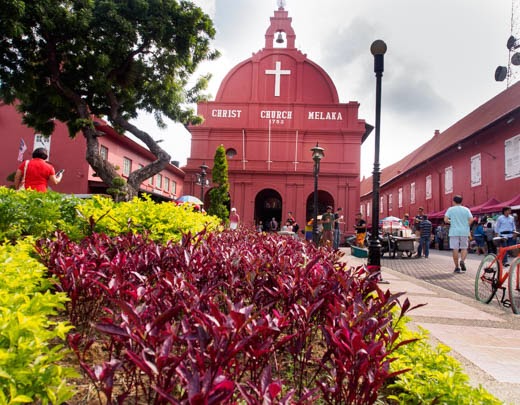
Perhaps the most photographed building in Melaka is the Christ Church and is the oldest functioning Protestant church in Malaysia . Built in 1753 with bricks brought from Holland, the church sits at the heart of what is known as the Dutch Square. The Christ Church was repainted to more closely match the pinkish original bricks, starting a fashion trend for façade colors in the vicinity.

Our tour guide pointed out its original door with characteristically large hinges. Overall, the interior was quite simple and unadorned. The pews, pulpit and windows were original.  Dark 30 foot beams spanned the ceiling, each from a single tree. Lining its floor are several tombstones written in Portuguese and likely from St. Paul's Church within the fortress.


Saturday, January 24, 2015

Red Around the Roundabout: Melaka's Dutch Square


Easily the most recognizable section of Melaka, this red façade historical section is a favorite gathering place. With its town hall (Stadhuys -built in 1650 and is the oldest surviving Dutch building in the East), church, market square and a school, visitors are are temporarily transported to a typical old European town. According to our tour guide (I went on a free tour provided by the Melaka State Government whose tourism center is right next to the square) it was Christ Church (center building, above) that was given this salmon color in order to match the original pinkish bricks that were showing through the whitewashed exterior. It also helped cover the reddish soil that splashed against the building during the prevalent tropical rains. Another story stated that the practical British repainted it the salmon color to hide the red from the unsightly habit of spitting chewed betel nuts. (Having traveled in India, I can attest to the ugly marring of buildings from betel nut spitting).   Other heritage buildings were then repainted to match.
Our tour guide eagerly pointed out the large windows so typical of Dutch architecture, which opened outward and louvered to provide ventilation. On the Stadhuys building as pictured on the right side), the black metal pieces helped support the beam areas. 
When the original clock on the clock tower ceased functioning, a replacement from England was sought but supposedly not available. Locals were not happy with getting a Japanese one, but at least the clock is up and running.
The figures in the roundabout retell the legend of Melaka where the Hindu founder saw a dog being kicked into the river there by white strong mouse deer.

Thursday, January 22, 2015

Masjid Melange

As I've already mentioned, Malaysia is a mixture of cultures. The Masjid Kampung Kling in Melaka is a great example of this. A neighbor of the Cheng Hoon Teng Chinese temple, this mosque dates back to 1748, with the current brick structure erected in 1872. According to the sign on front, "the architecture of this mosque is Sumatran, with strong Hindu influences. This is particularly evident in the minaret, which resembles a pagoda. On closer inspection, you will find an unusual blend of English and Portuguese glazed tiles, Corinthian columns with symmetrical arches in the main prayer hall, a Victorian chandelier, a wooden pulpit with Hindu and Chinese-style carvings, and Moorish cast iron lamp posts in the place of ablution for pre-prayer cleansing."


Tuesday, January 20, 2015

Cheng Hoon Teng Temple

One highlight of my time in Melaka was at the Cheng Hoon Teng Temple. Built in 1645 (, it is Malaysia's oldest functioning Chinese temple. Dedicated to the goddess of Mercy (Kuan Yin), its name means "Temple of the Evergreen Cloud." With its colorful entry gate, the Cheng Hoon Teng Temple is easy to spot on Jalan To'kong. Rebuilt in 1801, its artisans were brought from the southern Chinese provinces Fujian and Guandong. 
An active temple, Cheng Hoon Teng is equally devoted to the three doctrines of Chinese Buddhism, Taoism, and Confucianism. 


The interior contained dark wood beams, elaborate woodcarvings, pretty lanterns, and extensive lacquer work. Columns made from timber are flat, rather than round. Feng Shui was employed in the entire structure. In one of its three bays (typically the temples only have one),  a solid bronze was displayed of Kuan Yin brought from India in the 19th century. The main shrine hall was constructed without any nails - quite the carpentry masterpiece.


Like other Chinese temples I would visit in Malaysia, it had ornate Chien Nien (literally meaning "cut and paste" porcelain mosaic-like works on the roof. Mythical creatures, animals, birds, and human figures were a feast for the eye. Such fun to photograph!