Showing posts with label rural. Show all posts

Friday, August 18, 2017

Sunshine at the Sunflower Farm

A friend and I were eager to visit the sunflowers at the Pope Conservancy Farm, located just a short distance from Madison. Upon entering the parking area, I was already impressed; the large swath of grassed land was trimmed and had white lines painted to show denote parking spaces. A traffic attendant directed people to available parking spots. Signs indicated where we were to proceed. A few sprinkles on the windshield, we grabbed our rain jackets – just in case. As we walked up the slight incline to the sunflower field, I noticed a weak patch of blue amidst the very overcast skies. Perhaps things will change, I thought....
Neatly clipped paths led us along the outer perimeter of the sunflower fields. Every so often, some short sections of the field were cleared so visitors could walk into the field just a bit and take photos. Some took photos of their family; others selfies, and still others focused on the sunflowers. The nearly 500,000 plants were just waiting to be photographed, their heads proudly facing the sun. As we were putzing around taking photos (it's nice to be along with a fellow artist; both are eager to explore and take photos, rather than being bored after a minute or two), I noticed that the sky became increasingly more blue.  

Soon, the clouds had dissipated, and the sun was free to cast its glow on the yellow petals. The nine acres of sunflowers made such a beautiful sight. What a great place for sneaking in a photo of myself!

Bees were busy flitting from sunflower to sunflower, whose heads were heavily laden with pollen and ripe with nectar. Zooming in gave opportunities for capturing other views.

The clipped paths led visitors along fields of corn, soybeans, and prairie. 


A few monarchs were spotted fluttering about, landing on various wildflowers.

What a great place to spend the morning with a friend!

When talking with some volunteers at the site, I learned that the Conservancy is a popular place for school trips. Students (grade 4 is a popular year, as this grade focuses on Wisconsin history) have many opportunities to learn about how Native Americans and early settlers used the land and the types of crops they raised. Some thematic gardens had informative signs and some artifacts were also present. I learned that the seeds from the dried plants are harvested in late November or early December. 
The Friends of Pope Farm Conservancy help the farmer (see farm in the distance) through the sale of sunflower seeds to the public. Interestingly, nearly a third of the crop will have already been eaten by birds prior to harvest – nearly 4,000 pounds of snitching! 

There still are a few more days left to Sunflower Days (Aug 12-20). If you're in the area, come and visit! Great for the whole family!

Sunday, December 04, 2016

Artwork: Rabari Farmer, Gujarat (Watercolor)

In anticipation of an art exhibition, I wrote a short story about each painting, as if written by the person in the painting. These are all real people, and the stories are based on experience, observation, and representative/factual information typical of someone from that region/profession. Some of these paintings are still available, so if you are interested in purchasing one, please contact me.

Greetings, a blessed Ram-Ram to you! After a long, hot day in the sun with my sheep, goats, and a few water buffalo, I walk along the dusty path that will take me to my village. It’s amazing that my white tunic isn’t dirtier! The lack of rains requires my herd to walk even further in order to find water and grazing land, and now . With the support of my fellow Rabari clan and blessings of the gods, somehow we will persevere through the oppression of industry and capitalization.

See more artwork on www.melissaenderle.com.

Thursday, June 23, 2016

A Night at the Goatcienda

Our Philippines spring break trip started with a flight from Manila to Laoag. We arrived on time and while we were waiting for the owners of the bed & breakfast place to pick us up, decided to purchase a SIM card for a week's worth of service at around $10. Due to a blockage of the town's bridge for a Good Friday procession, it took around 90 minutes (instead of the normal 15 minutes) before the truck was able to pull up to the small airport. Hungry, the friendly family took us downtown to an open market area, where we were treated to fluorescent orange empanadas and sugary drinks.
Although simply furnished, the spacious room had modern comforts such as a shower, internet, and AC. The next morning I awoke early and was greeted by the rural landscape surrounding the Goatcienda. The upper balcony opening framed a magenta bougainvillea and other tropical plants.
A cool breeze was refreshing in the morning. Roosters crowed, accentuated by the barking of some dogs.

The friendly staff at the Goatcienda prepared a hearty breakfast with organic food from their small farm, along with freshly-ground coffee. 
The owner, an American who married a Filipino, gave us a tour of the Permaculture farm. He introduced us to his pigs, dogs, cats, and roosters. 

Even the little piglets were friendly.

After our tour, we were treated to a tour of Laoag.

Sunday, March 13, 2016

Out for a Test Drive

On the way to the UNESCO World Heritage Site of Prambanan, we came across this short procession. My driver said that these bullock carts were going to be used for an upcoming celebration, and so the drivers needed to get experience navigating on the public roads. I certainly didn't mind this colorful Indonesian traffic hold-up. 

Friday, January 01, 2016

Rural Landscape of Central Java


Although the train passed by some smaller towns, much of the landscape to Yogyakarta was quite rural. Most of the land was quite flat and fertile, enhanced by volcanic ash. Rice was the dominant crop, with fields in different stages of the process. Corn, papayas, and veggies also were grown.

The pace of life was a bit different in the villages. Boys fished with cane poles in muddy waters. Goats, sheep, geese, chickens, and ducks wandered about. 

Some were digging in the rice fields by hand, while others worked up the land with two-wheeled tractors. 

Some homes were brightly painted, while most were quite simple - sometimes not much more than metal and bricks.
At times, the skies became very heavy, unloading rain with intensity. A little while later, patches of blue sky could be seen.
As we neared Yogyakarta, some lands became hillier. I was looking forward to seeing even more terraced rice fields when I went to Bali.

Wednesday, August 26, 2015

The Beauty of Rain, Yunnan region

While traveling by car to the village of Shaxi in the Yunnan of China, we encountered several heavy rains. The build-up of the clouds became quite apparent that rain would soon come. Portions of the mountains became partially obscured where downpours occurred. 

Mists and low clouds formed, contrasting with the emerald-green rice paddies.

Sometimes patches of blue sky managed to peek between the clouds. Workers in the fields or doing construction on the roads (as in the photo above) continued on with their manual labor.

Even if the cloudy skies persisted, the views were still beautiful. 

Anything beats the polluted, hazy skies I later saw in Beijing....

Sunday, July 20, 2014

Rural WI Walk

Walking along the hilly rural Wisconsin countryside is an enjoyable summer thing to do. Right now, the wild dill is quite abundant, along with some Queen Anne's Lace.

Friday, January 17, 2014

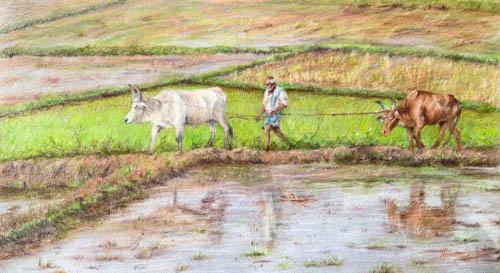
Through the Paddy Field

Through the Paddy Field
Color Pencil
by Melissa Enderle

Paddy fields such as this are very common in South India. I loved seeing the brilliant green of a lush field. Each paddy is rather small and is bordered by a raised mound of dirt. In this color pencil drawing, a farmer leads two of his cows on the narrow raised border of a Tamil Nadu field. Distorted, but discernible reflections of each is found in the flooded field in the bottom portion of the drawing. Measuring only about 24x44 cm, this rather small drawing made it a bit more challenging to render the figures. It did fit well into my suitcase back to Korea though!

Saturday, November 23, 2013

Neutrals and Brilliants

Gathered stalks from the harvested rice proudly stood, vying for attention against the brilliant hues of the chrysanthemums.

Thursday, October 24, 2013

Backpackin' Scarecrow

Like any respectable field or larger garden, this plot of land at the Korean Folk Village in Suwon contains a scarecrow. A more unusual feature on this skinny understuffed figure is the backpack. Perhaps it's in reference to the typical hiker in Korea (young and old alike), all decked out with special hiking pants, shoes, breathable jacket, hat/visor, walking sticks, and a backpack. 

Thursday, October 17, 2013

Traditional Korean Wedding, Suwon

On my visit to the Korean Folk Village in Suwon, I attended a reenactment of a traditional Korean wedding ceremony. Similar to the table set at the Chuseok Thanksgiving festival, food (particularly fruits) were carefully arranged in the center of the happenings. Also on the table was a stuffed hen and rooster - a change to the last time my friend came, when live poultry was used. On a low table, a wooden pair of ducks, symbolizing the idea of mates for life, was carefully enveloped in cloth. The groom and other males stood on one side of the table, while the bride and two attendants stood at the other. 

Two cups (I presume rice wine) were poured by a man and offered up by the bride - one in a wooden-looking container (above) and another that appeared to be made out of a gourd. Following the ceremony, the bride was escorted into a palanquin while the groom rode on a horse. 

Tuesday, October 15, 2013

Egg Papoose

When visiting the traditional homes inside the Korean Folk Village in Suwon, woven goods of many sorts could be seen - some for sifting rice, storing goods, mats, ropes, etc. This home had something I had never seen before - a papoose-type device especially made for storing and protecting eggs. Clever indeed.

Thursday, August 22, 2013

Saturday, April 27, 2013

Doggies and Noodles


I enjoyed peeking over the walls in Yangdong Village, catching a glimpse of daily life. In others, we were able to enter onto the property. True to any place, some of the homes looked very orderly and neat, while others appeared spartan, and still others were quite cluttered. Laundry was strung next to some homes, their brighter colors contrasting with the natural-colored buildings, bare trees, and brown grass. Satellite dishes were mounted on a number of the thatched roof homes - definitely a modern upgrade. Fire extinguishers, smoke detectors, and a few fire hydrants were prominent - reminders of the flammable nature of these old structures. Quite a number of homes had dogs tied up in the yards, but they seemed quite well-behaved and were very tolerant of strangers walking by. One scruffy one was particularly friendly and wanted some attention.
For lunch, we ate in a nondescript traditional homey restaurant, likely a home whose front room was converted into an eating area. Taking our shoes off (as is custom in Korea), we sat on cushions around the low tables. Here we enjoyed Kalguksu (meaning “knife noodles”). Ready to pay, we called for the lady who served us, but she was not around. We found our cook out in the potato field, working with hand tools (they had no machinery or tractors). After visiting another hill in Yangdong, we boarded a bus and headed back to Gyeongju. 

Thursday, April 25, 2013

Yandong Village


After a night of sleeping on the yo mattress on the heated floor of our room, we got up fairly early to head to the Yandong Village. Placed on the UNESCO World Heritage list in 2010, it is described as reflecting “the distinctive aristocratic Confucian culture and architectural style” of the early Joseon Dynasty. Still home to around 500 residents in the 160 tile and thatched-roof homes, I was looking forward to seeing a traditional village in action. 
After a 35 minute bus ride, we reached the outer limits of the village. A walk-through of the visitor’s center gave us an idea about the layout of the village and some of the notable buildings contained within it. 

Walking past the currently used elementary school whose architecture resembled the sloped tile roofs of the much older homes in the village, we had our first view of the village. The thatched-roof homes were found in the flat land below and on the lower layers of the hills, while the tiled homes of the VIPs were found on top. A few cars were interspersed in the scene, feeling rather incongruous with the old homes - of which 54 are over 200 years old. 

Farmers and gardeners were out in the early morning, working up the ground. Others were doing spring chores around their homes. A cat sunned itself on the thatched roof, alternately licking itself and stretching. Another perched on top of one of many ceramic kimchi pots placed in front of a house. Spring birds happily chirped; roosters crowed; a few pheasants flapped their colorful wings, landing in some taller dried grass.   A few men were already gathered outside the tiny local  “supermarket,” already in a jovial mood as they enjoyed a few bottles of soju. The mud brick walls surrounding the thatched roof properties had matching thatched tops, braided and winding up the hill like the back of a dragon.  Some gates were formed out of bamboo, arranged in a decorative pattern. The sweet scent of flowering trees caused me to linger and savor the moment. As we made our way up the narrow roads, the compact homes made out of mud walls and thatched roofs gave way to more spacious homes with tiled roofs. Signs revealed that these were the head family homes of the clans of the village, along with some wealthier members. Such homes were typically built on the higher portions of the hill, commanding a great view of the area. From here, the distant and uninspiring high-rise apartments were visible; I much preferred the traditional architecture. 

Friday, July 27, 2012

Silken Threads

These silk threads are emerging from a stunted, spiky corn plant. Will a cob of any use be formed here?  Please pray for the many farmers who depend on a corn crop to feed their livestock or to sell a harvest. 

Thursday, July 26, 2012

Spikes and Tassles


As far as one can see in this hilly field, the corn plants are in a classical stressed "pineapple" formation. These stunted plants are now tasseling as well. Will my brother (whose farm is pictured in the upper left corner) be able to even use any part of the corn to feed his elk?

Tuesday, July 24, 2012

All Dried Up

Taken in the same field as yesterday's photo, it's bad enough to see stunted, spiky corn leaves, but even worse when you have stunted plants that are drying up before your eyes. I doubt this field will give any type of yield.


Monday, July 23, 2012

Wisconsin's Pineapple Crop


No, this isn't from Hawaii or another tropical paradise. Right here in Wisconsin.

Monday, July 16, 2012

Golden Lace

A backlit Queen Anne's Lace against the golden wheat in the background. Despite the drought around Wisconsin, there still is a bit of beauty along the roadside.