Showing posts with label Chennai. Show all posts

Friday, September 10, 2021

Pastel Artwork: Snuggles and Simple Pleasures

 My latest pastel portrait, "Snuggles and Simple Pleasures." ©2021 Melissa Enderle


After finishing Sunday morning chores and creating a fresh kolam in front of my humble home, I sit down to enjoy a cup of hot filter coffee.  Our alley is filled with the squeals of laughter from young neighborhood children playing together. As the coffee warms my insides, the sun's early rays warm my thin skin. Soft fur brushes against my legs. It's my favorite kitten, coming for a visit. As I snuggle with him, I see what looks like a smile emerging from this contented creature. In this poor Chennai neighborhood, we might not have much, but it's these simple pleasures that keep me happy.

See more of my artwork on my website

Monday, July 02, 2018

Kathak Dancer, India

My latest painting of a Kathak dancer. I saw her performance in Chennai, India
Kathak Dancer
Pastels on PastelMat paper

It is my turn to be on stage. The scent of jasmine from the previous Bharatnatyam dancer still lingers in the air. After giving a salutation and paying respects to my guru and accompanying musicians, I begin the thath sequence with slow movements - first with the eyebrows and neck. I bend one elbow and extend the other arm, making elegant but gentle movements with my upturned wrist and fingers. At this stage of the dance, the scarf covering my head is limp. Sensing the quickening pace of the music, my eyebrows move up and heavily-lined eyes widen. The small Ghungroo bells on my ankles collide as I rapidly stomp my feet on the stage floor in perfect syncopation with the music. As my feet movements become lighter and more complex, I pick up speed and execute a series of turns, causing my skirt to lift like that of a whirling Sufi. 

Sunday, February 19, 2017

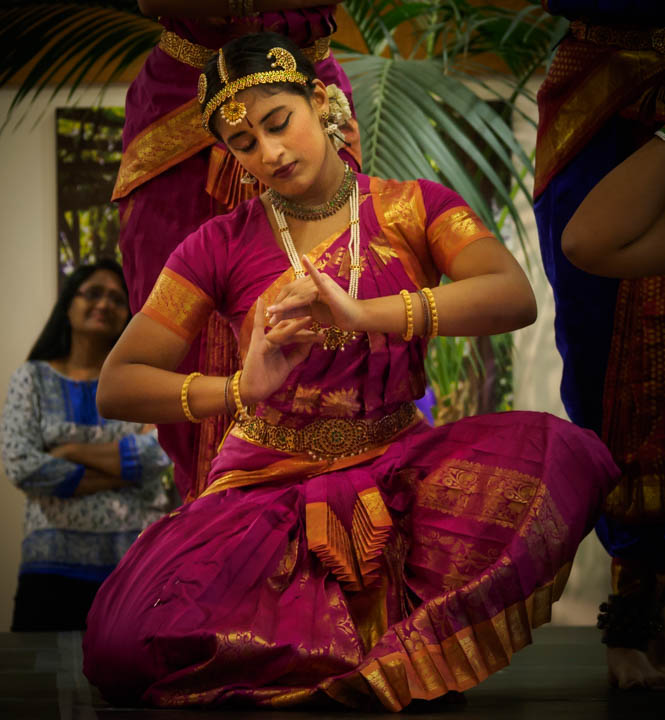
Bharatanatyam Meets Madison


When I read an announcement that Bharatanatyam Dancers were going to be performing at Olbrich Gardens in Madison, I jumped at the opportunity to see this oldest of classical Indian dances, right in my neighborhood. Although it was not hot and sticky like it often was when I attended the performances in Chennai, the unusual spring-like February temperatures were just fine for me.

I arrived around the same time as some of the younger dancers. Unzipped winter jackets revealed the colorful costumes. A mother quickly "painted on" the finger designs with a colored Sharpie in place of customary henna. Artificial jasmine had to suffice instead of the customary fragrant floral strands adorning the plaited hair.

An instructor of the local Bharatanatyam Dance school introduced the girls (ages 5-16) and gave the audience a brief intro to what they were about to see. She explained how the eyes and hands were a highly integral part of conveying emotions in the expressive dances. Some of the younger students
The sophistication of footwork, hand gestures, and eye/neck movements increased with the age levels. Poses hearkened to the gods celebrated at Hindu temples, such as Krishna and Shiva. An enjoyable Saturday morning in Madison!

Sunday, December 11, 2016

Artwork: A Long Night's Catch (Watercolor)


In anticipation of an art exhibition, I wrote a short story about each painting, as if written by the person in the painting. These are all real people, and the stories are based on experience, observation, and representative/factual information typical of someone from that region/profession. Some of these paintings are still available, so if you are interested in purchasing one, please contact me.

I live in a densely populated fishing village in Besant Nagar, Chennai. During the December 2004 tsunami, the majority of the thatched huts in our village were either washed away or damaged. The wooden catamarans and fiberglass boats didn’t fare any better, and most had to be replaced. Even though we received funding to buy new boats and fishing nets, we were given no assistance in addressing sanitation issues. Our homes still lack access to clean drinking water, toilets, and drainage. Despite these challenges, the Christian faith of my family, which we can trace back to the apostle St. Thomas, enables us to remain optimistic. We know God is in control and will work even these challenges for our benefit.

See more artworks on www.melissaenderle.com. 

Thursday, October 15, 2015

Two-Wheeled Floral Sellers of Hanoi

During the Korean fall festival of Chuseok, a friend and I headed out to Hanoi, Vietnam. Although this trip would be very short (only a few days off of school), it would give us a quick flavor of the country, utilizing some cheap airfare secured last spring. A driver from the hotel picked us up at the airport. It's so nice not having to think about transport.
After checking in at our hotel, we headed out in the late afternoon. The activity outside immediately hearkened me back to India. I love the activity on the street - people dining on plastic chair cafés, others selling their wares, transport of all different sorts. Gone was the go-go-go streets of Seoul, where every person was glued to their cell phones - even when crossing busy streets.  

Back again were the fresh flowers. Whereas in India I usually spotted the women selling their flowers at small makeshift stands along the street or near the temple, many of the floral sellers of Hanoi were on two wheels. In this flat city, no-speed bicycles were a perfect choice. Carefully arranged and secured to their mobile store, the women slowly pedaled their way through the busy streets.


With the city's hoards of motorbikes, I wasn't surprised to see some donning flowers as well. Not quite the same charm as the bicycle sellers though.

Unable to visit the big flower markets due to time, I would have to be satisfied with these mobile floral sellers. Such rainbow beauties definitely brightened my day.

Saturday, August 15, 2015

Three Wells

Clean water was a highly regarded resource to the Naxi people in Yunnan, China. In its villages where I visited, streams and canals were a dominant feature. When walking through the village of Shuhe, I saw these three pools/wells with a signpost. Streams were guided by farmers into the village, where they were diverted into three small pools; the first one for drinking/cooking, second pond for washing food, and the third for washing clothes. 
Nowadays, most homes have their own indoor water, but some people (as this woman) still make use of these public pools. Even now, the water looked rather clear.
How different this scene is to what I recalled from my time in India, particularly the Adyar River which flowed close to my apartment in Chennai. How fitting that The Hindu, one of India's main newspapers, wrote and compared the waterways of the Yunnan region to that of the main rivers in India. 
Adyar River, Chennai

Sunrise silhouettes obscures some of the garbage strewn along the fowl-smelling Adyar River


Saturday, May 30, 2015

Lotus Lantern Festival - Tibetan Mandalas

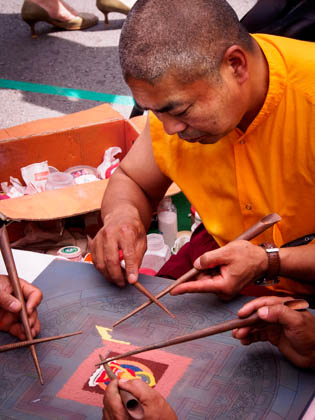
As part of the Lotus Lantern Festival in Seoul, Buddhism from different parts of the world were in attendance. Some Tibetan monks painstakingly collaborated on a mandala. I went back several times to check on their progress. 

Such incredible, temporary art, reminding me of the kolams painted in front of South Indian homes & businesses.


Friday, January 30, 2015

Melaka Sultanate Palace

With the rain coming down once again, I headed over to one of Melaka's many museums - the Sultanate Palace. A rather stark contrast to the Dutch buildings in the central core of Melaka's UNESCO area, it is actually a replica of the palace of Sultan Mansur Shah (1456-1477). Although built only 30 years ago, its construction methods are traditional, using no nails whatsoever. 
Its galleries depict some aspects of sultanate life and culture and also display rare local artifacts, weaponry, ceramics, brassware, and a royal meeting chamber. I especially liked the display of traditional costumes and jewelry.

The inexpensive entrance ticket also includes access to the beautiful grounds in the style of the "Forbidden Garden" reminiscent of the landscaping of the Sultan's period. My stroll through its quiet but lush grounds reminded me of the many walks I took through tranquil Theosophical Society of otherwise chaotic Chennai, India. If I lived in Melaka, the palace garden would definitely be a place I'd frequent.


Thursday, August 21, 2014

Happy Anniversary, Chennai!

Today marks the 375th anniversary of the founding of modern Chennai. On this date, the East India Company was granted a 3-mile strip of land in a fishing village called Madrasapatnam, establishing India's first modern city. It was here that a fort and castle was to be built.
Pictured below is the Secretariat of Fort St. George, which houses the Tamil Nadu legislative assembly.

Tuesday, June 17, 2014

South India and South Korea Beaches

Although both of these beach photos contain similar colors, the contrasts couldn't be larger. Pricey, touristic well-developed beaches in South Korea, vs. the polluted fishing beaches of South India where its residents don't even have access to toilets.
Busan, South Korea
Chennai, south India

Wednesday, September 11, 2013

Kolams of South India

Below is a video I just created on the kolams (also known as rangolis), a beautiful traditional art form of South India. During my four years living in Chennai, I never grew tired of watching women transform the white rice flour or colored powder into incredible radial designs - only to sweep them away and do it again the next morning.
The blog post South Indian Kolams; Radial Symmetry of Powder goes through a bit more of the process in how I created the video. All photos, video footage, and artwork is that of my own.

Thursday, March 28, 2013

A Tale of Two Train Stations

This spring break, I decided to stay in Korea to explore one of its historic cities, Gyeongju. To get there, we took the KTX, Korea's high speed train. What would have taken around 5 hours by regular speed train (with stops) would be reached in about 2 1/2 hours. The golden glow of the rising sun reflected off the beautiful semi-circle windows of the old station’s dome. Some passengers were arriving by taxi, while others were ascending the escalators from the subway below. The shiny light-colored floors of the brightly lit train station reflected the shapes of the empty silver-colored seats. Samsung LCD TVs played local stations, giving some entertainment to those who weren’t already glued to their cell phone TV reception. Electronic signs posting the departure and arrival information in rotating languages were prominently displayed in convenient locations. True to other Korean public places, the station had plenty of coffee and eatery places, as well as opportunities to shop. 
As I waited for my friend to arrive, I thought about my previous experience waiting for a train - in Chennai, India. What a scene of contrasts. After disembarking a auto rickshaw, I jostled my into the first main waiting hall of the train station. Every seat was occupied, with others plopping themselves wherever they could find a spot to rest. Most had at least two bags - one containing a tiffin of still-hot rice, sambar, idlies, and other South Indian food. The scene was noisy, with family members and friends excitedly talking to each other, while others spoke loudly over cell phones. A single set of signs posted the many trains information, with a large number likely being delayed by quite some time. If you wanted some filter coffee, or something to eat, you went to one of the few small cafés for a cheap eat, or you got something from the kiosks near the platforms. In addition to passengers, trains were being loaded with packages of various sizes. Porters deftly balanced large suitcases on their heads, sometimes also carrying other bags in their hands. Announcements were being made over the PA, but it was difficult to discern anything over the noise.


Entering the equally spotless platform area of the Seoul train station, we easily located the platform and walked down the stairs, free of porters and hordes of people. We looked at our computer-generated ticket and entered the new-looking car - complete with glass on the windows. No pushing needed, no competing for space. The briefcases or small backpacks that most carried easily fit above the seats. Precisely on time, the train took off, with its quiet passengers scattered throughout the non-full car. We could hear each other talking very easily, not having the rumbles and creaks of an old Indian train and rail with which to compete. Trolleys of food were pushed through the aisle, but I kind of missed the loud announcement of “chai! chai!” repeated over and over by the chaiwallahs in India. Instead of mere pennies for a cup of hot drink, these Korean beverages would likely be in the $5 range. 

As expected, we arrived at our destination right on time. From the equally clean train station, we easily located a bus that would take us into town. True, the KTX was a lot more expensive than the cheap transport of India, but it was very easy and efficient - albeit without the character and chaotic-ness that makes India India.


Sunday, September 23, 2012

Ganesh Chaturthi - Seoul-Style

Having read my Facebook post about how different this weekend's cultural experience (seeing the musical Wicked) was from that which took place a year ago (Ganesh Chaturthi in Chennai), a colleague asked if I wanted to go with her to a Ganesh celebration one of her students had told her about. Boarding the back of her scooter, we proceeded down the fairly quiet Sunday morning streets of Seoul until we reached Seoul National University. As we were nearing the building, the number of salwars and saris was a good indicator that we were on the right path. Inside the lecture/performance hall, I was suddenly transported back to India, with women and children (and some men) donning their Indian garb. In one corner of the stage a Brahmin priest from the Mumbai area was chanting some Sanscrit verses, while another priest and a priestess rang the small bell and whisked the multi-wicked lamp around the decorated ivory idol of Ganesh. Around Ganesh were many plates of fruit, sweets, milk, and some roses. Not the elaborate floral decorations of India, but they would have to do. After more chanting and pujas, Hindu devotees came up to pay homage to Ganesh. I stayed for a bit longer, watching some Indian children do some simple dances, recite a poem, some chanting, a very boring speech, and some more chanting. None of the women wore fresh garlands of jasmine in their hair; a couple girls had a white fake set. A meal was to follow (at some point), but knowing that the event was on "Indian Standard Time," I wanted to get home to do some drawing.

From talking to some of those sitting near me, it was apparent that keeping their Hindu culture was important to them, but fairly significant challenge in a place like Korea. Most parents are sending their children in Korea to top international schools, which typically happen to be Christian ones. Interestingly enough, the parents didn't seem to be concerned about having to send their children to a Christian school (as this is a very common practice in India), but that their children were growing up knowing very little about their own culture, traditions, and religion. The small Indian children's group of which the performing children were participants is a helpful part in addressing this, but does not make up for the permeating cultural influence families would have experienced in India. Boring speeches and less-than-smooth performances aside, I hope that the children in the audience had their curiosity at least a bit piqued about some elements that are so much of their tradition.
For those families who are living overseas (especially in cultures so different than their own), how do you seek to ensure that your children experience and understand some vital parts of your traditions, culture, and beliefs?

Sunday, June 24, 2012

India Reflections


So now my four years in India are over. I've met such wonderful, warm people, both at school and within communities around the country. I've had the opportunity to experience glimpses all over "Incredible India" –from the temples and churches of Tamil Nadu to the lush coconut backwaters of Kerala, to the deserts & fortresses of Rajasthan to the snowy mountains of Kashmir. I've been fortunate to have witnessed a variety of handicrafts being made. It never ceases to amaze me how India's artisans are able to transform simple threads into masterpieces; zardosi, silk saris, bandini tie dyeing, ikat weaving, and endless types of embroidery. Such a rich artistic heritage. Reflecting back though, I would have to say that India's greatest wealth is its people. I will miss the many citizens of India who were my colleagues for four years, as well as the many others I have met while living and traveling in the incredibly diverse subcontinent.

Friday, June 22, 2012

Last Drive to the Chennai Airport: India Reflections

The school driver has come to take me to the airport. Nightfall Has brought some relief from the heat, but it still is just as humid. On a main street, we pass by old familiar scenes; stalls pouring steaming hot filtered coffee, others frying samosas and other various quick Indian foods, a store selling school uniforms (the new school year had just begun), others displaying sari material, and numerous sweet shops. Women stringing garlands of fresh jasmine and other flowers worked alongside those hoping to sell bananas and neatly piled mangoes. Reading the sign "Hotel Runs," I had to chuckle one last time at its rather odd naming for a restaurant. Along the way to the airport, we passed by churches, Hindu temples, and a mosque. Construction for the upcoming Metro and several larger hotels was underway, both signs of growth and modernization in the city. Finally we arrived at the airport, which also was undergoing construction. For now at least, the scene was as chaotic, crowded, and colorful as it always has been since I've lived here. Perhaps that just is a part of India that will remain in one way or another.

Tuesday, June 19, 2012

Last Ride from School: India Reflections

School has ended. Lots of hugs and goodbyes, adding in phrases such as "keep in touch on Facebook." After four years teaching at the American International School in Chennai, it was time to move on to yet another chapter of my life. An autorickshaw driver took me on the familiar path back to my apartment, now empty of my belongings. We scoot past the road in front of school, its one side still a long ways from completion, despite over a year and a half of construction. Once on the IT highway, we pass by modern complexes housing various software and IT companies. The light in front of us is red, causing an immediate backup in traffic. The autorickshaw driver wiggles his yellow contraption through the space between a city bus and a produce truck; a motorcyclist squeezes between that. Immediately the heat and humidity hits inside the still vehicle. Concrete walls are painted with colorful slogans of the current movie star-turned political leader of the state. People congregate in an unmarked area for boarding busses. A bullock cart hauling potted flowers ambles by. Cheap sandals are sold next to a cart overflowing with fresh mangoes. Incense from a Hindu temple momentarily intermingles with smells of the street. Now past the strong odors of a poultry shop, we turn on the street where a sari-clad woman picks out select produce, next to a man sitting on the sidewalk repairing shoes, and a coconut seller after that. Turning at the next corner, the driver pauses momentarily to let a truck pass through the narrow space remaining from an unfinished pipeline project. Following the entrance to a Pentecostal missionary, we arrive at the spot I hate most about my neighborhood (and actually India as a whole) –garbage. This eyesore is a perpetual sight, strewn about in front of an apartment building. At least the goats are enjoying themselves there. Having turned onto my street, I glance at one of several apartment construction projects going on, transforming the neighborhood from its primarily single-dwelling homes. Spotting the small convenience store I had frequented for basic supplies over the past 2 1/2 years of living in this neighborhood, I motioned the driver to stop. My last ride in these yellow 3-wheelers –my primary mode of transport– was over. I presented one last doctor's prescription at the tiny pharmacy and watched as one customer searched through a selection of phone recharge cards and another eagerly grasp a small glass bottle of Coke presented from behind the counter. It took the manager a bit longer than normal to find the diminutive packet amongst the myriad of small boxes labeled with several meds each, but thankfully he was successful. To the right of the pharmacy was a small Hindu shrine, with its jasmine garlanded idol inside. Although I didn't yet see the local who dutifully tended the shrine and swept up around it, he cheerfully waved at me minutes later as I walked towards my apartment. Spotting the cluster of bamboo in front of a building, I knew mine was next. Soon I would be transferring this tropical scene for a Midwest American one.

Wednesday, June 06, 2012

Books are for Everyone

These children seemed so engaged in the books before them. While it is likely that they are supposed to be selling the books/coloring books to passers-by on the street, I can hope that these young kids are able attend school and experience the joy of reading.

Monday, June 04, 2012

Refreshing Coconuts

Coconuts are a major part of South Indian life. In Kerala, it is an essential ingredient in almost every meal. Tender green (young) coconuts are a favorite drink, renowned for its refreshing rehydrating qualities, particularly in the horrid heat of the summer. With temps hovering in the mid 100's (40-43°C) here in Chennai,  this inexpensive drink is a sure bet.