Showing posts with label Tibet. Show all posts

Saturday, July 30, 2016

Artwork: With a Begging Bowl and a Toy Car

Here is my latest artwork, a color pencil drawing of a little monk at a Tibetan temple of Zhiyun Monastery, located by Lashi Lake in the Yunnan province. Wearing pink crocs and a red robe, this little monk playfully swung his orange bowl as he passed through the ornamental gate up to the main Buddha Hall. In his other hand he clutched a green plastic toy car. In the massive shade trees near the temple entrance, many young monks engaged in a game of soccer.

Monday, September 28, 2015

Zhiyun Monastery - A Grand View

Although the intricate details of the Zhiyun Monastery captured my attention, I was also drawn to the grand view that presented itself at different points while walking up its different levels. I particularly loved this view,  an incredible combination of red/golden doors with the distant Lashi Lake landscape. A great blend of artistry by God and by man.

A similar view to the photo above, minus the frame of the door. Here we can see more of the mountains near Lashi Lake.
The saturated yellow of the monastery, alsong with some prayer flags

A symmetrical composition of the monastery living quarters, with the mountains and wide-open skies beyond the flags.

The temple buildings in the upper section of the monastery. Some areas were under repair, due to recent roof leaking.

Saturday, September 26, 2015

Rainbows of Zhiyun Monastery

Temples are a feast for the eye. I feel like an explorer, discovering all the incredible details contained within them. A feast for the eye. Not constrained by the limits of the number of film exposures, time was my challenger. 
Despite suffering destruction during the Cultural Revolution (only 6 buildings of the original 13 are still around), there still was plenty to see. 

The monastery had several of these intricate door handles and rainbow braids. The creatures on them looked sort of like dragons, but their snouts were more like the trunk of an elephant.


In addition to rainbows and bronze, red dominated the hues of the walls. This website says that the color red in Tibetan Buddhism is associated with life force and preservation. The rainbow connotes the highest state prior to achieving nirvana.  

I'm so grateful for having the opportunity to visit such incredible places. So different from the little dairy farm on which I was raised. 

Thursday, September 24, 2015

A Bit of the Naxi and Tibetan Elements


Upon entering the Zhiyun Temple, I felt transported back to Dharamsala, the Indian enclave for Tibetan refugees. Prayer wheels of varying sizes where rotated by devotees who looked more Tibetan than Chinese. Rainbow colors adorned the walls.

Santu, Naxi god of fighting and agriculture
 However, there were visual elements that differed from that of the Tibetan temples of Dharamsala. My guide explained that Zhiyun Temple, built in 1727, also includes elements of the Naxi, Bai, and Han people. Himself a member of the Naxi ethnic group, my guide told me that the sculpture above was Santu, the Naxi god of fighting and agriculture.

Cycle of Incarnation
This menacing looking figure displays the cycle of Incarnation. The commoners depicted in one section of the wheel wore the traditional clothing of the Bai people. The large lower section on hell-like suffering contained some rather gruesome illustrations. Full of symbolism, I did later recognize the same tiger skin displayed at the Mu Family temple in Lijiang.
Incense and smoke filled the air.

Murals filled the walls, adorned with guardians, gods, and other imagery, all depicted in curvilinear, colorful styles. I would have loved to have learned more about the imagery on the walls and elsewhere in the temple. Alas, we had to move on.


Tuesday, September 22, 2015

Soccer Players below the Prayer Flags


After saying good-bye to the elderly guesthouse couple in Lashi village, we traveled to Zhiyun Monastery. Typical of Tibetan monasteries, rainbow bands of prayer flags welcomed us, fluttering in the breeze. Beautiful stonework, similar to the style I saw at the guesthouse, adorned the walkway.

With around 74 young monk apprentices, the Zhiyun Monastery was not tranquil. These saffron-clad youngsters took advantage of the flat space to play some soccer.


Entrance to the Zhiyun Monastery


Monday, August 31, 2015

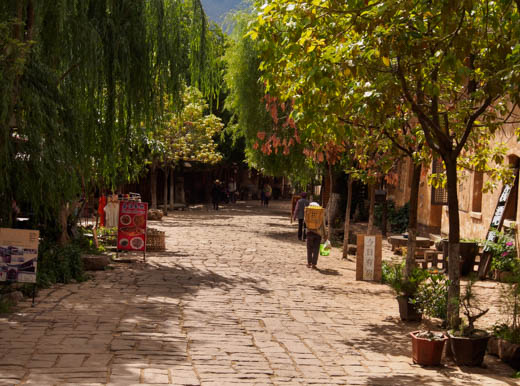
The Tea Horse Trail Through Shaxi

Sideng bazaar street, part of the tea-horse route
Nestled in a valley, the small town of Shaxi played a vital role along the ancient tea-horse route starting over 1,400 years ago. Tibetan horses were highly prized and traded in China for tea and salt. Shaxi became a main trade station along this route. In just the year 1661, over 1.5 million kilos of Yunnan tea were traded to Tibet.

Some of the guesthouses still remain where traders and their horses rested for the night. The structures of trading shops are also present, but many are now converted into cafés, restaurants, and stores.


The Tea-horse trail was also used by Buddhist monks, Christian missionaries, and armies as they moved in between India, Myanmar, and China. In the 18th century, the route began its slow decline as China stopped trading horses for tea.  Railways, air freight, and highways further reduced the importance of the road. Today the town of Shaxi, including the cobblestone tea-horse road of Sideng Street, becomes an active trading area during the Friday market.

I loved meandering through the narrow lanes. Some of the gates were truly impressive. The early morning light illuminated the lime-painted walls.
The town of Shaxi has been listed by the World Monuments Fund as one of the 100 most endangered sites in the world. Recent efforts have been made to preserve the architecture and culture.

Saturday, May 30, 2015

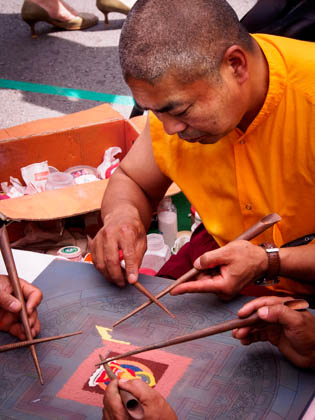
Lotus Lantern Festival - Tibetan Mandalas

As part of the Lotus Lantern Festival in Seoul, Buddhism from different parts of the world were in attendance. Some Tibetan monks painstakingly collaborated on a mandala. I went back several times to check on their progress. 

Such incredible, temporary art, reminding me of the kolams painted in front of South Indian homes & businesses.