Showing posts with label Rajasthan. Show all posts

Thursday, December 17, 2020

Playing for the Maharaja


 "Playing for the Maharaja"

Color Pencil. Jaisalmer, India

©2020 Melissa Enderle


It is the day of the Gangaur festival in this ancient city of Jaisalmer. I'm doubly giddy about the festival celebrating our goddess of love and marriage this year since my granddaughter is in the procession of other eligible young females eager for love. She looks so beautiful and grown-up in her new dress and jewelry. Plus I'm one of the musicians selected to perform. Both me and my trusty kamaycha instrument are a bit worn but we both will sing out our best today. I've already performed some songs that beseech the goddess Gauri to bless these young women with prosperous marriages. Behold! The Maharaja has arrived! I quickly switch to a song singing the praises of His Highness. May he and his family live a long, prosperous life! The Golden City of Jaisalmer loves you!

See more of my artwork from India and other places on my website.

Monday, December 03, 2018

Old pit loom weaver, Rajasthan


This old man demonstrated weaving in a pit loom, which was located in his home in a village outside of Jodhpur, Rajasthan (India). In addition to demonstrating the weaving process, he also showed me a tree where he got his brilliant pink dye. A couple of years later when I revisited his village, I heard he had passed away. 

Thursday, June 01, 2017

Block Printing of India

A video shared by my friend reminded me of why I love the textiles of India so much. Each step reveals the artistry and intricacy that is so lovingly performed.                                                                    

The textile lover that I am, the Anokhi Museum in Jaipur was a perfect place to visit when in the Pink City. Along with informative displays on the history of block printing in India, they had a few craftsmen doing demonstrations.
I especially enjoyed watching the man carving the wood block. It amazed me how such intricate, narrow lines could be formed by such simple tools. Each stroke was made with confident precision. Definitely not a beginner piece!

Holding up a finished block
Floral block detail with chisels
Three blocks that are needed to form one print. Precision is needed for both the carving and in alignment of the inked blocks.
Printing on a small handkerchief cloth

Stamping on a resist (in Gujarat, India)

In addition to printing with multiple blocks, a resist might be added, the cloth immersed in a dye bath, and the cloth washed, dried, and re-printed multiple times. So next time you see a hand-printed piece of fabric, you'll appreciate the artistry and understand why it is more expensive than that commercial knock-off.

Thursday, November 10, 2016

A Roadside Shave

Gotta love the convenience of services in India. On the road to Agra (a few years ago), we spotted this man getting a shave.

Sunday, June 24, 2012

India Reflections


So now my four years in India are over. I've met such wonderful, warm people, both at school and within communities around the country. I've had the opportunity to experience glimpses all over "Incredible India" –from the temples and churches of Tamil Nadu to the lush coconut backwaters of Kerala, to the deserts & fortresses of Rajasthan to the snowy mountains of Kashmir. I've been fortunate to have witnessed a variety of handicrafts being made. It never ceases to amaze me how India's artisans are able to transform simple threads into masterpieces; zardosi, silk saris, bandini tie dyeing, ikat weaving, and endless types of embroidery. Such a rich artistic heritage. Reflecting back though, I would have to say that India's greatest wealth is its people. I will miss the many citizens of India who were my colleagues for four years, as well as the many others I have met while living and traveling in the incredibly diverse subcontinent.

Sunday, May 06, 2012

Sha Hamdan Mosque


Even though we had already been to a number of mosques, my gracious hosts were eager to bring me to one more - the Chanukah Mosque of Shah Hamdan. Although one of the oldest mosques in Srinagar (originally built 1395, rebuilt 1732), it was easily the most beautiful I had seen here. The beautifully patterned wood sections glowed in the golden late afternoon light. The ornamental Pinjrakari (latticework) on the closed window shutters reminded me of jalis found in Rajasthan. Although each let in light and provided ventilation and privacy, these were created in wood, instead of stone. On a few walls and ceilings were covered with papier mâché designs - so beautiful and yet delicate. Even the graceful wooden pyramidal steeple included ornamentation - a feast for the photographer’s eye wherever the lens was pointed!

Monday, July 11, 2011

Like Old Times

While visiting a village south of Jodhpur, India, I captured this shot. These two farmers slowly strolled along, engaged in a cordial conversation. Perhaps they were discussing about one of farmers' favorite topics - the weather. Regardless, I really like it how even busy farmers take the time to meet w/ each other while enjoying tea.


- Posted using BlogPress from my iPad

Location:Jodhpur, Rajasthan India

Tuesday, June 21, 2011

Reflections: Gujarat


Despite the heat, we had an awesome time in Gujarat. It’s a pity that the neighboring state of Rajasthan commands all of the attention on touristic scene. While Gujarat doesn’t have the sheer numbers of forts and palaces of which Rajasthan can boast, its stark beauty, vibrant rural life, exquisite step wells and Jain temples, incredibly warm, authentic people, and magnificent crafts puts Gujarat on par with its neighbor. Considering that most of the textile pieces I had purchased in Rajasthan were actually from Gujarat, it was only fitting that I traveled to see where they were created. Going into the homes of the artists and seeing the process made me appreciate the demonstrated art form even more. Having a car and driver, along with a knowledgeable guide, enabled us to spontaneously stop or stay longer at things that particularly interested us. While this method is more expensive than traveling by public transport or going on a bus tour, we experienced so much more. Gujarat will forever hold a special place in my heart.

Sunday, June 19, 2011

Aina Mahal, Bhuj


In the same compound as the Prag Mahal was the Aina Mahal, heavily affected by the 2001 earthquake. A portion of it has been made into a museum. Meaning “palace of mirrors,” the 18th-century palace’s name to fame is its Hall of Mirrors room. Though its splendor didn’t quite match that of the palaces I had visited in Rajasthan (not to mention the earthquake tarnishing some of that beauty), there still was some to see. The wall still contained portions covered with white marble. Gilded mirrors covered the majority of space at eye-level. Venetian glass candelabras and colored glass lamps dangled from the ceiling. For me, the room’s most striking feature was the floor, decorated with blue china tiles manufactured in Bhuj.

Friday, June 10, 2011

Vijay Vilas Palace, Mandvi


Next, we visited the Vijay Villas–the summer palace built for its courtly ruler in 1929. Its architecture, particularly the curved bangaldar eaves above the windows in the upper floor, was reminiscent of that in Rajasthan. From its rooftop, we had a sweeping view of the Arabian Sea.

Monday, May 23, 2011

Meeting the Mir Tribe Family


After resting during the heat of the day, it was now time to meet some more local people. Our first stop was to a temporary settlement of a Mir family (semi-nomadic people from Rajasthan). Certainly not their first visitors, they brought out bangles and decorative items with broken mirrors in hopes that we would purchase something. Although living in a plastic tent, the females had quite a bit of jewelry. All the children had tousled hair that hadn’t been combed in quite some time.

Time for the young goat’s feeding, one of the girls scooped up the goat and asked to have her picture taken, still clutching a cell phone.

Monday, April 04, 2011

From Jaipur to Agra


What should have been a rather simple drive on major roads to Agra turned into a more interesting, albeit slower journey through rural areas, thanks in part (again) to the Gujars blocking the roads in an effort to have their demands met. First we stopped at the Chand Baori stepwell, dating back to the 8th-9th century and the deepest in Rajasthan - 19.5m (64 feet) deep.


On the bumpy, narrow roads, our slower trek took us through tiny villages scattered in between fields. Kids engaged themselves on a favorite pastime of the region - kite flying. Women pumped water at the wells. Older men squatted near the road, smoking bedis as they chatted. Along both sides of the roads in these villages, children and some puzzled adults lined up as if observing a parade, waving at the unusual procession of trucks, tourist vehicles, and other unfortunates who were diverted. Children ran ahead and climbed on top of mud brick walls and further ahead in order to get a better (or second) viewing. It reminded me a bit of traveling by a traditional dugout boat up the Niger River to Timbuktu.


The flat land in the area yielded brilliant yellow fields of mustard plants. This crop, also seen in abundance in the Shekhawati region and even a bit in Himachal Pradesh, is used for cooking oil and creating dyes. Indian-style scarecrows stood above the crops, sporting a black pot for a head. Early in the morning steam from recent rains rose above the field, replaced later by deep, blue skies. Brick factories were situated in the middle of the mustard fields, with their blue and white striped chimneys rising high. Men and children piled bricks neatly in a cleared field next to the factory, creating patterns with their expert stacking techniques. In other ploughed fields, camels were hitched up to farm equipment. Others could be seen in the villages and towns hauling goods with special trailers. Tractors received special attention here as well, sporting decorations of colored tinsel tassels, artificial flowers, and colorful garlands. In the courtyard of farms, the women patted small mounds of cow dung into thicker disks to be used for fuel. Cowpies dried on the roof and dried ones were stacked 7-high on a low wall near the road, probably for purchase.

Sunday, April 03, 2011

New Year's Eve in Mandawa


For New Year’s Eve, we decided to stay at a beautifully restored haveli in the town of Mandawa. The main courtyard was particularly ornate – a feast for the eyes. After dropping off our luggage, we walked into the main part of town. Soon a small group of local kids followed us, with more offering their service as guides. The golden late afternoon light glowed on the outer walls of the town’s many havelis. Here we saw frescoes of the Wright Brothers, chauffeur-driven cars, trains, and the usual Hindu scenes. Far more of Mandawa’s havelis were in rather poor shape or had their murals painted over. On a remnant of one wall, a peacock stood proudly in the afternoon light. Donkey pulled carts competed for road space along with camel-pulled carts and buses. Revealing its more frequently visited tourist destination, the main street contained souvenir shops and touts requesting tourists to “come look into my shop.”

Although tired from the long day, we went to the New Year’s celebration taking place at the hotel. Guests donned layers of clothing as they watched the dancers and musicians, with some later joining in the dance. Finally, a meal was served, including both veg and nonveg Indian specialties. Absent was alcohol, but some guests did get some from the upstairs restaurant. At midnight, firecrackers were lit on the street outside the hotel.

On our way back to Jaipur, we passed through the town of Fatehpur and visited a few havelis there. The market area was quite active. Cows, busses, and donkey carts all contributed to traffic congestion. My friends were getting “haveli-ed out,” so we moved onward. Along the road we passed by a group of Jains on a cart, wearing white masks over their face to avoid accidentally ingesting any insects. Camels hauled gnarled wood on crude carts and straw on others. Alongside the road in a few spots we saw dead cows, apparently victims of traffic. Colorfully decorated tractors puttered along, with bran names including Mahindra, New Holland, and Massey Ferguson. As we neared Jaipur (143 km – 3hrs away), yellow mustard fields became more common, replacing the more arid fields of the Shekhawati region.

Saturday, April 02, 2011

Dundlod Fort


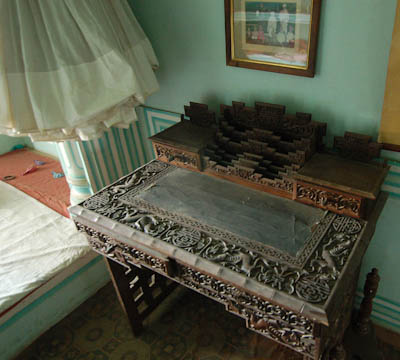
Although there was more we could have seen in Parsurampura, we headed to Mandawa, our destination for New Year’s Eve. Along the way we stopped at Dundlod to visit the fort. After waiting for a rather disorganized staff to take us inside, we toured the well-preserved interior. The main room was extremely spacious, framed with warm-yellow columns and filled with ornate European furniture and a collection of rare books. An old photo of the young handsome maharaja was on display on an antique table, accentuating the feeling of his presence. Also of note was an ornately carved wooden writing table and a whole room full of equestrian trophies.

Friday, April 01, 2011

Old Frescoes of Parsurampura


Leaving the town of Nawalgarh, we made a little side detour to Parsurampura, a little village 20 km southeast of there to see some of the region’s best preserved and oldest frescoes. The Shamji Sharaf Haveli, dating back to the end of the 18th century, had particularly interesting motifs. Here we saw Hindu gods intermixed with images of Europeans. In one corner, a European-looking lady dressed in black clothes holding a parasol was depicted right above a local woman with a spinning wheel.

We then visited the Chhatri of Thakur Sardul Singh. From a distance, the white domed structure looked like nothing special. Looking up at its interior, we were treated to a visual feast. Dating back to the mid-18th century, the well-preserved images were painted with natural pigments – whereas most of the frescoes we had seen on buildings were done with artificial pigments. The deep reds, rich blacks, and tans provided a harmonious color palette. Following the curved contour of the dome were incredibly detailed battle scenes of the Hindu epic Ramayana, local noblemen, and the love story of Dhola Maru. Of similar style is the Gopinathji Mandir temple, built in 1742. Legend goes that the son of the nobleman who had the Chhatri built chopped off the hand of the artist (hoping that would prevent him from completing the temple paintings and retain exclusivity of the artist’s work), but the undeterred artist completed the temple paintings with his feet.

Thursday, March 31, 2011

Nawalgarh, Shekhawati


In order to break up our tour through the Shekhawati region, we stayed the first night in the town of Nawalgarh. I had read that it had a good selection of havelis as well as a colorful market – two great ingredients! We were arrived in time for a great home-cooked dinner, seated around a long table with other guests. Partway through the meal, a cow poked its head through the door, on the lookout for a snack. The tourist pension owner said that the cow visited often (several times a day, sometimes) and had a particular fondness for chapattis. With the small fire in the courtyard of the haveli growing dim, we retired to our upstairs bedrooms, each beautifully painted and containing handmade carved furniture.

After a breakfast prepared from ingredients grown in the pension owner’s garden, we headed out into the muddy streets to begin our haveli tour, aided by a map indicating the location of some of the main sights. Some of the places were closed, so we could only enjoy their frescoed exteriors. Others, such as the Uattara Haveli were open (small admission fee), giving us a chance to experience more of its glory. Entrance was usually through a tall, rather fortified-looking door framed by an archway. With the really tall entrances, a smaller normal-sized could be opened within it for normal use. An outer formal courtyard, typically single-storyed, was used for attending guests and conducting business. The real beauty was in the inner courtyard, typically more spacious and multiple-storyed. This is where the women spent most of their time. Fluted arches framed the courtyard. Some framed intricately carved doors or shuttered windows. Others led into small rooms with thick walls. Adorning nearly every square inch of wall space were frescoed murals. Framed by floral motifs were scenes of Krishna and Rama, interspersed with paintings of red-uniformed soldiers, locals riding elephants, women milking cows, etc. In some havelis, one could find scenes of local merchants driving a car, locomotives (some painted rather naively), gramophones, and bicycles.

Also of note in Nawalgarh was the Bala Quila with its mid-19th century room filled with mirrorwork, large portraits, and painted domed ceiling. Had there not been a sign out in front of the rather plain-looking building, we would have walked past it. The Ganga Mai Temple, dating back to 1868, also has some fine floral motifs on the fluted archways of the courtyard.


The state of condition of the havelis varied greatly. Some appeared to be recently restored, with its murals very bright in color and structure intact. Murals on other havelis were fairly intact, but rather faded. In many, the lower portion of the building’s exterior no longer contained images, instead replaced by plain plaster, exposed bricks, or graffiti. Some of the havelis were still used as dwellings; others were bricked up or abandoned, sadly falling apart. Others were stripped of their intricate carved wooden doors and shutters, sold as antiques or made into tables. We were told that most of the owners no longer lived in the Shekhawati region and of these, too few seemed to care enough to pay for any upkeep or maintenance on the buildings. We saw some havelis being torn down, probably being replaced with more bland, modern buildings. How sad that these historical national treasures are literally and physically crumbling before our eyes, with little being done about it!

Wednesday, March 30, 2011

Samode, Shekhawati Region


One of the areas of Rajasthan that I was most looking forward to was the Shekhawati region, located NW of Jaipur. I had seen photos of some of its painted havelis, the grand homes of merchants, in some books and wanted to see them for myself. Many of these painted wonders date back to the 18th-late 19th centuries when the region’s towns were important trading posts on the caravan route from the ports of Gujarat. In addition to rendering more traditional subjects such as Hindu mythology and everyday life, many of the murals (covering both the interiors and exteriors of the structures) depict contemporary events of the time and new innovations. Often times such scenes were depicted from imagination without having ever actually seeing them. As such, there is a certain naivety and innocence about the murals.
A series of narrow rural roads took us to the various selected villages. On our way, we passed through stretches of countryside with rather bare scrubby trees, thatched conical huts, homes made from mud brick or cement, and ploughed flat land.

About 50 km from Jaipur, we stopped at the town of Samode. Our objective was to visit the 19th century palace, now converted into a rather luxurious hotel. Walking through the arched gateway, an employee stopped us and said that the hotel was closed, due to preparations for a 3-day wedding for around 400 guests being held there. Although disappointed, I spotted some colorful piles of flowers being used for the wedding decorations and asked if we could at least go there to take photos. Sensing our interest, he made a phone call and told us we could come in. To our surprise, we were given a tour of the palace’s main rooms. In true Rajasthani style, each room was lavishly decorated with contrasting colors and patterns. Even the ceiling contained floral patterns and portraits. Through an archway, the reflective mirrors of the Diwan-i-Khas room sparkled, begging us to enter. Inside, we admired the mirrorwork covering most of the walls and ceiling, as well as naturalistic and figurative murals near the bottom. Back out in the courtyard, several men were draping long garlands of marigolds and jasmine to form a canopy. Another created designs out of different flower petals arranged along the path leading up to the main door. Scents of rose and jasmine filled the air. No doubt it would be a beautiful wedding!


Tuesday, March 29, 2011

Anokhi Museum, Jaipur


Our next destination was the Anokhi Museum, housed in an excellently restored haveli. An admirer of the wooden block printed cloth for which Anokhi is so famous, I was interested in learning about the process and history of the technique. The displays were well lit and signposted, giving those interested plenty to read. In an open courtyard, a man sat on the floor, deeply engaged in carving a wood printing block. He explained that it took him 10 days working eight hours a day to make one block out of teak wood. Many of the prints used three blocks to create the pattern, requiring precision and planning on the part of the carver. A wood block could stamp around 1,600 meters of cloth before it needed to be retired. Mr. Mugeebulla Khan had 35 years of experience, having started at ten years of age, following the footsteps of his father.

Monday, March 28, 2011

Amber Fort, Jaipur


On our way to the Amber Fort, we stopped briefly at the pink Hawa Mahal “Palace of the Winds” building, and the Jal Mahal palace that seemingly floated in the middle of the lake. At the Amber Fort, colorfully painted elephants carried tourists up through the Suraj Pol gate and into the main courtyard. Some of the entrances such as the Ganesh Pol were beautifully restored, containing intricate floral patterns with the elephant god above the door. The Aram Bagh comprised of a geometric maze made out of carefully trimmed bushes. The splendid Sheesh Mahal room contained inlaid mirrors along with arabesque and floral designs. The bottom portion comprised of relief flowers in white marble, reminiscent of the Taj Mahal. Perched high up, we had a great (although misty) view of the Kesar Kyari Bagh ornamental garden below, surrounded by water.

Sunday, March 27, 2011

When it Rains in Jaipur, Go Shopping!


Using the rains and muddy streets as an excuse, we went in some stores and did some jewelry shopping. A few chais later, we managed to pick out a few that we liked , both as gifts and for ourselves. We also enjoyed wandering through the narrow streets, peeking in the shops were jewelry metal was being pounded and lac bangles formed. The brilliant colors and intricate ornamentation of the saris was enough to tempt the eye of any woman. Inside the shops, women poured over piles of the colorful material, with the salespeople pulling out more to show them.