Showing posts with label Dutch. Show all posts

Monday, February 02, 2015

Up on the Hill


On our way up the stairs to the natural vantage point of Melaka known as St. Paul's Hill, I admired the banyan tree. A white statue of St. Francis Xavier greeted us.  Our guide of South Indian descent proudly explained how this Jesuit priest visited Melaka several times and used Melaka as a base for his missionary visits to Japan and China. In 1553, his incorrupt body was temporarily buried here (later that year he was buried in Goa, India). St. Francis Xavier's open grave (covered with a grate) is still present within the church. The statue was erected in 1952 to commemorate the missionary's 400th anniversary of his travels to Melaka.

St. Paul's Church was originally built by the Portuguese in 1521 and was consecrated to the Virgin Mary. The Dutch then used the enlarged church as its main church for 112 years until the iconic Christ Church was completed in 1753. At that time, it was modified and became part of the fortification. Further deterioration occurred when the British took over in 1824, using the structure for powder magazine. 

During excavations by the Melaka Historical society in 1930, Portuguese gravestones from the hill were affixed to the interior walls of the roof-less structure. 


Wednesday, January 28, 2015

Defensive Remnants

Porta de Santiago
One of the older structures in Melaka, the Porta de Santiago was originally built by the Portuguese in 1512 as one of the four main gates to its fortress during their 130 year colonial rule. Restoration was undertaken by the Dutch. Sadly, the British destroyed the A'Famosa fortress, with only the one gate remaining. Upon entering the arched interior, visitors had a mini concert provided by a few guitarists and singers.

Until 2006, the ruins of the Portuguese fortress/wall lay buried underground. It was the intended site for the city's tower, which was subsequently relocated. Laterite rocks from nearby Upeh Island were used to rebuild the watch tower.

Sunday, January 25, 2015

Christ Church, Melaka

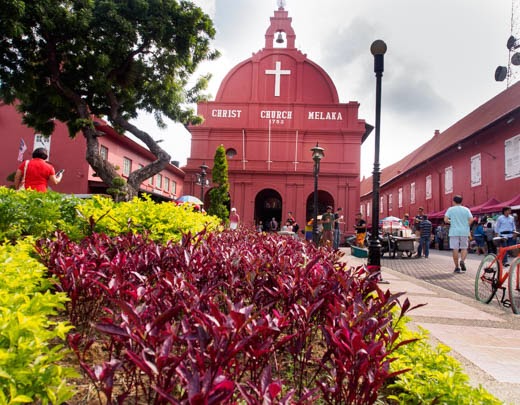
Perhaps the most photographed building in Melaka is the Christ Church and is the oldest functioning Protestant church in Malaysia . Built in 1753 with bricks brought from Holland, the church sits at the heart of what is known as the Dutch Square. The Christ Church was repainted to more closely match the pinkish original bricks, starting a fashion trend for façade colors in the vicinity.

Our tour guide pointed out its original door with characteristically large hinges. Overall, the interior was quite simple and unadorned. The pews, pulpit and windows were original.  Dark 30 foot beams spanned the ceiling, each from a single tree. Lining its floor are several tombstones written in Portuguese and likely from St. Paul's Church within the fortress.


Saturday, January 24, 2015

Red Around the Roundabout: Melaka's Dutch Square


Easily the most recognizable section of Melaka, this red façade historical section is a favorite gathering place. With its town hall (Stadhuys -built in 1650 and is the oldest surviving Dutch building in the East), church, market square and a school, visitors are are temporarily transported to a typical old European town. According to our tour guide (I went on a free tour provided by the Melaka State Government whose tourism center is right next to the square) it was Christ Church (center building, above) that was given this salmon color in order to match the original pinkish bricks that were showing through the whitewashed exterior. It also helped cover the reddish soil that splashed against the building during the prevalent tropical rains. Another story stated that the practical British repainted it the salmon color to hide the red from the unsightly habit of spitting chewed betel nuts. (Having traveled in India, I can attest to the ugly marring of buildings from betel nut spitting).   Other heritage buildings were then repainted to match.
Our tour guide eagerly pointed out the large windows so typical of Dutch architecture, which opened outward and louvered to provide ventilation. On the Stadhuys building as pictured on the right side), the black metal pieces helped support the beam areas. 
When the original clock on the clock tower ceased functioning, a replacement from England was sought but supposedly not available. Locals were not happy with getting a Japanese one, but at least the clock is up and running.
The figures in the roundabout retell the legend of Melaka where the Hindu founder saw a dog being kicked into the river there by white strong mouse deer.