Showing posts with label market. Show all posts

Tuesday, December 13, 2016

Artwork: Kampong Phluk Woman with Purple Scarf (Watercolor)


In anticipation of an art exhibition, I wrote a short story about each painting, as if written by the person in the painting. These are all real people, and the stories are based on experience, observation, and representative/factual information typical of someone from that region/profession. Some of these paintings are still available, so if you are interested in purchasing one, please contact me.

Every week I take my basket of vegetables to sell at a small market  outside of Kampong Phuk. I look forward to this time, when I can gossip with my other friends who also spread out their goods to sell. It helps me forget, at least for a little while, all the terrible things I saw and experienced as a young woman when the Khmer Rouge extended their reign of terror over my homeland. It is nice to see smiles once again on the faces of children, who can play games and go to school instead of slaving away and seeing loved ones being killed. The money I make from my little garden isn’t much, but it’s enough for me to buy rice, fish, and a little oil. Today my sales were even better, enough for me to buy some chicken and even a Hello Kitty pouch for my granddaughter. I am happy again.

See more artworks on www.melissaenderle.com.

Wednesday, August 03, 2016

Get your Frog Purse (or Dried Fish)

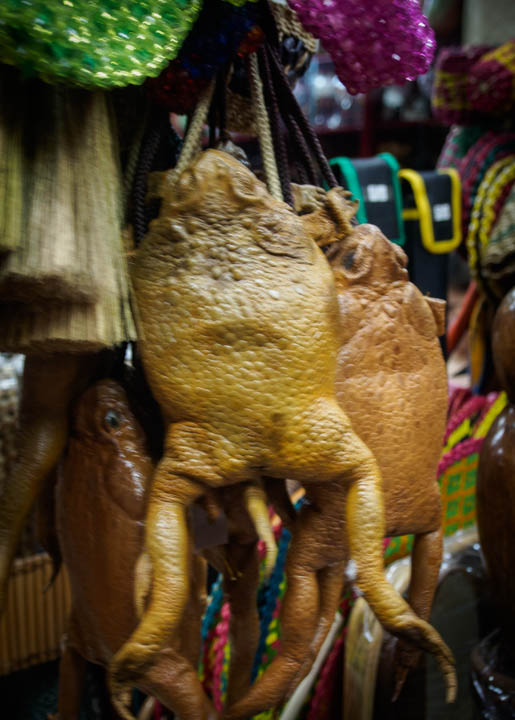
More market photos, this time from Laoag in the Philippines. Aside from the common items such as poultry, fish, and Philippine sausages, one item caught my eye - purses made from frogs. Unique, but not quite my thing. With their leathery, bumpy skin, bulging eyes, and those long legs, they would make an interesting conversation piece. I decided to save my backpack space for textiles.


Gotta love the colorful fresh fruit!
Nicely arranged display of dried fish and eggs


Wednesday, February 10, 2016

Ready to Fire at a Klipoh Village pottery shop

After the visit to a local market near Borobudur, the driver took me to a pottery shop in the town of Klipoh. Although I have visited many pottery shops in different countries, I always enjoy seeing the varying ways they create and fire their wares.

Today was the day to do some firing. Some pieces needed their drying time to be hastened, so they were heated just a bit on some ashes.
Using a rag like a potholder, the two women grabbed the still-hot pots and carried them over to the kiln shed. The hot ashes didn't seem to bother their bare feet.

The pots and bowls were stacked over a bed of thin bamboo, husks, and some coconut shells.
The clay pieces were then covered with leaves, husks, and more coconut shells,  over which some ash was placed.
Some dried fronds were bundled and lit.
This was used to light the material covering the pottery.
The man used a long wooden rake to stoke the fire, which quickly enveloped the dry leaves and emitting a thick haze of smoke.
According to the driver, after a few hours, the firing would be finished. This seemed rather short to me, but I can imagine that these utilitarian pieces would be of rather low fire.


Wednesday, January 20, 2016

Through the Market Alleys

Having a few more minutes to spare, we meandered a but further within the local market near Borobudur, past the cheap plastic Chinese stuff and to locally made items. Functional hats and baskets were plentiful.
Ceramic "piggy" banks in bright and neutral colors seemed too pretty to break.

A sweet little lady was immersed in her task of peeling garlic.


Poultry sellers - even those wearing "SpongeBob" aprons - quickly hacked off parts and weighed them on the simple scale.
Chicken heads, anyone?
All done at the market? Plenty of becak drivers are eager for your business.

Monday, January 18, 2016

Purple Chicks and Green Eggs

Vibrant colors at markets are not limited to produce. Look what I spotted at the market near Borobudur - live peeps! Coloring chicks apparently makes them more attractive to customers. They certainly caught my attention! However, I actually was a bit disturbed at the sight. The dye may be injected into the embryo, resulting in colored hatchlings. Coloring can also be achieved through spray painting or dipping the live chicks in dye - eeks!
Reading online, it is apparent that Indonesia is not the only place where this is done. Sometimes the chicks are sold as playthings for kids; they often don't live for very many days. Colored chicks are more popular at Easter time. Even though I don't care for them, I think the marshmallow type is much more humane.
Should the chicks make it to adulthood, the adult feathers typically come in their normal colors. 
So no, those blue-green eggs were not hatched from that turquoise chick above. However, different breeds of chickens will produce different colored eggs.


Saturday, January 16, 2016

Snakeskin Fruit and Sator Beans

If possible, I try to visit local markets when I visit new places. They are a beehive of activity and awaken the senses. Such wonderful combinations of color and textures. 
The photo above has some great complementary colors - the reds of the rambutan, other (I'm not sure what they are) produce, and the man's shirt are offset by the bright green sator beans. These "stink beans" make a great combination with durian, which was also sold at the market.

At the market and along the roadside, I saw lots of Salak being sold. Also known as snakeskin fruit, I can definitely see where it gets its nickname!


Thursday, October 15, 2015

Two-Wheeled Floral Sellers of Hanoi

During the Korean fall festival of Chuseok, a friend and I headed out to Hanoi, Vietnam. Although this trip would be very short (only a few days off of school), it would give us a quick flavor of the country, utilizing some cheap airfare secured last spring. A driver from the hotel picked us up at the airport. It's so nice not having to think about transport.
After checking in at our hotel, we headed out in the late afternoon. The activity outside immediately hearkened me back to India. I love the activity on the street - people dining on plastic chair cafés, others selling their wares, transport of all different sorts. Gone was the go-go-go streets of Seoul, where every person was glued to their cell phones - even when crossing busy streets.  

Back again were the fresh flowers. Whereas in India I usually spotted the women selling their flowers at small makeshift stands along the street or near the temple, many of the floral sellers of Hanoi were on two wheels. In this flat city, no-speed bicycles were a perfect choice. Carefully arranged and secured to their mobile store, the women slowly pedaled their way through the busy streets.


With the city's hoards of motorbikes, I wasn't surprised to see some donning flowers as well. Not quite the same charm as the bicycle sellers though.

Unable to visit the big flower markets due to time, I would have to be satisfied with these mobile floral sellers. Such rainbow beauties definitely brightened my day.

Saturday, September 12, 2015

A Hairy Deal

One of the more unusual "stalls" at the Shaxi Friday market was this one, consisting of two bags of hair and a scale. Quite likely, this purchased hair would be made into wigs. I wonder how much the seller received for the hair. Would she receive a higher price for longer pieces, or did it go simply by the weight?

It made me think of the large amounts of hair that is generated at Hindu temples (most Hindus have their head shaved at least once in their lifetime and some donate it multiple times to show their piety).

Tuesday, September 08, 2015

Me and My Goats

Along with the Friday Market, there also was a bit of action happening outside the gateway to Shaxi. Here, a livestock market was actively underway. Men and women were actively engaged in inspecting and haggling over cows, goats, and pigs.


Some of the pigs were not too pleased about the transaction. The large pigs protested as they were loaded up onto the trucks by their ear.  Despite the pigs' complaining, it did appear that the livestock were healthy and well cared-for.


As with the market in town, the livestock market felt very local and authentic - exactly what I wanted to see. 

Saturday, September 05, 2015

Shaxi Friday Market


A woman from the Yi minority group sets up her produce
 Visiting the markets in a town is a highlight for me. Produce and goods, transported on the backs, heads, livestock, and overburdened vehicles of vendors, reveals so much about the locals. Some traverse for quite a distance over difficult terrain to sell and buy. I love looking at the costumes worn by the locals and marvel at how they present their goods, no matter how meager the amounts.
Simple scales are still used
Colorful produce, some I've never seen before, are carefully arranged. A variety of fragrances intermix, further assaulting the senses. People struggle to be heard over the noise of chatting, bargaining, animals, and vehicles. 

Woven baskets, particularly used by the Bai people, are sold.
Although the tea-horse trading between Tibet and China no longer exists, the town of Shaxi, the last remaining market town on the Tea Horse trail, becomes alive during its Friday market. People from the Bai and Yi ethnic minority groups come down from their mountain villages to trade goods. Some came on foot or motorbike; others piled out of the back of small trucks or public vans. 

Both tropical and temperate produce tempted the eyes. Buyers had an overwhelming variety of mushrooms from which to choose. Local honey, hand-made rope, and cow bells competed for space with lightbulbs, traditional and machine-made clothing. Women carried woven baskets on their backs, while others hauled slaughtered pigs in a wheelbarrow. Emanating from a small radio, "Gangnam Style" competed for attention over the exchange of commerce and gossip.
Pork, including the snout, offered by a vendor
Care for a couple of eggs or a dozen?

Monday, August 31, 2015

The Tea Horse Trail Through Shaxi

Sideng bazaar street, part of the tea-horse route
Nestled in a valley, the small town of Shaxi played a vital role along the ancient tea-horse route starting over 1,400 years ago. Tibetan horses were highly prized and traded in China for tea and salt. Shaxi became a main trade station along this route. In just the year 1661, over 1.5 million kilos of Yunnan tea were traded to Tibet.

Some of the guesthouses still remain where traders and their horses rested for the night. The structures of trading shops are also present, but many are now converted into cafés, restaurants, and stores.


The Tea-horse trail was also used by Buddhist monks, Christian missionaries, and armies as they moved in between India, Myanmar, and China. In the 18th century, the route began its slow decline as China stopped trading horses for tea.  Railways, air freight, and highways further reduced the importance of the road. Today the town of Shaxi, including the cobblestone tea-horse road of Sideng Street, becomes an active trading area during the Friday market.

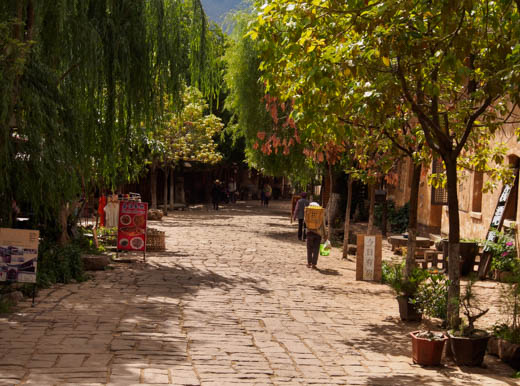
I loved meandering through the narrow lanes. Some of the gates were truly impressive. The early morning light illuminated the lime-painted walls.
The town of Shaxi has been listed by the World Monuments Fund as one of the 100 most endangered sites in the world. Recent efforts have been made to preserve the architecture and culture.

Saturday, August 22, 2015

The Women at the Gate

At the town square in the heart of the old town of Baisha was a large gate. Sitting at each side of the gate were several women, chit chatting with their displayed vegetables for sale. With their distinctive Naxi blue aprons, blue caps, dark pants, and a T-shaped cape, their ethnicity was immediately recognizable. 


Note the baskets next to one of the women. The basket is used to haul produce and other goods. The cape helps protect the rubbing of the basket on the woman's back. Over my time in Yunnan, I would see many women walking through the towns carrying baskets on their backs.

Friday, May 23, 2014

Jagalchi Fish Market


Markets are one of my favorite types of places to visit. Everything seems to be a bit more intense in local markets, from the sellers and their wares, to the shoppers. Markets can be an assault on the senses. Being a port city, Busan is known for its seafood. As such, we visited the Jagalchi Fish market, Korea’s seafood market. Much of the market is indoor, but we chose to spend more time walking through the stalls outside. In both, the variety of fish and seafood was quite amazing. Tanks contained live fish and colorful plastic bowls were piled high with mounds of various colored fish and shells. Dried fish in interesting shapes were arranged with care. Fresh seaweed was neatly cut and stacked. Older women, known as “Jagalchi Ajumma” were clearly masters of this domain, donning short curly black hair, long rubber gloves, and brightly colored waterproof aprons and high rubber boots. 
Gaebul spoon worm

Prepared Gaebul, eaten raw


Visitors had their choice of small booth-like restaurants. Nothing fancy, but definitely places to eat fresh catch. Choose your desired seafood by pointing to the tank or bowl, and soon it will be on your plate. We actually ate at the market twice, once having fish & eel cooked on a hotplate right on our table, and the other time eating a most strange spoon worm gaebul, known as the penis fish. Those tubular non-descript creatures that looked more like bratwurst to me were quickly deflated, their insides scraped out. The outer portions were cut up, sprinkled with sesame seeds, and placed on our table, along with some various sauces. Not quite sure how to prepare or eat them, we patiently waited for the lady to return. Meanwhile, she worked on an order for another table, decisively stabbing one end of a still wiggling eel and deftly filleting it. Guts and other unwanted parts of the seafood were scraped together, then the next items prepared. Perhaps a bit puzzled why we were not eating our food, another lady came to our table and gestured that we were to dip the raw fish into the sauce - no cooking! Can’t say that I enjoyed the taste or rubbery texture, but my Vietnamese friend and I did eat it, albeit giggling while we did. Not satiated, we left and ate a bit more familiar food shortly thereafter.