This morning I walked to the COPE Center in Vientiane, Laos. The visitor center is part of a larger complex that is focused on the continuing victims of a war that ended nearly 50 years ago.
Sculpture made from cluster bomb materials
Walking past buildings dedicated to supporting those disabled by unexploded ordnances (UXO's) such as a special gymnasium and wheelchair fitting, signs pointed me to the visitor center. In front of the building was a sculpture made from different components of cluster bombs. Next to the entrance, a cluster bomb casing was repurposed as a planter.
Inside, one of the video displays played this (above) video. Posters listed some staggering statistics of the horrible bombings that occurred in Laos from 1964-1973.
A few statistics:
Over 270 million "bombies" (small bombs contained within large cluster bombs) were dropped over Laos during this time period.
580,000 bombing missions were conducted
Between 10-30% of all "bombies" (over 80 million) failed to detonate and are still dangerous
From 1996-2009, nearly 1,100,000 unexploded "bombies" were destroyed by UXO Lao.
Laos is the most heavily bombed country; more bombs were dropped here than in all of WWII.
The center had a small theatre for watching a selection of videos. The one I watched featured some of the victims of these unexploded munitions, particularly the small "bombies." Examples of some victims' stories included a mother whose leg was blown off when the heat from her cooking fire detonated a bombie. Or a rice farmer who when using a tool to plant rice accidentally hit a bombie.. Having lost vision in one eye and one leg amputated, he no longer is able to support his family. His children have had to drop out of school in order to help farm in the same fields that may contain more UXO's. The video also showed children using metal detectors to find scrap metal left from the bombing raids, irrespective of the real dangers of encountering UXO's.
Prosthetics "wall"
The COPE center also helps fit victims with more lightweight prosthetics; these give victims more mobility than even the clumsy, heavy ones they may have fashioned themselves in their villages. The organization also provides community outreach, going directly to remote villages to provide equipment, repairs, medical assistance, etc. Funding is also provided to enable victims to come to rehab centers, receive surgery, etc.
While in Luang Prabang, I visited a similar visitor center. Posters there described how programs continue to occur in educating villagers of the dangers of UXO's - what they look like and what to do if they encounter a UXO. Specially trained people are working at locating and destroying the UXO's, enabling the cleared land to be safely used for farming or residences. Due to the large numbers of UXO's remaining despite continued efforts at locating and destroying the bombies, it is estimated that it may take nearly 100 years for Laos to be free of this scourge that continues to negatively impact the economy of Laos and its citizens.
Clay figures were not the only thing present in the pits. Encased in large wooden coffins were two bronze chariots of remarkable state of preservation, discovered in 1980. Both bronze chariots, each led by four bronze horses, are now in on display in the Exhibition Hall.
Chariot #2
About half life-size, the chariots are thought to be for Emperor Qin as he toured around in the afterlife. Each of the chariots had over 3,000 accessories. The one known as Chariot #2 has separate back and front rows, with the empty back row reserved for the emperor. A replica of both chariots can be seen at the Shaanxi History Musuem in Xi'an.
Over 40,000 bronze weapons were recovered from the pits where the Terracotta Warriors were buried. These were not just simulated weapons, but ones that were fully functional. Weapons included over 37,000 arrowheads, as well as spears, swords, daggers, crossbows, battle axes, bayonets, and more unique ancient types.
Despite being over 2,200 years old, the weapons were still sharp. These military-grade state-of-the-art weapons were also never used, indicating that they were made just for the Terracotta army.
Reconstructed crossbow with mechanism from the burial pit
When studying the crossbow triggers, researchers determined that the parts were very uniform, made in molds and in small batches. Assembly of the standardized, five interlocking parts happened in small workshops – not in large assembly lines. The crossbows are capable of piercing modern armor and kill with a single strike. Read more about the weapons in this article.
Traveling and living overseas has created a heightened sensitivity and awareness of events that happen outside the border of my home country. Not only am I more knowledgeable about where those events are occurring, but there is a personal connection.
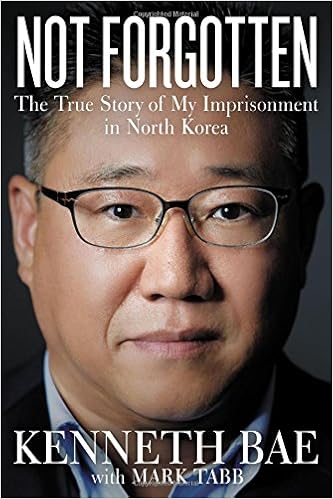
Having lived in South Korea for four years, I have read quite a few books pertaining to the Koreas on both side of the 38th parallel. My collection of read books (and documentaries) on North Korea is getting quite large. Each of the books, such as Barbara Demick's Nothing to Envyand Yeonmi Park's In Order to Live enlightened me on a slightly different aspect of the people and country called North Korea. My latest book I read on the "Hermit Kingdom" was Not Forgotten: The True Story of My Imprisonment in North Koreahad an entirely different perspective. Instead of trying to escape the horrible prison labor camps such as in Escape from Camp 14, Kenneth Bae's true story mainly focuses on the transformations which occurred while a "prisoner of Jesus Christ" in North Korea.
Although I highly encourage you to read the book, here is a basic summary. Kenneth, an American missionary of Korean descent, was arrested after a portable hard drive was discovered in his bag when his tour group arrived in the country from China. Even though he admitted to being a missionary who had made the mistake of accidentally leaving the backup hard drive in his bag, the North Korean government convicted him of the highest level of treason against the country.
Sentenced to 15 years of hard labor, Bae originally prayed and hoped for quick release - even though he knew he was being used as a political pawn. Now he was forced to manual labor from 8am-6pm out in the extreme elements and then subjected to the political brainwashing of the TV in the evening. Prior medical conditions exacerbated the already difficult situation, along with isolation and uncertainty. It wasn't until he asked the Lord to do His bidding and use Bae while "in chains" that things turned around for Bae. This was such a parallel with the Apostle Paul, who while imprisoned for witnessing about Christ, shared the Gospel with the prison guards. A sense of peace enveloped Bae, known as Prisoner 103; "Once I accepted this place as God's will for my life, and I started praying, God use me, instead of God, save me, doors opened". The guards took note and asked why he was so happy and where his hope came from, to which he responded, "God has me in here because he cares for you and all of North Korea. He wants to you to know who he is and how much he loves you."
A citizen of the US but a native South Korean, Bae had a unique opportunity. He was able to communicate directly to the guards and develop special insight. "My two years in North Korea also taught me what it means to have compassion for those who live in darkness. People in North Korea have no access to information from the outside world, no freedom to travel, no freedom to speak their minds, and now way to choose their own religions."
He realized that there was a special sense of safety within a totalitarian regime, and that those who raise questions about the societal structures is a direct threat to the nation. In North Korea, the Kim Jun family is their god.
Kenneth Bae recounted multiple instances of where God seemed to directly intervene or send strong messages that He had not forgotten His missionary. For example, there were times when Bae was at a low point in the hospital when he was craving and had prayed for a particular food; for the next meal, that exact food was brought in from a special restaurant, even though he had not verbalized any request. This happened over 40 times. At the prison, Bae's planted field was spared the flooding that affected all the other fields. When initially held in a cold detention room, his left hand suddenly became warm and the Spirit's presence was felt. At another low point while in the hospital, the Disney movie "Finding Nemo" was on instead of the usual shows venerating the Kim family, providing Bae a connection with America. Also, since it was known that Bae was a pastor and the government wanted to convey to the world that they were being merciful, he was allowed to keep his Bible. Two years after he was arrested, Bae woke much earlier than usual and heard the Spirit of God direct him to open the Bible to Zephaniah 3:20 (Bae had no idea what it would be) - and read: At that time I will gather you; at that time I will bring you home. Four days later, Bae was released.
In the end, Kenneth Bae spent 735 days in detainment - the longest held of any American since the Korean War.
Some interesting things I learned:
In 1907, Pyongyang was known as the "Jerusalem of the East" for having more churches than anywhere else in Asia. Now, there is only one "token church" that is under total control of the government. North Koreans have no knowledge of Jesus. One guard said he had heard of a God, but not this Jesus, asking where Jesus lived - China or North Korea.
The Bible is viewed as a dangerous weapon. North Korea even has a Bible on display at an anti-American propaganda museum that is filled with weapons the US has used against them in the Korean War.
Everyone is expected to contribute to the common good, including manual labor. For instance, Bae witnessed tens of thousands of people (including women with children on their backs) clearing the 200 mile long highway to Pyongyang with snow shovels. Even at the labor camp, the guards had to plant and tend their own fields for their food.
The guards had no conception of how families in South Korea or the USA could own both a car and a home. Years ago, the North Korean government provided families with a modest home, but now that is not typical.
I was amazed how Bae did not hold animosity towards the North Korean government. With a reframing of his outlook, he saw the period of detainment as a wonderful opportunity to witness for Christ, to a nation in the dark about their Savior. Bae continues to pray for the people of North Korea and hopes that one day, the spiritual wall that surrounds the country will fall. "More than a billion people worldwide still have not heard the gospel. We must remember them, pray for them, and build a bridge to them through which we can share God's love and compassion. May God be their God, and may they be his people."
Follow the east gate out of Shaxi, and you will encounter a bridge along the river. This classic humpback stone bridge marks the same path that traders used on the tea-horse trail.
The shape of the bridge reminded me of the 400 yr old bridge in Mostar, Bosnia - the largest single-stone bridge in the world. Although both bridges are set amongst a picturesque scene, the Yujin bridge was very quiet and was not a tragic victim of a civil war.
Although the buildings at Changgyeonggung Palace are not that impressive (many were destroyed by the Japanese during unsuccessful invasions and later during colonial rule), this Seoul palace does have some pretty grounds. I find it to the be the prettiest in spring when the azaleas are in bloom.
More azaleas on the path leading up to the glass house beyond Chundangji Pond
Spring abounds just beyond the Chundangji Pond.
Devoid of any buildings (Japanese demolished the royal carriages & livery stable area to make space for a zoo stable), the Gwolnaegaksa area now contains many tall bushes and trees. Fuchsia, pink and magenta were the colors of the day.
I love the twisted juniper tree, contrasting with the blooms and brick wall.
As part of the Cherry Blossom festival in Jinhae, we walked to the city's Naval Academy and Naval Command base. (Buses were trying their best to take as many people over to the base as possible, but walking was quicker than trying to wait for a bus and dealing with the traffic). On the way, we walked past some Naval Academy guards. We had a little giggle to see two guards each holding up oars in a defensive stance as if they were spears.
Like much of Jinhae, the Naval area was enveloped with cherry blossoms. I especially liked the ones right by the sea.
Visitors could go into the reconstructed turtle ship, the original ones made famous in the naval battles under Admiral Yi. How it must have been during Yi's time, with the gun ports emerging from the dragon's mouth (as well as the top & bottom of the head and in several other places around the ship), fire arrows shooting forth, as well as canons booming. Even the ship's spiky roof looked rather menacing. Today's ships may be much more advanced, but I prefer the aesthetics of this wooden ship.
During my recent trip to Japan, I visited the national historical site of Kumamoto Castle. Considered one of the premier castles of Japan, Kumamoto Castle (named after the city in which it is found) has some impressive architecture, interior decoration, and a museum. Although its construction dates back to 1601 many of its structures were lost by a considerable fire just three days before a siege in 1877. Some parts were never rebuilt, while others were reconstructed as recently as 2005.
Detail - tower
Turret and walls
With its curved stone walls and wooden overhangs designed to repel ninja, it was considered to be a fairly impregnable fortress. The architect Kiyomasa also helped design some castles in Korea.
In addition to the large exhibition hall and many outdoor war equipment exhibits, the War Memorial of Korea in Seoul has several poignant memorial sculptures. The two pictured above show the human side of war. The "Statue of Brothers" is probably its most famous one, depicting two brothers embracing on the battlefield - an older brother from the ROK and his younger brother who is fighting with the North Korean army. A powerful symbol of love, forgiveness and reconciliation, it expresses the hope of Koreans. The granite used in the domed shape portion was collected from various parts of Korea, symbolizing the nationwide sacrifices.
Although I've taken the bus past the War Memorial of Korea quite often, I finally stopped to visit it. Located on the former site of the Army Headquarters in the section of Seoul known as Yongsan, the site covers over 20,000 square meters. Comprised of over 13,000 items (more added via donation each year), free entry to both the outdoor and eight exhibition halls has plenty to offer for the whole family. Exhibitions were signposted in several languages and QR codes enabled visitors to get more information via smartphones. From ancient arrowheads to the Kobukson turtle ships of the Joseon Dynasty to wars of the present day, the Memorial commemorated the sacrifices of the warriors and victims that helped contribute to the Korea of today. Some sections were more abstract and symbolic, some were more high-tech, while others encouraged visitor hands-on participation. As expected, the Korean War of the 1950's was particularly well and well-chronicled, taking up the second floor.
Free tours are offered.
The following morning, we started our tour at Taegeukdo Village. Located in the Gamcheon neighborhood of Busan, this community developed when around 4,000 followers of the Taegeukdo religion became refugees during the Korean war and settled here. Over 800 cube-like shacks were erected upon the steep hillside, virtually stacked one on top of each other. Photos in one building showed how shanty-like this poor village appeared during the Korean War. Encouraged by the leader of the Taegeukdo religion, the religious refugees began building the concrete homes seen today. Most of the homes are painted in rather bright colors; blue is the dominant roof color. On top of the flat roofs, water holding tanks were a common sight. Occasionally, one spotted a few older residents (only about 10,000 remain here, down from double that amount in the 1980s) working in tiny gardens. Kimchi pots with rocks on top of the lids were a rather common sight; flower pots and lines of laundry added a bit of color.
Book-themed stairway
Visitors (there were quite a few of them on this day) were free to wander through the narrow alleys and steep steps. Many were on a quest to get the “passport” on their map of the village all completed with the requisite stamps from various locations within the village. Some of the homes and surroundings were theme-based, such as the spotted cow, optical illusion, and books homes. Brightly painted wooden plaques in crude fish shapes pointed visitors to some of the more popular locations. A large mural of these fish plaques were assembled in a large mural near the entrance of the village where small shops selling snacks were located. Visitors were taking “selfies” or photos of acquaintances everywhere, sometimes stopping every few feet. Walking further, the harbor of Busan appeared beyond the hill, along with a view of a few high-rise apartments nestled amongst more matchbook-like homes. The city of Busan continues its work to transform the village into a popular tourist site, making it into an artsy area with galleries, book cafés and other cultural facilities. Murals and other public artwork can be seen throughout the village. Visitors are reminded though that it still is a place where people live, and thus they should be respectful of noise levels, where they are trampling around, and keeping things clean. Although bathed in sunlight throughout much of the day, I think its nickname of “Korea’s Santorini” is a bit of a stretch. Nonetheless, it can be an enjoyable visit.
Back in January of 2013, I blogged about some terrible news I had read regarding Timbuktu. In that post, I wrote about how the Ahmed Baba center, location that housed hundreds of thousands of precious manuscripts (some dating over 800 years ago) had been burned by Islamic fundamentalists. At the time of that writing, it was hoped that at least some of the manuscripts had been saved, but their fate was unknown. This morning, I read with relief a great article entitled The Book Rustlers of Timbuktu. Largely through the proactive and often risky efforts of a librarian, nearly 90% of the over 400,000 documents were saved. Through land and boat, over the Sahara, thousands of small metal lockers - 2 or 3 at a time- containing the books eventually made their way down to the capital. Imagine carrying this out, initially right under the noses of the fundamentalists during afternoon siesta times, facing searches, using public transport including tiny dugout canoes, not having the financial resources, etc.
Amazingly, not one of the documents smuggled down was lost. Efforts are being made to repair the nearly 40% suffering from damage, as well as to digitize the works whose contents range from diaries to medical texts. Just as some successfully hid artwork from the Nazis, dedicated people in Timbuktu saved historical treasures from the wrath of destroyers. They are the heroes of the manuscripts.
March 24, 2014 was a beautiful spring day in my life. The warmth of the spring sun invited early blossoming and birds to sing. On that day, I was in Seoul, South Korea, enjoying my first day of spring break. For residents of a place I called home for four years, the day was a reminder, not of rebirth and renewal, but of the start of events that forever changed their lives. March 24, 2014 was the 15th anniversary of the NATO bombing campaign in Serbia. For 78 days, bombs and missiles fell in Serbia as well as Montenegro, particularly in the Serbian capital of Belgrade.
Even when I was there from 2005-2008, reminders of the bombing were very prominent. On the same street with so many embassies (including the US Embassy), were these bombed-out shells, remnants of what used to be governmental buildings. Graffiti covered remnants of a former TV station where young people senselessly lost their lives. Far from being a clean-cut attack on the government, the citizens were profoundly affected. Over 2,000 civilians lost their lives, including 88 children. My colleagues who lived through the bombing described giving birth without electricity (one maternity hospital was actually bombed), the piercing noise of the missiles whizzing by and then lighting up the sky, seeking shelter during the raids and then observing the damage the following day, and much more. One friend, an excellent photographer and blogger, wrote a book from her perspective and experiences. She also talked about the everyday hardships, such as food and petrol shortages, wondering if the bridge would be there to get to school, how the International School of Belgrade dwindled down to a few students and teachers during that time, how a chemicals from a bombed factory in a nearby town flowed into the river, poisoning all the fish, and so much more. Through talking with her and others, it was powerful reminder of bias - the news media, government, etc. There is always more of the story we don't hear, and perspectives that are not shared - either by choice or neglect.
Below is a documentary of the bombing campaign which seeks to tell the story from some people with direct experiences. Not collateral damage or terrible accidents, but tragic events that forever changed their lives. When watching TV reports (or reading on Flipboard) of news events such as what is currently happening in places such as Syria, let us remember the human side of the events.
During the heat and humidity of summer, the blooms of the Hibiscus known as Mugunghwa, or the Rose of Sharon, quietly adorn Korea. The ancient Chinese nicknamed Korea as "the land of the gentlemen where Mugunghwa blooms." Considering the number of times that Korea has resiliently stood against various invasions and hardships, it is fitting that Korea has chosen the Mugunghwa - a hardy plant whose flowers withstand even transplanting or cuttings for floral arrangements - for its national flower. It symbolizes the country's wish for national development and prosperity.
In addition to dotting the lands of Korea, the Mugunghwa can be found in China, Japan, and northern India.
One of the more interesting and unusual sculptures at the 2013 Lotus Lantern Festival held by the Cheonggyecheon Stream in Seoul was this figure. Holding a skull that seemed to have representative water flowing into an open lotus, the figure was definitely intriguing. The sculpture reminded me of the Kali Puja festival I saw in Kolkata, India. Kali, a Hindu goddess who developed a taste for killing after she was asked to assist in slaying a menacing foe at a battle. She is depicted with a garland of heads of her victims, as well as carrying a recently decapitated head.
Bulguksa contains two of Korea’s most revered pagodas - the three-story Seokgtap and the octagonal Dabotap. Each were made during the Silla Dynasty. Sadly, the Seokgtap was being restored, with a huge glass and corrugated metal structure enclosing it. The Dabotap, standing 10.3 meters tall, was built in the mid-8th century. It successfully and skillfully balances square, octagonal, and circle forms in one holistic design. Only one of the four stone lions on Dabotap remains, with the others lost during Japanese occupation. The ornate structure of Dabotap is reproduced on the South Korean 10 won coin.
Located at the intersection of the neoclassical Seokjojeon, National Museum of Art, and Jeukjodang, this bronze fountain feels as out of place in the palace as Seokjojeon itself. Unlike Korean gardens which are traditionally located at the rear of buildings, this more Western style is located in front. Water was a typical feature of Korean gardens, but in a manmade waterfall - not a fountain. The fountain was completed in 1937, but parts of it were torn down and used to make artillery shells during WWII.
Yes, I'm still in the Deoksugung Palace. What is this neoclassical building doing here, you might ask? In a culture that so prided itself with conformity and harmony, this building (in a Korean palace) looks more like an eyesore to me. Designed by a British architect during the time of the Great Han Empire, much of the construction was actually done by a Japanese civil engineering company that was notorious for smuggling out thousands of cultural treasures to Japan. It was built as part of the Empire's push to modernize. Unlike other palace buildings that each had a unique, singular purpose, Seokjojeon was intended to have multiple functions. Its lower floor was a waiting area for servants, the second floor as a reception area, and the third floor was to be the residence for Emperor Gojong. In actuality, the building was rarely used. Following the death of Emperor Gojong, the Japanese expanded the west wing of Seokjojeon to become the Yiwangga Art Museum. After the Korean War, it was changed into National Museum and then the Royal Museum. Currently the museum is undergoing restoration.
Located a short distance from Gyenbokgung Palace is Deoksugung. Originally (1593) a residence for Prince Wolsan, Deoksugung served as the main palace for the short-lived Great Han Empire (1897-1910) after the Japanese burned the palaces in the capital. Named Gyeongungung by the then-king Gwanghaegun, it then became a secondary palace after the king moved to Changdeokgung Palace in 1615. During its peak when serving as a main palace, it comprised of a space nearly three times the present size. This included the Hwangudan Altar, where rites to heaven were performed. When the Great Han Emperor Gojong relinquished his throne in 1907, Gyeongungung was downgraded to a residence. It was at this time that the name was changed to Deoksugung, meaning "palace of longevity," by then king Sunjong, in hopes that his father Gojong would live there in peace for a long time.
After the administrative complex and Hwangudan Altar were later removed, the palace lost its status as an important center. In 1904, four years after electricity was installed in the palace, most of the buildings were destroyed by fire. (Although not proven, it highly suspected that this fire was the result of arson at the hands of the Japanese, who wanted Emperor Gojong to move to another palace). In 1933, the Japanese destroyed most of the remaining palace buildings, sold the lots in public bidding, and developed a public park.
In spite of all of this, Deoksugung is still viewed as a symbolic seat of modern Korea, as it saw the country through several national crises, most notably the Japanese invasion (1592) and the tumultuous final years of the Great Han Empire.
This Victorian-style greenhouse looks pretty in and of itself, but it placement was designed to be anything but. Built just one year (1909) before Korea was formally annexed by Imperial Japan, it was part of a larger Japanese plan to degrade Changgyeonggung from its royal palace status. Many palace buildings were cleared to make way for a zoo and botanical garden - a grave insult to the reverent Koreans. During this planned destruction phase, a road was laid between the palace and Jongmyo Shrine (housing the memorial tablets of royalty) in order to sever their symbolic link between the two places. In 1983 the zoo was removed. Reconstruction of Changgyeonggung continues to this day.
Walking through the park-like section of Changgyeonggung Palace, I came across this octagonal stone fence with a mushroom-like stone sculpture in the center. I was quite surprised to find out what it was - the placenta chamber for King Seongjong. According to Korean tradition, the placenta of a baby was to be stored in a porcelain jar on the seventh day after birth. A few months later, the jar would be sealed multiple times and then placed into a stone chamber. According to the palace's guidebook, this placenta chamber is located here because the Japanese during Korean occupation moved it there in order to display it at the Yiwangga Museum. When looking up where this museum was located, it sounds like Yiwangga was at the nearby Deoksugung Palace. Not sure why it wasn't moved there right away...