Showing posts with label tea. Show all posts

Saturday, September 05, 2015

Shaxi Friday Market


A woman from the Yi minority group sets up her produce
 Visiting the markets in a town is a highlight for me. Produce and goods, transported on the backs, heads, livestock, and overburdened vehicles of vendors, reveals so much about the locals. Some traverse for quite a distance over difficult terrain to sell and buy. I love looking at the costumes worn by the locals and marvel at how they present their goods, no matter how meager the amounts.
Simple scales are still used
Colorful produce, some I've never seen before, are carefully arranged. A variety of fragrances intermix, further assaulting the senses. People struggle to be heard over the noise of chatting, bargaining, animals, and vehicles. 

Woven baskets, particularly used by the Bai people, are sold.
Although the tea-horse trading between Tibet and China no longer exists, the town of Shaxi, the last remaining market town on the Tea Horse trail, becomes alive during its Friday market. People from the Bai and Yi ethnic minority groups come down from their mountain villages to trade goods. Some came on foot or motorbike; others piled out of the back of small trucks or public vans. 

Both tropical and temperate produce tempted the eyes. Buyers had an overwhelming variety of mushrooms from which to choose. Local honey, hand-made rope, and cow bells competed for space with lightbulbs, traditional and machine-made clothing. Women carried woven baskets on their backs, while others hauled slaughtered pigs in a wheelbarrow. Emanating from a small radio, "Gangnam Style" competed for attention over the exchange of commerce and gossip.
Pork, including the snout, offered by a vendor
Care for a couple of eggs or a dozen?

Monday, August 31, 2015

The Tea Horse Trail Through Shaxi

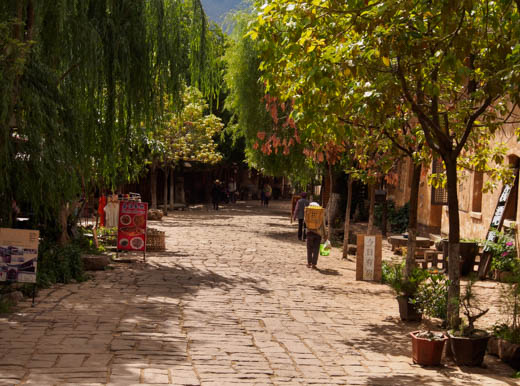
Sideng bazaar street, part of the tea-horse route
Nestled in a valley, the small town of Shaxi played a vital role along the ancient tea-horse route starting over 1,400 years ago. Tibetan horses were highly prized and traded in China for tea and salt. Shaxi became a main trade station along this route. In just the year 1661, over 1.5 million kilos of Yunnan tea were traded to Tibet.

Some of the guesthouses still remain where traders and their horses rested for the night. The structures of trading shops are also present, but many are now converted into cafés, restaurants, and stores.


The Tea-horse trail was also used by Buddhist monks, Christian missionaries, and armies as they moved in between India, Myanmar, and China. In the 18th century, the route began its slow decline as China stopped trading horses for tea.  Railways, air freight, and highways further reduced the importance of the road. Today the town of Shaxi, including the cobblestone tea-horse road of Sideng Street, becomes an active trading area during the Friday market.

I loved meandering through the narrow lanes. Some of the gates were truly impressive. The early morning light illuminated the lime-painted walls.
The town of Shaxi has been listed by the World Monuments Fund as one of the 100 most endangered sites in the world. Recent efforts have been made to preserve the architecture and culture.

Monday, July 27, 2015

Choose Your Tea Type

 Tea is a big deal in China. Both Hangzhou and the province of Yunnan where I visited are known for their tea. Entire trade routes were set up here and through treacherous paths to Tibet for trading tea. The shops posted here contained a huge variety of tea, with a bewildering variety of packaging, preparation types, flavors, and prices. I did see a few people purchasing items, but lacking the knowledge of the tea itself and the labeling (most was in Chinese only), I decided to purchase the tea for my cousin elsewhere.

What beautiful patterning at this store in Shuhe
More tea stores in Shaxi
Most restaurants I visited, as well as some of the guest houses, provided complimentary tea. In the picture above, that large silver thermos at my guesthouse was filled with hot water and intended solely for me. Dried tea leaves were already placed in the cup, to which my host continued to pour hot water. Its delicate flavor was enjoyed without any additions such as milk or sweetener - much different than the tea I had in other countries, particularly India (I do love chai), Tunisia (sweet and served with pine nuts), and Mali (sweet "gunpowder" tea).

Tuesday, July 21, 2015

Tea Fields of Hangzhou

After visiting the Lingyin Temple, we took a cable car up the mountain. Below us were some emerald-green tea fields. Known as Longjing Tea, the highly-prized (and expensive) tea from the area is grown. Longjing Tea is pan-roasted and was given the distinction of being labeled by the Qing dynasty emperor Kangxi as Imperial Tea.


From the top, we had a good view of the surroundings, including West Lake in the distance. Too bad it was hazy.

Saturday, April 05, 2014

Seonamsa Templestay: Ask a Monk

Scooping dried tea leaves ($150 a package) into the teapot
A short while later, we reconvened in a room off the area where our sleeping rooms were located. Waiting until the boiled water was at just the right temperature, the monk combined the water with some dried tea leaves grown on the temple grounds. Through an interpreter, he explained that we were indeed honored guests, as the small wooden box of dried leaves was sold for $150 retail. The tea coming from same tea bushes, was prized by King Sejong six hundred years ago. After all had some tea, we were given a chance to ask questions. Even simple questions such as what a monk's typical daily routine was like was answered with a complex, philosophical response. Our tour guide (a Korean) struggled to interpret the monk's response with its technical, spiritual terminology, into English.The monk's sense of humor and wit did come through though.
Pouring the tea

Bedtime

Warned that we had to be up and ready for the 3:30 AM ceremony, I eagerly heeded the advice to go to bed after that at 9:00. The warmth of the ondol-heated floors made the sleeping much more pleasant than the colder "slumber-party" style few hours of "sleep" we had at the jinjabong the night before.

Friday, May 04, 2012

Tea with the Family


With two days left before I had to return back to Chennai, time was spent in a leisurely fashion, partaking in some of the routines of the family. Mornings always started with a cup of tea. The mother always got up early, preparing the tea (both salt tea and the Qahwasweet tea flavored with saffron and sprinkled with chopped almonds she knew I liked). Sitting on a low stool in the tiled kitchen, she kneaded the dough and deftly transformed it into nearly perfectly round chapatis. A relative comes in the unlocked front door, wearing his pheran and greeting the mother. She offers him some tea, along with some still-warm chapatis. Over the two-burner gas stove, she flips the chapati onto its other side, engaging in morning greetings simultaneously. The grandmother wearing her pheran with zari embroidery enters the carpeted portion of the kitchen, settling into her usual spot with its comfy floor cushions. The father enters and begins the first of many cups of tea. With his government job, he has several hours before he has to leave for work. One by one, the children also come and make their spot in the room. A neighbor comes in and joins the morning tea routine. The pace is unhurried and relaxed, a great time to converse. For Kashmiris, tea time is much more than the contents of a cup - it’s an integral part of their community. 

Saturday, April 28, 2012

Village of the Gujjars


The following morning, the hotel owner drove me to a small village where some semi-–nomadic Gujjars stay for the winter.  The tiny road  took us past some crude shelters made out of stone, logs, and grasses -  the type of dwelling the Gujjar tribe (one of the largest ethnic tribes in Kashmir) used to build.  The house we visited was made out of brick and its interior covered with a smooth layer of mud.  With the parents away at the market, a young boy promptly gave us some tea.  A bit later,  a woman came in.  I admired  the traditional embroidered hat that she wore. Small, tight braids similar to that worn by African American people framed her face, a style typical of the Gujjars. In a couple months, the family would make their way up into the mountains where they would graze their sheep. With the mountains full of flowers and green grass, what a beautiful surrounding these shepherds must have in the summer!

Thursday, April 26, 2012

Chapatis in my Salt Tea


While we were taking pictures of each other, their mother returned and prepared for us a cup of the salt tea.  I watched  as they ripped a fresh chapati and placed the pieces into the tea and then did the same.  I can’t say that I cared for the salt tea, but it was quite filling.  As a token of appreciation for sharing the afternoon with them, they decorated my hand with mehendi.  Politely declining their invitation to spend the night at their place, I thanked them for their hospitality and made my way in the rain back to the hotel.  Such warm people, these Kashmiris. 

Wednesday, April 25, 2012

Come in for some Tea


 Determined to meet some local people, I made my way gingerly on the muddy road towards some homes and small shops. Several times I was warmly greeted, engaged in a short conversation (Kashmiris often inquired about how I like Kashmir), and offered some tea.  After politely deferring some tea invitations, I finally gave in when I met a beautiful teenage girl with a vivacious, outgoing personality.  I spent several hours in their house, engaging in conversation in between cups of delicious Kashmiri tea with a cinnamon taste. Her older sister (who was much more reserved)  performed kitchen duties such as creating a useful cooking fire in their traditional stove, rolling and cooking chapatis, and preparing the salt tea in a Samovar tea pot.  Typical of Kashmiri families, neighbors and relatives stepped in for a while, had a cup of tea, and left.  The younger sister gave me a pheran to wear on this cold, rainy day (like other Kashmiri homes, theirs was not heated), but it was way too short. The woven kangri, with hot embers in its metal pot, proved to be a nice personal heater.  

Saturday, January 29, 2011

Flight and Drive to Dharamsala


Looking out the small plane’s windows, the vast brown mountain peaks (a few distant ones capped with snow) indicated that we were near our destination – Dharamsala. A short time after the luggage was loaded airline’ red truck, we picked up our luggage on the tiny airport’s one carousel and grabbed a taxi. The taxi driver calmly navigated the narrow switchback road with its steep banks and forested surroundings. Streams flowed over stony beds. Occasionally we paused to let goats and their herder cross the road. Tea bushes formed green blankets in a few areas, punctuated by planted trees. Interspersed were diminutive clusters of homes and small shops hugging the road, with a hardware store, cement place, and tea stall almost as a prerequisite.
A pleasant ride later, we reached McLeodj, about four miles (7km) north of the actual town of Dharamsala. We knew that the Dalai Lama was not present at the moment in this Tibetan exile headquarters town, but we were confident there would be much to enjoy anyway.

See more photos of Dharamsala on my Flickr page http://www.flickr.com/photos/melissaenderle/sets/72157625792041888/ 

Monday, November 01, 2010

Macwood's Tea Estate

Around Nuwara Eliya (elevation 2,000m), we stopped at Mackwood’s Tea Estate for a tour. Founded in 1841, this company includes 27,000 acres of plantations consisting of 17 tea and rubber estates. In addition to exporting vast quantities of tea, it also exports essential oils, organic/biofoods, coconut/fiber geotextiles, and rubber. After some sampling of the orange pekoe tea, I went on a short tour of the factory.


The first step in tea is plucking. Only women do this job, as their hands are considered more nimble. These women deftly pick two leaves and a bud. About 10,000 kilos per day of leaves are picked on 1,200 acres. According to my guide, each bush yields about ½ kilo per pick. Each woman picks approximately 10-15 kilos per day and makes between 500-600 rupees ($4.40) a day. The company does provide health care, education, and other services for the families. Four times a month a bush can be picked again. About 1,000 workers are employed – most of whom are women. Men do work such as pruning (every five years a bush is pruned, after which plucking can be done in three months), weeding, and factory work. A natural tea bush can last 100 years. Macwood’s uses cloned ones, which last only about 60 years but produce a much higher yield.


The second step is withering. After about 14 hours, over 50% of the moisture from the leaves is gone. The crushing machine then takes about 250 kg of leaves at a time. Then the leaves are rolled for about 20 minutes, which twists the leaf and brings the juices to the leaf’s surface. Fermentation, the fourth step, takes about two hours. The tea is further dried for about 20 minutes in a special firewood kiln which reaches 105°C (220°F). Only about 2-3% of the moisture remains at this point. The extractor then separates the fiber from the leaves, with the leaves being graded by size and shape. Taste tests are conducted and the tea is packed in large bags, which are hauled to Colombo where they are auctioned. 80% of Mackwood’s tea goes for export. Asian and Arab countries are common destinations.


More costly tea grades such as silver tips follow a slightly different process, with the leaves drying in the sun. Seven kg of leaves yields only 1 kg of tea for this process. More expensive teas are flavorful by themselves and are not served with milk or sugar.

Thursday, October 28, 2010

Dowa Cave Temple

The next day we headed out in Kasun’s cousin’s auto rickshaw and headed towards the Halpewaththa Tea Factory for a tour. Unfortunately there was no production going on, since no tea had been picked the day before. I was invited to come back the next morning, but I had planned to head towards Kandy then. Equally disappointing, the only tea pluckers we spotted were way in the distance up a steep hill. So much for tea photos and tours.

The auto rickshaw coasted down the hill and then turned towards Bandarawela, where we stopped at the Dowa Cave Temple. While waiting for the attendant, we looked at the large standing Buddha carved into the rock. A sizable Bodhi tree (sacred to Buddhists) was adorned with streamers of Buddhist flags and some good-luck flags. A big skeleton key was used to open up the short doors, revealing old frescoes on the wall and ceiling. Lotus flowers were painted on the ceiling and some walls. Scenes of Buddha were painted in rows. Inside were two reclining Buddha statues as well as several seated figures. Newer rooms revealed more scenes of Buddha, depicted in a more realistic style. Through a back door Kasun showed me a cave whose entry (now blocked) once was connected to another temple.


Monday, October 25, 2010

Hike to Little Adam's Peak, Ella

The next morning I was awakened by the horn of a train, which coincided with the time the residents of the small town began to go about their daily business. After breakfast at the Sun Top Hotel consisting of eggs, mounds of toast, freshly made pineapple juice and honey made from palm trees, I returned up the small road to Kasun’s house. With his brother and younger cousin joining us, we walked through the tiny town and up the road towards Little Adam’s Peak. Amidst the tea bushes was a large tin corrugated roof structure, from which sounds of kids, dogs, and chickens emanated. Kasun said that over 200 tea pickers lived there, many whom were from Tamil Nadu (India) or were Tamil in origin. In addition to speaking their native language of Tamil, these workers also spoke Sinhalese. He added that the tea pickers (always women) earned about 15 rupees (13 cents) per kilogram of picked leaves and could pick up to 50 kg per day. Many families had around five children, creating a financial burden. Up past the dwelling I saw Hindu temple in early stages of construction.

On the way up, I paused to look at my surroundings – and beautiful they were. Blue and yellow flowers dotted the embankment by the tea bushes. Trees popped up amidst quilted landscape of the tea bushes. Looking forward on the path, Ella Rock appeared in the distance. Buildings occasionally punctuated the green landscape. Kasun explained that there were four tea factories in the immediate area. The government owned the land, but rented it to the tea companies in exchange for part of the profits. Hotels were also going up, especially in the hills. Although they would have a beautiful view, Kasun was concerned about water availability. We also walked past a plot of land with its trees being cut down. These trees were planted by the British but are not conducive to the land (take too much water, not good wood, birds don’t like), so new ones are going to be planted to take the place of the pine trees.
Up more paths and some steps, we arrived at Little Adam’s Peak. Oh, what a green view! The steep slopes were covered in grasses. Nearby hills had grass and were tree-covered. Red busses made their way along the narrow, slithering mountain roads. Near Ella Rock we could see Rawana Ella Falls – our next destination. On clear days, one can see the sea and some lakes, but with the haziness of today, all we could see where distant bluish mountains. After taking in the view for a while, we headed back down the hill and into the small town. Here we had a snack of curd (made from buffalo milk) mixed with fresh fruit, as well as some tea.

Sunday, October 24, 2010

Down a Friendly Path, Ella

Wanting to at least scope out part of the town, I took a hilly path past the police station and into a wooded area. Through the clearing, Ella Rock was visible above some tropical trees. Going past several small colorful houses, I had reached the end of the small road and so I turned back. At one house, I took some photos of eager children and their mothers. Next door, a grandmotherly woman came out and greeted me, asking if I wanted tea. (Thankfully there are many drinks with names common across languages, such as tea, coffee, coke, and juice). As she went to make the tea, I met her adopted sons, one of which was around 18 and the other around 25. The older son spoke fairly good English and eagerly showed me a school report he had made of Ella, with writings in both Sinhalese and English, and photos taken by him as well as postcards, etc. After tea and hard biscuits, the younger son asked if I could help him with Photoshop, of which I eagerly obliged. It was nice to be able to give back a bit, with the teen already feeling more confident with his new skills. When I bid the family good-bye and thanked them for their hospitality, the older son offered to take me the following morning to Little Adam’s Peak and some other local sights. Such generous people – something you likely wouldn’t discover so quickly in large cities!

That evening, I had supper at the Sun Top Hotel, consisting of homemade beef curry with coconut milk over local red rice. Okra, cassava, pumpkin, mushrooms, and pampadons were also brought out. Along with a drink, the large meal was about $4.50. Although some of the dishes were similar to what I’ve had in South India, they were less oily and gentler, probably due to the coconut milk. Back at my hotel room, the night was dark and quiet. Only the sounds of frogs and insects punctuated the silence. Lightning bugs flickered on and off, adding their touch to nature’s concert.

Saturday, October 23, 2010

Train Ride to Ella, Sri Lanka - pt 2

Further up into the highlands, the train chugged through tunnels, some of which were rather long. Children in the observation car stuck their heads out the open window, shouting and screaming in the dark. Daylight once again revealed lush vegetation of the area. In some parts, one side of the train revealed a beautiful view of the valley below. The other side, by contrast, might only have the side of hewn rock quite close to the train window as a view. Passengers familiar with the area alerted me to upcoming large waterfalls, granting me time to go to the open train door and get a better shot. Occasionally misting, the high points of the mountain were enshrouded in rapidly-moving low clouds and fog. Coupled with the streams and waterfalls, it gave the area a sense of serenity. Still higher, the tea plantations were replaced with tall trees that were not of the tropical variety.

By now, the observation train was mostly empty. Most of the warm Sri Lankan families I had met on the train had now reached their destinations. Thankfully even the tiny train stations had their signs posted in the triple language. The train began a slight descent towards Ella, once again revealing some tropical trees. After peeking out of the doorway to see the station sign, I quickly grabbed my backpack and headed onto the platform. Here I was met by the owner of the small hotel, who led me on a tiny footpath behind the train station down a hill to where the hotel was. Apologizing for the unavailability of the room at his Sun Top Hotel for that night due to a couple who decided to stay an extra day, he had already arranged with the neighboring nicer hotel to accommodate me at the same rate.
Ella Train Station

 Comfort Inn, Ella

Train Ride to Ella, Sri Lanka - pt 1

Instead of touring one of India’s many destinations for our October break, I decided to visit its southern neighbor, the teardrop-shaped island of Sri Lanka. Arriving in the capitol’s airport at just before 4AM, I quickly made it through immigration, got my visa, and some cash to get me started. A city bus took me within a few blocks of the train station – much cheaper than getting a taxi. After purchasing a few local snacks for the train, I purchased a ticket for a seat on the observation car - less than $7 for what would be a ten-hour ride.

Train Ride to Ella
Morning light revealed rather flat land, with many rice paddy fields barren or flooded. Paths between the fields were also made muddy with the recent rains. White pinnacles of Buddhist stupas peeked between the palm trees. Moving slightly higher in elevation, we began seeing some rubber trees and plenty of bananas. Fields gave way to steep tree-covered hills. Rubber tires were placed as steps, assisting navigation up step paths to homes perched up high hills. Farming of the terra-cotta colored ground here was mostly restricted to terraced methods.

Between the trees, I spotted some tea bushes – the first of many to come. Soon the landscape was converted into an emerald green carpet of tea bushes, the hills and mountains appearing as if manicured by giants. Streams flowed through the fields, carving right through the plantations. Waterfalls of varying sizes became a common sight, emerging from forested areas and cascading down rocky slopes. Signs in Sinhalese, Tamil, and English indicated to which tea plantation the land belonged. The white of the larger buildings made it easy to spot the many tea factories dotting the area. Occasionally distant flecks of color were spotted in the tea fields, indicators of women tea pluckers. Near villages, plots of land was reserved for vegetable gardens. The mounded ground particular to that area reminded me of a Hershey’s bar. Auto rickshaws in a variety of colors scooted along the narrow road, with artificial flowers, pictures of religious icons, small statues, and writing distinguishing one from the other. Colorful Hindu temples, white Buddhist stupas, and green minarets (along with the occasional Christian cross) dotted the sides of the roads in towns.

Monday, October 18, 2010

Monday, February 01, 2010

Madumalai Wildlife Sanctuary

Wanting to have as much time as possible to also enjoy Mysore located 155 km away, we reluctantly headed onwards after buying some tea and scented sandalwood oil. We passed by tea fields appearing to flow down steep hills, some of which contained speckles of distant women picking. Suddenly the scene would change, varying between groves of bamboo plants, thin, tall trees, some banyan trees, and those of a more tropical type. A sign indicated that we were now in the Mudumalai Wildlife Sanctuary, the largest in Tamil Nadu and perhaps one of the most important in the southern region. This sanctuary borders the Bandipur National Park in Karnataka and the Wynad Sanctuary in Kerala. Although we did not spot any tigers, sambar, antelope, leopards, or panthers present in the area, we did spot some elephants, wild boar, peacocks, common langur, and bonnet macaques. In addition to the variety of traffic with wheels, we now had to contend with the four-legged type – elephants on the road moving along large bundles of grassy branches. Along the way to Mysore we also passed by large strands of coconuts dangling from a tree with the seller sitting nearby ready with straws and a knife. Shepherds (men and women) carefully tended their sheep and goats, an umbrella in the left hand just in case the weather changed. Women carried large bundles of twigs, walking gracefully towards the village. So many wonderful photographic scenes passed us by.

Friday, January 29, 2010

Drive to Ooty

For a departure from temple towns, flat land, and rice paddies, a trip to the Nilgiris is an excellent choice. Nicknamed the “Blue Mountains” (or nila giri), this junction of the Eastern and Western Ghats is named because of the Kurunji shrub that turns the hills blue with blossoms once every 12 years. Similar to the hill station in Munnar, this region contains high altitude grasslands, shoals (montane evergreen forests), and steep hills covered with freshly plucked short tea bushes. Although the drive up to the Nilgiris can be slow, one is rewarded with beautiful glimpses of lush green valleys, tea plantations, various types of trees, and some wildlife. Due to its high elevation, clean air, and cooler climate, Ooty and surrounding areas in the Nilgiris are popular tourist destinations, particularly by South Indian residents who come here to escape the scorching heat.

What started as an efficient drive from Srirangam abruptly changed shortly after passing the “Welcome to the Nilgiris” sign. Our car climbed up the steep road, passing through forests of tall sholas and tropical trees. Due to a road closure further up (the Nilgiris had problems this monsoon season with mudslides), we had to turn around and take the less efficient route to Ooty. Seeing that some people had pulled over and were now looking in the valley below, we also went to check things out. Several wild elephants were spotted, but unfortunately trees mostly obscured the view. The air was much cooler and cleaner up here – a refreshing change from the normally hot & humid Chennai. Our driver expertly maneuvered the car through the narrow winding roads without becoming impatient, stressed, or aggressive. A bit higher up, we began spotting more monkeys along the roads and in trees. Soon the light began to fade, enveloping the tea fields with a cool blue fog. Visibility was further reduced by rainfall. Further along, our pace slowed from a crawl to a halt, due to an accident. Needless to say, we arrived in Ooty much later than expected.

For more photos of Ooty, visit my Ooty Flickr page