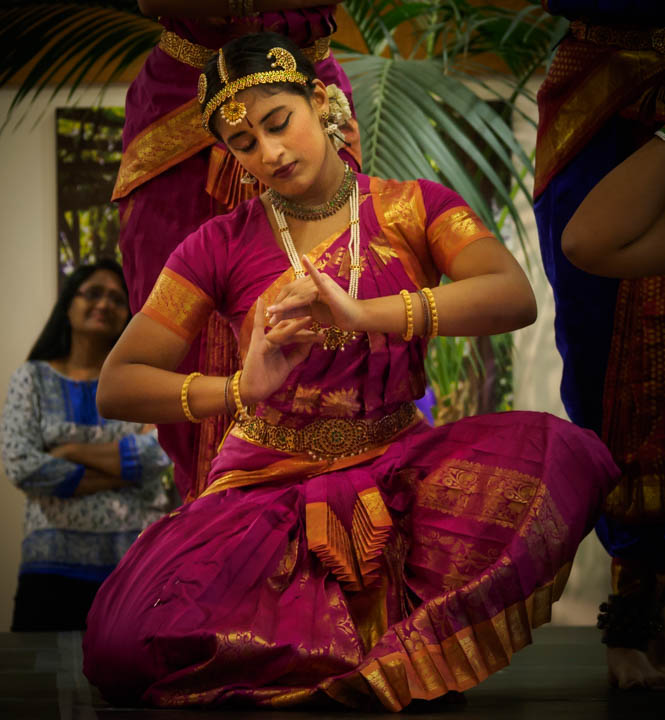
It's the dead of winter in Madison, WI. Along with other teens of South Indian origin, I am performing at the Olbrich Botanical Conservancy. Although the weather is vastly different than that of Tamil Nadu where our ancient dance form of Bharatanatyam originates, this is a great opportunity to showcase a bit of South Indian culture. I take great care to form a complex mudra with my fingers, mindful of its spiritual symbolism. Deep in concentration, I imagine myself performing in a Hindu temple far away in India.
It's another humid summer evening in this ancient town of Lijiang. In the air-conditioned of the Naxi Ancient Music performance hall, I sit amongst my fellow musicians all clad in purple embroidered silk robes. Although I am the oldest member, a few of the wizened beards belong to those in their 80's. Next to me is a young disciple of mine who has been most eager to learn how to play the Erhuang. Behind me is a young Pipa player, already confident with the ancient solemn tunes of Dongjing music. Most of the audience members have come to this UNESCO World Heritage town from other parts of our motherland, China. It is reassuring to see that they, like the young members of our band, are expressing interest in the traditional music of my Naxi people. Hopefully, they will help keep this most ancient of music alive, much like I helped ensure it survived during the tumultuous Cultural Revolution. We have just begun a slow, fluid, pentatonic melody. As my eyes begin to close, I am transported to the days of yesteryear when I performed beside my revered father.
Although I've been a part of my family's Yellow Bird Dance group since I was a toddler, performing in front of audiences with the hoop dance is something I've only done in the last few years. It takes a lot of coordination and practice to get those hoops into the different formations such as a butterfly or eagle while at the same time doing fancy footwork, accented by the jingle of bells attached to my sheepskin leggings. Everything– the formations, facial expression, movement, and the homemade costume– has symbolism. My ancestors created the hoop dance to be part of a healing ceremony, but for the past 30 years, our dance group has used a form of the hoop dance to share a bit of our culture with others. I can't grasp as many hoops as my older brother, papa, or uncle, but I'm feeling much more confident with my form. In a couple of weeks, we'll be heading to the Heard Museum for the annual World Championship of Hoop Dancing. Native American groups from all over the country will be competing. My papa, who has used 40 hoops in one dance, is a five-time world champion. Last year I got 2nd place in my age division. After today's performance, I think I can get first place. Wish me luck!
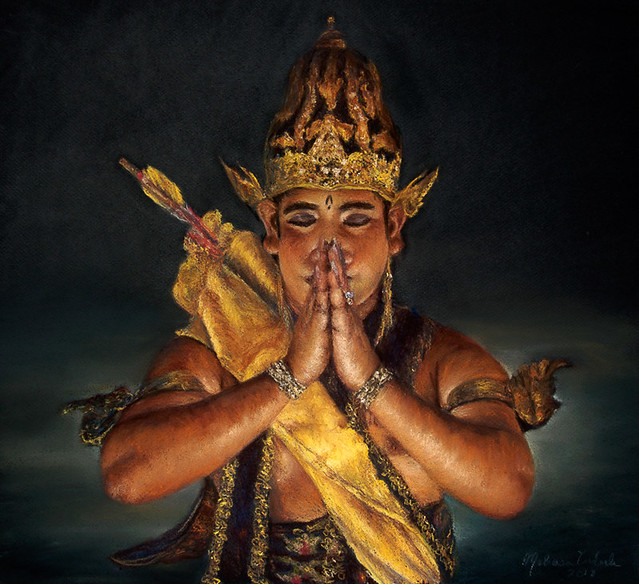
The full moon is out tonight. I am playing the role of Lord Krishna as we perform at the Kalakeshetra Fair in Chennai, India. The crowd always loves seeing the love between Lord Krishna and Radha being reenacted. Just like the Bharatanatyam dancers of Tamil Nadu, much emphasis is placed on the hand and upper body gestures I make. We don't wear anklet bells or perform such forceful footwork though. The tube-skirted Radha and I dance gracefully, accompanied by kartal cymbals, a barrel Pung drum, and singers chanting beautiful Sanskrit poetry. As I move about in our courtship dance, the feathers from my headdress and tassels affixed to my arms sway in the humid air. Did our Lord Krishna have as much fun when he courted Radha? I wonder.
While strolling through Xingqing Park in Xi'an, I came across these Uyghur ladies. The Uyghurs are a Muslim minority ethnic group found mostly in northern China and the Hunan province. Attracted to their colorful costume, I inquired (by gesture) a request to photograph them. Immediately they grabbed me, signaling that I was to be in the photo with them. Soon a bunch of photos were being taken from multiple cell phones.
After my photo session was over, I managed to snap a few photos of the dancers before they went off to practice.
I stayed for a few minutes, enjoying their dancing amidst the autumnal setting.
Nearby, a few couples were also dancing. The sheer joy on this man's face made me smile. Have fun dancing!
My latest painting of a Kathak dancer. I saw her performance in Chennai, India
Kathak Dancer Pastels on PastelMat paper
It is my turn to be on stage. The scent of jasmine from the previous Bharatnatyam dancer still lingers in the air. After giving a salutation and paying respects to my guru and accompanying musicians, I begin the thath sequence with slow movements - first with the eyebrows and neck. I bend one elbow and extend the other arm, making elegant but gentle movements with my upturned wrist and fingers. At this stage of the dance, the scarf covering my head is limp. Sensing the quickening pace of the music, my eyebrows move up and heavily-lined eyes widen. The small Ghungroo bells on my ankles collide as I rapidly stomp my feet on the stage floor in perfect syncopation with the music. As my feet movements become lighter and more complex, I pick up speed and execute a series of turns, causing my skirt to lift like that of a whirling Sufi.
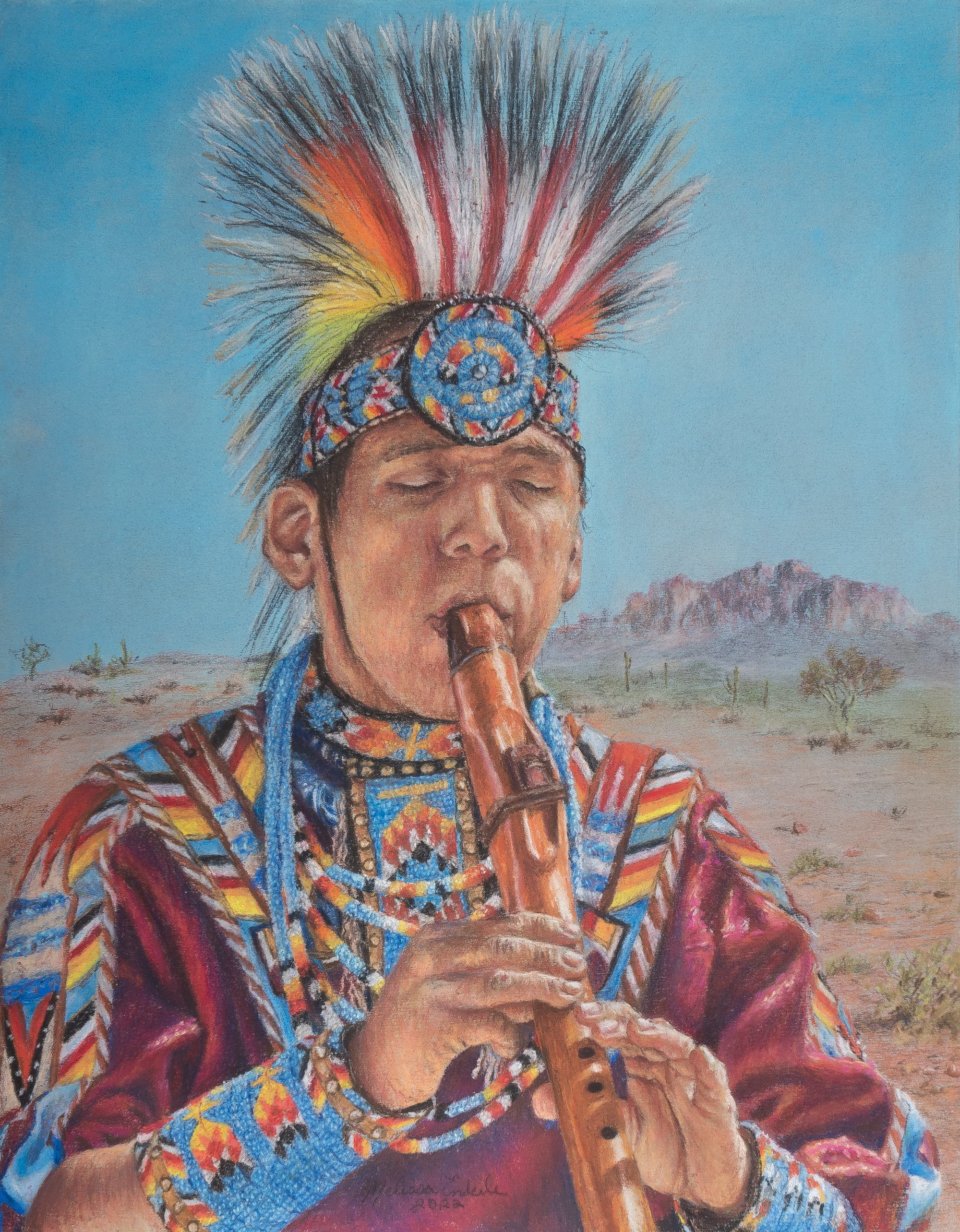
My latest - a color pencil of an Apache Yellow Bird Dancer, set amidst the beautiful Horseshoe Bend. In just over a week, I will see them perform and will hopefully get more information so I can write an accurate story about the dancer.
When I read an announcement that Bharatanatyam Dancers were going to be performing at Olbrich Gardens in Madison, I jumped at the opportunity to see this oldest of classical Indian dances, right in my neighborhood. Although it was not hot and sticky like it often was when I attended the performances in Chennai, the unusual spring-like February temperatures were just fine for me.
I arrived around the same time as some of the younger dancers. Unzipped winter jackets revealed the colorful costumes. A mother quickly "painted on" the finger designs with a colored Sharpie in place of customary henna. Artificial jasmine had to suffice instead of the customary fragrant floral strands adorning the plaited hair.
An instructor of the local Bharatanatyam Dance school introduced the girls (ages 5-16) and gave the audience a brief intro to what they were about to see. She explained how the eyes and hands were a highly integral part of conveying emotions in the expressive dances. Some of the younger students
The sophistication of footwork, hand gestures, and eye/neck movements increased with the age levels. Poses hearkened to the gods celebrated at Hindu temples, such as Krishna and Shiva. An enjoyable Saturday morning in Madison!
This past week we went to Mesa for a double-treat; pizza and music. Our destination was Organ Stop Pizza. Waiting for our pizza to be finished wasn't a hardship, with plenty of awesome music to pass the time. From our balcony table, we had a good view of the veteran organist (who was named "Organist of the Year" in 2000 by the American Theatre Organ Society) who commanded mastery over the instrument and its plethora of keys, stops, and buttons. Being right before Christmas, he played plenty of holiday songs. It was amazing to hear him play Mannheim Steamroller's version of "Carol of the Bells" in such a way that he was nearly able to replicate Chip Davis' entire band. Nary a sheet music could be seen, as he expertly switched between a variety of music styles, rhythms, etc.
This is no ordinary organ. Known as a theatre pipe organ, this 1927 Wurlitzer was originally designed to provide background music for silent movies and stage shows. Once an integral part of theatres of every size, these orchestral organs (with plenty of theatrical sound effects) fell out of fashion when talking picture movies became emerged. This particular organ started with 15 ranks/set of pipes, but was rebuilt with parts from other Wurlitzers in the early 1970s to have 23 ranks. In 1997, it was further expanded and now has 78 ranks, 17 tuned percussions, lots of sound effects, and 6,000 pipes. Four large turbine blowers provide the needed wind. The walls of the expansive restaurant are adorned with the pipes and lots of different percussive instruments and lighting designed to complement the music. The curtain in front was opened a couple times to reveal dancing marionette-style cats - perfect for the song "Alleycats." The ornate organ was perched on top of an 8,000 lb rotating hydraulic elevator, enabling all to catch a view of the maestro tickling the keys.
In anticipation of an art exhibition, I wrote a short story about each painting, as if written by the person in the painting. These are all real people, and the stories are based on experience, observation, and representative/factual information typical of someone from that region/profession. Some of these paintings are still available, so if you are interested in purchasing one, please contact me.
My husband and I have been invited to perform at the American Ambassador’s residence, along with fellow Tamascheck tribal musicians. Such events give me the opportunity to dress in my flowing Indigo robes and adorn my hair with silver pieces handed down from my grandmother. Most of all, it’s a chance to dance to the slow, flowing, repetitive melodies that are so much a part of our nomadic Saharan heritage. When I close my eyes and focus intently on the music, I almost forget that we are over a thousand kilometers away from our homeland. It is rather fascinating to see Westerners join in on the dancing or even give some of our traditional percussive instruments a try. In this way, we can share our culture with others far beyond our isolated desert village. See more artworks on www.melissaenderle.com.
In anticipation of an art exhibition, I wrote a short story about each painting, as if written by the person in the painting. These are all real people, and the stories are based on experience, observation, and representative/factual information typical of someone from that region/profession. Some of these paintings are still available, so if you are interested in purchasing one, please contact me.
A lover of music, the prince has invited his guests into the garden area of Changdeokgung Palace for a concert. The other musicians and I sit on embroidered mats arranged on the grass between the prince’s dwellings. With my legs in a lotus position, I balance the barrel of my instrument on my right foot and anticipate my entry with a hint of nervousness. Taking a deep breath, I rest my left hand over the neck and its two silk strings, while the right hand deftly grasps the horsehair bow. Easing a bit of tension, I gently glide the bow over the strings in order to create a delicate sound. Soon my haegeum is transported into a bird.
In anticipation of an art exhibition, I wrote a short story about each painting, as if written by the person in the painting. These are all real people, and the stories are based on experience, observation, and representative/factual information typical of someone from that region/profession. Some of these paintings are still available, so if you are interested in purchasing one, please contact me.
As a young boy, I loved to hear the stories told by my grandfather. Now I am a pansori singer. Accompanied by a drummer who strikes a rhythmic pattern on his buk, I sing narratives based on popular tales. Performing on this festive Chuseok harvest festival, my excitement is apparent in my dynamics and the way I manipulate the fan with crisp, fluid movements.
As the last performer of the night, I want to leave a lasting impression on the audience and of course, the gods. I am proud to be one of a small select member of the Pemangku temple priests. I deeply breathe in the incense that a fellow priest wafts in my direction. Now possessed by the celestial soldier deity Gandarwa, I enter a trance and mount my hobby horse. The chants and percussive rhythms of my fellow performers encourages me to imitate the movement of a soldier on horseback as I dance in a circular motion around the blazing fire of coconut shells. After several circumnavigations, I have achieved the state needed to pass directly through the fire, filled with the energy and powers of Gandarwa to scatter the red hot coals with swift kicks of my bare feet. Surely I, as with previous Sanghyang dancers, now have been endowed with the power to drive out illnesses and disease.
The lawns of the Madison state capitol became a patchwork of colorful blankets for the evening's Concert on the Square. Around 50,000 attendees attended the free concert featuring well-known movie songs by composer John Williams. It was a great evening to enjoy a picnic dinner, and even some wine. Both young and old (as well as some dogs) were captivated by the well-known songs of the composer whose scores span six decades. Some of the favorites included the Star Wars theme, Indiana Jones, Superman, and ET.
This afternoon, I went to the Seoul Friendship Fair. Held since 1996, this fair is celebrates the sister cities of Seoul from various places around the world. Considering my love of cultures, the lure of traditional music, costumes, as well as traditional food and handicrafts was too much to pass up. For a few hours in the afternoon, I sat on the grass by Seoul City Hall in the bright May sunshine and soaked up not only sun rays, but some wonderful performances.
Belarus
Their costume and singing reminded me of some of the performances I saw in Serbia. Some songs were very happy and one was more somber. The accordion player was very energetic and the roh player was able to get a variety of tones out of the animal horn.
Japan
The Shamisen player from Japan played a few lively, energetic pieces. Two puppeteers also performed a few skits, including one with a lion and some butterflies. The lion reminded me of a larger version seen in some Korean performances.
Lion and human marionettes manipulated by a skilled Japanese puppeteer
Uzbekistan
As there was no shade on this very sunny day, I didn't want to push being too long out in the sun. However, when I saw the beautiful costumes from Tashkent, I decided to stick it out a bit longer. We had to wait for the drumset and other instruments to be assembled and set up, but it was worth it. A clarinet player myself, it was fun to hear the different tones and melodies produced from such common instruments. The male singer was both forceful and tender. The dancers, however, stole the show. In the four or five pieces, different costumes were worn for each one. The dancing and music had a more Middle Eastern feel to it. The dancers were very particular with their hand and arm positions, and their twirling and footwork was great. Imagine twirling and dancing in high heels!
Each of the dancers had their hair in long braids, which twirled like ribbons as they spun around.
It was an enjoyable afternoon at yet another Seoul festival! #visitseoul
Over my years in Korea, I've tried to attend performances that are of part of special events. One such event occurred at the Unhyeongung Palace. Located right next to Anguk station, this former royal residence was easy to get to - perfect for a free winter performance. Prior to the musical performance, different areas were set up for activities such as playing traditional games, trying on (and of course taking photos) traditional Korean costumes, stamping a wooden block with good luck/health characters, and writing good luck messages on small pieces of colorful paper. I loved the patterning of the colorful message papers tied onto rope, contrasting with the brick patterns on the residence wall.
My favorite part of the performance was the solo female dancer. Her movements were very slow and deliberate - no camera shake/blur here!
Two young drummers took a break from their gongs and drums to do some plate spinning. The balanced disks were also hurtled in the air and caught by the second performer. A couple of audience members were asked to try their hand at keeping the disk spinning or to pass the disk to be caught.
What's a drumming performance without drums? These guys (and a few gals) looked like they were having fun, despite the rather chilly temps - especially with such thin blouses. I only took a couple photos of their drumming, as the scene, their shabbier-looking drums, and simpler outfits weren't as inspiring. It was still enjoyable though, and a nice way to spend the day off.
After our tour of portions of the Kraton, our palace tour guide led us to the Gamelan orchestra that was gathering and bid us farewell. With far more lighting than that at the Wayang puppet performance the previous night, it was far easier to see the instruments. Each musician was dressed in traditional local costume, complete with beautiful batik fabric. The men sported a sword as part of their outfit.
Huge gongs were arranged in a row behind the metallophones. Women and men looked very studious as they read the cipher system notation on a sheet of paper.
The women all had huge "buns" of what looked like fake hair. They also sang. Note the lidded tea cup which was omnipresent in so many places I visited in Indonesia.
The wood carving on the instruments was quite ornate and bore the seal of the sultan.
Many musicians played different bonang instruments. These covered kettle-like instruments were an essential part of the gamelan orchestra.
After thanking the puppet maker for the demonstration, I headed over to the building at the Sonobudoyo Museum where the puppet show was taking place. The music had already started, with the Gamelan orchestra comprised of gongs, metallophones and xylophones, flutes, zithers, drums, and vocalists.
The dalang puppeteer was seated in front of the wide screen. Large puppets and several Tree of Life props were in front of the screen, their bone sticks stabbed into the soft banana leaf log. I was a bit surprised to see how tall some of the puppets were; Wayang Kulit puppets range in size from around 8-40 inches (20-100 cm) tall.
Additional puppets were lined up on each edge of the screen. Traditional Wayang shows might last around 9 hours and comprise of between 100-500 puppet characters.
The dalang puppeteer was quite the multi-tasker. In addition to manipulating the sticks of the puppets, he was the narrator, made lots of sound effects, and leads the gamelan orchestra. He must know the entire performance by heart and keep track of all the different puppet characters - their personality, voices, actions, and physical location. Humor and the ability to comment on current affairs is also important. I can only imagine that with so many puppets lined up, the dalang must be very organized, arranging the puppets in an efficient order so he can grab the correct one at the correct moment. Improvisation is also a part of Wayang performances, ensuring that things stay fresh. The dalang traditionally had a priest-like role which was passed on from father to son, but now there are special schools that provide training. A dalang may have an assistant, who also must know the story well so he can anticipate the needs of the narrator. In the battle scenes, it was fun watching the dalang flip, spin, and twirl the puppets and then crash them together, much like a young boy does with cars or action figures. The "good" characters were positioned to the right of the puppeteer.
As much fun as it was watching the behind-the-scenes work of the dalang and the gamelan orchestra, I spent part of my time watching the actual shadow performance on the other side of the screen. (Years ago it was customary for women to view the colorful "behind" side, while the men viewed the shadow side). The intricately painted designs that were so apparent on the other side of the screen were replaced by an emphasis of contrasting negative and positive spaces. The lace-like perforations I had seen the puppet maker punch into the leather were now much more visible. I found it interesting that the puppets were never totally flush against the screen. The heads were pressed against the screen for clarity, but the legs were often slightly away. I later read that this was done to help achieve the desired proportions of the shadow. At times the action was quite slow and subtle, emphasizing the intricate movements of the arms. Punctuated with vocal cues of the dalang and synchronized orchestral accents, some scenes became quite dramatic.
During the 80 minutes or so that I was there, I went back and forth between the front and back sides. I could see that the storyline was about good vs. evil, but found it a bit difficult to stay focused. It is rather typical for viewers to wander in and out. Imagine though, how challenging it must be for the dalang to stay on top of things and keep his voice for the entire duration of those really long performances. No wonder his role is held in high esteem!