Showing posts with label Asia. Show all posts

Friday, January 03, 2020

My Weaving experience at the Ock Pop Tok Center

After a wonderful lunch overlooking the Mekong River with fellow workshop participants, I began my 1/2 day weaving experience. The warp on the floor loom was already set up with 400 black dyed silk threads. Likewise, the supplementary heddle was already in place. This is the "program" that helps establish the patterns seen in the weaving.
Silk colored through natural dyes
Natural materials for dyes

To start, I chose the color that I wanted for my main weaving and for the design. Both the dusty rose dye and the cream color were created from the fresh leaves and bark of the teak tree; the light color was only briefly dipped. The skeins of silk were then wound onto spools, a process that also separates the silk and makes them smoother. Due to limited time, I only did a couple spools.
My weaving in process. The Naga design is at the bottom.
Most of the weaving was a simple tabby weave (over-under-over-under). I quickly got in the groove of which bamboo foot pedal my right foot should be on, scooting the shuttle through the opening, and the correct even pressure needed on the beater. For the design, I chose the naga - a mythical protective water serpent that I had seen in many local Buddhist temples.

The magic behind achieving the Naga continuous supplementary weft (kit) design comes from the supplementary heddle. Once a row of the design was woven, that string on the supplementary heddle was moved upward. Had my weaving called for a repetition of the Naga design, the supplementary heddle was already set up for this. In this complex part, the instructor was directly involved. Thankfully, she was also there when one warp string accidentally broke; she patiently attached some extra black thread to make the warp thread tight again. 
The loom with the supplementary heddle pictured on the left.
  Due to time constraints, the instructor removed the weaving from the loom after weaving several rows of thread. Multiple strands of the black warp threads were moistened, grouped and then two groups twisted together. The end was then knotted.
My finished weaving
I am pleased with my finished piece. I'd love to go back and try the more complex discontinuous supplementary weft (chok)  weaving. That is a 3-day course though. At any rate, the experience gives me a greater appreciation for the time and skill it takes to create such beautiful textiles. 

Wednesday, January 01, 2020

Hmong Batik Experience in Luang Prabang, Laos

During my Christmas vacation, I participated in a half-day workshop on Hmong batik. The instructor was Mae Thao Zu Zong. This petite 66-yr old from the Striped Hmong (Hmong Lai) group is the remaining Hmong batik artist in Luang Prabang.
Mae Thao, Hmong batik artist
With a photo of her in the background, Mae Thao demonstrated how to hold the tjanting tool and make straight lines with the hot beeswax first on a small piece of woven flax. The locally harvested wax was tinted slightly with indigo to make it easier to see on the cloth. While she confidently formed straight lines in rapid succession, I found holding and controlling the tool (the metal part is near the heel of your hand) with the correct amount of wax (and at the correct temperature) a bit awkward. The weave was rather coarse, which sometimes made my movements a bit jerky.
Backstrap loom with hemp fibers
Thankfully, the less-than-perfect grid lines were camouflaged when additional details and symbols were added. Symbols included natural items such as cucumber seeds, pumpkin seeds, animal teeth, and ferns. For the curves of the center design, the tjanting tool was held more like a traditional drawing tool. 


Mae Thao demonstrates how to do the spirals
Instructor and student
Once I was finished with the wax part, I asked Mae Thao to pose with me. I stepped down so there wouldn't be quite the height difference in the photo. Because I wanted my piece to be dyed indigo, I had to leave it at the center. The following morning it would be dunked in a vat of indigo dye and the wax removed. Because it was only dipped once, it didn't get the deep blue color seen on many Hmong works that may be dipped up to 20 times.
My completed batik


Sunday, December 29, 2019

COPE Center in Laos

COPE Center, Vientiane
This morning I walked to the COPE Center in Vientiane, Laos. The visitor center is part of a larger complex that is focused on the continuing victims of a war that ended nearly 50 years ago.
Sculpture made from cluster bomb materials
Walking past buildings dedicated to supporting those disabled by unexploded ordnances (UXO's) such as a special gymnasium and wheelchair fitting, signs pointed me to the visitor center. In front of the building was a sculpture made from different components of cluster bombs. Next to the entrance, a cluster bomb casing was repurposed as a planter.

Inside, one of the video displays played this (above) video. Posters listed some staggering statistics of the horrible bombings that occurred in Laos from 1964-1973.
A few statistics:

  • Over 270 million "bombies" (small bombs contained within large cluster bombs) were dropped over Laos during this time period.
  • 580,000 bombing missions were conducted
  • Between 10-30% of all "bombies" (over 80 million) failed to detonate and are still dangerous
  • From 1996-2009, nearly 1,100,000 unexploded "bombies" were destroyed by UXO Lao.
  • Laos is the most heavily bombed country; more bombs were dropped here than in all of WWII. 
The center had a small theatre for watching a selection of videos. The one I watched featured some of the victims of these unexploded munitions, particularly the small "bombies." Examples of some victims' stories included a mother whose leg was blown off when the heat from her cooking fire detonated a bombie. Or a rice farmer who when using a tool to plant rice accidentally hit a bombie.. Having lost vision in one eye and one leg amputated, he no longer is able to support his family. His children have had to drop out of school in order to help farm in the same fields that may contain more UXO's. The video also showed children using metal detectors to find scrap metal left from the bombing raids, irrespective of the real dangers of encountering UXO's. 
Prosthetics "wall"

The COPE center also helps fit victims with more lightweight prosthetics; these give victims more mobility than even the clumsy, heavy ones they may have fashioned themselves in their villages. The organization also provides community outreach, going directly to remote villages to provide equipment, repairs, medical assistance, etc. Funding is also provided to enable victims to come to rehab centers, receive surgery, etc. 

While in Luang Prabang, I visited a similar visitor center. Posters there described how programs continue to occur in educating villagers of the dangers of UXO's  - what they look like and what to do if they encounter a UXO. Specially trained people are working at locating and destroying the UXO's, enabling the cleared land to be safely used for farming or residences.  Due to the large numbers of UXO's remaining despite continued efforts at locating and destroying the bombies, it is estimated that it may take nearly 100 years for Laos to be free of this scourge that continues to negatively impact the economy of Laos and its citizens.

Wednesday, January 30, 2019

A Visit to the Terra Cotta Warrior Museum - Part One

On the first day of my Chinese New Year break, I decided to go to the famed Terra Cotta Warriors Museum. I had waited to visit this UNESCO World Heritage site in winter, hoping that fewer people would be visiting. Having lived in various Asian countries for nine years, I knew that getting there early would be advantageous. Due to the southerly location of my apartment, I decided to take a DiDi (China's version of Über) directly to the museum. My pre-arranged DiDi driver arrived about 15 minutes early to pick me up, but I didn't complain; it was much better than being late. Daylight had just broken by the time we arrived at the museum, located 53 km from my apartment. Although the ride cost me around $25, it was worth the hassle-free experience and time saved.
Ticket entrance to the Museum

The place was virtually deserted. After about 20 minutes, the ticket lines opened up. I was one of the first in line to pay my 120 RMB ($17.86) ticket. I was ready to see what is considered the Eighth Wonder of the World and the greatest archaeological find of the 20th century.
Pit One ahead. No crowds!
Knowing that the crowds would come, I headed directly to Pit One. By far the largest building at over 14,260 sq meters, Pit One housed over 8,000 warriors, infantry, horses, cavalry, and officers and over 50 chariots.
Overview of Pit One
Arriving early had paid off. I was the first one inside and had it to myself for over five minutes. Standing in front of me were over 2,000 excavated figures to protect the emperor in death. Over 700,000 workers contributed to the building project that took 38 years to complete. (Side note: many of the workers' bodies were found in mass graves within the massive complex).

Emperor Qin Shi Huang
Even though the Qin dynasty was rather short (221-206 BC), it was quite amazing that so much of his legacy lives on. Emperor Qin Shi Huang succeeded in unifying a series of warring states to form the precursor to modern China. Other accomplishments: initiating the Great Wall, standardizing weights and currency, and evolving the written language into contemporary Chinese script. 
Three-line vanguard
Standing at the front was a three-line vanguard of 204 troop members. Imagine how imposing they would have looked with weapons in-hand! 

Tuesday, October 30, 2018

Hanyangling Terracotta Figures

This past Friday, I and a few other teachers were invited to attend an event at the Hanyangling Museum. A van picked us up directly from our school (which is located a fair distance south of Xi'an and took us to the museum which is located about 20 km north of the city and quite close to the airport.  Upon entering the complex, I immediately saw two large grass-covered mounds which were royal burial sites. The larger tomb belonged to Emperor Jin, who ruled the Western Han Dynasty from 180 BC-141 BC, and Empress Wang. Construction of the tomb began in 153 BC and ended in 146 BC.
Covering an area of 10 square km, the site also includes 86 burial pits, a ceremonial site, human sacrifice graveyard, and a cemetery for criminals. To reach the exhibition space of the museum, we descended in an underground tunnel; this is the first underground museum in China.
In general, the museum was rather dark. I wasn't sure whether this was due to its after-hours status or if it was typically this dark, perhaps to minimize the effects of light on the artifacts. Through the glass, visitors could see the burial pits which were still being excavated. In addition, some of the walkways had glass sections, enabling visitors to see items directly below.
Items just below the walkway, including horses, chariots, and figures
Some pits contained more pottery items and fragments of textiles. Others were full of naked ceramic figurines. Although they were about 1/10 life-size, their bodies included anatomical details and the faces were expressive. A few even had some remnants of paint, but most of the coloration had vanished years ago or when exposed to air. The wooden arms had long since rotted and the exquisite costumes deteriorated. In total, over 50,000 figurines were made to depict the royal court, a number that even exceeds that of the more famous Terracotta Warriors. Both male and female figures are represented, including female warriors, servants, eunuchs, singers, and dancers.
Figures with genitalia

In some pits, the figurines were vertical, as if ready to march. In others, the present arrangement reminded me of the parting of the sea or perhaps violent bowling. Broken fragments indicated visitors of the fragile nature of the sculptures and the amount of work needed to restore the artifacts. 
Entire herds of domesticated animals were also formed out of clay. Bones from animals were also seen. 
Further on in the museum were restored displays that attempted to give visitors an idea of how things originally looked. 
Restored display
Bells, weapons, articles of everyday use, and jade were also on display. Of interest, tea was also discovered, showing that tea was consumed even at this early date.

Life-size horses and chariots
Clothes similar to what the figures would have worn

Figures with and without clothing
Figures with expressive arms and one still encrusted
We had to move rather quickly through the museum in order to return in time for the cultural performance and speeches being held outdoors for the event. I think it would be fascinating to return during the day when actual excavation is occurring and to also see more of the expansive site. Although it receives far fewer visitors than its famous big brother, the Hanyangling Museum is quite remarkable. In fact, it is considered the most intact royal mausoleum of the Western Han Dynasty, giving excellent research data for the burial customs of the day. It is a testament to the remarkable lengths the emperors took to ensure they were ready to rule in the parallel world of the afterlife.

Wednesday, August 29, 2018

In Xi'an - first post

Now that I have internet via hotspot from my phone, I'm getting around to posting about my experiences in Xi'an as a teacher at an international school in this historic city.

On late Sunday afternoon, I arrived in Beijing. The process was a bit longer than anticipated - waiting in line to go through immigration, shuttle train from international to domestic terminals, security screening, and more. I was thankful to see that all my luggage arrived from the 13 hour Chicago to Beijing flight as well as the Milwaukee to Chicago flight. After collecting the pieces, I had to go through another security screening with the luggage. If only there were the perks of Global Entry here. The one medication I was taking with me drew extra attention and further scrutiny, but thankfully they let me keep all the bottles. After another short scan of all the luggage, I then waited in line for domestic transfer. Relieved of my luggage, I quickly went to the gate and was one of the last ones on the plane. Those 2+ hours went by quickly!

In a little over 2 hours, I landed in Xi'an. Alas, two of my suitcases did not arrive with me, likely due to the short amount of time after I dropped off the luggage for transfer. Thankfully the airport said they would deliver the suitcase to the school address the next day. The school principal and nurse were there to greet me. The principal took me to my apartment. After taking a brief, lukewarm shower (the gas hookup needed some attention) by maintenance staff, I went to bed. I sat down on the bed and heard a THUD. It was so hard, I could knock on it. Tired, I gave it a try, hoping that the A/C and nice comforter were enough comforts to override the rock-hard "mattress." Thankfully my down pillow was in the suitcase that arrived with me, so I had another softer item. After a non-so-super sleep, I got up to enjoy the sunrise. I had quite an overview from the 34th floor, the top floor of the building. No, it's not a penthouse.
Sunrise from the enclosed balcony on the 34th floor
I proceeded to unpack and put items away. A few hours later, a gal from the agency the school partners with came to take me to IKEA. Later we also went to the gas company to pay $30 for 2 months worth of gas. A rep from the cell phone company came right to my apartment and set up my service. For $15 a month, I have unlimited data, but after 20 GB,  the data is slowed to 3G. The school was able to communicate with the airport to deliver my baggage to my apartment complex, so the evening was spent unpacking that and setting up/unwrapping IKEA items. For a later supper, one of the teachers took me to a shopping mall where we ate at a Japanese restaurant.

The next morning I had to go with a school nurse downtown to a government clinic for foreigner workers entering China as well as Chinese people seeking to study/work abroad. Because we arrived early, my turn in the queue was not long and after going through the multiple stations (ultrasound, x-ray, blood, vision, etc), we were done. In the afternoon, the gal from the agency went with me to a supermarket that also had imported items. Although I was able to figure out most items, she helped decipher a few labels that were only in Mandarin and lacked visual clues. Now that I had a screwdriver, I was able to assemble my couch table. My apartment was coming together. Below are a few photos of each room.


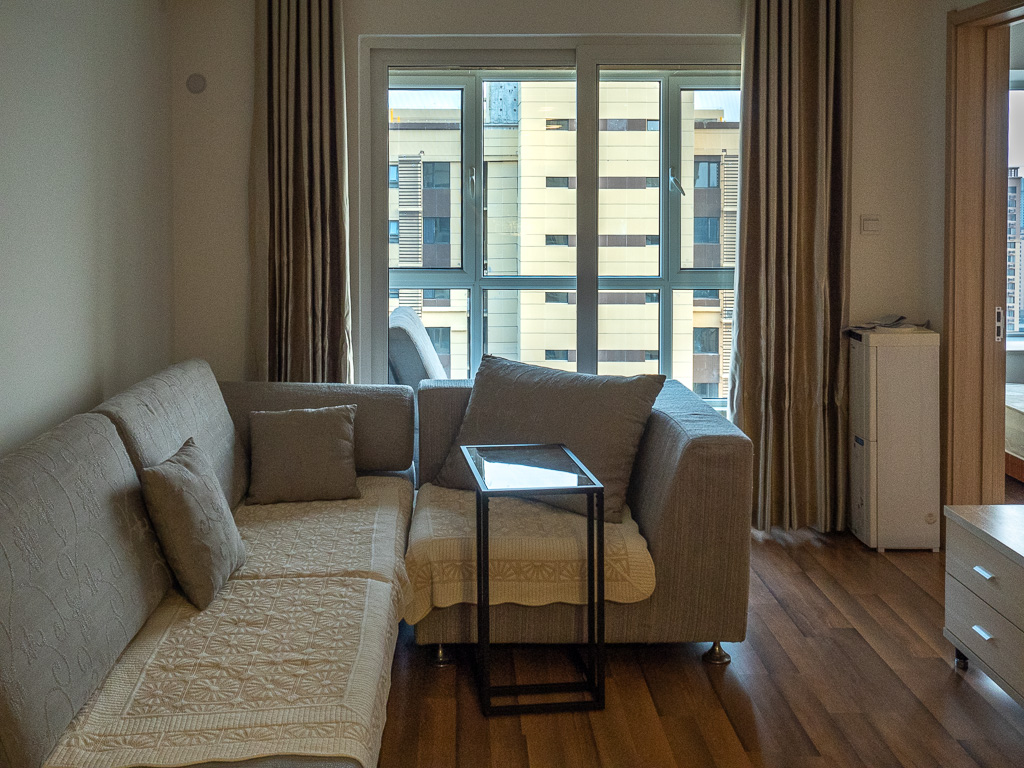
Living room and enclosed balcony (a rod can be cranked down so you can hang laundry from hangers). Note the identical building as seen through the balcony window

Dining room table and door entry

Master bedroom with closet

Master bedroom and view

Spare bedroom with slightly less hard real mattress

Spare bedroom desk and closet. I'll try doing my drawing here.

Bathroom with washing machine that is complex and all in Mandarin

Shower with just a short lip - easy for water to overflow onto bathroom floor

Kitchen with two burners and no oven. Refrigerator is very narrow.

Spare room with raised storage. I presume a bedroll could be placed on top of it. The next part of the building blocks out most light.

Monday, July 02, 2018

Kathak Dancer, India

My latest painting of a Kathak dancer. I saw her performance in Chennai, India
Kathak Dancer
Pastels on PastelMat paper

It is my turn to be on stage. The scent of jasmine from the previous Bharatnatyam dancer still lingers in the air. After giving a salutation and paying respects to my guru and accompanying musicians, I begin the thath sequence with slow movements - first with the eyebrows and neck. I bend one elbow and extend the other arm, making elegant but gentle movements with my upturned wrist and fingers. At this stage of the dance, the scarf covering my head is limp. Sensing the quickening pace of the music, my eyebrows move up and heavily-lined eyes widen. The small Ghungroo bells on my ankles collide as I rapidly stomp my feet on the stage floor in perfect syncopation with the music. As my feet movements become lighter and more complex, I pick up speed and execute a series of turns, causing my skirt to lift like that of a whirling Sufi. 

Tuesday, December 13, 2016

Artwork: Kampong Phluk Woman with Purple Scarf (Watercolor)


In anticipation of an art exhibition, I wrote a short story about each painting, as if written by the person in the painting. These are all real people, and the stories are based on experience, observation, and representative/factual information typical of someone from that region/profession. Some of these paintings are still available, so if you are interested in purchasing one, please contact me.

Every week I take my basket of vegetables to sell at a small market  outside of Kampong Phuk. I look forward to this time, when I can gossip with my other friends who also spread out their goods to sell. It helps me forget, at least for a little while, all the terrible things I saw and experienced as a young woman when the Khmer Rouge extended their reign of terror over my homeland. It is nice to see smiles once again on the faces of children, who can play games and go to school instead of slaving away and seeing loved ones being killed. The money I make from my little garden isn’t much, but it’s enough for me to buy rice, fish, and a little oil. Today my sales were even better, enough for me to buy some chicken and even a Hello Kitty pouch for my granddaughter. I am happy again.

See more artworks on www.melissaenderle.com.

Wednesday, August 03, 2016

Get your Frog Purse (or Dried Fish)

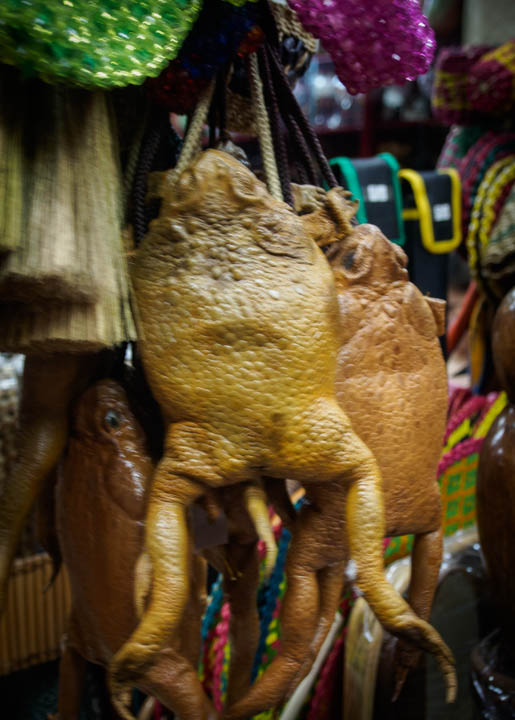
More market photos, this time from Laoag in the Philippines. Aside from the common items such as poultry, fish, and Philippine sausages, one item caught my eye - purses made from frogs. Unique, but not quite my thing. With their leathery, bumpy skin, bulging eyes, and those long legs, they would make an interesting conversation piece. I decided to save my backpack space for textiles.


Gotta love the colorful fresh fruit!
Nicely arranged display of dried fish and eggs


Saturday, July 30, 2016

Artwork: With a Begging Bowl and a Toy Car

Here is my latest artwork, a color pencil drawing of a little monk at a Tibetan temple of Zhiyun Monastery, located by Lashi Lake in the Yunnan province. Wearing pink crocs and a red robe, this little monk playfully swung his orange bowl as he passed through the ornamental gate up to the main Buddha Hall. In his other hand he clutched a green plastic toy car. In the massive shade trees near the temple entrance, many young monks engaged in a game of soccer.

Thursday, June 09, 2016

Melons and a Meow

As if to maintain the symmetrical ordered structure of the scene, the cat sits in the middle of the paneled doorway at Bongwonsa temple. Next to it are some yellow Korean melons and other shrinkwrapped fruit that would likely be used for the upcoming celebration. Perhaps the cat was intent on getting a front-row seat! 

Saturday, June 04, 2016

The Sun Sets in the East

The apartment is as bare as it was when I arrived. My belongings are in the suitcases, ready for tomorrow's long journey back to Wisconsin. After four years in Korea and sixteen years overseas, it's time to say goodbye. Lots of hugs, some tears, and plenty of dinner gatherings have taken place these last few weeks. Packers have quickly wrapped up and boxed the many mementos I have carefully collected during my many travels to over 32 countries.  The numerous to-do lists have been completed and the art room is all tidy, ready for the next art teacher to inspire creative minds at SFS. 
The last sunset I will see at SFS has come and gone. This beautiful campus has been such an inspiration for so many photos, transformed in the change of seasons. I will forever cherish the memories that I have of the splendid people and places at SFS, Seoul, and South Korea. I hope to return someday. For now, the sun has set in the East of my world.