After a wonderful lunch overlooking the Mekong River with fellow workshop participants, I began my 1/2 day weaving experience. The warp on the floor loom was already set up with 400 black dyed silk threads. Likewise, the supplementary heddle was already in place. This is the "program" that helps establish the patterns seen in the weaving.
Silk colored through natural dyes
Natural materials for dyes
To start, I chose the color that I wanted for my main weaving and for the design. Both the dusty rose dye and the cream color were created from the fresh leaves and bark of the teak tree; the light color was only briefly dipped. The skeins of silk were then wound onto spools, a process that also separates the silk and makes them smoother. Due to limited time, I only did a couple spools.
My weaving in process. The Naga design is at the bottom.
Most of the weaving was a simple tabby weave (over-under-over-under). I quickly got in the groove of which bamboo foot pedal my right foot should be on, scooting the shuttle through the opening, and the correct even pressure needed on the beater. For the design, I chose the naga - a mythical protective water serpent that I had seen in many local Buddhist temples.
The magic behind achieving the Naga continuous supplementary weft (kit) design comes from the supplementary heddle. Once a row of the design was woven, that string on the supplementary heddle was moved upward. Had my weaving called for a repetition of the Naga design, the supplementary heddle was already set up for this. In this complex part, the instructor was directly involved. Thankfully, she was also there when one warp string accidentally broke; she patiently attached some extra black thread to make the warp thread tight again.
The loom with the supplementary heddle pictured on the left.
Due to time constraints, the instructor removed the weaving from the loom after weaving several rows of thread. Multiple strands of the black warp threads were moistened, grouped and then two groups twisted together. The end was then knotted.
My finished weaving
I am pleased with my finished piece. I'd love to go back and try the more complex discontinuous supplementary weft (chok) weaving. That is a 3-day course though. At any rate, the experience gives me a greater appreciation for the time and skill it takes to create such beautiful textiles.
From the height of the Xi'an City Wall, I had a fairly good view of the surrounding area. Outside of the wall were quite a few skyscrapers and modern buildings. Contained within the wall were buildings typically of an older era and generally shorter. Some were rather dilapidated and in desperate need of repair. Others had received some renovation but still retained an older look.
Some of the buildings just inside the south wall were hostels. A sign here indicated that this building was the site of the Honglu Guesthouse, built during the Tang Dynasty to accommodate foreign guests and ethnic envoys. How interesting that the area has retained its original function!
I liked how some of the newer buildings reflected aspects of the traditional architecture.
Buildings as seen from the North Wall.
Within the Northwest corner of the city is the Guangren Llama Temple. It was built in 1703 as a Palace Hotel for Dalai Lamas and Panchen Lamas on their way to pay homage in Capitol. It is the only Tibetan Buddhist temple within the Shaanxi province and the only worship temple for the Green Tara. The bronze roof of the Golden Worship Hall glistened in the late afternoon sunlight.
One of the most popular artist installations within the GLEAM exhibition at the Olbrich Gardens, "The Fire Monkeys" is the creation by local artists Laurie Rossbach & Jennika Bastian. According to the Chinese (and Korean) zodiac, it is the year of the Monkey.
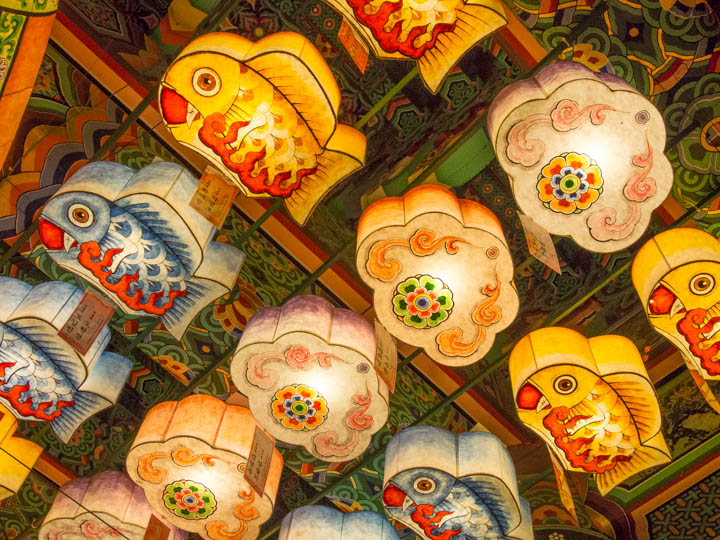
The installation hearkened me back to the beautiful lanterns I saw while in Korea, in the Lotus Lantern Parade, at the Jogyesa Buddhist Temple, and at Seoul's annual fall Lantern exhibit. The Fire Monkeys were also created out of paper (in Korea it was called hanji paper), wire, and paint.
While walking around the gardens at night, I heard the yelping monkey sounds well before I arrived at the willow tree. Each of the monkey sculptures glowed as if on fire, which is one of the four purified elements within Buddhism.
It's comforting to know that when I have a need to feel transported back to Asia, I can go for a walk from my Madison condo and visit the Thai pavilion at Olbrich Gardens. Between the ornate details such as the pavilion's gold foil columns and the broad elephant ear leaves nearby, I get a temporary whiff of Thailand.
Hard to believe this is Madison, eh? I'll be returning once the autumn leaves start to appear, and again when it is snowing. Now THAT will be a scene unique to tundraland...
Here is my latest artwork, a color pencil drawing of a little monk at a Tibetan temple of Zhiyun Monastery, located by Lashi Lake in the Yunnan province. Wearing pink crocs and a red robe, this little monk playfully swung his orange bowl as he passed through the ornamental gate up to the main Buddha Hall. In his other hand he clutched a green plastic toy car. In the massive shade trees near the temple entrance, many young monks engaged in a game of soccer.
While working on a travel book, I did a little online research on some statues I had seen at several temples in Japan. The red knitted caps on the figures, particularly little children, had caught my eye. These are known as Jizo statues, and are found in the temple courtyards. In the mizuko kuyō (literally meaning "water fetus," ceremony, special memorial services are conducted for families that have lost a child due to miscarriage, stillbirth, or abortion.
A bib or necklace is first made, followed by some chants to Jizo, the bodhisattva who protects children. The ceremony is conducted by a Buddhist priest and may be done to comfort the mourning parents or the soul of the dead child, address guilt from an abortion, or even out of fear of retribution from a vengeful spirit.
Outside of Japan, different forms of the practice have also emerged. It can be particularly difficult for a family who has lost a child before it has been born, as modern societies often don't address this loss. While the grieving families will never be able to replace the child through a ceremony or any other action, formal acknowledgement and a place/method to mourn can be very therapeutic.
As if to maintain the symmetrical ordered structure of the scene, the cat sits in the middle of the paneled doorway at Bongwonsa temple. Next to it are some yellow Korean melons and other shrinkwrapped fruit that would likely be used for the upcoming celebration. Perhaps the cat was intent on getting a front-row seat!
Reflection of the lanterns and a large Buddha statue through the window of the temple
Jogyesa Temple is a magical place in early May. This is when the place is all decked out for Buddha's birthday. In addition to the large hanji lantern sculptures and flowers, the courtyard is bathed with a rainbow canopy of lanterns. Some are arranged in striped rows of colors, while others help spell some words in hangeul. Tags dangle from the lanterns, bearing the name of donors. Such color to behold!
I love the variety of lanterns that line the temples and streets during Buddha's Birthday. Many are made from hanji rice paper. Some of the lotus lanterns below are decorated with silk or tissue paper petals. While pretty during the day, the full beauty may be appreciated when illuminated at night.
The entrance gate to Jogyesa Temple
On the street near Jogyesa
On the street near Jogyesa, suspended from bamboo poles
A display of children's lantern submissions, next to Jogyesa Temple
As part of the Buddha's Birthday festivities at Jogyesa Temple, a floral well was erected. In the middle of it was a golden baby Buddha.
Devotees took a special ladle and poured fragrant water over the baby Buddha to bathe it.
Typically they would pour water over the small figure three times, signifying the washing away of evil thoughts, then cultivation of good ideas, and a desire to save all living beings.
Nestled amongst the flowers was a coffee cup. The hanbok-clad devotee was a bit embarrassed when she saw that I had noticed the "addition" to the display. Perhaps Buddha would have liked a sip of this oh-so-popular drink of Korea.
This morning I went over to Jogyesa Buddhist Temple in downtown Seoul. In just a couple of days, it will be a beehive of activity for the annual Seoul Lotus Lantern Festival. The Lotus Lantern Parade will end at this beautiful, central temple. The figures above will be illuminated and the lanterns glowing. Although the scene will be at its most magnificence at night, during the daytime it has a special quality as well - and lots less people.
Some of the figures that will be on floats for the parade. It amazes me how such beautiful sculptures are made from wire frames and hanji paper.
Although Korea's cherry blossoms tend to steal the show, they're not the only game in town. An equally beautiful blossom is the maehwa plum blossom.
In Confucian times, the maehwa was considered one of the Four Gentlemanly plants. Still seen as one of the Four Seasons symbols (along with the wild orchid, bamboo, and chrysanthemum), the maehwa plum blossom represents courage. One of Korea's earlier blossoming trees, it was admired for blooming in the cold of early spring. A beloved symbol for scholars, the maehwa represents strength, fidelity, integrity, and nobility.
I photographed these images on a late afternoon at a local temple. Although it had been a long day at school, I'm glad that my friends invited me to go on a walk with them.
Along with the Buddhist Borobudur temple nearby, the Hindu complex of Prambanan competes for the distinction of most important site on Indonesian Java. Both have deservedly earned the distinction of being a UNESCO World Heritage site. Borobudur is the world's largest Buddhist temple and Prambanan is the largest Hindu complex in Indonesia and one of the largest in Southeast Asia.
Just as the Borobudur temple struggled with natural calamities, the 9th century Hindu Prambanan complex faced a devastating earthquake and volcanic destruction already in the early 11th century. Combined with the shift of political power at this time, Prambanan was largely abandoned. A subsequent major earthquake in the 16th century caused further collapse, at which time the temple became swallowed up by the jungle. In the 17th century, a British surveyor rediscovered the site, but it wasn't until the 1930s that proper restoration really began. An earthquake in 2006 caused severe damage to the temple and the surrounding area, including the destruction of 300,000 homes and the loss of over 6,000 lives.
Efforts have been made to rebuild some of the 240 temples within Prambanan, but it is unlikely that all can or ever will be restored. Some of the blocks were taken by locals for construction materials and many of the statues were stolen. Financial support is always a need.
The tour guide I had within the complex also had worked on the restoration effort. He described how each block was numbered, moved, and regrouped. Restorers utilized the traditional interlocking method for reconstruction. Concrete was also used to strengthen the structure. In the quest for authenticity and accuracy, it will take some time to complete the individual projects.
On our way to the UNESCO World Heritage Hindu temple of Prambanan, we stopped at some smaller temples, including Candi Plaosan. Built around 825 AD, this Buddhist temple was gifted by a Hindu prince to his Buddhist princess wife from another dynasty. Although comprised of 174 buildings of varying sizes, many of the structures suffered significant damage during the 2006 earthquake.
Despite its proximity to Prambanan (about 1 km northwest), it lacked the large crowds, enabling ease of exploration.
Two massive Drawapalas serve as guardian figures in front of the two main temples at Plaosan.
Flanking the outer walls of the main temple are beautiful carvings of Bodhisattvas. Some of the carvings reminded me of those at Tamil Nadu's impressive Thanjavur Hindu temple, except that the color of these stones were much darker than those in India.
Inside the main temples, portions of sculptures remained, although some were headless.
During the time I was there, Plaosan became slightly more lively when a wedding party arrived to take a few photos. Although many of the members were dressed in jeans, the bride was dressed in a Western gown and the groom in a white Indonesian outfit. As in other places, several people came up to me, asking if they could have a photo taken with me.
Having had a chance to explore most of the site, we now were ready for the granddaddy of them all - Prambanan.