Showing posts with label textiles. Show all posts

Tuesday, August 04, 2020

My latest Portrait Art


Here is my latest portrait artwork, a color pencil drawing of a dancer I saw a few times in a park in Xi'an, China. It is the first artwork I did with the Polychromos color pencil set I bought. Based on her costume (especially the embroidered hat), I believe she is from the Uyghur ethnic group, those Muslims who are being heavily persecuted by the Chinese government. Some even are calling it a genocide. After the day I photographed her, I never saw any of the dance troupe again. I sure hope that the reason for their absence is not a sinister one.

You can find more of my artworks (for sale) on my website http://www.melissaenderle.com/art.html

Friday, January 03, 2020

My Weaving experience at the Ock Pop Tok Center

After a wonderful lunch overlooking the Mekong River with fellow workshop participants, I began my 1/2 day weaving experience. The warp on the floor loom was already set up with 400 black dyed silk threads. Likewise, the supplementary heddle was already in place. This is the "program" that helps establish the patterns seen in the weaving.
Silk colored through natural dyes
Natural materials for dyes

To start, I chose the color that I wanted for my main weaving and for the design. Both the dusty rose dye and the cream color were created from the fresh leaves and bark of the teak tree; the light color was only briefly dipped. The skeins of silk were then wound onto spools, a process that also separates the silk and makes them smoother. Due to limited time, I only did a couple spools.
My weaving in process. The Naga design is at the bottom.
Most of the weaving was a simple tabby weave (over-under-over-under). I quickly got in the groove of which bamboo foot pedal my right foot should be on, scooting the shuttle through the opening, and the correct even pressure needed on the beater. For the design, I chose the naga - a mythical protective water serpent that I had seen in many local Buddhist temples.

The magic behind achieving the Naga continuous supplementary weft (kit) design comes from the supplementary heddle. Once a row of the design was woven, that string on the supplementary heddle was moved upward. Had my weaving called for a repetition of the Naga design, the supplementary heddle was already set up for this. In this complex part, the instructor was directly involved. Thankfully, she was also there when one warp string accidentally broke; she patiently attached some extra black thread to make the warp thread tight again. 
The loom with the supplementary heddle pictured on the left.
  Due to time constraints, the instructor removed the weaving from the loom after weaving several rows of thread. Multiple strands of the black warp threads were moistened, grouped and then two groups twisted together. The end was then knotted.
My finished weaving
I am pleased with my finished piece. I'd love to go back and try the more complex discontinuous supplementary weft (chok)  weaving. That is a 3-day course though. At any rate, the experience gives me a greater appreciation for the time and skill it takes to create such beautiful textiles. 

Wednesday, January 01, 2020

Hmong Batik Experience in Luang Prabang, Laos

During my Christmas vacation, I participated in a half-day workshop on Hmong batik. The instructor was Mae Thao Zu Zong. This petite 66-yr old from the Striped Hmong (Hmong Lai) group is the remaining Hmong batik artist in Luang Prabang.
Mae Thao, Hmong batik artist
With a photo of her in the background, Mae Thao demonstrated how to hold the tjanting tool and make straight lines with the hot beeswax first on a small piece of woven flax. The locally harvested wax was tinted slightly with indigo to make it easier to see on the cloth. While she confidently formed straight lines in rapid succession, I found holding and controlling the tool (the metal part is near the heel of your hand) with the correct amount of wax (and at the correct temperature) a bit awkward. The weave was rather coarse, which sometimes made my movements a bit jerky.
Backstrap loom with hemp fibers
Thankfully, the less-than-perfect grid lines were camouflaged when additional details and symbols were added. Symbols included natural items such as cucumber seeds, pumpkin seeds, animal teeth, and ferns. For the curves of the center design, the tjanting tool was held more like a traditional drawing tool. 


Mae Thao demonstrates how to do the spirals
Instructor and student
Once I was finished with the wax part, I asked Mae Thao to pose with me. I stepped down so there wouldn't be quite the height difference in the photo. Because I wanted my piece to be dyed indigo, I had to leave it at the center. The following morning it would be dunked in a vat of indigo dye and the wax removed. Because it was only dipped once, it didn't get the deep blue color seen on many Hmong works that may be dipped up to 20 times.
My completed batik


Thursday, February 15, 2018

Mirrorwork Murals of the Kutch


About 63 km north of Bhuj lies some remote Banni villages in the Kutch region of Gujarat. We made the dusty drive there to appreciate the architecture and handicrafts of the people living here. Many of the people still live in these circular bhoonga (also spelled bhungahuts, whose shape and mud walls are conducive to counteracting the oppressive heat of the region. In direct contrast to the drab surroundings, the exteriors of these conical dwellings are painted with brilliant colors. Traditional bhoongas have thick mud walls and conical thatched roofs, but some of the ones rebuilt after devastating earthquakes in 2001 were constructed from cement. 

Enter these bhoongas, and you'll be treated to some intricate mirrorwork murals. This mud relief mirrorwork is known as Lippan kam or Chittar kam. There are variations of this relief mudwork in various communities throughout the Kutch region. Equal mixtures of dung (either from wild ass or camels) is mixed with finely sifted clay. Men traditionally are in charge of gathering the clay and hauling it to the village. Some use millet husks, which provides a natural repellent to termites. Very fine coils are rolled on top of fresh slabs of clay. Round, diamond, or triangular mirrors known as aahbla are interspersed. Muslim artists generally constrain their motifs to geometric or floral designs. Women, often working together, form communal bonds as they work on the creative process, much like our quilting bees.

Lippan Kam is also functional. When placed on the outside, it acts as an insulator by reflecting heat. interior work helps magnify the effect of limited light sources. Imagine even how a single candle could magically light up an entire room, reflected by all the mirrors! 
A Rabari woman demonstrates how to make Lippan kam
A Banni woman with Paako embroidery

Interior of a Muslim Mutwa home

Lintel above a doorway
Mutwa embroidery
The designs of the Lippan kam are strongly reminiscent of their highly intricate embroidery. Beauty times two!


The Lippan Kam mirrorwork has currently appeared in two of my artworks, seen below.
Two of My Favorite Things. Color pencil, 2018 by Melissa Enderle

Bhunga and Bhandani. Color Pencil, 2017 by Melissa Enderle

See more of my artwork at www.melissaenderle.com.

Thursday, June 01, 2017

Block Printing of India

A video shared by my friend reminded me of why I love the textiles of India so much. Each step reveals the artistry and intricacy that is so lovingly performed.                                                                    

The textile lover that I am, the Anokhi Museum in Jaipur was a perfect place to visit when in the Pink City. Along with informative displays on the history of block printing in India, they had a few craftsmen doing demonstrations.
I especially enjoyed watching the man carving the wood block. It amazed me how such intricate, narrow lines could be formed by such simple tools. Each stroke was made with confident precision. Definitely not a beginner piece!

Holding up a finished block
Floral block detail with chisels
Three blocks that are needed to form one print. Precision is needed for both the carving and in alignment of the inked blocks.
Printing on a small handkerchief cloth

Stamping on a resist (in Gujarat, India)

In addition to printing with multiple blocks, a resist might be added, the cloth immersed in a dye bath, and the cloth washed, dried, and re-printed multiple times. So next time you see a hand-printed piece of fabric, you'll appreciate the artistry and understand why it is more expensive than that commercial knock-off.

Monday, January 02, 2017

My latest Artwork: Bhunga and Bandhani, Gujarat (Color Pencil)


Here is my latest artwork, a color pencil composition of a Gujarat woman inside a Bhunga home in the Gujarat, whose walls were covered with mirror-work known as Lippan. She was wearing a heavy silver necklace, anklets, bangles, and gold earrings and nose ring. Her clothing is in Bandhani tie-dye. 

Thursday, December 01, 2016

Thai Village Handmade Crafts: Sewing for Sustainability

The other week when walking up the stairs at church, I noticed a colorful display of handicrafts.  Couldn't pass that up, now could I? In front of me were well-crafted handmade jewelry, bags & purses, an adorable stitched Noah's Ark, tin ornaments, and much more. The embroidery designs were characteristically Hmong, reminiscent of what I had seen in Thailand and Myanmar.

 A young woman standing nearby told me more about the non-profit organization based in Thailand and initiated by WELS Kingdom Workers. She shared with me a brochure which stated the mission: "Through the production of handicrafts, we seek to develop long-term relationships with artisans and encourage self-sufficiency by providing opportunities for vocational training, Christian education and higher education, made possible by not-for-profit sales." The organization also helps support community health and development, literacy and children's programs, and Bible education.

Bible Cover - Hmong design
Each item is designed and produced by local Thai artisans who earn living wages in fair-working conditions. The products are a team-effort, involving several people to create each piece. 100% of each donation is tax-deductible as a charitable contribution.
Over my years of traveling internationally, I have sought out cooperatives and other organizations that promote self-sustainability, empowering and training locals and promoting their unique crafts. A win-win for all!
Hmong Coin Purses
Nativity Set 


If you're looking for a unique gift or simply want to donate, check out the Thai Village website

Tuesday, August 16, 2016

Hanging out with a Living Legend

Knowing how eager my colleague and I were to visit the abel weaving studio, our Laoag hostesses patiently inquired en-route and willingly drove down narrow lanes until we arrived in the tiny town of Pinili. Even though it was early evening, the open-aire studio still was active. A framed poster indicated that we indeed were at the correct place. This was the weaving studio of Magdalena Gamayo, designated as a National Living Treasure. Through the tutelage of Magdalena, the complex, high-quality abel weaving techniques have been preserved for the next generation.

Amongst the weavers was a diminutive figure - none other than Magdalena Gamayo herself. Through the translation of our Laoag hostess, I learned that Magdalena, now aged 93, no longer weaves but still is teaching. She learned weaving from her aunt around the age of 16. Magdalena continued to refine her skills, learning new abel weaving techniques and even developing new designs. Her dedication to the craft, renowned quality, and passion for preserving the traditional abel technique prompted the national honor. What a treat to meet her.

Weaving designs of a high quality were seen at the different looms. A woman with grey hair demonstrated the abel weaving process. Magdalena explained that it may take five days to warp the loom. Both warping and weaving must be done precisely, as an error preventing the intended pattern to emerge might not be immediately noticeable. A skilled weaver could achieve about 2-3 yards in eight hours.


She also took a few spins for us on the humble-looking spinning wheel. I was surprised that such a rickety-looking contraption could work, but it did.
With the sun quickly disappearing, it was time to leave this little village and check into our hotel in Vigan. 

Friday, August 12, 2016

Landap Malong Cloth


While at the Manila Collectible shop near Fort Santiago in Intramuros, Manila, this cloth caught my eye.  According to the informative woman at the shop, this 50+ yr old piece (which I purchased) was hand-woven from Maranao with all natural dyes (tumeric for yellow, cikariro root for the purple) using the ikat weaving technique. When at the National Museum of the Filipino People, I saw the Landap Malong cloth amongst its textile display. From the descriptive label: "Malongs are of several types. One type landap (means 'pure'), consists of three panels of plain, solid colored cloth. Yellow panels are called binaning. The other colors for landap may be green (gadong)  and black (pangelemen). With the color yellow reserved for royalty, this particular malong is exclusively for the members of the Maranao royal family. Tapestry panels called langkit, woven using a specialized tapestry loom, join the solid colored panels. The langkit is what makes the landap type of malong unique among the tubular garments in the Philippines." 

More information on the designs


Tuesday, August 09, 2016

Piña Barong - You can Wear your Pineapple Too

I love pineapples. While visiting some museums in the Philippines, I came across a very sheer blouse that is woven from pineapple fibers. From the description: "The piña fabric for this Barong Tagalog (upper garment) is made in Kalibo, Aklan (one of the centers for piña production in the Visayas). Piña fabrics are woven from fibers processed from the pineapple of the 'Red Spanish' variety. The fabric is then embroidered in Luzon, either in Taal, Bantangas, or Lumban, Languna, hence the term 'Barong Tagalog' to refer to the type of embellishment that completes the fabric for wear (traditionally for men."
The Barong is considered the national dress of the Philippines. It is worn untucked and with an undershirt. Fewer places are weaving the variety made from pineapple fibers, which has made the lustrous cloth very expensive and highly prized. The embroidery style is known as calado. 


After watching a video on the delicate production process, I have even more appreciation for the final product.  It takes over an entire day to make just 1/4 of a yard. While a pure piña barong fabric costs well over $35 per yard, one that is blended with silk or other fibers will bring down the cost. Repackaging the piña cloth as high-end eco fashion has brought about a resurgence. The cloth is also being used for other purposes, such as tablecloths, fans, paper, handkerchiefs, and novelty items.

Wednesday, August 03, 2016

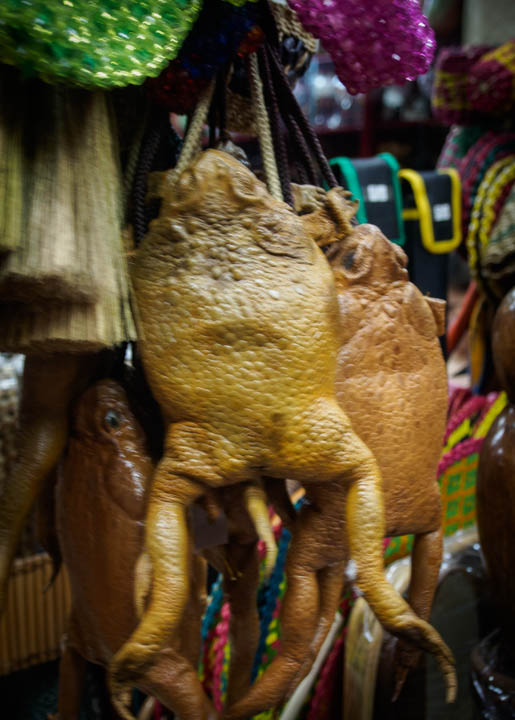
Get your Frog Purse (or Dried Fish)

More market photos, this time from Laoag in the Philippines. Aside from the common items such as poultry, fish, and Philippine sausages, one item caught my eye - purses made from frogs. Unique, but not quite my thing. With their leathery, bumpy skin, bulging eyes, and those long legs, they would make an interesting conversation piece. I decided to save my backpack space for textiles.


Gotta love the colorful fresh fruit!
Nicely arranged display of dried fish and eggs


Monday, August 24, 2015

Tie-Dyeing of the Bai Ethnic Group, Yunnan

Having a "weakness" towards loving textiles, I was naturally attracted to the tie-dyeing by the Bai ethnic group. This ancient handicraft was already being practiced around the 3-4th century in China. The Bai people living around the Dali area of Yunnan (southwest China) are renowned for their tie-dyeing in this particular style. The village of Zhoucheng has been awarded the title of "The Hometown of National Embroidery and Dyeing." 

The Bai people use white cotton cloth, or sometimes a blend of cotton and linen. To create the "resist" areas where the dye will not reach, the Bai people use knots, rubber bands, sticks, and stones. According to the needs of the desired pattern, several binding techniques are used, such as pinching, crimping, folding, squeezing and pulling into shapes. The cloth is stitched, bound, and tightened, with the un-dyed piece looking like a very textured sculpture. 


Bandhani tie-dye from Gujarat, India
 Having seen the process already when traveling in Gujarat, India, I could appreciate the finished products of this time-intensive art. The Bandhani  piece pictured here took 21 days just to tie the knots.
Removing the knotted strings, revealing the designs. Gujarat

The natural indigo color is formed from fermented leaves of the radix isatidis, mugwort, and a few other plants. The cloth is typically soaked and then air-dried several times before the desired intensity of color is achieved.
Like so many other traditional handicrafts, Bai tie-dyeing is becoming increasingly endangered, due to industrialization, as well as limited access of the dye plants themselves because of over-harvesting and pollution.

For more information on Bai tie-dyeing, visit this article or another by Interact China.
Tie-dying video by TravelChina Guide

Wednesday, August 19, 2015

Baisha Naxi Embroidery Institute

After walking around Shuhe, we drove a few kilometers to the small town of Baisha. 
Our main destination was the Baisha Naxi Embroidery Institute, created to preserve and develop Naxi embroidery. Due to the Cultural Revolution (embroidery making was banned, and some practitioners were even imprisoned) and the rise of machine embroidery, this handicraft is endangered. At the Institute, local women can train at no cost. Students are exposed to consistently more difficult projects that are designed by their teachers. One of the students gave me a tour of the institute, including the gallery.
A Master embroider at work. 
My student guide eagerly pointed out her teacher, who was intensely focused on her own embroidery. The teacher obliged in briefly pulling up the cloth covering her embroidery, revealing a shimmering lotus pond design with subtle variations of tightly packed shorter stitches. After a moment or two, she silently covered it back up again and continued working. My guide explained that the silk thread was separated into further strands, the amount varying according to the embroiderer's skills and design. Whereas beginners might use 1/8 of the thread, master embroiderers might use only 1/32 of the strand seen on the blue cloth covering.
My student guide at the Institute
An embroidery piece of Koi made into a screen, displayed in the gallery
 A well-laid out gallery displayed pieces, most of which were for sale. Each piece had a label that included the creator's name, title, price (if applicable), and number of days it took. Simpler student ones sold at more affordable prices and may have taken as little as a week (working 8-hour days), all the way up to a year. Many pieces were way beyond the pricing on a teacher's salary, but would definitely make a great purchase for a collector. In a country where quality traditional handicrafts are becoming harder to find, this was a breath of fresh air.

Photography was not allowed in the gallery. You can see some examples here.

In 2006, Naxi embroidery was listed as an intangible heritage by UNESCO. It is the goal of the Institute that 30% of all Naxi women in the area would be knowledgeable on this embroidery style, 60% by 2030, and that by 2040, Naxi embroidery would once again become the Naxi national industry.

Old embroidery examples on display in the museum area
 Some other rooms held some nicely displayed embroidery pieces created in the past. One was the robe of the Mu family clan leader. Embroidered with blue dragons, the robe lacked the yellow color reserved for the emperor.
Robe of the Mu family clan leader

Appliqué work


Baisha is located about 8 km north of Lijiang.