Showing posts with label Polonnaruwa. Show all posts

Tuesday, November 09, 2010

Polonnaruwa Archaeological Site - Gal Vihara


For many, the Gal Vihara is the highlight of the Polonnaruwa site. Here, one feasts their eyes on four Buddha images, carved from the massive granite rock there. The standing Buddha measures 7 m in height and is beautifully carved. Its expression is quite marked, perhaps a bit sad. The most massive sculpture is of a reclining Buddha and measures 14 m. The incorporation of the rock grains was quite remarkable. Despite the rigid hard material, there were details such as the slight indentation of the pillow made it almost seem as made of a more pliable one.

Monday, November 08, 2010

Polonnaruwa Archaeological Site - Rankot Vihara

Shiva Devala 2
We then went past several Shiva Hindu temples (some still used), a dagoba, and through a jungle area with many trade stalls. Judging from the number of stalls, the city must have been quite large during its peak. Columns and mounds of foundations jutted up, struggling against the destructive trees, roots, vines, and grasses of the jungle that threatened (and many times won) visibility and preservation. It made me wonder how much more still remained, unexcavated. In the northern area, we saw the Rankot Vihara, a dagoba 54 m in height – the largest one in Polonnaruwa and 4th largest on the island. Like the ones I saw under construction in Thailand, this one had ground covered by a brick mantle and plaster. A 12th century hospital (very little remaining) contained some surgical tools at the time of excavation, bearing strong similarity to modern ones.
Rankot Vihara

Sunday, November 07, 2010

Polonnaruwa Archaeological Site - Quadrangle Section

Vatadage with Moonstone
Guardstones

After lunch, we went to the Quadrangle section. One of the main structures (and my favorite) was the vatadage. Due to its religious significance, we had to take our shoes off, making walking on the carved stone a challenging affair with the hot noon sun. In the second terrace were four entrances, each with beautifully carved guardstones on each side. Almost like a doormat (the guide said part of the function was actually to help wipe the feet), the semi-circular relief carved moonstones were quite beautiful, nicely framing the stairway up to the Buddhas at the top. One of the four Buddhas was made out of marble.
Sathmahal Prasada

Across from the vatadage was the Sathmahal Prasada, an unusual pyramidal stupa. Its style resembles those seen in northern Thailand. A few Buddha relief sculptures could be seen in the front.
60-days Tooth-relic chamber

A tooth-relic chamber, built in 60 days, was nearby, in direct line to the vatadage. It also had some guardstones and a larger Buddha statue at the far end.
Gal Pota

Off to one side was the Gal Pota, a stone book measuring 9 m x 1.5 m wide, with a thickness between 40-66cm. On it were stone inscriptions – the longest in Sri Lanka, as well as relief carvings of elephants and birds that resembled geese.

Saturday, November 06, 2010

Polonnaruwa Archaeological Site, Sri Lanka pt. 1

Drive to the Site
Early the next morning we began the downward drive from Kandy to the UNESCO site of Polonnaruwa. Some of the towns we passed through were predominantly Muslim, its men wearing white caps, loose clothing, and donning henna beards. The dress of women varied from jeans to the burqa. Occasionally I spotted the orange robe of a Buddhist monk. Buddha statues of differing sizes and materials were lined up in front of some stores and stands, waiting for the eager buyer. The occasional church added some variety. Along the way, we also passed by numerous signs touting spice gardens or hotels. Over four hours later, we were in Polonnaruwa, the second capital of Sri Lanka after Anuradhapura was destroyed in 993 AD.

Royal Palace
Archaeological Museum
Prior to visiting the archaeological site, I decided to visit the museum. It gave a good idea of how the structures once looked, especially those that had wooden upper portions. Most where destroyed by Chola invaders, leaving very little remaining. Black & White photos of some structures as they were just prior to restoration illustrated just how destructive the jungle can be, particularly trees and vines. I was surprised by how Chinese many of the buildings looked, but learned that Chinese architects and workers were involved in the construction – a testament to global trade, even in ancient days. The museum also had artifacts taken from the site, such as some beautiful Hindu bronze statues, coins from various countries (found in the trading stalls), pottery, and jewelry.
 
On the way out of the museum, we drove past the huge tank that looked more like a lake. Remnants of two brick walls, constructed to protect the inner and outer city, were visible in some places.
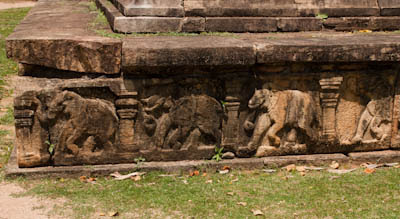
Audience Hall

Royal Palace Group
The first set of buildings we visited is known as the Royal Palace group. It included the Royal Palace, built during the reign of Parakrambahu I. Measuring 31x13 meters, at one time it supposedly had seven storeys. According to the scale model of the palace seen in the museum, the palace’s top floors were made out of wood. Hence, after the South Indian invaders set fire to the place, nothing remained except the brick ground floor walls (now charred) with holes to receive floor beams of the next level. Portions of plaster on the wall still remained in some places. Nearby was the Audience hall, which had a great row of elephants carved in relief on the bottom row, lions on the top, and remnants of columns. We also visited the Bathing Pool, whose water was provided from the large tank and channeled down through clay piping. A small circular fountain still occupied the middle of the pool, once spouting forth with water.
Bathing Pool