Showing posts with label Angkor Wat. Show all posts

Monday, February 20, 2012

Apsara Dance Performance


While in Siem Reap, we also attended an Apsara dance performance. Much like the apsara (celestial nymph) dancers we saw depicted on the walls and columns of Angkor structures, these danced with grace and fluidity. Movements, particularly the placement of the hands and pose of the fingers was beautiful, but prescriptive. While the announcer was very difficult to understand (other than the word dance), we did enjoy the performance.

Sunday, February 19, 2012

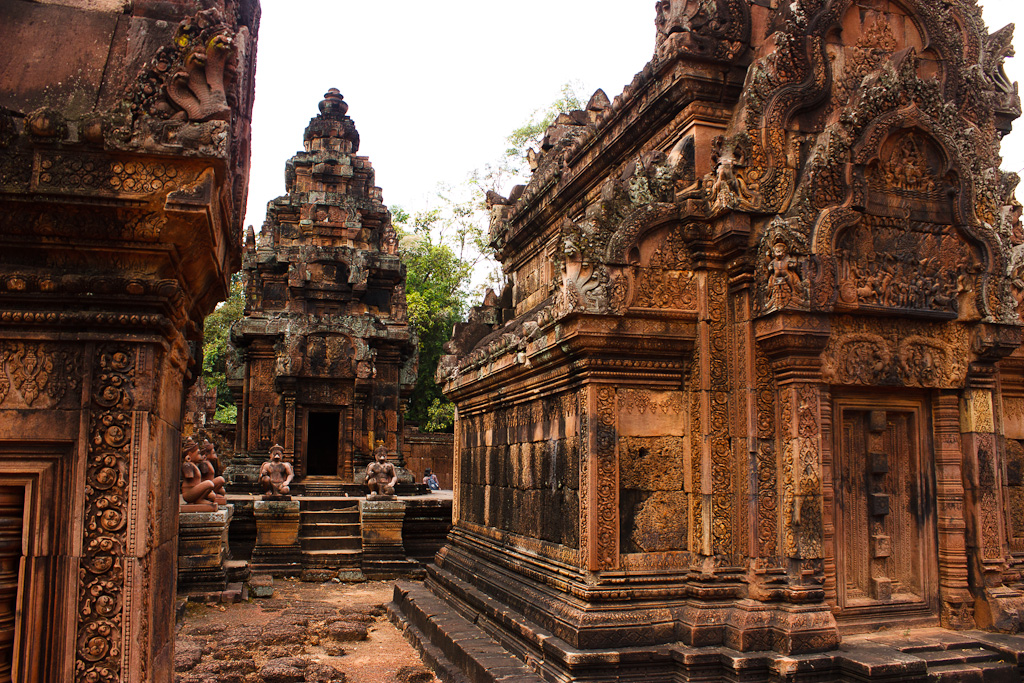
Banteay Srei - save the Best for Last


Our last Angkor site was also my favorite - Banteay Srei. Although just a fraction of the size of the Angkor Wat temple, this miniature-sized Hindu temple more than makes up for things with its exquisite carvings. The red sandstone from which most of the structures here are carved was perfect material to achieve and preserve some of the most elaborate, intricate carvings I have ever seen. Consecrated in 967 AD by a counsellor to the king, Banteay Srei was dedicated to the god Shiva. Meaning “Citadel of the Women” or “Citadel of Beauty,” some say such intricate work could only done by the hands of women. Its lintels and pediments were particularly beautiful, but nearly every square inch was covered by carvings or sculptures. A feast for the photographer’s eye! Many of the sculptures found on the site are reproductions, with the originals stored in the National Museum. Additional pieces are housed at the museum in Siem Reap and were easily distinguished from “inferior” carvings from other Khmer sites. Such measures have ensured that at some of this “jewel of Khmer art” will be preserved and safe from the hands of unscrupulous looters. Visit http://en.wikipedia.org/wiki/Banteay_Srei for more detailed explanations and images.
View many more photos of mine on Banteay Srei and the other sites within the Angkor area on my Flickr set .

Friday, February 17, 2012

River of a Thousand Lingas


Still rather early in the morning, we began our trek through the forest to reach our destination of Kbal Spean - known more popularly as “River of a Thousand Lingas.” The shade of the tall trees shielded us from the bright sun. Roots wiggled across the path like snakes, making it imperative to watch one’s step. Rocks and boulders and provided an extra challenge, but some areas had stairs to make it easier to climb upward. About half an hour later, we arrived at the 9th-12th century Hindu carvings.  Clear water glided and over river boulders, some of which contained carved Yoni symbols (womb or sacred temple). Shallow Lingas (representing the male fertility organ) were carved in neat grid rows in the sandstone river bed, reminding me of giant bubblewrap. It was believed that the water was purified as it flowed over the religious sculptures, thus cleansing the king’s sins. On the river bank boulder, a relief carving contained a reclining Vishnu, serpent god Anenta, goddess Lakshmi, and Brahma sitting on a lotus petal. I also spotted a rock containing relief carvings of small figures (depicting Shiva and Uma) riding a bull and other larger figures looking up to them. Additional carvings were found near a waterfall.

Thursday, February 16, 2012

Angkor Wedding

Even wedding couples felt the need to visit Angkor Wat and pose for photos there. I wonder how many bobby pins and hairspray was used for her hairdo...

Monday, February 13, 2012

Angkor Wat - Arrival


Finally we reached Angkor Wat. Arguably the most famous of structures in Cambodia, it is the pinnacle for many tourists. The largest within Angkor, it may even be the largest religious structure in the world. Never completely abandoned, Angkor Wat is the best preserved temple in Angkor. Built by King Suryavarman II from around 1113-1150, Angkor Wat was actually dedicated to the Hindu god Vishnu. In the 16th century, it was converted into a Buddhist Monastery and temple, which still functions to this day.

Symbolism abounds at Angkor Wat. The moat (still containing water) symbolizes the seven oceans. The bridge represented a link from the kings to the gods. Its inner wall and towers represent the seven mountains which were home to the gods. The three towers of the Wat represent the three Hindu gods - Shiva, Vishnu, and Brahma. The central tower is meant to be like the mythical Mount Meru, surrounded by smaller peaks and the continents (courtyards). 
Angkor Wat was built on this location due to its proximity to a sandstone quarry, large lake, and fertile land. Over 500,000 volunteers built the structures, believing that their service would provide them a better life. Around 200,000 elephants transported rocks to the site using rattan rope. Sadly, only around 300 wild elephants remain in Cambodia.

Terrace of the Leper King


Next door was the Terrace of the Leper King. According to our guide, the name is actually inaccurate. Rather than being a king with leprosy (toes and fingers are missing), the statue, for which the place was named, is likely Yama, the god of death. This 12th century terrace had five tiers of beautifully carved figures. Female figures dance gaily about, while male figures look rather stern, whose swords are firmly grasped. Some of my favorite carvings were found on an inner terrace. Although unfinished and containing topographical carving marks, these pieces had a beauty unique from all the others.

Friday, February 10, 2012

Terrace of the Elephants


The Terrace of the Elephants was used as a stadium for public ceremonies, tightrope acts, and acrobatic stunts. Foreign delegations would come here after meetings, enjoying performances. Decorating its wall were garudas, lions, and a parade of elephants, whose trunks resembled columns. 

Phimeanakas


Next to a walled area once housing the royal palace was Phimeanakas. It was a 10th century Shiva temple, built entirely of laterite. Meaning “Palace of the Air,” it is theorized that perhaps the structure was once topped with a golden spire. Although the pyramidal structure is in not the best condition, I did enjoy the elephant statues found on the corners and lions by the stairway.

Thursday, February 09, 2012

Baphuon


The pyramidal Baphuon was next on the agenda, just a short distance from The Bayon. Symbolizing the mythical Mount Meru, the 11th century Buddhist structure was constructed of sandstone and volcanic stone, transported from the quarries through the assistance of elephants, bamboo, and ferries. Compared to The Bayon, it appeared to be quite plain and non-decorative. The French have just completed restoration work on Baphuon, to the tune of around 4.5 million euros.

Tuesday, February 07, 2012

The Bayon


Once through the south gate of Angkor Thom, our first destination was The Bayon located in the exact center of the city- one of Angkor’s most popular sites and the favorite of our guide. Here, one can find around 50 towers decorated with 216 massive faces. It is thought that those faces signified keeping watch over the greater kingdom. In addition to the omnipresent faces, a highlight of The Bayon had to be its impressive bas-reliefs. Comprising a surface of over 1.2 km are over 11,000 figures depicting everyday life from the time period. Examples included cock &boar fighting, playing chess, a woman crying over her husband, fishing nets, picking out lice, fighting the Chams (Vietnamese), barbecuing fish, and victory meals. 

Monday, February 06, 2012

Angkor Thom Gate


Leaving Siem Reap early in the morning, we were ready for another day of temple visiting. Our first destination was the fortified city of Angkor Thom, meaning “Great City.” Spread over a 10 sq km area, it was built by the great Jayavarman VII. Around 200,000 people once lived within the city and around 1 million in the surrounding area during its height. We entered through the South Gate- one of five monumental gates into the city. Surrounded by an 8 m high wall and a moat, 54 gods greeted us one one side of the causeway and an equal number of demons on the other side, portraying the mythical story of the Churning of the Sea of Milk. Many sported lighter-colored heads, indicating that they were not the originals. Some tourists chose to ride through the 20 m high gate on the back of an elephant - quite likely the mode of transport used by the elite back around 1200 AD. A series of carved stone elephant trunks below huge heads could be seen on the gate. 

Chau Say Tevoda and Thommanon


Under the glow of the late afternoon light, we visited the twin temples of Chau Say Tevoda and Thommanon. Dedicated to Shiva but with many statues of Vishnu, only the central part remained of the 12th century Chau Say Tevoda site. Just north of its twin was Thommanon. Built around 1113-1150, this structure is similar in look but has more buildings. Once again, Vishnu and Shiva are featured in the sculptures and reliefs. 

Saturday, February 04, 2012

Ta Keo


After mingling about the vibrant Ta Phrom, the 50 m very plain Ta Keo was a bit of a let-down. Built of sandstone, this undecorated step pyramidal temple dedicated to Shiva was surrounded by four towers. Although reasons for the sudden construction abandonment are not certain, our guide said it was because workers were killed by lightning; other sources speculate that it was due to the death of king Jayavarman V (reigned 968-1001 AD).

Ta Phrom


Built in 1186, the temple of Ta Phrom has been left much as it had when European explorers first laid site on the ruins. The giant spung trees had massive roots which appear to swallow the rock structures, paying little heed to the beauty of the bas-reliefs they have enveloped, breaking apart the temple rock by rock. In some areas, the thick roots reminded me of a huge boa constrictor, squeezing out the life of its man-made victim. What the trees haven't claimed, the lichen has covered. The deafening constant noise of the cicadas and the call of the green parrots overhead were additional reminders that the jungle around us was still very much alive.


Wednesday, February 01, 2012

Land Mine Bands


On the walk from the parking lot to the atmospheric ruin of Ta Phrom, we passed by a band -one of several we'd see in the next few days that were comprised of victims of land mines. Some were missing one or several limbs, while others were blinded by explosions. Like much of what we saw in Cambodia, these band members are a testament to the resiliency that has led to the rapid turnaround in the country. 

Estimates are that there still are around 9 million land mines remaining from the civil war, with about 400 injured last year (down from 700 in 2000). How many more will be maimed or killed due to these cowardly devices?

Tuesday, January 31, 2012

Banteay Kdei, Cambodia


Next we visited Banteay Kdei, a Buddhist temple and monastery constructed in 1181AD. Having the place mostly to ourselves, we enjoyed walking though the ruins, past the entrances decorated with sculptures of Garuda, and past massive tree roots. Inside the structure, the domain belonged to bats, while the skies were home to the calls of green parrots. 

Sunday, January 29, 2012

Prasat Kravan, Cambodia


True of most tourists to Cambodia, our main destination within the country was found just outside the town of Siem Reap the temples of Angkor. Due to the sheer numbers and spread-out locations of some of the many Buddhist and Hindu sites ranging from the reign of King Jayavarman II (802-850AD) to the mid 1200's, visitors focus on a certain number, depending on their length of stay and temple "stamina." 
The first site we visit was known as Prasat Kravan. Built for Hindu worship in 921AD, the five brick towers had some particularly nice bas-relief carvings inside the central tower of the god Vishnu.

Adding to the destruction wreaked upon the temples by jungle nature and centuries of abandonment, the temples suffered further destruction in Civil War. The Khmer Rouge took statues from the sites and sold them to other countries.

Monday, January 23, 2012

National Museum, Phnom Penh


Our next stop was to the National Museum, located just north of the Palace. Although photography of most objects was not allowed, we did enjoy viewing the Hindu statues (some dating back to the 6th century), a statue of the leader responsible for some of the grandest structures within the Angkor period, and some post-Angkor Buddha figures. Wings of the museum opened to a central garden, complete with water gardens, tropical vegetation, and a Buddhist sculpture in the middle. Although the museum was interesting to look at and contained information in English, it would have had more impact had we come after touring Angkor Wat.