Showing posts with label clothing. Show all posts

Sunday, August 02, 2015

Appliqué work of the Yi People

In addition to having lacquerware in the shop, Yi ethnic member Joel Zheng also had a display of the traditional Yi clothing. 

Yi clothing typically consists of contrasting, bright colors such as dark red, black, green, yellow, and blue. The skirt is long and pleated, with black, red, and yellow being the most typical colors. At a young age, Yi girls are taught how to do cross-stitch and other sewing techniques such as appliqué. Women also do the weaving of the cloth.
Floral and fern-like designs are commonly featured on women's clothing. Some of the designs reminded me of those I saw on Hmong cloth - as was the pleated skirts. Silver jewelry and ornamentation adds a decorative touch. 

The cone-shaped baubles on this head piece reminds me of the Lisu people I had met in Thailand.
Spinning of the thread for weaving

Appliqué steps

Designs found on Yi clothing
The clothing on display was quite elaborate and of fine craftsmanship. Nowadays, the level of the typical costume isn't quite at this level, particularly if it is purchased.

I was also shown some shawls that were felted. The natural wool color pieces were plain, but very practical.

This article had quite a bit of detail on the clothing of the Yi people in Sichuan, the province where Joel Zhang is from. 


Friday, June 19, 2015

The Art of Maedeup, Korean Ornamental Knotwork

Mrs. Young Ae Lee twists and crosses strings to make the dahoe (cord)
After attending a Royal Wedding ceremony reenactment at the Unhyeongung Palace in Seoul, I stopped for a few minutes in one of the buildings which had an exhibit. Here I met Mrs. Young Ae Lee who is a master of maedeup, an ornamental knotwork of Korea. Literally meaning "knot" in Korean, maedeup utilizes one type of fiber and its finished piece is both symmetrical from side to side and the same on both back and front.
A type of maedeup is a norigae, which comprises of the knotwork, tassle, and ornament. The ornament may be made from precious metals or stones, such as gold, silver, bronze, jade, amber, coral, pearl, or malachite. One's status or importance could traditionally be ascertained according to the size, shape, materials and colors of their norigae. Although natural-dyed silk was used for more expensive pieces, even simpler pieces could be enhanced through embroidery. Norigae are often attached to the jacket of a hanbok, the traditional dress of Korea. Typical of many forms of Korean art, nature was a popular theme. Knots, for example, were made in the forms such as lotus buds, plum blossoms, chrysanthemums, butterflies, bees, and dragonflies. Ornaments included animals such as the bat or tortoise, as well as butterflies, plants (i.e. grapes, peonies), or household objects (i.e. gourds, drums, locks, bells). Symbolism was attached to these ornaments, such as a pepper for a prosperous marriage, a peach for longevity, or tiger claws to repel evil spirits.

Although Mrs. Lee originally learned to do maedeup from her family, she has also refined the craft by incorporating aspects discerned in historical research. Hoping to keep the craft alive (fewer people are learning the skill), Mrs. Lee regularly exhibits her work and teaches others. For others continuing the craft, demand is mostly limited into either high art or for accessories. Future generations may likely need to adapt further in order to survive.

When seeing Mrs. Lee at her maedeup instrument machine, it reminded me of the traditional lace-making I saw in Bruges. To the untrained eye, it looked like haphazard twisting of spools of thread. I hope to revisit this art form at a later time when I have a bit more time and can see more of the design emerge.

Sunday, February 08, 2015

Golden Lotuses

Besides the wau bulan kites, another display that caught my attention at the People's Museum in Melaka was of the lotus shoes. I had first read about this Chinese practice when reading the excellent book Snowflower and the Secret Fan. Looking at these tiny but beautifully embroidered silk shoes, it was difficult to imagine that an ideal size of an adult female - known as a golden lotus -  was around 3 inches in length. What pain these young girls and women must have endured - often at the hands of their own mother! Such dainty feet were highly desirable and could enable even non-wealthy girls to marry into much higher status homes.
Although the animal head on the pink shoes above is likely a bat (a Chinese symbol of good fortune), it reminds me of a mouse. 


Friday, October 25, 2013

Hanbok Day, SFS Style


Starting on a cool, fall morning, the entire elementary school gathered in the courtyard in front of the Korean Gate, posing in their hanboks (traditional Korean costume) and taekwando uniforms for the annual Hanbok photo. Although there was a sea of colors, pink was one of the more dominant colors, for boys and girls alike. 

 Sponsored by the PTA, each grade level had a chance to play a few traditional instruments, twirl the nongak hat with ribbon, and sample some Korean treats. 
Some students and teachers took their hanboks off after the photos, while others kept them on the entire day. Shifting a few art projects for the day to "less mess" ones enabled me to bravely keep on my hanbok for the entire day. Pictured here is my volunteer assistant Hae Jung next to me. Being a lot taller than the average Korean woman, I had to have my hanbok tailor made. The colors I selected look a lot different than that of the typical one (Hae Jung's is her wedding hanbok and is the pink color normally associated with weddings), but I feel the colors suit me well. Although I wouldn't want to wear it that often, at least I could dress myself - unlike trying to tie a sari :)

Sunday, June 16, 2013

Jongmyo Daeje Royal Ancestral Rite - an Expat's Reflection


Observing the rites and ceremonies happening at both the Yeongnyeongjeon and Jeongjeon halls at Jongmyo Shrine was a mixture of fascination, confusion, and frustration. The highly prescribed rituals were very strict and solemn. I was happy to see the young dancers and musicians of various ages who were eager to learn the music, dance, and songs in order to preserve this national treasure and tradition. Some of the traditional instruments used in the ceremony were unique and those I had not seen before. Elaborately carved and painted, form and function were equally important. With the large expansive courtyard separating the viewers from the main action taking place under the sheltered chamber area, it was difficult or next to impossible to really see what was going on.


 The cameramen with their massive equipment went back and forth, documenting the ceremony but also obscuring any view of spectators. Some wore a blue uniform making them slightly less distracting, but many others wore jeans - marring any photographic shot of the events. Announcements were made throughout the ceremony, but everything was in Korean, so foreigners were even more clueless as to the events and their meanings. To the untrained ears and eyes, things could look and sound rather repetitive and monotonous. The singing was more like chanting and the rhythms and melodies of music very different than that of Western music. This definitely was no farmer or folk masked dance. Still, I understand that the ceremony is not about nor is it for the spectators. This is a deeply traditional cultural ritual with a very solemn tone that needs to be respected and preserved. 

Tuesday, June 11, 2013

Regalia of the Jongmyo Jerye


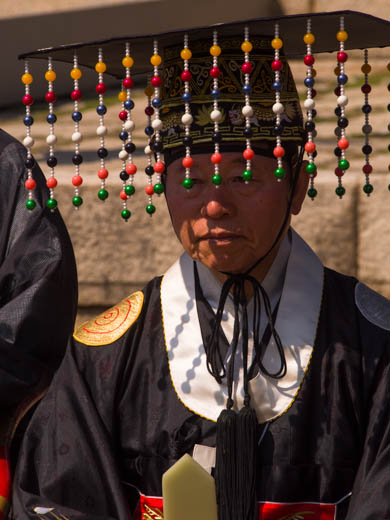
After a while longer, the officiators, all dressed in ritual robes, hats called a coronet, an angled waist belt, rear tasseled trimmings, black & white leather shoes, and carrying a jade tessera, solemnly made their way up the stairs and over to their designated spot by the different royal chambers of the Yeongnyeongjeon hall at Jongmyo Shrine. 
Each of these men would have partaken of a special purification rite beforehand, designed to keep their mind and body clean and pure before the ritual. Participants, including the king, were required to refrain from visiting sick people, listening to music, or even signing a document for a death sentence. 


Wednesday, November 14, 2012

Tuckered Out

After a long stroll through the Gyeongbokgung Palace in Seoul on the day of Chuseok (harvest festival), this young girl succumbed to her need for a nap on the stairs of a building in the queen's quarters. 

Monday, November 12, 2012

Common no More

During the Joseon Dynasty, this scene in the palaces likely would have been rather common - women and men wearing colorful hanbok outfits. Literally meaning "Korean Clothing," the hanbok, with its simple lines, underwent many changes throughout the years - some due to practicality reasons and others influenced by fashion from neighboring countries. Today, however, its use is reserved for only special occasions and TV drama. 

Sunday, September 02, 2012

Minis on a Line

I couldn't resist taking a photo of these miniature crocheted clothes, so lovingly hung from a jute "clothesline" and attached with equally miniature clothespins. The shop in Insa-Dong was closed at the time, so I couldn't go in and take a closer look. I wonder what the story is behind these items....

Thursday, May 24, 2012

Laundry day

Like my friend "Bibi" I enjoy taking laundry pictures. This one is in a small village in Kashmir. To think how laborious it must be to wash one's clothing by hand that way. To think that we complain when we have to place laundry in an automatic machine and either plunk it in a dryer or hang it on the line!

Monday, May 21, 2012

The Zari Embroiderer


While sitting in the kitchen one cool morning, the mother gave me one of her pherans to wear. Just like the grandmother’s, hers was embellished with swirling silver designs around the V neck and sleeves. So uniformly sewn, surely it was done via machine. With Kashmiri pride, grandmother pointed out in her limited English that this was hand done. Later that morning, the mother took me to the shop where her Zari embroidery man worked. Sitting on the floor against the wall nearest the shop’s picture window, the embroiderer in his neutral-colored costume was engrossed in his detailed work. Slender silver-coated thread dangled across his shoulders. Using the couching stitch, he secured the tight silver swirls onto the “V” neck of the midnight-blue woolen pheran. Seeing how enamored I was, he showed me a maroon-colored wedding pheran, executed in a highly elaborate, skillful manner. Considering the high cost of the thread and length of time required to complete each order, it was not surprising that the elderly man’s son was not following in his father’s footsteps. 

Saturday, April 28, 2012

Village of the Gujjars


The following morning, the hotel owner drove me to a small village where some semi-–nomadic Gujjars stay for the winter.  The tiny road  took us past some crude shelters made out of stone, logs, and grasses -  the type of dwelling the Gujjar tribe (one of the largest ethnic tribes in Kashmir) used to build.  The house we visited was made out of brick and its interior covered with a smooth layer of mud.  With the parents away at the market, a young boy promptly gave us some tea.  A bit later,  a woman came in.  I admired  the traditional embroidered hat that she wore. Small, tight braids similar to that worn by African American people framed her face, a style typical of the Gujjars. In a couple months, the family would make their way up into the mountains where they would graze their sheep. With the mountains full of flowers and green grass, what a beautiful surrounding these shepherds must have in the summer!

Wednesday, April 25, 2012

Come in for some Tea


 Determined to meet some local people, I made my way gingerly on the muddy road towards some homes and small shops. Several times I was warmly greeted, engaged in a short conversation (Kashmiris often inquired about how I like Kashmir), and offered some tea.  After politely deferring some tea invitations, I finally gave in when I met a beautiful teenage girl with a vivacious, outgoing personality.  I spent several hours in their house, engaging in conversation in between cups of delicious Kashmiri tea with a cinnamon taste. Her older sister (who was much more reserved)  performed kitchen duties such as creating a useful cooking fire in their traditional stove, rolling and cooking chapatis, and preparing the salt tea in a Samovar tea pot.  Typical of Kashmiri families, neighbors and relatives stepped in for a while, had a cup of tea, and left.  The younger sister gave me a pheran to wear on this cold, rainy day (like other Kashmiri homes, theirs was not heated), but it was way too short. The woven kangri, with hot embers in its metal pot, proved to be a nice personal heater.  

Wednesday, April 18, 2012

From Kashmir to Japan


Warmed up with the tea, we headed to a modest wooden building and climbed the stairs to an upper room.  There we met three men, all wearing long, woolen outer garments called a pheran.  Each man was busy doing hook work stitching on colorful pieces of cloth, including some scarves destined for a Japanese boutique shop. The fine work resembling the chain stitch was highly detailed and rather tedious, so the men would only work on this for part of a day.

Wednesday, August 10, 2011

Bounty of Bangles

Indian outfits are all about color. It makes sense then, to accessorize them with matching bangles. Some are plain, while others are studded with mirrors and other decorative elements.

Monday, June 06, 2011

Banni Women: of Sparkles and Spectrum


Muslim communities form a majority of the inhabitants of the Banni area. A few are from the Harijan (formerly called the “Untouchable” Hindu caste). Regardless, they are known for their bright colored clothing–probably as a response to the normally arid, hot conditions of the area. Here the women wore a type of blouse that was completely open in the back, with a couple strings securing it. Brilliant red, green, and yellow colors dominated. Their clothing was particularly heavily embroidered and sparkled in the sun as the light reflected off the mirrors.

Tuesday, May 24, 2011

At the Water's Edge


Moving onward, our driver took us to the outskirts of a village where women were drawing water out of a well. Balancing two pots of water on their heads, the women then proceeded towards the village. Even a little girl worked at carrying a bucket on her head. With a golden light of the late afternoon sun, the women in their brightly colored Ghanghara skirts, choli blouses, and odhni shawl, were stunning. Walking tall, they went past men resting in the shade. Other women were busy washing clothes at the water’s edge.

Friday, December 03, 2010

Three Fishermen in a Row

The sun still rising, these three fishermen are relaxing after being out in the boats very early in the morning. Note the typical plaid dhotis they are wearing, which tends to be cooler than pants.

Friday, June 11, 2010

The Dupatta

While the traditional dress for women of South India would be the sari, the salwar-kameez has become popular throughout India. This pant and tunic ensemble, originally from northern India, is usually accompanied by a scarf known as a dupatta. Made from a length of fabric between 2 1/2 - 3 meters, the dupatta is an indispensable fashion accessory for today's modern Indian woman, worn with both Indian and western-style clothing. In south India, the most common way to wear the dupatta is over the chest, with the tail lengths trailing over the back. Often times it is more gathered together, as shown by the young woman on the right of this photo. When the air conditioner is a bit too high or the temperature drops below 22°C (71°F), the chilled woman can bring the cloth over her arms. Or, the fabric can serve as a slight sun block, mask to cover the face from dust, and much more. Safety pins over each shoulder help prevent the dupatta from flying away - essential if one is riding a motorcycle. The dupatta can also be draped over one shoulder or covering the head - more common in north India.
Dupatta fabric is as varied as Indian textiles used for dresses. It can be printed, embroidered, or plain. The material can be translucent or opaque; lightweight or rather heavy; beaded fringes or straight; stiff or flowing. Typically the dupatta matches the pant in terms of color or pattern. Regardless, the dupatta adds to the already regal look of the modern Indian woman.

This is a photo of two young women in my neighborhood picking through the garbage to find recyclable or usable items. 

Monday, June 07, 2010

Greeting the Couple

After the formalities of the wedding reception, guests had a chance to walk up the stage to congratulate the wedding couple and have photos taken. It was a great opportunity to see the beautiful saris and jewelry the women were wearing. Such a rainbow of color!