Showing posts with label education. Show all posts

Thursday, September 18, 2014

The Ox at the Shrine

Having lived in India where cows were considered sacred and often freely roamed the streets, I found the statues of the ox to be rather curious. According to legend, the ox carrying the coffin of revered scholar Michizane stopped at this spot and refused to budge. Therefore, the funeral procession halted here and Michizane was buried at this site. The shrine was then built to venerate this scholar. I love how the horns of the ox are highly polished. Many people stopped to have their photo taken with the resting creature with its red and white braid.

Note also in the photo above the tree with its rather "fuzzy" branches.


Sunday, September 14, 2014

Dazaifu Shrine, Japan

For our Chuseok (harvest festival) holiday in Korea, I decided to join some other expats and head off to Japan. Following an overnight bus from Seoul to Busan, we boarded a ferry and landed in Fukuoka, Japan, less than three hours later. Rain pelted us just as we boarded the bus, but everyone was in good spirits anyway. Having followed the weather forecast carefully, I arrived prepared with an umbrella and didn't get wet. 

A short distance from Fukuoka, the rather small city of Dazaifu was once an important administrative center for the island of Kyushu. Our first stop was the Dazaiful Shrine, a Tenmangu Shinto shrine dedicated to a well-known scholar Sugawara Michizane who died in 903 AD. The shrine complex is built on the site of Michizane's grave and still is a popular place to visit for students. Its main building dates back to 1591.
I loved the contrast of the neutral, slightly "fuzzy" roof compared to the more ornamental portion just below it. The main hall is a classic example of Momoyama-style architecture. I read that the tree next to the temple was one of 6,000 plum trees on the complex; how beautiful it must look in spring.

Absent in the shrine were deities or other statues. Shintoism, we were told, was not about following a particular scripture, dogma, or founder, but rather more about a reverence for ancestral traditions, customs, and living & acting to the guidance of the gods.


Devotees sat on cushions on the porch, while the priest performed his chanting and rituals from the elevated platform.

Thursday, August 15, 2013

Let the School Year Begin

This year marks my 20th year of teaching - hard to believe!
Below are some photos of my art room at Seoul Foreign School where I teach art to students aged 3 through grade 5. Today was our first day of school. Lots of returning, familiar faces as well as about 90 new ones at the school. You're welcome to visit our Artsonia online gallery. There are some very talented kiddos!
Entrance to our spacious, 4th floor room

Yes, ten sinks!


New this year: a couch and carpet by an area I'm developing as a center

SmartBoard and carpet area, where we begin every class


My crayon monitor system, scrap paper trays, and lots of natural light

Entrance at the elementary school
Looking down the stairs. Being on the 4th floor = good exercise!


Tuesday, January 29, 2013

Timbuktu's Manuscript Center, an Insurgent Victim

In 2009, I wrote about a welcomed development in Timbuktu, Mali, that was a long time coming. The precious ancient manuscripts (some dating back to the 1300's) I had seen several years earlier just sitting exposed on dusty shelves and cabinets had now finally received a proper building that would help preserve them. The Ahmed Baba Institute of Higher Learning and Islamic Research, with its collection of over 30,000 manuscripts, became an arson victim, burned by the Islamic fundamentalists as they were pushed out of Timbuktu by the French.  It is hoped that at least some of the manuscripts were removed to safe places ahead of time, just as they had been hidden or buried over the centuries in times of conflict. With only a small fraction digitized, it would truly be a loss if these historical and religious documents went up in smoke after surviving so long in a challenging environment.

Sunday, August 19, 2012

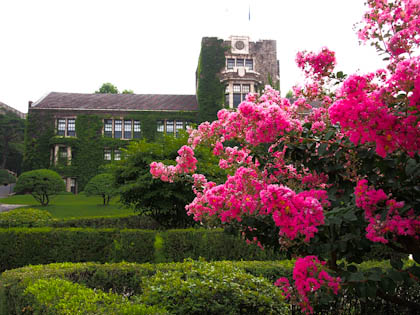
Yongsei University, Seoul

Down the slope of the hill from Seoul Foreign School is Yongsei University. Here we see a brilliant pink flowering tree in front of one of the university's Tudor-style buildings. It's a pleasant walk though well-maintained grounds. I anticipate taking many walks through this campus in different seasons.

Friday, August 17, 2012

Ewha Women's University area - shopping for shoes

Like in most countries, Korean women love shopping for clothing and shoes. The area around Ewha Women's University is no exception, boasting of streets lined with clothing, shoes, and accessories particularly geared towards the female gender. With such a large display item and color to match, no doubt the store next to this mega shoe beckons the average female in search of footwear. Too bad they don't carry my size...

Wednesday, June 06, 2012

Books are for Everyone

These children seemed so engaged in the books before them. While it is likely that they are supposed to be selling the books/coloring books to passers-by on the street, I can hope that these young kids are able attend school and experience the joy of reading.

Monday, February 27, 2012

Kampev Primary School


Our destination was a local primary school. Children sat on wooden benches, ready to take notes from the teacher’s lecture on the chalkboard. Typical of kids anywhere, our presence caused distraction for some. The teacher of one class called an early recess, with his young pupils quickly darting out of the doorless entryway before any minds were changed. We had seen this teacher earlier today, as he was one of the bullock cart drivers. Even here, the teachers need to supplement their salary! It was fascinating watching the kids play at recess. Some boys were engaged in a marble game, crouching down to the dusty ground in order to get the competitive edge. Most of the other children were engaged in a “try to make it to the other side while avoiding being hit” type of game, but using what looked like a large, weighted badminton birdie. The girls playing were equally as aggressive, throwing the birdie just as hard as the boys and not complaining when they got hit in the head - even though it clearly hurt. Although I am sure that the manufacturers of the birdie device did not intend for their toy to be used in that fashion, these kids sure made it an engaging recess activity.

Wednesday, October 05, 2011

Ganesh Teaches the Mice

My friend bought this cute kolu set. Although Ganesh was a popular figure in the many displays we had already viewed, this one caught our eye. How appropriate is it to find the beloved elephant god seated in the front of an invisible room, while his pupils with their paper diligently listen. Look closely and you will notice each of these mice students each have a shock of black hair running down their back - female students! 

Sunday, December 12, 2010

Education: Extra Obstacles for Indian Girls

Girls in India, particularly in rural India, face extra obstacles that make it not only challenging to go to school, but to stay in school. Rural families, unable to afford the cost of educating all their children, choose to send their sons instead. For those girls that do make it to school, puberty brings with it extra problems. In many schools, toilets are either dysfunctional, inadequate in terms of numbers, lack water, lack privacy, or don't exist at all. In a survey of 80 schools  conducted of a district in the state of Andhra Pradesh (north of Tamil Nadu), 52 had no drinking water facilities, 57 had no toilets, and five had toilets but without doors or water. In the latter case, children had to use the open space behind the school, and since that was used by boys, social norms meant that girls did not feel comfortable using the same space. Girls sometimes deliberately dehydrated themselves to avoid relieving themselves at school. For those living in dormitories also without adequate facilities, girls sometimes skip the evening meal hoping to avoid going out in the dark and defecating.
When such basic needs are not being met, how can we expect India's girls to stay in school, particularly for those whose home issues already makes it challenging? 

Last year, our elementary school's Roots & Shoots program raised money to build toilet facilities at several schools in Tamil Nadu.

Note: More information from the survey can be found in the Hindu Newspaper, Dec. 12, 2010.

Tuesday, November 30, 2010

School: Just a Dream for Some Indian Kids

Today's Hindu newspaper posted some wishes of some kids who for one reason or another, do not have the privilege of going to school. According to the article, in the southern state of Tamil Nadu alone, for over 193,418 children, attending school is just a dream. Reasons often include inaccessibility, lack of facilities, poverty, or general lack of awareness. Village and rural children are particularly affected.
In the words of one child "My mother is the sole bread winner for my family of five. Doing odd-jobs, she managed to put me in school. But my school is more than three kilometers away from home, and there is no public transport. Everyday I had to walk six kilometers. In bad weather it was impossible. So I dropped out of school. For two years I did not go to school. Then Rural Workers Development Society, a community-based organization, coaxed me to return to school. I go to school now but transportation is still a problem."


Another: "We belong to the Irula community. The access to our school is difficult so teachers do not come to our school. The closest school is two kilometers away but it is a Telugu medium school. Our village is located near the Andhra Pradesh and Karnataka borders and we speak Tamil and Kannada. Our parents see no point in us pursuing education in a language that we do not understand and hence ask us to stay back and help them rear cattle. When I grow up, I want to build schools and hospitals for my community."

Friday, October 15, 2010

Sarawathi Puja

On the ninth day of Navaratri, the Sarawathi Puja is celebrated. On this day, all books and musical instruments are placed in the puja room of Hindu homes and worshiped. Sarawathi is regarded as the goddess of education and learning. Pictured is a kolu doll of this popular goddess.

Wednesday, June 02, 2010

Backpacks and Braids

Walking home from school today, it was hard not to notice all the giggling girls and smiling boys, all dressed in school uniforms. For girls, the standard issue was a salwar outfit (typically light checkered top and plain pants), and a dupatta (scarf) matching the pants. Hair was shiny and tightly braided, accentuated by bright ribbons - different colors which likely denote grade level. For boys, short sleeved shirts (also light checkered) and solid pants were the uniform. Plain backpacks, "Hello Kitty," Dora, and other cartoon characters were common. Some carried empty lunch containers in plastic mesh baskets. For the local students, June marks the beginning of the new school year. The months of April and May were their summer vacation, avoiding school during the two hottest months of the year - logical, seeing that most schools do not have air conditioning. So as the American International School kids prepare to finish their school year, the local kids are starting theirs. complete with the high academic expectations and rigors so typical of the Indian education system.

Monday, March 15, 2010

English Spoken Here

Adapting to living in another country isn't always easy. Language can be a huge barrier/challenge, particularly for folks such as me who find learning another language difficult. Thankfully in India it's a bit easier, since English is its second most popular language, with over 125 million speakers. Even the auto rickshaw drivers often speak at least a little English - particularly if money is involved or if your local language skills are nonexistent. In fact, the number of English-speaking Indians is more than double that of the entire population of the UK and more than all European English speakers combined! It's also the second top English speaking country after the US. Of course, a huge difference is that a large percentage of Indians are at least bi-lingual: Over 255 million speak at least two languages and 87.5 million speak three or more languages. By contrast, only about 10% (according to the 2000 census) of Americans were fluent in more than one language. 

This photo shows a sign advertising one of the major English newspapers in India. Like a high percentage of signage/text, this one is dual-posted, both in English and in Tamil, the dominant language for Tamil Nadu.

Tuesday, December 01, 2009

Precious Documents in Timbuktu Get a New Home


When I traveled via pinasse (traditional boat) up to Timbuktu, Mali in 2001, I was excited to see the fabled city deemed by many to be the very epitome of remoteness. (Actually you can fly to Timbuktu now, but I find that rather sacrilegious). Amongst the sandy streets and mud brick structures was the Ahmed Baba center, a humble building belying its contents. Inside we found stacks of precious manuscripts, some dating back nearly 800 years, just sitting there on the counter, piled in shelves, and a few in a glass case. Many were right there in the open, able to be handled and touched  - or should I say maimed - by people and exposed to the elements - and termites. There was no air conditioning and the room was warm. Such terrible conditions for fragile, writings documenting the rich education & cultural history of Timbuktu, illuminated Korans, and much more. It was great that the center sought to collect documents from the region, but preservation in these conditions was a definite concern.

Today's BBC website posted an article and video announcing that a new building has been constructed to house the documents, along with people who are working to document and restore/conserve the manuscripts. Amidst the crumbling mud brick buildings, the new white building will probably look a bit out of place, but such an endeavor is necessary if the manuscripts will be around for the next generation.

Thursday, October 09, 2008

Vijayadasami and Saraswathi Puja


On the eighth day of the Navarathiri festival, Hindus offer prayers to Saraswathi – the goddess of learning and seeking knowledge. This goddess resides in books, reading materials of all types, and musical instruments. To celebrate this puja (ceremonial worship), children place their books and musical instruments before a figure of the goddess. This shows respect for such items that impart knowledge.

The 10th day of Navarathiri is seen as a day of victory for Hindus, commemorating the day the goddess Sakthi slayed the demon – a victory of good over evil. On the day of Vijayadasami , if one begins new ventures (i.e. business or education) he/she is assured of success. Young children are taught their first alphabet on this day, with parents helping them form the letters in rice flour. For some, this day marks the beginning of their formal education or training in various arts forms. Vijayadasami is also a day to honor one’s teacher.

So happy Vijayadasami all you teachers!

Above: Images of Saraswathi

Internet Sources: http://archives.chennaionline.com/festivalsnreligion/Festivals/dasara.asp, http://www.durga-puja.org/saraswati-puja.html