Showing posts with label Cambodia. Show all posts

Tuesday, December 13, 2016

Artwork: Kampong Phluk Woman with Purple Scarf (Watercolor)


In anticipation of an art exhibition, I wrote a short story about each painting, as if written by the person in the painting. These are all real people, and the stories are based on experience, observation, and representative/factual information typical of someone from that region/profession. Some of these paintings are still available, so if you are interested in purchasing one, please contact me.

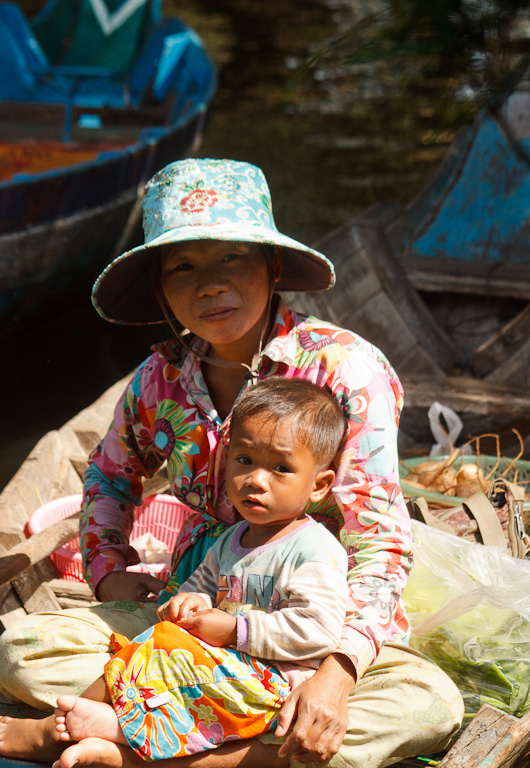
Every week I take my basket of vegetables to sell at a small market  outside of Kampong Phuk. I look forward to this time, when I can gossip with my other friends who also spread out their goods to sell. It helps me forget, at least for a little while, all the terrible things I saw and experienced as a young woman when the Khmer Rouge extended their reign of terror over my homeland. It is nice to see smiles once again on the faces of children, who can play games and go to school instead of slaving away and seeing loved ones being killed. The money I make from my little garden isn’t much, but it’s enough for me to buy rice, fish, and a little oil. Today my sales were even better, enough for me to buy some chicken and even a Hello Kitty pouch for my granddaughter. I am happy again.

See more artworks on www.melissaenderle.com.

Friday, December 18, 2015

Christmas around the world

It is a rainy, Christmas Day morning here in Bali. When the rain lets up, I hope to go on a walk through the rice paddies around Ubud, then meet a colleague who is also in town with her family to have Christmas dinner this evening. Right now it's a great time to finish the post I started before I left Seoul for my trip in Indonesia. 
Bali

On some Christmas breaks, I have taken advantage of the time to travel to new destinations. Many of them were to warmer destinations, but others (such as Eastern Europe) were not. When visiting Pondicherry (South  India) with friends, we were able to visit a church celebrating the birth of their Savior, followed by some festive games. In places such as Prague, I relished in the festive atmosphere of the well-lit city squares, enhanced by Christmas carols. In less Christian areas, we made do with secular signs of the holiday-for instance, the skinny Malaysian Santa at our hotel. 

Next year, my Christmas celebrations will be much more familiar to me, as I will be moving back to Wisconsin. It will be nice to once again be with family as we sing those magnificent Christmas hymns in church, followed by family gatherings and other traditions. 

Wherever you are, a most blessed Christmas to you!

Prague
Pondicherry, India

Penang, Malaysia 

Mesa, Arizona 
Cambodia 
Bulgaria
Bratislava, Slovakia
Udaipur, India 

Pondicherry, India 


Thursday, November 26, 2015

Travel Thankfulness


Seonunsa - South Korea
School is out for the rest of the week - I finally have a chance to take a breath. I am sitting in my cozy warm apartment just steps away from my classroom. With the cold wind and even a few flurries in the air, I was thankful for such a short commute. Our faculty Thanksgiving lunch was started with a prayer and Thanksgiving song, sung first in English and then in Korean. This evening I'll attend another one with some friends, and yet another one tomorrow. So wonderful to be in the company of colleagues, celebrating a holiday where we just begin to touch on the many blessings heaped upon us by our Lord and Creator.   
The Great Wall - China

I'm in my 16th year teaching internationally. What incredible places I've had the opportunity to travel in and to teach. I'll never tire of the incredible beauty that God has created - such diverse landscapes, how He faithfully causes the seasons to happen each year, providing renewal in so many ways. 
Shekhawati - India
Angkor Wat - Cambodia
To explore incredible man-made wonders with friends - and even have a little fun.
Kashmir - India
To meet locals and put a personal side on travels, even if we can't speak the same language.
To witness such generosity and hospitality, freely giving and sharing what little they have. 
Timbuktu, Mali
To witness far-flung places at a time when it was safe to do so. 
Sirogojno, Serbia
To shop with friends and share new experiences.
HaLong Bay - Vietnam
To be able to fly during holidays, transported to a new world and arrive back at school, refreshed.
Taj Mahal - India
To see some Wonders of the World and UNESCO World Heritage Sites
Penang - Malaysia
To view unique crafts being created, including those that are slowly disappearing.
Ella - Sri Lanka


Wednesday, September 04, 2013

Twisted Topiary

With all the perennial bushes within the grounds of Yonsei University in Seoul, it's quite obvious that there are some groundskeepers who are quite skilled in the art of the topiary. It's rare to find bushes here to look like they are in need of a "haircut." Some of the bushes are sculpted in such a way that they look like green puffy lumps stacked one on top of another; others render an almost twisted effect. No sculpted elephants here as I have seen in India and Cambodia, but aesthetic nonetheless.

Tuesday, February 28, 2012

Kampev Buddhist Temple


While in the village, we also visited a Buddhist temple. I was rather surprised to see the floor covered in a film of dust. Although rather large in size, it lacked the opulence that some of the Buddhist temples I had seen elsewhere. Off to one side was a crematorium and next to the temple was a plot to honor the dead, with the stupa-like “gravestones” each seeming to compete through scale and decoration. 
Back in Siem Reap, we thanked our guide for his service that day. Although he experienced many hardships during his young life, I am confident that his wisdom and passion, along with a willingness to work hard will take him far. All the best to him.
Monday, February 27, 2012

Kampev Primary School


Our destination was a local primary school. Children sat on wooden benches, ready to take notes from the teacher’s lecture on the chalkboard. Typical of kids anywhere, our presence caused distraction for some. The teacher of one class called an early recess, with his young pupils quickly darting out of the doorless entryway before any minds were changed. We had seen this teacher earlier today, as he was one of the bullock cart drivers. Even here, the teachers need to supplement their salary! It was fascinating watching the kids play at recess. Some boys were engaged in a marble game, crouching down to the dusty ground in order to get the competitive edge. Most of the other children were engaged in a “try to make it to the other side while avoiding being hit” type of game, but using what looked like a large, weighted badminton birdie. The girls playing were equally as aggressive, throwing the birdie just as hard as the boys and not complaining when they got hit in the head - even though it clearly hurt. Although I am sure that the manufacturers of the birdie device did not intend for their toy to be used in that fashion, these kids sure made it an engaging recess activity.

Sunday, February 26, 2012

Making a Difference


We then walked towards the village. Our guide pointed out various homes, stating that the agency through which we paid for the volunteer activity had funded the roof, another cement walls (vs. thatched), still another a toilet. We saw several wells with the names of donation families. What a difference that well will have in the lives of those villagers...

Saturday, February 25, 2012

Roasted Fire Ants


Done with our light fieldwork, we walked across ploughed fields and in between rows of short corn to reach a house for our next task. Sitting on a plastic tarp in a shaded area, we watched our guide demonstrate how to weave and sew palm fronds which would be used to construct the sides of a house. A young boy wheeled a large wheelbarrow to the  driveway of the house - the same boy we had seen earlier running towards us in the field, firmly clutching a kitten. Although we didn’t see the kitten now, we hoped it was ok. With no more palm fronds to weave, we watched the cooking taking place on the floor of the stilt house. The mother was pounding fish paste with garlic and chilies, while our guide was working on the dish’s main ingredient - fire ants. He explained that the although the delicacy dish was often eaten raw after the ants were pulverized and mixed with the fish paste, he actually preferred roasting it in banana leaves first. Although grateful that the stinging ants were no longer alive, I can’t say that I really appreciated the slightly crunchy dish. Like the other volunteers, I was happy to eat the white bread sandwiches prepared for us. 

Friday, February 24, 2012

Pajamas and Watermelon Seeds


Climbing aboard carts drawn by water buffalo and a bullock, my two traveling companions and the other volunteers enjoyed a dusty ride out into the field. Our presence attracted the children of the village, with uniformed children at the school playground waving and smiling. One young boy ran to our car and followed us to the field, holding on to the back as if he was undertaking a very important job. He only stopped momentarily when he ran to pick up a yellow object he had spotted in a field - a spool of thread. We were taken to our first task - planting watermelon seeds for an illiterate farmer and his wife. They had already mounded the sandy soil, all we had to do was scoop a shallow hole and place five seeds inside, then covering it up. The wife then used her sprinkling can to water the freshly planted seeds, drawing water from the adjacent rice paddy. Village women were working in the rice paddy, planting rice. Despite being dressed in comfy looking pajamas (we found that walking around in pajamas was fairly common in Cambodia), their work looked far casual.

Thursday, February 23, 2012

Kampev Ingenuity


On our free day in Siem Reap, we decided to give back to the community, volunteering in the village of Kampev. Our young guide (who raised himself and brother after his father was killed by the Khmer Rouge and mother died shortly thereafter) explained that the village was comprised of approximately 150 families. As is tradition in villages, we first met the village chief. With his closely shaved white hair, the elder quickly shared his age of 63 - something of which he was proud, as the average life expectancy here was around 50. He gratefully accepted the bags of school supplies and hygiene products we had bought in Siem Reap and at a village market. 

Seeing the quantity of large bags filled with plastic bottles, we inquired about what looked like a collective effort. Smiling with his remaining teeth, the chief explained that the plastic bottles were being collected and filled with rubbish were actually being used for construction. When these bottles were stacked in between wire mesh and then covered with concrete, the walls were actually stronger than simple brick walls. What an ingenious way of solving the litter problem and building walls for schools or homes!

Tuesday, February 21, 2012

Kampong Phluck Floating Village


As part of our tour, we visited the village of Kampong Phluck. Located in Ton Le Sap lake, a motorized boat took us to this floating village. Homes here were built on tall stilts or floating foundation. Getting into a boat and going from place to place looked as natural as getting into a bus. Children dressed in uniforms hurried down the steps of the school to reach the waiting boats at the pier below. Our boat buzzed past stilted homes made out of palm frond thatch, monks getting their head shaved by the river edge, and women rowing boats heavy laden with vegetables just purchased from the small market. 

Chickens clucked about and pigs lazed around in floating cages. Underneath some homes were large collections of rather small fishing traps. Not surprisingly, most of the 3,500 villagers are fishermen. The collection of stilt buildings soon gave way to scattered ones, after which the mangrove trees became more common - but no where as dense as those in the Sunderbans. After a bit, we were in the main Ton Le Sap lake - the largest freshwater lake in South Asia. Of interesting trivia is that that the Ton Le Sap River flows north for about half the year and south the rest of the year, as dictated by the floods of the monsoon rains.

Monday, February 20, 2012

Apsara Dance Performance


While in Siem Reap, we also attended an Apsara dance performance. Much like the apsara (celestial nymph) dancers we saw depicted on the walls and columns of Angkor structures, these danced with grace and fluidity. Movements, particularly the placement of the hands and pose of the fingers was beautiful, but prescriptive. While the announcer was very difficult to understand (other than the word dance), we did enjoy the performance.

Sunday, February 19, 2012

Banteay Srei - save the Best for Last


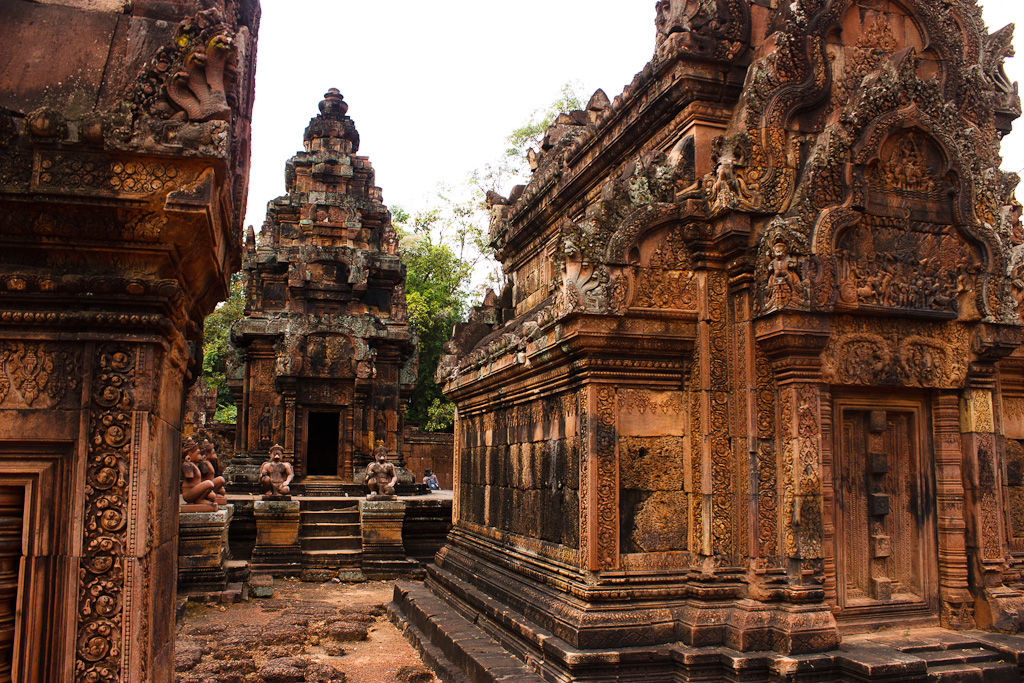
Our last Angkor site was also my favorite - Banteay Srei. Although just a fraction of the size of the Angkor Wat temple, this miniature-sized Hindu temple more than makes up for things with its exquisite carvings. The red sandstone from which most of the structures here are carved was perfect material to achieve and preserve some of the most elaborate, intricate carvings I have ever seen. Consecrated in 967 AD by a counsellor to the king, Banteay Srei was dedicated to the god Shiva. Meaning “Citadel of the Women” or “Citadel of Beauty,” some say such intricate work could only done by the hands of women. Its lintels and pediments were particularly beautiful, but nearly every square inch was covered by carvings or sculptures. A feast for the photographer’s eye! Many of the sculptures found on the site are reproductions, with the originals stored in the National Museum. Additional pieces are housed at the museum in Siem Reap and were easily distinguished from “inferior” carvings from other Khmer sites. Such measures have ensured that at some of this “jewel of Khmer art” will be preserved and safe from the hands of unscrupulous looters. Visit http://en.wikipedia.org/wiki/Banteay_Srei for more detailed explanations and images.
View many more photos of mine on Banteay Srei and the other sites within the Angkor area on my Flickr set .

Friday, February 17, 2012

River of a Thousand Lingas


Still rather early in the morning, we began our trek through the forest to reach our destination of Kbal Spean - known more popularly as “River of a Thousand Lingas.” The shade of the tall trees shielded us from the bright sun. Roots wiggled across the path like snakes, making it imperative to watch one’s step. Rocks and boulders and provided an extra challenge, but some areas had stairs to make it easier to climb upward. About half an hour later, we arrived at the 9th-12th century Hindu carvings.  Clear water glided and over river boulders, some of which contained carved Yoni symbols (womb or sacred temple). Shallow Lingas (representing the male fertility organ) were carved in neat grid rows in the sandstone river bed, reminding me of giant bubblewrap. It was believed that the water was purified as it flowed over the religious sculptures, thus cleansing the king’s sins. On the river bank boulder, a relief carving contained a reclining Vishnu, serpent god Anenta, goddess Lakshmi, and Brahma sitting on a lotus petal. I also spotted a rock containing relief carvings of small figures (depicting Shiva and Uma) riding a bull and other larger figures looking up to them. Additional carvings were found near a waterfall.

Thursday, February 16, 2012

Angkor Wedding

Even wedding couples felt the need to visit Angkor Wat and pose for photos there. I wonder how many bobby pins and hairspray was used for her hairdo...

Wednesday, February 15, 2012

Angkor Wat Temple Complex


Along the outside of the central temple complex is an 800 m long series of beautiful bas-reliefs. One portion depicts a battle scene from the Hindu Mahabarata epic. Another is of a triumphal battle march of Suryavarman II’s army. Our guide pointed out the mercenary Thai army (who wore headdresses, skirts, and carried tridents), the Khmer troops (with breastplates and spears), and the king riding an elephant, shaded by 15 umbrellas and fanned by scores of servants. Part of the south gallery depicts the punishments of hell and rewards of heaven. Another section shows the famous churning of the Ocean of Milk. Some of the relief figures were quite black and shiny, polished by the many hands rubbing their surface. From the top of the temple, we had a panoramic view of the forested area, the libraries with rather intact roofs, gates, and the many tourists walking up the causeway. Despite its popularity, Angkor Wat definitely was not my favorite.

Monday, February 13, 2012

Angkor Wat - Arrival


Finally we reached Angkor Wat. Arguably the most famous of structures in Cambodia, it is the pinnacle for many tourists. The largest within Angkor, it may even be the largest religious structure in the world. Never completely abandoned, Angkor Wat is the best preserved temple in Angkor. Built by King Suryavarman II from around 1113-1150, Angkor Wat was actually dedicated to the Hindu god Vishnu. In the 16th century, it was converted into a Buddhist Monastery and temple, which still functions to this day.

Symbolism abounds at Angkor Wat. The moat (still containing water) symbolizes the seven oceans. The bridge represented a link from the kings to the gods. Its inner wall and towers represent the seven mountains which were home to the gods. The three towers of the Wat represent the three Hindu gods - Shiva, Vishnu, and Brahma. The central tower is meant to be like the mythical Mount Meru, surrounded by smaller peaks and the continents (courtyards). 
Angkor Wat was built on this location due to its proximity to a sandstone quarry, large lake, and fertile land. Over 500,000 volunteers built the structures, believing that their service would provide them a better life. Around 200,000 elephants transported rocks to the site using rattan rope. Sadly, only around 300 wild elephants remain in Cambodia.

Terrace of the Leper King


Next door was the Terrace of the Leper King. According to our guide, the name is actually inaccurate. Rather than being a king with leprosy (toes and fingers are missing), the statue, for which the place was named, is likely Yama, the god of death. This 12th century terrace had five tiers of beautifully carved figures. Female figures dance gaily about, while male figures look rather stern, whose swords are firmly grasped. Some of my favorite carvings were found on an inner terrace. Although unfinished and containing topographical carving marks, these pieces had a beauty unique from all the others.