Showing posts with label palace. Show all posts

Wednesday, December 07, 2016

Artwork: Haegeum Player, Changdeokgung Palace (Watercolor)


In anticipation of an art exhibition, I wrote a short story about each painting, as if written by the person in the painting. These are all real people, and the stories are based on experience, observation, and representative/factual information typical of someone from that region/profession. Some of these paintings are still available, so if you are interested in purchasing one, please contact me.

A lover of music, the prince has invited his guests into the garden area of Changdeokgung Palace for a concert. The other musicians and I sit on embroidered mats arranged on the grass between  the prince’s dwellings. With my legs in a lotus position, I balance the barrel of my instrument on my right foot and anticipate my entry with a hint of nervousness. Taking a deep breath, I rest my left hand over the neck and its two silk strings, while the right hand deftly grasps the horsehair bow. Easing a bit of tension, I gently glide the bow over the strings in order to create a delicate sound. Soon my haegeum is transported into a bird.

See more artworks on www.melissaenderle.com. 

Friday, April 22, 2016

Changdeokgung Moonlight Tour and Injeongjeon Hall

This past week, I went with a few colleagues on the Changdeokgung Moonlight Tour. Held for two nights during the months of April-June and once in March, it is an opportunity for expats to see one of Seoul's favorite palaces in a whole new way. The tour started at 8pm, with the participants (limited to 100 in number) being divided into a number of groups. It was raining a bit, so ponchos were handed out along with LED-illuminated lanterns. After crossing the stone bridge (where a brief intro was given) and through Jinseonmun Gate,  our soft-spoken guide gave us further information at the main Injeongjeon Hall. 
The light rain added some sheen to the stone courtyard in front of the hall. The status markers leading up to the hall were individually illuminated and its ornate exterior glowed in warm light. 
We had a brief peek of the interior, as seen through the opening. 
Ray streamed from beyond the japsang figures on the rooftop of one of the nearby buildings.
With a tight schedule and other groups behind us, we had to move on to the next section of our tour.

See more photos from the Moonlight Tour and other photos of Changdeokgung Palace in my Flickr album

Monday, February 01, 2016

Sultan's Palace, Yogyakarta

The morning after the Wayang Puppet Show, I went to see the Sultan's Palace, otherwise known as the Kraton. It is essentially a walled city, with a population of around 25,000, complete with its own mosque, shops, schools, and more. The façade of this building read 1925, the date when some European touches were added, but the innermost section where the sultan still resides dates back to 1755. 

This grand complex, with its spacious halls, beautiful pavilions, smooth marble floors, and decorative symbolic touches, is considered the epitome of Javanese architecture. 

I especially loved this pavilion, with its music-themed Dutch stained glass and pretty flooring.

The lavish ceiling decorations and chandeliers reminded me of the Chow Mohalla in Hyderabad, India. Both palaces were an interesting combination of European and local elements, with grand imported chandeliers.

 Our palace guide shared with us (in her very thick Indonesian accent) some of the symbolism that abounds in almost everything in the palace - from the trees and flowers all the way down to the decorations. From the image above, the date of that building's renovation could be determined (1 = crown on the serpent's head, 8 = serpent, 5 = giant, 3 = leech).
More beautiful Dutch stained glass and some ornamental teak columns
Many of the buildings we saw were made into a museum holding furniture, clothing, puppets, family photos, gifts to the sultan, and other collections of the ruler.

Over 1,000 residents are employed at the Kraton. 

Saturday, November 14, 2015

A Visit to Cheong Wa Dae

On this very dreary Saturday morning, two colleagues and I toured Cheong Wa Dae, which means "The Blue House." The executive office and official residence of the President of South Korea, Cheong Wa Dae is set amidst a beautiful landscaped grounds. 
It got its name from the 150,000 blue tiles adorning the roof. Each was individually baked to ensure durability of over 100 years.  In the background is Mt. Bugaksan; however, the mists of the rain enshrouded the mountain.

We reserved a tour spot over two months ago. Passports were required, and a security screening was conducted at the time of reservation and a physical one repeated upon entrance into the grounds upon leaving the required shuttle bus. I had to leave my zoom lens at the security check. My colleagues and I each were given an English translation player, as the tour was only in Korean. Schoolchildren comprised most of those on the tour. 
Before our English narration was even completed for each stop, we were herded to the next stop, always accompanied by tall, handsome security men in black suits. At one stop, we were given permission to take photographs in a certain direction, which included the umbrella-shaped bansong tree. One of the guards offered to take our photos, so we obliged.

At the reception hall, about 20 minutes after the tour started, we were asked to give back the required number tag around our necks. It was then that we realized that the tour was over. Another security person arrived with my zoom lens and our passports. 
So long, Cheong Wa Dae!

Thursday, June 25, 2015

Unhyeongung Palace

Unhyeongung Palace was the last palace in Seoul that remained to be visited. Located right by Insadong, its small size, lack of a fancy main gate, and natural colors would make it very easy to pass by without realizing it was a palace. It was constructed in 1864, the first year of Emperor Gojong's reign. Two gates were erected for Gojong and is father Regent Heungseon to easily go between there and Changdeokgung Palace, but they no longer remain. Additional buildings were added for conducting of state affairs, with the formal layout and size exuding the feel of an inner palace. Its triple-fold windows, wood floored storage spaces, and sunscreen eaves are more typical of a palace than the home of a wealthy individual. The buildings also have ondol Korean floor heating systems. After the Korean War, a large part of the property was sold.

Unhyeongung is very easy to get to - just a stone's throw away from exit 4 of Anguk Station, Subway line 3. Admission is free. Twice a year the Royal Wedding Ceremony reenactment is held here.

Right behind the palace is Unhyeongung Yanggwan, a French Renaissance style house built for Heungseon's grandson.

Friday, June 19, 2015

The Art of Maedeup, Korean Ornamental Knotwork

Mrs. Young Ae Lee twists and crosses strings to make the dahoe (cord)
After attending a Royal Wedding ceremony reenactment at the Unhyeongung Palace in Seoul, I stopped for a few minutes in one of the buildings which had an exhibit. Here I met Mrs. Young Ae Lee who is a master of maedeup, an ornamental knotwork of Korea. Literally meaning "knot" in Korean, maedeup utilizes one type of fiber and its finished piece is both symmetrical from side to side and the same on both back and front.
A type of maedeup is a norigae, which comprises of the knotwork, tassle, and ornament. The ornament may be made from precious metals or stones, such as gold, silver, bronze, jade, amber, coral, pearl, or malachite. One's status or importance could traditionally be ascertained according to the size, shape, materials and colors of their norigae. Although natural-dyed silk was used for more expensive pieces, even simpler pieces could be enhanced through embroidery. Norigae are often attached to the jacket of a hanbok, the traditional dress of Korea. Typical of many forms of Korean art, nature was a popular theme. Knots, for example, were made in the forms such as lotus buds, plum blossoms, chrysanthemums, butterflies, bees, and dragonflies. Ornaments included animals such as the bat or tortoise, as well as butterflies, plants (i.e. grapes, peonies), or household objects (i.e. gourds, drums, locks, bells). Symbolism was attached to these ornaments, such as a pepper for a prosperous marriage, a peach for longevity, or tiger claws to repel evil spirits.

Although Mrs. Lee originally learned to do maedeup from her family, she has also refined the craft by incorporating aspects discerned in historical research. Hoping to keep the craft alive (fewer people are learning the skill), Mrs. Lee regularly exhibits her work and teaches others. For others continuing the craft, demand is mostly limited into either high art or for accessories. Future generations may likely need to adapt further in order to survive.

When seeing Mrs. Lee at her maedeup instrument machine, it reminded me of the traditional lace-making I saw in Bruges. To the untrained eye, it looked like haphazard twisting of spools of thread. I hope to revisit this art form at a later time when I have a bit more time and can see more of the design emerge.

Wednesday, May 13, 2015

Temporal and Long-lasting Fixtures at Chunggyeonggung

Nestled under the shade of some tall trees around Chundangji Pond within the grounds at Chunggyeonggung Palace is a 7-story stone pagoda. It is actually Chinese in origin and was brought to Korea in 1470. Its neutral colors contrasted beautifully with the bold spring colors of the blossoming azaleas and emerging leaves of the willows. A harmony between temporal and ancient.
Gwancheondae  - Astronomical Observatory
On the opposite side of the palace grounds is another stone structure. Gwancheondae is an astronomical observatory built in 1688.


Sunday, May 10, 2015

A Walk Around Chundangji Pond

My favorite area within Changgyeonggung Palace is the pond known as Chundangji. The smaller of the two ponds here is the original one, dating back to the Joseon Dynasty. The larger one seen in these photos was built on the site which was once covered with eleven rice paddies which were tended to by the king himself. This pond was built by the Japanese in 1909 for the public to enjoy boating. Although boats no longer float along its serene surface, Chundangji remains a popular place for visitors to walk on the paths around its shores, have a picnic, or feed the ducks/fish. 


Saturday, May 09, 2015

Royal Palace Reborn with Light - Multimedia Light & Sound Show


As part of the Royal Palace tour, we were treated to a light and sound show at Gyeongbokgung Palace. It was cool how the façade of the gate and surrounding building was transformed into colorful blocks, Warhol-esque display, and a path for a swirling dragon.

Wednesday, April 29, 2015

Unhyeongung Yanggwan

Built in 1912, this neo-Baroque home is located behind the Unhyeongung Palace in downtown Seoul. After attending the Royal Wedding Ceremony reenactment at the palace, the gardens of this home provided a peaceful end to the day.

I love the fragrance of lilacs - just wish they'd last longer.

Friday, November 21, 2014

Looking for Details

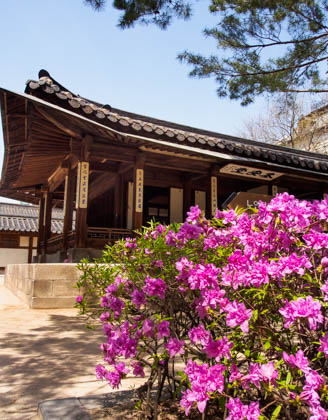
Revisiting places gives me an extra challenge of looking for new things to photograph. This lonely azalea bud looked a bit out of place amidst the flaming red leaves of its bush. I guess it wanted to make a second appearance of the year. Red made another appearance in the photo below, this time at the ornamental carved porch of Jeonggwanheon - a beautiful pavilion I've photographed before.


Wednesday, November 19, 2014

Japsang and Gargoyles, Deoksugung

A splash of color around the more neutral creatures at Deoksugung Palace.

Hamnyeongjeon rooftop with japsang

Distant shot of Hamnyeongjeon pavilion

Monday, November 17, 2014

Changing of the Guard

Warm autumn hues added an extra splash of color for the Guard Ceremony at Deoksugung Palace in Seoul. Although the yellows on the gingkoes was subdued due to the overcast sky, I still liked the repetition of color with these guard's uniforms. 


Saturday, November 15, 2014

Deoksugung Palace, Autumn 2014


Nearly a year to the date that I visited Deoksugung, I made my annual autumn visit to this downtown palace. The overcast sky prevented the beautiful backlighting of leaves or the shadows at the Jeonggwanheon pavilion, but the softer light brought its own unique qualities. 


Sunday, November 09, 2014

Seoul Lantern Festival 2014

One of my favorite annual festivals in Seoul started this past Friday. The Seoul Lantern Festival, held from November 7-23 at Cheonggye Plaza, transforms the downtown stream into a colorful display for all ages. I went with some colleagues on Saturday night. With no wind and pleasant temperatures, it seemed like all of Korea also thought it was a good night to attend the festival. The line just to get down to the stream was jam packed, snaking up the main sidewalk and all around; thankfully people were civil during the LONG wait.
When we finally got down to the stream, a beautiful array of lanterns were before us, enhanced by music. Many were different from last year, but some of my favorites were there once again. Some such as the Jongmyo musicians were life-size. The leaping fish (larger ones seemed to be made from silk fabric) varied from much larger than life-size to quite small. A few such as the turtle ship were even animated; its sail folded up and down and the dragon head puffed smoke.
The large crowd (made a bit more challenging by very narrow pathways in some points) made it difficult to take the time needed to truly appreciate the intricate craftsmanship of these wire armature works of art covered with handmade hanji paper. Photography was more difficult as well, between the large number of "selfie sticks" competing for space and sheer numbers of people sometimes forcing you to move on. I didn't see anyone fall into the creek, but it wouldn't surprise me if it happened. 
The Seoul Lantern Festival still is a "must see" for me and one I'd recommend to others. However, I'd recommend going on a weeknight or right before it gets dark, in order to avoid the crowds.


Created with flickr slideshow.

Here's a short video by the Globe and Mail on this year's Lantern Festival.

Monday, October 06, 2014

Shokun Hall, Kumamoto

Visitors to Kumamoto Castle have the opportunity to see part of the interior. Perhaps the most splendid is Shokun Hall found inside the Hon-maru Goten main hall. Palace reconstruction was done using traditional materials and methods. Its lacquer panels feature tales of the Chinese imperial court. 


Equally beautiful was the ceiling, comprised of lacquered squares, each measuring 90cm. The gold leaf and various plants of Japan was truly magnificent. What an incredible room for which to receive guests!

Saturday, October 04, 2014

Visit to Kumamoto Castle


I enjoying traveling to different places and photographing what "speaks to me" at the scene, but admittedly I am not much for having my own photo taken. After taking a few photos for a fellow traveler, I took up the offer to also have my photo taken with these folks dressed in traditional costumes and corresponding props. Combined with the backdrop of the commanding castle in Kumamoto in Japan, it made for a compelling scene. So yes, I was there! 


Tuesday, September 16, 2014

Taikobashi and Shinjiike Pond, Dazaifu

The bridge within the Tenmangu Shrine in Dazaifu, in its red-orange color, contrasted sharply with the abundant greens of the foliage and muddier-colored water. The Taikobashi bridge is actually comprised of three elements; the first arched portion represents the past, the flat part connotes the present, and the second arched bridge is for the future. Although the arched portions were not smooth, the slight steps were quite gentle.
Shinjiike Pond, I read, is actually in the shape of the ideogram of a heart. With its trees in the island in the middle and pavilions around the edge, it reminded me of some places in Korea, such as the UNESCO "Secret Garden" at the Changdeokgung Palace in Seoul.