Showing posts with label fishing. Show all posts

Sunday, December 11, 2016

Artwork: A Long Night's Catch (Watercolor)


In anticipation of an art exhibition, I wrote a short story about each painting, as if written by the person in the painting. These are all real people, and the stories are based on experience, observation, and representative/factual information typical of someone from that region/profession. Some of these paintings are still available, so if you are interested in purchasing one, please contact me.

I live in a densely populated fishing village in Besant Nagar, Chennai. During the December 2004 tsunami, the majority of the thatched huts in our village were either washed away or damaged. The wooden catamarans and fiberglass boats didn’t fare any better, and most had to be replaced. Even though we received funding to buy new boats and fishing nets, we were given no assistance in addressing sanitation issues. Our homes still lack access to clean drinking water, toilets, and drainage. Despite these challenges, the Christian faith of my family, which we can trace back to the apostle St. Thomas, enables us to remain optimistic. We know God is in control and will work even these challenges for our benefit.

See more artworks on www.melissaenderle.com. 

Thursday, April 02, 2015

Ttangkkeut - Land's End

From the small bus station in Haenam, a couple friends and I took a local bus to Ttangkkeut. Also called Tomal, which means "the Edge of the Land" in Korean, it is considered the southern-most location on the South Korean mainland. Most of the others who also got off here were all geared up for some hiking. 
Before we did a little hiking, we first walked on the pier of this fishing village. Most of the boats we saw were on the smaller side. 

Note the two police boats, including the cute little one on the left.

Out on the pier, we had a good view of the Korea Straights along with the observatory on Sajabong Peak. I liked the small rocky outcropping with the small trees.

Friday, May 23, 2014

Jagalchi Fish Market


Markets are one of my favorite types of places to visit. Everything seems to be a bit more intense in local markets, from the sellers and their wares, to the shoppers. Markets can be an assault on the senses. Being a port city, Busan is known for its seafood. As such, we visited the Jagalchi Fish market, Korea’s seafood market. Much of the market is indoor, but we chose to spend more time walking through the stalls outside. In both, the variety of fish and seafood was quite amazing. Tanks contained live fish and colorful plastic bowls were piled high with mounds of various colored fish and shells. Dried fish in interesting shapes were arranged with care. Fresh seaweed was neatly cut and stacked. Older women, known as “Jagalchi Ajumma” were clearly masters of this domain, donning short curly black hair, long rubber gloves, and brightly colored waterproof aprons and high rubber boots. 
Gaebul spoon worm

Prepared Gaebul, eaten raw


Visitors had their choice of small booth-like restaurants. Nothing fancy, but definitely places to eat fresh catch. Choose your desired seafood by pointing to the tank or bowl, and soon it will be on your plate. We actually ate at the market twice, once having fish & eel cooked on a hotplate right on our table, and the other time eating a most strange spoon worm gaebul, known as the penis fish. Those tubular non-descript creatures that looked more like bratwurst to me were quickly deflated, their insides scraped out. The outer portions were cut up, sprinkled with sesame seeds, and placed on our table, along with some various sauces. Not quite sure how to prepare or eat them, we patiently waited for the lady to return. Meanwhile, she worked on an order for another table, decisively stabbing one end of a still wiggling eel and deftly filleting it. Guts and other unwanted parts of the seafood were scraped together, then the next items prepared. Perhaps a bit puzzled why we were not eating our food, another lady came to our table and gestured that we were to dip the raw fish into the sauce - no cooking! Can’t say that I enjoyed the taste or rubbery texture, but my Vietnamese friend and I did eat it, albeit giggling while we did. Not satiated, we left and ate a bit more familiar food shortly thereafter. 

Friday, August 09, 2013

Mopti, City on Three Islands


December 29, 2000 

Built on three islands connected by dykes, Mopti is the country's major route intersection. Peoples from many groups call Mopti home, including the Bambara, Songhai, Fula, Tuaregs (and their former slave - the Bellasha), Moors, Bozos, and Dogon. Once a Bozo fishing village, it has the largest river port in what was the French Sudan and now has about 100,000 people. Pirogues and their larger counterparts, pinasses, carry goods up and down the Bani/Niger River. Transport is even possible to Timbuktu during and after the rainy season. While in Mopti, we walked over to the busy port. Here we saw slabs of salt and other items that had come from Timbuktu. People were boarding pinasses and pirogues, for either transportation or fishing. 

The Niger river as well as the converging Bani river is much higher than what the Niger is in Bamako. Fishing continues to be of great importance. We also walked through the older part of Mopti. While it too had mud architecture, neither the mosque or houses were as impressive as those in Djenne. On the second day we took a pinasse to the opposite side of the Niger River, to a Tuareg slave village and then to a Bozo village. Drying fish were spread out over the sandy shore.  Like children at other villages, the Bozo children followed us, full of curiosity. However, their energy levels and demands for bics (pens) and bonbons far overshadowed any others. In the evening, we were treated to a glorious sunset while traveling by river back to the hotel. 

Friday, March 23, 2012

A Fisherman Farewell

Determined to make the most of every last moment we had before we had to leave for the one-room airport at Ngapoli Beach, I darted back out to the shoreline. Sporting a Burmese hat, muscle shirt, and a stogie, this fisherman calmly cast his net out into the shallows. His throw was swift and precise, indicators of collective practice. I would have loved to have watched him and other laborers make their living along this beach, but it was time to go. Such tranquil images are how I will remember Myanmar and hope that even when it becomes a stronger player in the tourism scene, this remains.

Sunday, March 18, 2012

Inle Lake Fishermen


Saying goodbye to our cute cabin, we boarded the boat for one last time. Finally, the lake and distant shore were visible - no more rain and fog shrouding the view! With plenty of time before our flight, we convinced the boat driver to make a wide sweep around near the fishermen and then over to a village. The fishermen proudly displayed rowing skills with a foot and fishing using nets or large conical fish traps. 

Sunday, March 11, 2012

Nagging Rain of Inle Lake


Despite the nagging rain, we forged ahead the next morning, braving the cold and wet while traveling across the lake to reach a village. Due to the weather, the lake was devoid of the usual fishermen and gardeners who normally would be tending their floating gardens. We had to trust my friend who had visited here that the beautiful scene she described was a normal sight here. On a positive note, I like the atmospheric effect it created on some distant village homes. It might not have been the type of photography normally achieved on Inle Lake, but I would have to take it.

Saturday, February 25, 2012

Roasted Fire Ants


Done with our light fieldwork, we walked across ploughed fields and in between rows of short corn to reach a house for our next task. Sitting on a plastic tarp in a shaded area, we watched our guide demonstrate how to weave and sew palm fronds which would be used to construct the sides of a house. A young boy wheeled a large wheelbarrow to the  driveway of the house - the same boy we had seen earlier running towards us in the field, firmly clutching a kitten. Although we didn’t see the kitten now, we hoped it was ok. With no more palm fronds to weave, we watched the cooking taking place on the floor of the stilt house. The mother was pounding fish paste with garlic and chilies, while our guide was working on the dish’s main ingredient - fire ants. He explained that the although the delicacy dish was often eaten raw after the ants were pulverized and mixed with the fish paste, he actually preferred roasting it in banana leaves first. Although grateful that the stinging ants were no longer alive, I can’t say that I really appreciated the slightly crunchy dish. Like the other volunteers, I was happy to eat the white bread sandwiches prepared for us. 

Tuesday, February 21, 2012

Kampong Phluck Floating Village


As part of our tour, we visited the village of Kampong Phluck. Located in Ton Le Sap lake, a motorized boat took us to this floating village. Homes here were built on tall stilts or floating foundation. Getting into a boat and going from place to place looked as natural as getting into a bus. Children dressed in uniforms hurried down the steps of the school to reach the waiting boats at the pier below. Our boat buzzed past stilted homes made out of palm frond thatch, monks getting their head shaved by the river edge, and women rowing boats heavy laden with vegetables just purchased from the small market. 

Chickens clucked about and pigs lazed around in floating cages. Underneath some homes were large collections of rather small fishing traps. Not surprisingly, most of the 3,500 villagers are fishermen. The collection of stilt buildings soon gave way to scattered ones, after which the mangrove trees became more common - but no where as dense as those in the Sunderbans. After a bit, we were in the main Ton Le Sap lake - the largest freshwater lake in South Asia. Of interesting trivia is that that the Ton Le Sap River flows north for about half the year and south the rest of the year, as dictated by the floods of the monsoon rains.

Tuesday, November 29, 2011

Canoe Ride in the Sunderbans


Once in the canoe, we were rowed past small fishing boats with a short semi-circular shelter. Kingfisher birds of varying colors perched on top of poles and branches. From the muddy shores, birds such as Indian pond herons searched for fish, tadpoles, and crustaceans. Crabs merrily scampered along the muddy beach. In the calm waters, tiny fish skipped across the surface. The sky now changing from a warm orange to pink, a few fishermen were spotted, casting their nets from the muddy shore. Flocks of birds flew across the sky, mere silhouettes at dusk. With the light rapidly fading, our expert rower navigated to the large boat that would be our abode for the night and tour vehicle the next day. After some live entertainment by several local Bengali musicians, we headed below deck for the night. 


A Marooned Boat and a Mudskipper


Near where the goats were happily nibbling away on the breathing roots of some mangrove trees, a canoe lay marooned on the bed of very mucky clay. A very wet zigzag led down to the river, indicating that even this height would be underwater come high-tide. At this time though, it seemed to be improperly placed.

Walking carefully on the raised mud path, I spotted a mudskipper fish below, successfully walking on the mud with its pectoral fins and looking rather muppet-like with its closely-placed beady eyes.

Thursday, November 10, 2011

Rice Paddies of West Bengal


Reflecting the West Bengali’s steady diet of rice, the fields leading down to the Sunderbans largely contained the tell-tale green of rice plants. Along with fish, rice is a staple of many residents. Alongside the river in some towns, I saw small plots of marigolds, popular flowers in the area for festive occasions. Tied to posts  and tree trucks near the road, goats rested on the edge of the road. Motorists had to watch out for them, lazy dogs, and the ambling cow.

Tuesday, November 08, 2011

Water - Source of Pleasure and Livelihood


Rural West Bengal  seemed to place great importance on water. In some areas, the wide, expansive flat areas edging each side of the road was filled with water. Fishermen stood in waist-deep water, armed with fishing nets and box traps. Narrow, mounded mud served as paths leading to thatched homes and across to other “ponds.” In towns, kids (and adults) happily splashed in the town ponds, playing around or lathering themselves with soap. Women took advantage of the the water to wash clothes and kitchen pots.

Monday, August 08, 2011

Lone Fisherman

Unlike the group of fishermen working in yesterday's post to remove the fish, this fisherman is working alone. He seems to be in a contemplative mood, deep in thought. Perhaps it was an unproductive fishing trip. 

Friday, August 05, 2011

Picking Out the Fish

After an early morning fishing excursion, these men are picking out the small fish entangled in their nets.

Saturday, July 09, 2011

Head of Fish

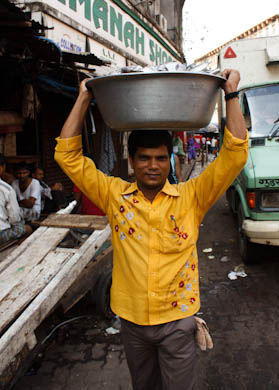
Early in the morning in Mumbai, you can find people walking at a brisk pace, carrying bowls of fish on their head. The fish have just arrived from the sea and scooped into bowls, along with some ice. It is up to these people to take the fish and get them to destinations around Mumbai in a timely manner. This man was walking towards Victoria Terminus.

Monday, May 02, 2011

Cochin, Kerala


The drive to coastal Cochin was a downward one, with the curves of Munnar giving way to leveled, straight roads. We passed through more towns with their share of election posters and deafening announcers, as well as more Christian establishments. Cows seemed to enjoy particular road status in these towns, ambling around and laying down wherever they felt like it.

Just before reaching the modern town of Ernakulam, we stopped at a palace now converted into a museum. The heat and humidity immediately met us as we stepped outside the car. Definitely ice cream weather! The increased traffic of this larger city was quite apparent; at least the roads were straight. That afternoon, we went to the area known as Cochin and saw sights such as the Chinese fishing nets, the rather simple St. Francis Church (one of India’s earliest European churches), Paradesi Synagogue (India’s oldest synagogue), a spice warehouse where workers were placing ginger into large sacks, and a bit of shopping.

Sunday, December 05, 2010

Team Fishermen

When a fishing boat comes to shore, a number of men and boys immediately comes to its aid, helping to push the boat farther on the sand and carry the heavy-looking nets to a flat area near the huts for sorting the catch. A real sense of teamwork and community collaboration.

Saturday, December 04, 2010

Direct Look

There's something piercing about the direct look this boy, a son of a Chennai fisherman gave me. Is it confidence? Yearning? Something else?

Friday, December 03, 2010

Catamaran Fisherman

These log boats - the original catamarans - are still heavily used along the shores of Tamil Nadu. Fishermen, considering the strong waves and undertow, must have great balance in order to ride so confidently.