Showing posts with label church. Show all posts

Thursday, September 21, 2017

Steeple Workers

Early in the morning, the workers were already busy performing exterior cleaning and maintenance to a local church. Reaching the roof and steeple was a quick and easy process. I immediately was reminded of a scene I had seen in Kerala, India. 

This worker utilized ropes (likely coir ropes locally made from coconut fibers) and simple scaffolding to climb up and around in order to do some maintenance work. Keeping it simple, he donned a lungi and went barefoot. 
I'd have to say, the Kerala steepleworker made a much more interesting photo....

Sunday, July 31, 2016

Santa Monica Church of Sarrat

On our way to a small weaving village, we stopped in Sarrat. Here we visited the Sarrat church, more likely known as Santa Monica, and earlier as San Miguel.  The church was constructed around 1669 in the Earthquake Baroque and Neoclassical styles. Large buttresses give the structure its strength and stability. 
Its 137 meter long nave is the largest in the country. After several devastating fires (the church was rebuilt twice), the church was restored for a June, 1983 wedding of the daughter of Ferdinand Marcos. Just a few months after this massive (and costly) expansion and restoration, a devastating earthquake caused massive destruction of the façade and toppled the bell tower. I wondered how ornate the interior must have been prior to the destruction. 


Grotto outside the main church

Crucifix during Holy Week against the exposed bricks


An open shutter reveals the thick brick walls of the church


A bridge staircase connecting the church to a convent was constructed in 1799. Despite the earthquake and other destructive forces, it was still in rather good condition.

According to our local guide, this was once a torture room.

The church has now been declared by the government as an important cultural heritage property. It is hoped that this will provide funding needed for restoration.

The town of Sarrat is also known as the birthplace for  President Ferdinand Marcos.


Tuesday, July 26, 2016

Sinking Bell Tower

One of Laoag's famous monuments is known as the Sinking Bell Tower. Built around 1707 by Augustinians after an earthquake, it is one of the oldest and most massive bell towers in the Philippines. Standing at 45 meters ( feet) tall, the structure is of the earthquake baroque style, constructed of locally manufactured bricks, joined with molasses and plastered with lime stucco. The massive base whose foundation is 90 meters (300 ft) supports its graduated upper tiers and is topped with a dome and cross. 

Like other earthquake-proof baroque style buildings, the tower has sturdy buttresses and is separate from St. William's Cathedral, which is actually 85 meters (279 ft) away. 


Built on sandy soil, the tower has been sinking at a rate of 2.5 cm (one inch) per year, thus lending its landmark name. At one time, a horse-mounted rider could once enter the vaulted door quite easily; now even a person of ordinary height would have to stoop. Despite its sinking status, the tower still performs its function of calling its Catholic members to mass via massive bells. 
When I visited the Ilocos Norte town, entry inside the tower was not permitted.

Sunday, March 27, 2016

Philippino Easter


Wishing you all a Blessed Easter. The images below were taken inside a church in Vigan, Philippines.


Monday, December 21, 2015

Preparations for the Christchild


Outside the Myeongdong Cathedral in Seoul, a worker assembles the nativity scene. It was rather refreshing to see such public displays of CHRISTmas.  

Thursday, December 17, 2015

Interior of Myeongdong Cathedral

The interior of the Myeongdong Cathedral is quite beautiful. In a typical Gothic Revival style, the ceilings are high and vaulted. 

Stained glass windows provide light, decoration, as well as illustrate stories of the Bible and the Rosary. Originally created by the Benedictine Monasteries in France, the windows were restored in 1982.
Nativity and Adoration of the Magi

Jesus and His Twelve Disciples

The Fifteen Decades of the Rosary

Pipe organ
I'd love to hear these pipes bellow out the organ sound.
Statue of St. Kim De-gun
Although it is an active church, visitors are welcome. If you're in need of a quiet solace from the hubub of the nearby shopping, check it out!

Tuesday, December 15, 2015

Myeongdong Cathedral and a French-speaking Korean Nun

Prior to visiting the Christmas lights around the shopping area of Myeongdong, I visited the Myeongdong Cathedral. The Catholic church was established at the site in 1784. With its brick, Gothic style, the Cathedral (built in 1898) is a stark contrast to the modern, commercial area around it. 
During the 1970's and 1980's, the Myeongdong Cathedral was a focal point for the democratic movement in Korea, as well as for the advocacy of the advancement of human rights. It continues to be very active in mission work as well as support of the local community. 

As the first church in Korea that is built in the Gothic style, Myeongdong Cathedral has been designated a historical site. Typical of many Gothic churches, it has a Latin Cross floor plan with a center and two side aisles. Its roof is 23 meters (75 feet) high, with the bell tower 45 meters (148 feet) tall. The exterior lacks any significant decorative elements, such as gargoyles.

When I stopped to take the exterior photo at dusk, a Korean nun stopped to greet my friend and me. After inquiring about where we were from and what brought us to Korea (my friend and I are both teachers at Seoul Foreign School), the nun switched from Korean to a mixture of French and English. She explained that she has been living in France. Although my French was a bit rusty, it felt good to be able to converse a bit - vs. my nonexistent Korean! It did feel a bit strange speaking French to a Korean nun.

Monday, February 02, 2015

Up on the Hill


On our way up the stairs to the natural vantage point of Melaka known as St. Paul's Hill, I admired the banyan tree. A white statue of St. Francis Xavier greeted us.  Our guide of South Indian descent proudly explained how this Jesuit priest visited Melaka several times and used Melaka as a base for his missionary visits to Japan and China. In 1553, his incorrupt body was temporarily buried here (later that year he was buried in Goa, India). St. Francis Xavier's open grave (covered with a grate) is still present within the church. The statue was erected in 1952 to commemorate the missionary's 400th anniversary of his travels to Melaka.

St. Paul's Church was originally built by the Portuguese in 1521 and was consecrated to the Virgin Mary. The Dutch then used the enlarged church as its main church for 112 years until the iconic Christ Church was completed in 1753. At that time, it was modified and became part of the fortification. Further deterioration occurred when the British took over in 1824, using the structure for powder magazine. 

During excavations by the Melaka Historical society in 1930, Portuguese gravestones from the hill were affixed to the interior walls of the roof-less structure. 


Sunday, January 25, 2015

Christ Church, Melaka

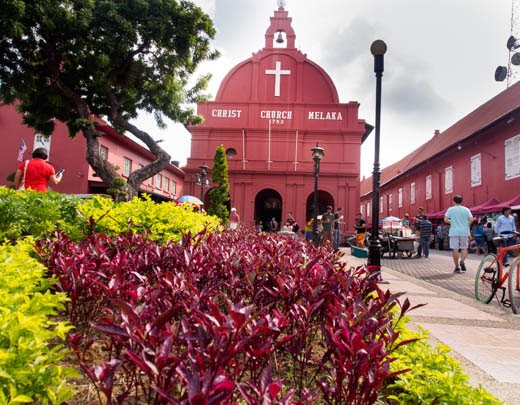
Perhaps the most photographed building in Melaka is the Christ Church and is the oldest functioning Protestant church in Malaysia . Built in 1753 with bricks brought from Holland, the church sits at the heart of what is known as the Dutch Square. The Christ Church was repainted to more closely match the pinkish original bricks, starting a fashion trend for façade colors in the vicinity.

Our tour guide pointed out its original door with characteristically large hinges. Overall, the interior was quite simple and unadorned. The pews, pulpit and windows were original.  Dark 30 foot beams spanned the ceiling, each from a single tree. Lining its floor are several tombstones written in Portuguese and likely from St. Paul's Church within the fortress.


Saturday, January 19, 2013

Built on a Firm Foundation

In the Bible book of Mark chapter 7, it talks about building one's house on a rock - a firm foundation, as an allegory for establishing a firm foundation for one's faith. I'm not sure if the sculptor Staude had this in mind when he conceived the Chapel of the Holy Cross or when the architect Strotz built the Catholic church in the beautiful red rocks of Sedona, but that's what came to mind for me when I saw it. Set amidst the Coconino National Forest (it seems a bit strange to me to see some forests in Arizona that are devoid of trees), the Chapel of the Holy Cross was completed in 1956, after decades of searching for the perfect spot. Just a year later, it was given the Award of Honor by the American Institute of Architects. It is now on the list of National Register of Historical Places.


A bright, clear day with the warmth of the sun, we walked up the steep curving road to get to the church. The massive cross, silhouetted against the panes of windows comprising nearly the entire front of the church interior, commanded its presence. What a view worshippers have, with the blue sky and red rock vistas! Lining the sides of the wall were rows of candles, lit in identical red jars. Although the lofty ceiling gave the church interior a vertical spaciousness, it didn't seem like the space would hold that many people for a service. Considered bold and audacious at the time of construction, it now is a major destination for visitors to the Sedona area, welcoming people of all faiths to enjoy its majesty.


Tuesday, June 19, 2012

Last Ride from School: India Reflections

School has ended. Lots of hugs and goodbyes, adding in phrases such as "keep in touch on Facebook." After four years teaching at the American International School in Chennai, it was time to move on to yet another chapter of my life. An autorickshaw driver took me on the familiar path back to my apartment, now empty of my belongings. We scoot past the road in front of school, its one side still a long ways from completion, despite over a year and a half of construction. Once on the IT highway, we pass by modern complexes housing various software and IT companies. The light in front of us is red, causing an immediate backup in traffic. The autorickshaw driver wiggles his yellow contraption through the space between a city bus and a produce truck; a motorcyclist squeezes between that. Immediately the heat and humidity hits inside the still vehicle. Concrete walls are painted with colorful slogans of the current movie star-turned political leader of the state. People congregate in an unmarked area for boarding busses. A bullock cart hauling potted flowers ambles by. Cheap sandals are sold next to a cart overflowing with fresh mangoes. Incense from a Hindu temple momentarily intermingles with smells of the street. Now past the strong odors of a poultry shop, we turn on the street where a sari-clad woman picks out select produce, next to a man sitting on the sidewalk repairing shoes, and a coconut seller after that. Turning at the next corner, the driver pauses momentarily to let a truck pass through the narrow space remaining from an unfinished pipeline project. Following the entrance to a Pentecostal missionary, we arrive at the spot I hate most about my neighborhood (and actually India as a whole) –garbage. This eyesore is a perpetual sight, strewn about in front of an apartment building. At least the goats are enjoying themselves there. Having turned onto my street, I glance at one of several apartment construction projects going on, transforming the neighborhood from its primarily single-dwelling homes. Spotting the small convenience store I had frequented for basic supplies over the past 2 1/2 years of living in this neighborhood, I motioned the driver to stop. My last ride in these yellow 3-wheelers –my primary mode of transport– was over. I presented one last doctor's prescription at the tiny pharmacy and watched as one customer searched through a selection of phone recharge cards and another eagerly grasp a small glass bottle of Coke presented from behind the counter. It took the manager a bit longer than normal to find the diminutive packet amongst the myriad of small boxes labeled with several meds each, but thankfully he was successful. To the right of the pharmacy was a small Hindu shrine, with its jasmine garlanded idol inside. Although I didn't yet see the local who dutifully tended the shrine and swept up around it, he cheerfully waved at me minutes later as I walked towards my apartment. Spotting the cluster of bamboo in front of a building, I knew mine was next. Soon I would be transferring this tropical scene for a Midwest American one.

Sunday, December 25, 2011

Merry CHRISTmas

From the streets of Pondicherry to the coconut groves of Kerala, some in India are celebrating the most important birthday recorded in human history. No, not a Bollywood (or Kollywood) movie star, and not even that of a politician. It is someone who grew up in very humble circumstances - much like the village huts of the India of today. This individual was Jesus -or Immanuel, which means God with us. I pray that the Christians of India will hold fast to the true reason for Christmas - the birth of our Savior. Happy birthday, Jesus! 

Sunday, October 16, 2011

Poondi Matha Basicilica

Our final place of pilgrimage in Tamil Nadu was to the small village of Thiruvaiyaru Taluk. Amidst the emerald green paddy fields rose the large basilica known as Poondi Matha (meaning mother in Tamil). Erected in the late 18th century, this white structure of Gothic and French style was elevated to the status of minor basilica by Pope John II in 1999.

Like other churches along the pilgrimage path with Velankanni, Poondi Matha attracts large numbers of visitors around the time of the festival in Velankanni. The basilica has been enlarged due to donations and even contains an upstairs room that is air conditioned - a definite incentive to meditate!  Masses were held on a rotating basis in multiple languages, accommodating the various places of origins for these Indian visitors. More housing and eating facilities have been erected to try to accommodate the swell of visitors. Some still elect to cook and/or sleep outside - which is fine until the downpours come!

The Poondi Matha houses a tiny fragment of what it claims to be a piece of the cross of Christ. People kissed the glass in front of the relic as they walked by, then spending more time in front of the large statue of Mary and infant Jesus. Once again, Mary was clad in a silk sari (several more were draped in front of the display - gifts of devotees), gold chains given by people, and floral garlands. More garlands were tied in front of the display, constantly refreshed by people. Off to the side, a worker took off some still-fresh garlands and began (much to my horror) ripping them apart and tossing the roses and other flowers in what looked like a waste basket.

Thursday, October 13, 2011

Coming in With Mary

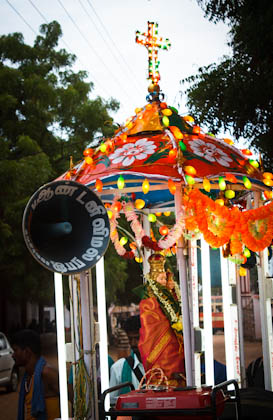
On our way to the Idaikattur Church in Tamil Nadu, we passed by a fair number of religious pilgrims walking alongside the road, all bare-footed. Most carried few possessions - typically what they could carry in a small bag. One group proudly pushed along a religious "chariot." Except for the cross on top, one could at a distance forgive it for being for a Hindu ceremony. Loudspeakers, powered by a large battery, broadcast praises of Mary to Christian and Hindu households alike. 
Wearing a silken sari, garlands made of fragrant flowers, and a large crown on her head, the statue of Mary dominated the chariot interior. Struggling to emerge amidst the cloth was the child Jesus. 
Now nearing dusk, the colorful decorative lights adorned the roof and cross. People gathering around the chariot began singing in unison, accompanied by drums. The positive energy was strong, evidence of the passion and devotion of all gathered.


Thursday, September 22, 2011

Tsunami Miracle at Velankanni


On December 26, 2004, over 2,000 pilgrims were taking part in a Mass in the main basilica. Along with other coastal areas of Tamil Nadu, the small coastal town of Velankanni was not spared, devastating the entire town. The only building that escaped destruction was the basilica, sparing all those lives. This is particularly remarkable considering that buildings on the same elevation, located even further inland, were destroyed, while the inside of the basilica remained completely dry. Many consider this a miracle, performed by the loving, protective hand of God.
A similar incident occurred in Chennai, near Marina Beach. St. Thomas Basilica, located right by the sea, was spared from the tsunami, with the devastating waters parting just before reaching the church’s backside. While the church was untouched, the waters spread past the road further inland. 
St. Thome Basilica, Chennai

Wednesday, September 21, 2011

Velankanni Night Splendor

Velankanni Basilica, lit up at night, as seen from the hotel window
Oh, how tranquil it looks! Not visible (but present): throngs of people camping out at night, still worshipping within the different chapels, stalls selling goods and making food, and much more.

Tuesday, September 13, 2011

Along the Path to the Tank


The path between the chapel at “Our Lady’s Pond” (site of the first appearance of Mary) and the main Basilica is filled with sand. Some devotees crawl or walk on their knees all or part of this distance as a way of showing gratitude, showing penance, or making a request. Others walk on foot, chanting, fingering rosary beads, and praying. Along the way, sculptural Stations of the Cross and Stations of the Rosary provided reflecting points. Thankfully, this path is kept quite clean and the middle part less crowded, making it easier to embark on the journey. 

Monday, September 12, 2011

Each According to Their Own Faith


Visitors of all faiths come to the Basilica of Our Lady of Good Health hoping to be cured of medical ailments, resolve fertility issues, and receive blessings. Much as I saw in a Hindu temple in Gujarat, devotees can buy a silver, gold, or tin offering in the shape of the affected body part.. Garlands of flowers to drape over statues of Mary were popular purchases. Some also brought gold chains and saris. Hindus could be seen carrying platters of coconut halves, camphor, bananas, and flowers. In one chapel, they brought in baby coconut trees as an offering for fertility. Of course, money, placed in large locked boxes near the front of the chapels, is always welcomed. As people inch their way up to the altar or while sitting on the crowded floor, ritual actions are made, each according to his/her religion. Even during a Holy Mass, people of various faiths are present; it may not be until the distribution of the Lord’s Supper that one can distinguish the Christians from non-participating others. 

Sunday, September 11, 2011

They All Go to Velankanni

I was one of over three million people descending upon the small (5,000 residents) southern Tamil Nadu town of Velankanni during the nine day festival which just ended on Sept. 8. People from all over India and elsewhere travel by train, plane, boat, car, and foot to reach this famed place called the “Lourdes of the East.” 
During the nine day festival which culminates on Sept 8  - the day of Mary’s birth and also the date when the sailors were saved from the storm - various forms of worship such as Holy Mass, blessings of the sick, and prayers & meditation occur in the basilica and chapels. Depending on the time of day, visitors can hear services in one of nine languages of India, including English.
Mary is reported to have made several appearances in this area. Around 1560, she first appeared to a Hindu milk boy (whose pot of milk overflowed after giving some go the infant Jesus) , then to a lame boy selling buttermilk (who was healed), and then to save Portuguese sailors from a dreadful cyclonic storm. Chapels were then built on these sites and were subsequently expanded.

Visiting Velankanni during the eight-day festival or other special occasions such as Christmas is not for the faint-hearted. It is chaotic, crowded, intense, color - in other words - so India. 


More to come!