Showing posts with label Georgetown. Show all posts

Thursday, April 09, 2015

Ah Ban Paper Oblation - Finished Piece

Later that afternoon, we returned to the Loh An Ban family Paper Oblation Shop. The piece the family had harmoniously been working together on had not yet been completed, but it was nearly done. Ean's mom brought over the garden stairway area that she was currently working on.
The brilliantly patterned paper piece reminded me of a doll house. Looking closer, one could see modern conveniences such as a car, bicycle, refrigerator, LCD TV, air conditioner, phone, cooking area (more traditional), and 3-d paper table and chairs. Representations of gold and silver were also included. 

Inside the paper oblation house

Ean estimated that the cost for a paper oblation house of this size and complexity typically went for around 1,100 myr, which is around $300. And to think that such a beautiful piece of handmade art would go up in flames in a matter of minutes. Ean's brother in law is training to take over the family trade from her father Mr. Loh An Ban. Let's hope that the art form is preserved through the unified efforts of this family.
Complete with a 3-d car


Tuesday, April 07, 2015

Ah Ban Paper Oblation Workshop

Mrs. Ah Ban works on the paper figures
It was through a very unassuming narrow alley past a Trek bike shop that I experienced one of my biggest highlights of my time in Penang. A dog keeping guard at the shed announced our presence, but a young woman named Ean greeted us in English. She welcomed us to come inside the large shed where her father Mr. Loh An Ban, mother, brother, and another family member all worked to create paper oblations. (According to the brochure Ean gave us, the shop actually employs 8 workers).

For over 40 years, Mr. Loh An Ban has been making paper oblations for the Chinese community in the area. Daughter Ean explained that the Chinese believe that the spirit of the dead person needs a place to dwell and enjoy the comforts of life. In Chinese custom, miniature replicas of the home, servants, worldly possessions (i.e. TV, car, cell phones) are burned for the newly deceased to accompany them to the afterlife. Such oblations are only made for those who had been married. If a person couldn't afford an oblation at the time of death, the family would wait until another member died, at which time a figure for that person would be included as well. The paper oblations are typically burned at home or at a temple, but a fire department must be present at the ceremony.

Her family is one of a few that still make these oblations in Penang. The number of craftsmen in China is rapidly decreasing as well.  Special figures are made at the time of the Ghost Festival which is usually held around August. The large paper effigies of Chinese gods are also made to commemorate deities' birthdays. Ean has incorporated the skills learned from her father (it takes over 10 years to learn all the parts of this craft) and combined it with her graphic design degree training to create contemporary items for others such as Christmas trees.   

Ean's brother forms the main structure, attaching the wood with strips of strong rice paper and flour-based homemade glue
 Her family had all been working for a couple of hours on this particular oblation for a man who had just died. They anticipated finishing it later in the afternoon and encouraged us to return then. More complex ones might take several days to complete.
Mrs. Ah Ban attaches thin paper with flour-based homemade glue

Beautiful patterned paper


Ean, father Loh An Ban, and mother

Friday, March 20, 2015

Wedding Photos at the Pinang Peranakan Mansion

While wandering through the Pinang Peranakan Mansion, we spotted this newlywed couple posing for photos in a bedroom. I read that you could rent the mansion and grounds for venues - certainly an ornate, unique location!

Wednesday, March 18, 2015

Lifestyle of the Babas and Nyonyas - Penang

One of many period photos of the Baba-Nyonyas
Within the many rooms of the Pinang Peranakan Mansion, visitors were given a glimpse of the opulent lifestyle of the Baba-Nyonyas particularly unique to Penang and Malacca. Artifacts from these Straights Chinese settlers filled every nook and cranny of the museum, to the point of visual overload. No minimalistic neutral decorating here! One cupboard would have ornate Chinese-style jewelry; another was filled with a large collection of British porcelain dinnerware, and yet another displaying colorful hand-blown glass vases. In the bedroom were neatly folded or hung contrasting batik and embroidered clothing worn by the Nonya women. 

Embroidery and textiles decoration on a bridal chamber bed

Such lovely textile work
Bridal chamber bed and other ornate bedroom accessories
One of three bridal chambers from three different eras from the 1900's - 1950's

Decorative fan and jewelry

Enormous painting of Kapitan Cina Chung Keng Kwee's grandmother - one of several commissioned paintings of his family

Detail of a  large ceramic vase


Heavy mother-of-pearl embedded teak furniture on English floor tiles

Ornamental casket perfumer

Wedding basket and porcelain

Detail of a portrait painting

Monday, March 16, 2015

Grandeur of the Pinang Peranakan Mansion

A "not to be missed" destination in the historical Georgetown area of Penang, the Pinang Peranakan Mansion is well worth the admission cost (20RM - approx $5.40). Built at the end of the 19th century, this mansion is an excellent example of the eclectic Baba-Nyonyas incorporating Chinese, Malay, and British architecture. After suffering from decades of neglect, the mansion was fully restored and is now a museum that recreates the traditions, lifestyle and culture of the wealthy Baba residents. In addition to the beautifully restored interior, it overflows with antiques and collectibles of the era. Unlike some of the other Baba-Nyonya museum/homes I had visited in both Penang and Malacca that required a guided tour, we were free to explore the two floors, adjoining ancestral temple, and a special jewelry museum. 

For more information, visit the museum's website.

English floor tiles

Central courtyard with an open airwell and stairs leading up to the second level. This allowed for air and light to freely circulate and rainwater to be collected.

Ornate carved wooden doors leading to a room with heavy teak furniture and an altar

Tranquil room with bamboo and a small pond

Carved wooden screens gilded in gold and flecked with mother-of-pearl

Sunday, March 15, 2015

Ancestral Tablets of the Khoo Kongsi Temple

Ancestral Tablets at the Khoo Kongsi Temple in Penang, Malaysia
An important part of any Chinese clan temple are the ancestral tablets. Following the belief that the spirit of the deceased continue to have influence on the living relatives, the ancestors are worshiped. This practice shows deep commemorative respect for the ancestors and is an act of filial piety. 
During special days, special ceremonies take place for worship as well as enshrinement. Ancestral tablets are arranged according to position within the clan.

Jongmyo Daeje Ceremony in Seoul
In Korea, the Confucian philosophy of ancestral worship is present in various levels. Annual Daeje ceremonies are held at the Jongmyo Royal Shrine in Seoul. Here, the ancestral tablets of royalty are enshrined. The ceremony with its rites and music is now a UNESCO Masterpiece of the Oral and Intangible Heritage of Humanity designation. Read about my visits to the Jongmyo Shrine and the Daeje ceremony.


Friday, March 13, 2015

Murals of the Khoo Kongsi Temple

Filling both the left and right walls of the temple are the murals depicting Celestial Guardians. Each wall portrays 18 of these message carriers - a common Fujian theme. Of both male and female genders, the detailed figures each ride an animal and carry a unique weapon.   

The artist known as Yeoh Boon Ngah the Hermit also painted several other murals in the temple, including the one above (detail shown), entitled "Hundred Sons and Thousand Grandsons." The level of preservation of these highly detailed murals painted over a century ago is quite impressive.

Read more about the murals at the Khoo Kongsi Temple.


Wednesday, March 11, 2015

Stonework of the Khoo Kongsi Temple

Due to generous donations to the clan, the Khoo Kongsi Temple includes some magnificent stone carvings. The stones were imported from the Fujian province in China. With just a hint of color, the rather neutral stonework contrasted with the brilliant gold and reds of the hall's interior. Ventilated windows came in round, octagonal, and rectangular shapes, each placed according to the hierarchal order of the Souther Fujian architecture. In addition to being decorative, the stone carvings filling the walls of the temple are full of symbolism and depict stories.

One of two lions facing towards the main hall, playing with two coins.

Stone child symbolizing beckoning of wealth
Read more about the stonework of the Khoo Kongsi Temple.

Monday, March 09, 2015

Khoo Kongsi Clan Temple

Due to clan ceremonies that were taking place in the morning, we had to return after lunch to visit the Khoo Kongsi temple. Thankfully, the extra time and even admission fee was worth it. A narrow, rather simple alleyway entrance suddenly gave way to a wide square. 
According to the official website, the Khoo Kongsi consists of an administrative building, opera stage, meeting hall, and 62 units of terrace houses and shophouses. The dense conglomeration of buildings with the three not-so-obvious entrances really evoked a sense of defensive protection as well as the communal closeness of the clan. Just as in the souks I had visited in Tunis and Sousse, it would take a bit of effort for unwanted visitors to reach the heart.  Located in the heart of historic Georgetown, this elaborate temple is a popular tourist attraction. 

 The Leong San Tong temple was by far the most decorative of the buildings, with the current structure completed in 1906. The temple's intricate wood carvings and richly ornamented beams were created by the finest craftsmen from China. 
Once again, we were on visual overload. Every single view was a feast for the eyes. I could have easily taken many more photos of just the main temple, not to mention wander around the complex and capture some of the architectural beauty of the rest of the buildings. Lack of time (and of course the ever-present rain) meant that we had to move on.
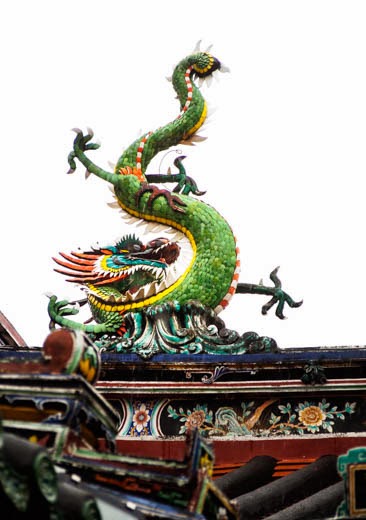
Note the dragon "gargoyle"
If you are interested in learning more about the Khoo Kongsi Temple, do visit its comprehensive website.

Friday, March 06, 2015

Chein Nien of Han Jiang Teochew Temple

Chien Nien porcelain mosaics and figures on the rooftop of the Han Jiang Teochew Temple in Georgetown. With its fairly recent restoration, the fragile artwork was still in good repair. Photography was marred by the heavy rainfall, in terms of contrast, color, and number of photos. Fiber optic lighting helps illuminate the workmanship at night.


Wednesday, March 04, 2015

Doors of the Han Jiang Teochew Temple

The doors of the Han Jiang Teochew Temple are noteworthy, not only in their size (13 feet/4.1 meters - tallest main temple doors in Georgetown) but also their beauty. The main entrance has three sets of paneled doors.

Quin Shu Bao
 On the main door are the martial Door Guardians - Qin Shu Bao and Yuchi Gong, who were generals of the Tang dynasty. These two warriors wear armor containing the dragon and phoenix motifs. Their helmets are embossed in gold. In their hands are rare weapons.

Robe detail of the martial Door guardian
Civil Door guardians
On the side doors are the Civil Door guardians. Their head gear and held wine cups connote aspirations for official ranks. Two servant women fan the men.  


Monday, March 02, 2015

Han Jiang Ancestral Temple, Penang


Also known as the Teochew Temple, the Han Jiang Ancestral Temple was built (1870) to serve the early Teochew settlers from the Guangzhou district in China. It is the only temple in Georgetown of the Teochew style. The temple houses an altar to the patron Taoist god of the North as well as ancestral tablets of deceased Teochews. 

Like many of the temples and other old buildings of the area, Han Jiang Ancestral Temple fell into disrepair, wear and tear, and unaesthetic additions, particularly when used as a school. In 2002, a committee was formed to begin restoration. Extensive funds were raised, research on the original structure conducted, and skilled craftsmen were brought from China. The temple's conservation of tangible and intangible heritage was recognized with a UNESCO World Heritage Conservation award in 2006.
Panels, murals and altar


Dragon mural near the entrance

Beautiful geometric tiles grace the floor
I enjoyed reading about the conservation work at the temple and looking at its superb craftsmanship. Knowing that there were so many other places to see, we knew we had to move onward.