Showing posts with label mosaic. Show all posts

Monday, June 26, 2017

Liberty and the Branches

Right below the rotunda, one can find four beautiful mosaics. Made by Kenyon Cox, Liberty and the branches of government are represented. Each measures about 28x20' and contains about 10,000 pieces of glass. The tiny hand-cut pieces are made from many different types of glass, including opaque, colored, shiny, and matte, with backings of aluminum and copper.  Considered some of the finest glass mosaics in the world, the varied glass types create a strong dimensional effect.

Liberty mosaic

Justice mosaic

Justice mosaic (detail)

Legislation mosaic

Government mosaic

Monday, May 08, 2017

Thuburbo Majus - Ancient Roman Site

While living in Tunisia, one of the sites I visited was Thuburbo Majus. Located about 60 km southwest from Carthage on a major thoroughfare connecting Carthage to the Sahara, it is a significant Roman site. Originally a Punic town, it was founded around 27 AD by the Romans as a place where army retirees could settle. Much of the trading town was built around 150-200 AD and prospered as a center for growing grain, olives, and fruit. 

Excavations began around 1916 and again around 1925 and the 1950's. Like many Roman sites in Tunisia, there likely is much still that remains below the surface. Now, visitors to this very rural site will find sheep grazing nearby, perhaps even walking over the large mosaics still in situ. Most of the significant mosaics and baths, along with a massive head of Jupiter are now in the Bardo Museum. Despite it not being as well known as Carthage, many of the impressive pieces in the museum were from Thuburbo Majus. I visited the site several times, but found it most beautiful when the fields were green and yellow flowers abounded. 

One of the more prominent structures at Thuburbo Majus is the Capitolium. Here, a fairly intact olive press can be found. At the center of the town was the forum. Many of its columns still stand. Near the forum can be found remnants of a market, shops, and a basilica.

Friday, March 06, 2015

Chein Nien of Han Jiang Teochew Temple

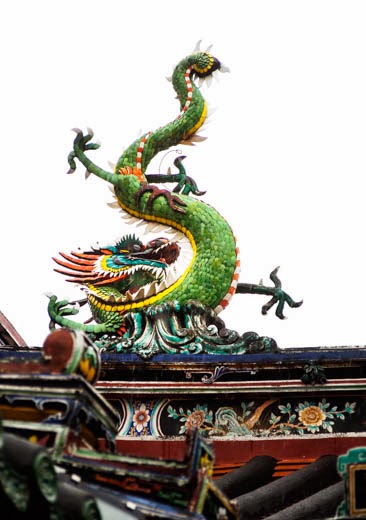
Chien Nien porcelain mosaics and figures on the rooftop of the Han Jiang Teochew Temple in Georgetown. With its fairly recent restoration, the fragile artwork was still in good repair. Photography was marred by the heavy rainfall, in terms of contrast, color, and number of photos. Fiber optic lighting helps illuminate the workmanship at night.


Tuesday, July 08, 2014

Mosaics in the State Capitol

Illuminated by the soft natural lighting from the rotunda, the four glass mosaics on each of the pendentives are worthy of attention. Representing the three branches of the state's branches of government as well as Liberty, each mosaic contains around 100,000 glass pieces. Recent restoration of the mosaics reveal the brilliant colors used by artist Kenyon Cox (1856-1919).


Sunday, March 04, 2012

Onward to Bagan, Shwezigon Pagoda


After five flight ascents and an overnight (Christmas Eve, mind you) in the Bangkok airport, we arrived in the ancient city of Bagan. It was founded in 849 AD and experienced its height as the first capital of the Burmese Empire between the 11th and 13th centuries. It is during this time that the majority of Bagan’s pagodas and temples were built. At one time having over 5,000 pagodas in a 40 sq. km (16 mi) area, only a little over 2,000 remain after a devastating earthquake in 1975. When the Mongul emperor Kublai Khan invaded the area, Bagan’s glory days were abruptly ended, with the city was abandoned.

One of the first places we visited was the Shwezigon Pagoda. Built around 1076 AD to enshrine one of four replicas of the Buddha tooth housed in Kandy, Sri Lanka, the large golden bell-shape of the pagoda surrounded by smaller structures, and rest areas, reminded me of the Shwedagon Pagoda we had seen the day before in Yangon. According to our guide, the pagoda was constructed from sandstone, instead of the normal brick material. Around the base of the pagoda are enameled panels illustrating scenes of the Buddha’s previous lives. I liked the highly detailed and beautiful old wood carvings in one structure depicting the story of Buddha’s life. In one room, 37 pre-Buddhist nats (spirits) of varying sizes were housed. The enshrined figures seemed a bit reminiscent of Hindu gods.


Thursday, March 01, 2012

Shwedagon Temple Details, Yangon


Encircling the pagoda were a series of small shrines, one for each day of the week and two for Wednesday. Devotees would offer flowers, prayers and pour water on the Buddha image corresponding to the day of the week on which they were born. Within the complex were other sheltered areas for meditating, praying, bring offerings, and placing requests. The structures were quite ornate, both in its interior and the roof. Glass mosaic columns reflected the colors of their surroundings. In various areas, people were enjoying their picnic lunches, absorbing the dynamic peacefulness and excitement. The gentle gong of drums and tinkling of chimes and bells managed to be heard above the voices. 

Thursday, April 07, 2011

Itimad-du-Daulah


Described as a “jewel box in marble,” this tomb of the “Lord Treasure of the Mughal empire under Shah Jahan is also nicknamed the “Baby Taj.” Predating the more famous structure, the Itimad-du-Daulah signals a change in Mughal architecture, away from the massive red sandstone structures to the more elegant structures such as the Taj Mahal. Highly symmetrical, the squat building had a minaret at each corner. Colored mosaic patterns of geometric and floral designs covered the outer surface and the interior floor. Window jail screens of complex geometric patterns were carved out of single pieces of marble. Inside, floral paintings were in various states of preservation were framed in arched niches on the upper half of the walls. The painted ceiling must have also looked rather beautiful with its incised patterns, relief textures, and golden accents. Not nearly as visited as the more famous structure in Agra, it was much quieter here, giving us ample opportunity to wander around the various rooms with tombs and admire the decorative architecture.

Thursday, February 24, 2011

City Palace, Udaipur


Braving the disorganized mass of people all trying to buy tickets (one criticism of India is that its citizens do not know how to follow queues), we bought tickets to the City Palace and proceeded through the gates leading to the complex of palaces built between the 16th and 20th century by various maharajas. We followed (and were sometimes pushed through) the marked tour through the labyrinth within the palace, past rooms with a dominant color, others with decorative glasswork over the walls and ceiling, some with jail windows, through narrow corridors, and into more spacious courtyards. Displayed on the walls of some rooms were an excellent collection of miniature paintings, for which Udaipur is famous. The Mor Chowk (Peacock Courtyard) was particularly popular, with its brilliantly colored glass mosaics of three dancing peacocks dating back to the 19th century, along with some other excellent figurative and floral mosaic designs.

Saturday, January 22, 2011

Humayun's Tomb, Delhi


Late in the afternoon we arrived at Humayun’s Tomb in Delhi. Built in the mid 16th century by the second Mughal Emperor Humayun, the tomb is a superb example of early Mughal architecture. It is now considered a World Heritage Site. Many of its architectural elements were later used in the Taj Mahal. The golden light of the setting sun warmed up the red stone of the gate and tomb even further. Surrounding the tomb are spacious gardens and a pool with fountain, which reflected the structure just as in Agra. Symmetry is a major component of the structure layout at Humayun’s tomb, just as it is at the Taj Mahal. Inside the tomb, the marble lace-like jali windows cast long decorative shadows on the wall and floor. The light illuminated the white marble central sarcophagus just enough to see portions of it, and yet to retain a bit of serenity. High above, the radial design on the domed roof lent a feeling of spaciousness.

Off to the other side of the complex was the octagonal tomb of Isa Kahn and the Nila Gumbad, monument with a blue dome. Portions of the Nila Gumbad still contained colorful mosaics; how beautiful it must have once been.


Tuesday, April 27, 2010

Chinese Figures, Wat Arun

China's influence on the Wat Arun goes beyond the porcelain used extensively for decoration. You will also find Chinese sculptures, mainly of human figures and dogs. Not quite sure if the bottom one is very welcoming!

Monday, April 26, 2010

Demon figures at Wat Arun

Like Wat Phra Kaew, the Buddhist site Wat Arun also has its share of demon figures. While the former ones are bejeweled and gilded with gold, the ones at Wat Arun incorporate pieces of Chinese porcelain. This slightly more raw and crude approach makes the figures look more menacing. Here are a few of these "baddies."


Sunday, April 25, 2010

Ceramics of Wat Arun

Due to my fascination with its ceramics, I revisited Wat Arun. How they took broken Chinese porcelain used as ballast and repurposed it to decorate their chedis and temple buildings fascinates me. It reminds me a bit of the incredible mosaics found at Roman sites and at Tunisia's Bardo Museum and the work of Barcelona's Antonio Gaudi.
Here is a closeup of some plates and tiles used to create flowers. Below you can see some shallow bowls used whole as well as others broken up for more flowers and decorations on the figures. 


For more about Wat Arun's central prang, visit my previous post
See more photos of Wat Arun on my Flickr page

Tuesday, February 17, 2009

Wat Arun's Central Prang


Dominating the river view of Wat Arun is its central prang. Up close, the sight is equally impressive. Towering 81 meters (266 feet), this 19th century structure is decorated with colorful pieces of broken Chinese porcelain. The flower is a common motif, with petals emerging from the surface, formed from portions of shallow bowls. A creative form of recycling, the pieces were offloaded from Chinese trading ships where they were used as ballast. The central prang represents Mount Meru, the dwelling place of the gods in Hindu-Buddhist cosmology. On top of the prang is a thunderbolt, the weapon of the god Indra. Monkey-like figures with their arms bent upwards appeared to be supporting the portion above them. Some of the faces almost reminded me of gargoyles present on Gothic churches.

Symbolism
The central prang has three symbolic levels. The base represents Traiphum, all realms of existence in the Buddhist universe. The middle portion stands for the Tavatimsa, where all desires are gratified. The top section symbolizes Devaphum, six heavens within seven realms of happiness. Even the stairs themselves and journey up the stairs contains symbolic meaning. Narrow and rather high, the stairs represent the difficulties people face when trying to attain a higher level of existence. The stairs were of different heights, keeping me keenly aware of what I was doing. Once up on the narrow terrace I had a great view of the Old City and Chinatown. This contrasted with the view to the right, composed mostly of modern skyscrapers and concrete structures. On the river one could watch the ferries and colorful boats-for-hire zipping along.

Sunday, February 15, 2009

Wat Pho Temple


While the Wat Pho Temple is most noted for its Reclining Buddha, there are plenty of other items worth seeing in Bangkok's oldest and largest temple. In the large grounds of this 16th century temple one can find around 100 chedi (stupas) covered with mosaics. Located in the western courtyard are four Great Chedi, which honor the first four kings of the Chakri dynasty. These impressive structures are decorated with porcelain mosaic.

While in the What Po grounds, one can catch glimpses of the resident monks, watch kids at play on the school grounds, and even get a traditional massage.

Wednesday, May 28, 2008

Construction at St. Sava's Cathedral


Every few months I like to go to St. Sava's Cathedral in Belgrade to check on its construction updates. While the exterior has been finished for a number of years now, much remains to be done to its massive interior.

As I approached the cathedral, its bells began tolling. Inside, the soothing recorded sounds of a choir greeted me. Just imagine when the real choir members sing their praises - with a choir seating capacity of 800 members!
I noticed an absence of large equipment inside the church. Actually, even these large construction vehicles are dwarfed in the church, 70 meters at its highest point. Piles of carved marble normally scattered around the floor were less conspicuous. Tour guides were pointing out aspects of the construction, with its already impressive green columns and carved white arches. To the left of the entrance, a large mosaic panel was well underway. The left gallery actually looked like a functioning worship area, complete with an altar, multiple podiums with icon paintings, and rich red-colored carpets. Thee area right gallery served as the place to light the candles for the living and the dead. Despite a rope cordoning off the front area, two older women approached the altar there, the light obscured partly by scaffolding.
Looking up, one only sees gray concrete cupolas. Already a beautiful play in light, it will be an impressive sight once the surface is covered with mosaics, including Christ in the central dome with eyes the width of 3 meters.

Outside piles of white carved marble slabs and sections of columns awaited their proper place in this magnificent structure. The sight reminded me of some of the Roman sites in Tunisia, portions of former temples and homes in the landscape. Children leaned over into the dancing fountains, located next to the library. The ubiquitous ice cream stand was present, with plenty of customers enjoying the tasty treats. People sat in the many benches along the flower landscaped grounds.
The bells tolled again. It was time for me to leave. Perhaps for the last time.

Sunday, April 13, 2008

The Mosaics of Oplenac

This weekend I revisited the beautiful St. George Church and mausoleum located in the historical region of Topola known as Oplenac. What it lacks for age (it was completed in 1930), it makes up for in its interior decoration. Built by King Peter I as his royal church and resting place of the Karađorđević family, the exterior is covered with the high-quality white marble from nearby Venčac Mountain. Above the main entryway is a mosaic of St. George killing the dragon, symbolizing the victory of Serbian people over its enemies. On top of that is a sculpted coat of arms of the old Karađorđević family.

Unlike the churches of old which were covered with frescoes, the interior of St. George is bejeweled with mosaics in 3,500 square meters of surface. Well crafted and very colorful, the sheer number (725 compositions and over 1,500 figures) makes it nearly impossible to focus anywhere without being distracted by a neighboring scene. Despite taking quite a few photos last time, I felt compelled once again to keep on shooting. Later I could go and zoom in on the photos, beginning to isolate the depicted scenes. In addition to the typical scenes of saints (Serbian and Biblical) and the life of Christ, other themes included the royalty of Serbia. Each king is depicted holding a model of his church in the palm of his hand. Some looked more like priests and others were dressed in more kingly garb.

Following the white marble columns to the top, light streamed through the rather small windows near the ceiling, revealing still more mosaics in the thick window frame. At the top of some columns was the double eagle symbol carved in marble. Looking up, one can't help but notice the huge Pantocrator figure of Christ in the central dome, a replica of the one in monastery at Gračanica. Nine meters in dimension, it's amazing to think that the nose is over 1.5 meters alone! The narrow windows encircling the Pantocrator help illuminate much of the church with soft light, including the splendid colored marble patterned floor. Hanging from the central dome is a huge chandelier made of bronze, weighing 1,500 kg. On the bottom of the chandelier is an upside-down crown, symbolizing the lost Serbian Empire in the battle of Kosovo in 1839.

Mausoleum
Walking down the marble stairs, the temperature became even more cool. Mosaics followed me all the way down. The mausoleum was quite dark, illuminated by some chandeliers and hanging colorful ball-like light fixtures. One's eye couldn't help but be drawn to the brightly lit central arches. Christ again dominates the central position, framed by what looked like a double cross. Four multi-winged angles as described in the Book of Revelations surrounded Christ, tapering off where the arches met the columns. In the rather dimly lit nooks were six generations of the Karađorđević dynasty. In addition to two tombs in the main church, there are 20 tombs in the crypt. Despite the significance of the people buried here, I admit that I gave only a cursory glance to the simple marble burial slabs and spent the rest of the time admiring the mosaics and glowing lamps.

Truly a remarkable place that every person visiting Serbia should see.

See my first entry on Oplenac:

Saturday, July 07, 2007

Mosaic Marvel - Oplenac's St. George Church

Continuing onward in the heat, our next destination was Oplenac. The area known as Topola served as Karađorđe’s campaign headquarters during the first National Uprising. After a brief visit of the small museum housed in what was King Peter’s house (built 1910), we walked up the hill to the entryway of the St. George’s Church, treating ourselves to an ice cream. The white marble edifice (with local marble) glistened against the deep blue sky, commanding a presence on top of the hill. Despite its relatively young age (consecrated in 1912 and founded by King Peter I), this 5-domed church didn’t escape damage from wars either. Damaged and desecrated in WWI by the Austro-Hungarians, it was partly rebuilt in the 1920’s. It was during this time that the mosaics were created. Over 40 million mosaic tiles cover the walls of the church and mausoleum (lower level) – the 2nd largest number of tiles in the world. Brilliantly colored, over 15 million shades of color can be found. Motifs are copied from frescoes in over 60 Serbian monasteries. Some of the columns depict the life of St. Sava, one of the founders of the Serbian Orthodox Church.

Following the stairs below the main part of the church is a crypt mausoleum built for the dynasty Karađorđe family. Although rather dark, the bright tiles glistened. The tomb of King Alexander (murdered in Marseilles in 1934), his mother, and other family rulers are here. Most of the tombs are vacant. The arched walls depicting the life of St. Peter. The angels reminded me of those described in the Book of Revelations.

Although some might find the mosaics of St. George’s Church a bit much, I found it to be visually stunning, full of details everywhere I looked. Only 80 km from Belgrade, perhaps I’ll have the chance.

Sunday, September 03, 2006

Another visit to St. Sava Cathedral

St. Sava Cathedral (Belgrade)
Back in Belgrade, I decided to visit St. Sava Cathedral and check its progress. Although the outside of the massive structure was completed several years ago, the inside decoration was in its beginning stages the last time I had visited. (The structure was begun in 1926, but interrupted many times, particularly during Nazi bombing in 1941, post WWII, and during the breakup of Yugoslavia). I took the entrance on the Vracar Plateau side, walking through the path lined with fountains. Here the Turkish burning of St. Sava’s relics in 1594 (as a way to break the spirit and punish the Serbs) is commemorated. Inside were the sounds of construction. The large cupola domes were still unornamented, as was most of interior. Parts of walls were covered with large sheets of colored marble, cut in geometric designs. The Serbian Coat of Arms, with its double-headed eagle, was carved in white marble, contrasting with the colored background marble. Through the scaffolding I saw a large mosaic mural in progress. Sections of white carved marble were piled on the floor, with some already in place. Piles of marble slabs and other building materials filled a large portion of the front entrance. On each side were places where candles were lit, one for the dead and the other for the living.

After walking past the smaller St. Sava Church (1935), I turned around to take another picture of the magnificent larger structure, brightly gleaming against the blue sky. The bells began to toll, briefly but with strength. Already the pride of Serbia, St. Sava Cathedral will be a thing of beauty once it is completed.

To get back to my neighborhood of Senjak, I took the bus instead of my preferred tram route. I was glad to see that the rails of the tram line finally were being redone, but lament their present inoperability and accompanying inconvenience. In the early evening, I heard traditional brass music coming from the direction of the hippodrome, overlooked by my apartment. Comprised of subtle but beautiful colors, the sunset provided a wonderful end to the gorgeous day.

Tuesday, January 03, 2006

An Update from Melissa in Tunisia - Nov. 2002

As it has been a bit since my last travelogue email, I thought it would be
good to take a few moments to recount recent happenings and observations. I
am sitting out on my small balcony writing this, grateful that the
temperature is cooperative enough to enable me to be out here in my short
sleeves with comfort. Rains of the past months have greened up things quite
a bit, with grasses, crops, and weeds replacing the neutral color of bare
ground.

This morning, I took advantage of the beautiful weather and went for a
walk. My destination was some freshly plowed fields near the US Cemetery,
discovered yesterday as I went on the HASH walk/run. With Roman and other
ruins within sight, it would probably be a good time and place to find some
pottery fragments, mosaic pieces, and other small items tilled up by the
tractor. I ended up walking to a field plowed probably last week and then
rinsed by the weekend rain, which revealed many more items. Amidst the
rocks, weeds, and modern rubbish, were mosaic pieces and lots of pottery
fragments. Walking through yielded some finds, but would have seen more if I
had sat down and intensely viewed a small patch at a time. Looking at the
mosaic pieces made me wonder what beautiful design they must have belonged
to at one time, and what building floor it must have decorated. One of the
HASH people said that just 10 years ago, the nearby Roman aqueduct and water
storage facilities were all covered up, with only holes sticking through the
surface. Now they are a vast excavated area. Just how much more is lying
beneath our feet?

Things are progressing quite well at school. We just finished three
afternoons of parent-teacher conferences. A number of parents actually
visited me, indicating their concern and support for their child's
education. Last Sunday we arrived back in Tunis from the MAIS (Mediterranean
Area International Schools) teacher's convention, held in Rome from the
7-9th of November. Here, I had the opportunity to network with some other
computer technology people, attend some sessions, sneak in a few sights, and
eat some wonderful food. During one of the evenings, we were given a tour of
the palatial home belonging to one of the families attending an American
school in Rome. The designs and imagery created in different colors/types of
marble made the floors equally as impressive as the huge painting
collection, antique furniture, or the painted walls and ceilings. Determined
to see the Sistine Chapel, I was one of the first ones to enter one morning.
With the room nearly empty, I had the whole floor to myself. Although I
recognized most of the frescoes, things were different than how I had
envisioned it from my art history book. Having just come from the family
palace, I expected the room to be a bit larger. The vivid colors were
certainly brighter than those in the book. Seeing the juxtaposition of the
scenes truly demonstrated the careful thought and compositional planning
that had to have occurred in order to achieve such unity. I had a bit of
time on Sunday morning to see a few more sites, but will definitely have to
return another time when I can devote all my time to what this splendid city
has to offer. Only an hour away by plane, this should definitely be a
possibility.

The first week of November also brought in the Muslim holy month of
Ramadan. Prior to the anticipated lunar sighting, families hastily shopped
to stock up on groceries and other items. The full stores and packed carts
reminded me of a Walmart on the day after Thanksgiving, when early shoppers
stampede the store to get the bargains. Fasting from sun-up to sun-down,
families rush home to prepare and share the big meals with extended family.
Celebration and visiting happens late into the night, with those wanting
breakfast getting up and finishing before the sunrise. Stores, businesses
and restaurants often adopt different hours - closing during the afternoon
and perhaps opening up after sunset. Traffic patterns also change. We have
been warned to avoid being out on the road around the time of sunset. At
this time, locals race to get home, sometimes even ignoring stoplights. I'm
sure the statistics of automobile/pedestrian accidents during this month
(although not published) would be quite telling. I will have to say though,
shopping at Carrefour (the large French store) which keeps its normal hours,
was certainly a most pleasurable experience, meandering through the aisles
with hardly another customer in sight...

I try to keep informed about recent news events through BBC.com and
CNN.com and other news internet sites. The US Embassy has just moved in to
its new building - right across the road from our school. Hopefully this
move will mean increased protection and safety for us. Taking into
consideration the worldwide heightened alert, the director, school board,
and some embassy personnel are taking a closer look at safety of the school.
Physical changes and practices will be made in order to assure the safety of
all at school.

If you haven't already, please take a look at some of the photos of Tunisia
I have placed on my website: http://homepage.mac.com/melissaenderle/

A Bientot!

Melissa

Trip to Dougga - 2002

After living in the capital city of Tunisia for a month, today would be
my first time out of the city and its sprawling suburbs. Our destination was
Dougga, site of some of the most splendid Roman ruins as well as some
earlier Punic funerary chambers. Like many destinations in Tunisia, the
distance was short enough to make this a nice day trip.

Driving past the modern capital and its many suburbs, traffic lessened
and the concrete buildings gave way to the rolling hills of the Tunisian
rural setting. Farmers plowed their fields, preparing the sandy brown soil
for planting. In other fields, irrigation equipment provided water during
dry spells. Groves of olive trees dotted the landscape, providing a
life-presenting green respite from the neutral tones of soil and rocks.
Along the road, one could catch a glimpse of workers placing picked olives
in large sacks. Roadside stands displayed the area's fresh picks including
pomegranates, watermelons, cactus fruit, tomatoes and plump bunches of green
grapes. Occasionally we would pass a horse-driven cart or small groups of
uniformed children walking home from school for lunch. After about an hour
and a half ride, we caught glimpses of temple columns as the winding road
neared the top of the steep hill.

Grabbing our picnic lunch, we headed towards the well-preserved theatre,
built in 168-169 AD. Walking about halfway up the theatre's flight of stairs
and determining that the view was pleasant, we ate our lunch. The strong
midday sun cast linear shadows of the theatre's slender columns. Through the
negative space framed by the columns, the magnificent Capitol could be seen
in the distance. The paved Roman road composed of large flat stone arranged
in an opposing diagonal pattern led past remains of homes directly to the
golden colored Capital. Immense fluted columns rose 8 meters high,
supporting an engraved architrave. On the pediment, a bas relief of a man
being carried off by an eagle remained partly visible. A blue sky began
emerging through the clouds as I peered through the space once occupied by a
grand roof. In the back room of the Capital, large numbered stones
containing inscriptions or carvings lined the periphery.

As we meandered down the steep slope towards the Temple of the Victory
of Caracalla, we were attracted to the portions of mosaic floors in some of
the closely spaced homes. Sprinkling water on the mosaics revealed the
bright colors of the floor designs, each unique. Some of the more
spectacular mosaics now reside in the Bardo Museum in Tunis- one of the next
places I need to visit. At the Temple, a mortar-less arch rose above two
tall, slender columns. In another section, the vaulted stone ceiling
reminded me of some cathedrals I had visited in Europe. Around the same
area, we visited the baths via an underground tunnel, a small forum, and a
well-preserved public latrine with twelve holes.

Exploring in another direction, we meandered down another Roman paved
street. Here, the loose ground rose quite high above the street level.
Fragments of pottery, oil lamps, and other items could be spotted. In
another area, the loose ground revealed a fossilized shell as I proceeded
down the steep slope. In some areas, indications revealed that there were
levels of buildings still buried. Imagine what treasures still lie buried
beneath the surface!

Tired from the heat of the strong sun, we headed towards the car. As we
headed down the winding road of the hill, we paused to let several sheep
slowly stroll across the road to the flock. Groves of olive trees provided a
little shade for the shepherd from the sun. In some ways, how much has
really changed over the centuries?

On the way back, Theresa, the director's wife, decided to take a
different route so we could see the Roman aqueducts that carried water all
the way to Carthage, a distance of 123 km. Along the way, we saw an unmarked
structure, similar in style to the Punic funerary chambers in Dougga. Near
the town of Oudna, the Zaghouan Aqueduct was spotted. The impressive
structure, dating back to 120 AD, varied considerably along the route. It
curved in some sections, rising in some places to quite a height. At other
times, it appeared to play hide-and-seek, with the arches appearing at
ground level and then seems to disappear, where the conduit is carried
underground.

About 30 km later, multi-level buildings began replacing the open
landscape. Instead of spotting cattle or sheep, groups of people could be
seen carrying out commerce or chatting at streetside cafés. In the distance
was the capital city. Our day journey had come to a close.