Showing posts with label sunset. Show all posts

Sunday, September 16, 2018

A Walk On Top of the City Wall - part 1

Archery tower on top of one of the ramparts
I hadn't intended to walk the city walls on this day, but after walking a bit along a park-like path alongside and looking up at the massive structure, I couldn't stay away. Its 40-foot (12 meters) high brick walls with protruding ramparts beckoned me.

Yongning - South Gate
I walked up the promenade leading to the South Gate, known as Nongning, meaning Eternal Peace. This was extremely close to the subway stop where I exited. Being one of the major tourist sites in the city, signs in English were present. I paid for the entrance ticket by having the QR code on my WeChat app scanned – much easier than using cash.
A wide and lengthy walk
Once on top of the walls, the width and legnth of the wall impressed me. It is between 40-46 feet in width. From my view at the South Gate, I couldn't even see to either corner. To make the trip around the 8.5 miles (13.7 km) wall more manageable, many people opt to rent a bike. Tandem bikes were quite popular. Riding at about medium speed, the whole circumnavigation would take between 1.5-2 hours. For those in a hurry, battery car can take smaller groups around.  Others like me chose to walk.
West Gate (Anding)
Built by the first emperor of the Ming Dynasty (1368-1644), the Xi'an City Wall was actually an enlargement of an original city wall made from rammed earth. The current structure is the largest and best-preserved city wall in China and one of the largest ancient military defensive systems worldwide. Around every 394 feet (120 meters), a rampart protruded from the wall. On top of each rampart was an archery sentry building. From here, soldiers could shoot arrows while being protected. The distance between each rampart was just within the range an arrow could be shot. Along the outer part of the wall were crenellations from where arrows could also be safely shot. The wall has a total of 5,948 of these battlements. Each gate had three gate towers. The outer one was used to raise and lower the suspension bridge. One opposite to it was used as a defensive outpost. An inner one was used as the main entrance to the city. Occasionally along the inner side of the wall, one could see very steep ramps that were once used for horses, but these were now blocked off. 

When I reached the West Gate (Anging) which means Harmony Peace, I had the option of descending. Seeing how clear the skies were and how pleasant the temperature was, I decided to push on.
Old and new structures side-by-side
Because I walked, I had plenty of opportunities to read the signs that were nicely posted in Mandarin and English. I also was able to take plenty of photos from different views.  Looking beyond the walls, one could see large contrasts in architecture, from run-down old structures to modern skyscrapers.
Wedding photos
A few bride and grooms took advantage of the beautiful weather and had some photos taken on this famous landmark. What a challenge the photographer must have had with the many bicyclists and pedestrians vying for the same space.
Northwest Watchtower
By the time I reached the northwest watchtower, the sun was already starting to get lower. I especially liked the roof of this building. Wanting to catch a taxi before it got dark, I pressed onward.
Bell from 1428
In the half of the wall that I walked, I saw a few bells. This bell near the Anding gate was from 1428 and was 5.6 feet (1.7 meters) high. Its rich tone once alerted people of the city.
North Gate at sunset

Just as I reached the North Gate (Anyuan), meaning Forever Harmony, the sun began to set. The flagposts, lamps, bell, and gate tower were now silhouetted against the warm glow of the sunset. It was a beautiful first trip to the Old City. With the address of my apartment written in Mandarin, a taxi driver successfully took me back to the concrete jungle of highrise apartments where I live about 25 minutes away. It was a good first adventure out.

Thursday, February 16, 2017

A February Winter Sunset

These last few days, we have been blessed by sunshine (sometimes a rarity in winter). This evening, the clouds were present just enough to create some beautiful sunset effects. This view is from my balcony in Madison.

Thursday, January 12, 2017

Sunrises (and Sunsets) of Arizona

With my time in Arizona setting like the sun, I thought it would be appropriate to dedicate this post to its sunsets (and sunrises). Although I've seen some beautiful sunset(rises) elsewhere, the dramatic colors and frequency of such brilliant displays seems to occur at a much higher frequency.

So what causes these brilliant skies? When the sun sets, light shines through more of the atmosphere, when compared to when the sun is higher in the sky. The light is bent, refracted, and reflected from tiny particles in that atmosphere. A lower frequency results in more warmer colors. 


Beyond the basic science, what makes Arizona's sunset(rises) so spectacular? Due to less moisture in the air, the clouds here are much higher. Such higher clouds reflect more light, with dramatic colors. 

With reduced levels of pollution, more variation in visible light can be seen, particularly those vibrant colors at the far end of the spectrum. It seems that dust (and pollution) actually diffuses or scatters color, resulting in a dull or muted sky. 


The presence of high clouds also greatly chances the chance of  dramatic sunset. These higher (and middle) clouds help intercept unadulterated light. 
I like how the higher clouds in the photo above reflected the orange color, making it appear as if those clouds were on fire.

For those willing to get up earlier and deal with the cooler early morning temperatures, the winter and fall months provide rewarding painterly effects.

Boo - back to the frozen tundra of Wisconsin!


Sunday, May 03, 2015

School Blooms at Sunset

One of the challenges I enjoy is revisiting places I've photographed, and finding new ways to see and photograph them. The azalea bushes at Seoul Foreign School are indeed beautiful and are a subject I've photographed often. This week, I revisited them around sunset. Like the fleeting sun, the azalea blooms will soon disappear, but faithfully return again.


Saturday, December 28, 2013

Winter Sunset, Wisconsin


Winter in Wisconsin often means grey, overcast days. On those days where it is clear and sunny, bitter cold often accompanies the brightness. Yesterday it was both sunny and pleasant (for Wisconsin winters). The beautiful day was followed by a colorful sunset, which I photographed from the balcony of my condo.

Friday, August 09, 2013

Mopti, City on Three Islands


December 29, 2000 

Built on three islands connected by dykes, Mopti is the country's major route intersection. Peoples from many groups call Mopti home, including the Bambara, Songhai, Fula, Tuaregs (and their former slave - the Bellasha), Moors, Bozos, and Dogon. Once a Bozo fishing village, it has the largest river port in what was the French Sudan and now has about 100,000 people. Pirogues and their larger counterparts, pinasses, carry goods up and down the Bani/Niger River. Transport is even possible to Timbuktu during and after the rainy season. While in Mopti, we walked over to the busy port. Here we saw slabs of salt and other items that had come from Timbuktu. People were boarding pinasses and pirogues, for either transportation or fishing. 

The Niger river as well as the converging Bani river is much higher than what the Niger is in Bamako. Fishing continues to be of great importance. We also walked through the older part of Mopti. While it too had mud architecture, neither the mosque or houses were as impressive as those in Djenne. On the second day we took a pinasse to the opposite side of the Niger River, to a Tuareg slave village and then to a Bozo village. Drying fish were spread out over the sandy shore.  Like children at other villages, the Bozo children followed us, full of curiosity. However, their energy levels and demands for bics (pens) and bonbons far overshadowed any others. In the evening, we were treated to a glorious sunset while traveling by river back to the hotel. 

Wednesday, March 21, 2012

Tropical Drink on an Island


A boat took us through some choppy waters to a small island, where we enjoyed a tropical drink while looking out over the setting horizon. Back on the mainland, the sun had now dipped below the Bay of Bengal. The silhouetted boat contrasted sharply with the intensely warm hues of the sky and reflecting wet shoreline, showing off its glory. Alas, the moment quickly faded, ushering in our last night in this relatively unknown paradise. 

Tuesday, March 20, 2012

Relaxing on Ngapoli Beach


A delayed flight and short ride later, we arrived at Ngapoli Beach. This beach area had been a favorite destination of a former colleague of ours, and now we were about to be captivated by its beauty. The sun was already setting, so I quickly brought out my camera and snapped a few photos, capturing the intensely warm colors through the palm fronds before the light faded. We had but one day to take in the quiet, clean beach and clear, warm waters. The pace here was decidedly slower and low-key. Seafood, tropical drinks, and coconut water was plentiful. Women balancing plates of fruit on their heads walked the shoreline, hoping to make a few sales from the limited number of beach-goers. Between some long beach walks, reading under the umbrella, tide-pool critter searching, and some swimming in the waves, time quickly went by. 

Friday, December 09, 2011

Leaving the Island


Our boat trip now done, a bicycle taxi once again picked us up and pedaled us through the island to pick up the boat taxi. This driver was rather “horn-happy,” squeezing the bulb horn as a regular communication tool. Others chimed in, dinging their bicycle bells or more robust motorbike horn. With several simultaneously honking, it could have been part of an Indian symphony. With evening soon setting, a fog began to descend over the rice paddies. Older girls and women carried water to their homes. A small child held his mother’s hand, skipping along the narrow dirt path past the rice paddy near their home. The small market area was bustling with those buying produce or picking out the choice firecrackers. Music blasted from the temples and small shops. Men played cards in near darkness. The homes of many now disappeared in the darkness. Others were lit by a single kerosene lamp or light bulb (some powered by solar electricity). The single bell at a church clanged, inviting worshippers as we departed the island. The taxi boat made its way in virtual darkness, guided by experience and the lights coming from the distant shore. 

Tuesday, November 29, 2011

Canoe Ride in the Sunderbans


Once in the canoe, we were rowed past small fishing boats with a short semi-circular shelter. Kingfisher birds of varying colors perched on top of poles and branches. From the muddy shores, birds such as Indian pond herons searched for fish, tadpoles, and crustaceans. Crabs merrily scampered along the muddy beach. In the calm waters, tiny fish skipped across the surface. The sky now changing from a warm orange to pink, a few fishermen were spotted, casting their nets from the muddy shore. Flocks of birds flew across the sky, mere silhouettes at dusk. With the light rapidly fading, our expert rower navigated to the large boat that would be our abode for the night and tour vehicle the next day. After some live entertainment by several local Bengali musicians, we headed below deck for the night. 


Sunday, May 01, 2011

Munnar, Kerala


The 3½ hour drive to Munnar was once again dominated by narrow roads that wound itself up and through the highlands. Our Kerala driver deftly handled the hairpin (and tighter) curves and registered no anger when others took great risks to pass. Churches dotted the hilly landscape and various political parties made their presence seen and heard. Due to the dry season, many of the area’s waterfalls were slowed to a trickle. Bridges took us over rather barren riverbeds, whose markings indicated fast flows when it rained. Lush, green dense forests framed one or both sides of the road. Nearing Munnar, tea plantations carpeted the steep land. Bright patches of color dotted the plantations, indications of female tea pickers. In contrast to the emerald green tea bushes, some fields were brown, indicating freshly trimmed bushes. Cows ambled on or alongside the road, seemingly unconcerned about its safety. For the next two nights, we made a cottage up an incredibly steep road (or really a path) our base.

From there, we made day trips around the area, visiting the Eravikulam National park where we got up close to its endangered Nilgiri Tahr (a rare horned animal related to sheep), several lakes and dams, a tea plantation factory, and even a Kathakali (Kerala’s classical dance-drama). The climate in Munnar was quite pleasant and even a bit chilly in the foggy morning, a feeling I knew would be short-lived.

Wednesday, February 02, 2011

Colors Fluttering in the Breeze


After a short tour through the streets and a visit to the Tibetan Children’s Village handicraft shop (where singing bowls and a few other gifts were purchased), we headed back to our hotel. Streamers of prayer flags in front of our room’s windows were now silhouetted against the colorful bands of the sunset. Off in another direction, the moon peeked in between two rows of flags, announcing that nightfall was here. For dinner, we enjoyed homemade carrot soup and local dishes that were as colorful as they were tasty.

See more photos of Dharamsala on my Flickr Page

Sunday, January 23, 2011

India Gate


By the time we reached the India Gate, the moon was prominent and the gate in a warm illuminated glow, contrasting with the cool colors of dusk. The area around the memorial (commemorates British and Indian soldiers who died in WWI and a few other wars) was a popular hangout destination for locals. A large number of vendors vied for attention, from the balloon seller, those selling light-up wands, devil horns, wooden flutes, and cotton candy. Off to one side were rows of ice cream vendors and those selling various vegetarian snacks.

Friday, January 21, 2011

Lotus Temple, Delhi


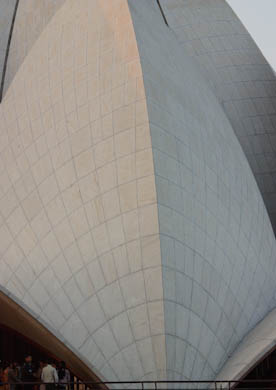
Following a day of sightseeing and shopping at Fab India, we arrived at the Lotus Temple (Baha’i House of Worship) as the sun was setting. This modern-looking structure was completed in 1986 for the Baha’i religious sect, but welcomes people of all religions to meditate and attend its short services held throughout the day. As its nickname reveals, the temple consists of 27 white marble lotus petals beginning to unfurl. Even at this time of day, a long line of people gathered to visit the temple. True to most Indian lines, queuing was not a strong point, but some temple officials did try to maintain some order. Along the main path and lining the manicured lush (92 hectares – 227 acres) lawns were rows of flowers including some mums. As we waited, the sun descended behind the temple, bathing the marble in violet. Surrounding the large temple are nine shallow chlorinated pools, adding to the tranquility. Once inside (shoes not allowed), people were invited to sit on the wooden benches, each of which had a lotus symbol carved in it. Looking upward, the expansiveness of the structure was felt. A floral symbol was seen at the top, radiating.
See more photos of Delhi on my Flickr page

Saturday, May 09, 2009

The Monkey Temple

Our rickshaw driver then offered to drive us to a place he called “The Monkey Temple.” While he sat at a table below and drank chai with other drivers, we headed up the path towards the temple. Along the way were many monkeys. Mother monkeys picked out lice from their young; others took a nap before their evening meal came. A few cows and hairy pigs also shared the path. Goats butted heads. A snake charmer swayed his punji instrument in a slight circular path as the cobra’s hood emerged from the basket. Beyond him a poor woman rocked her baby in a makeshift cloth sack cradle. A hunched swamy inched his way up to a temple building. At the top of the rocky cliff was the Surya Mandir (Temple of the Sun God). Rising about 100 m (328 ft) above the city, we had a good panoramic view of Jaipur. Punctuating the hazy air were minarets, popping up throughout the cityscape. Large gates marked entrances to the old city. On the way back down, we saw some young men throwing pieces of sliced white bread to the monkeys. Curiously enough, the monkeys ate the middle and left the crust - just like kids. If they saw more bread being thrown, the greedy monkeys would sometimes drop theirs and go after that one as well. Then a vehicle drove up the narrow path, tossing out small bananas to the monkeys. This was the treat they were waiting for.

Back in the chaos of the city streets, we were back in the traffic. A bicyclist somehow pulled six fridges. A passenger on a motorcycle cradled a computer tower in his arm. Rickshaws fluidly swerved between lanes without signaling. Almost like Chennai...

See more photos of the monkeys and the Sun Temple on Flickr