Showing posts with label goats. Show all posts

Thursday, March 01, 2018

Artwork: Just Me and My Goat

My latest artwork, a watercolor of a little girl from Gujarat, India
Just Me and My Goat
Watercolor
Dasada region, Gujarat, India
©2018 Melissa Enderle

Since I finished helping my sister carry water for cooking, I finally get some time to play with our baby goat. He is a lot less wiggly now because he just finished drinking from his momma. I like carrying our baby goat. It is fun and will help make me strong. Then it will be easier for me to help carry more wood for our cooking fire. I also have to watch and make sure that the baby goat doesn’t walk too close to the road. Daddy says that the goat is not so smart yet and might get runned over. I feel important when I can help my family.


See more artwork on my Facebook page - Melissa Enderle Artwork  or my website www.melissaenderle.com 

Tuesday, February 13, 2018

Two of My Favorite Things

I wrote a story to accompany the color pencil artwork I just finished. We met this family of the Mir ethnic group on our way back to Dasada, Gujarat. (Read my blog post on our encounter). Note the red flip phone that she is clutching, along with the goat "kid." Like other Mir families who have settled in the Rann of Kutch region of Gujarat, her family lives in poverty. Nowhere near their "tent" (a plastic tarp propped up with skinny logs) could I see access to potable drinking water, electricity, or toilets. 
The elaborate background in this piece is of Mutva mudwork known as Lippan Kaam, seen in some homes in the Kutch region.
See more of my artwork at www.melissaenderle.com.
With the heat beginning to let up, I climb over my sleeping brother and lift up the flap of our plastic tarp. Time to play a bit with the baby goats before their feeding time! I’m glad that our mamma goat had some babies. It gets a little boring living out here in the dry, flat region of Gujarat called the Rann of Kutch. I would like Papa to move our tent closer to the town of Dasada, because then I would have more kids to play with– besides my brother and three sisters. Plus, we might even get electricity so we could charge our cell phone more easily. Papa says our location is just fine because it is right along the highway. That way, more tourists can stop to buy our bangles. Oh, wait! Here comes a car right now! Gotta go!

Tuesday, September 08, 2015

Me and My Goats

Along with the Friday Market, there also was a bit of action happening outside the gateway to Shaxi. Here, a livestock market was actively underway. Men and women were actively engaged in inspecting and haggling over cows, goats, and pigs.


Some of the pigs were not too pleased about the transaction. The large pigs protested as they were loaded up onto the trucks by their ear.  Despite the pigs' complaining, it did appear that the livestock were healthy and well cared-for.


As with the market in town, the livestock market felt very local and authentic - exactly what I wanted to see. 

Tuesday, December 20, 2011

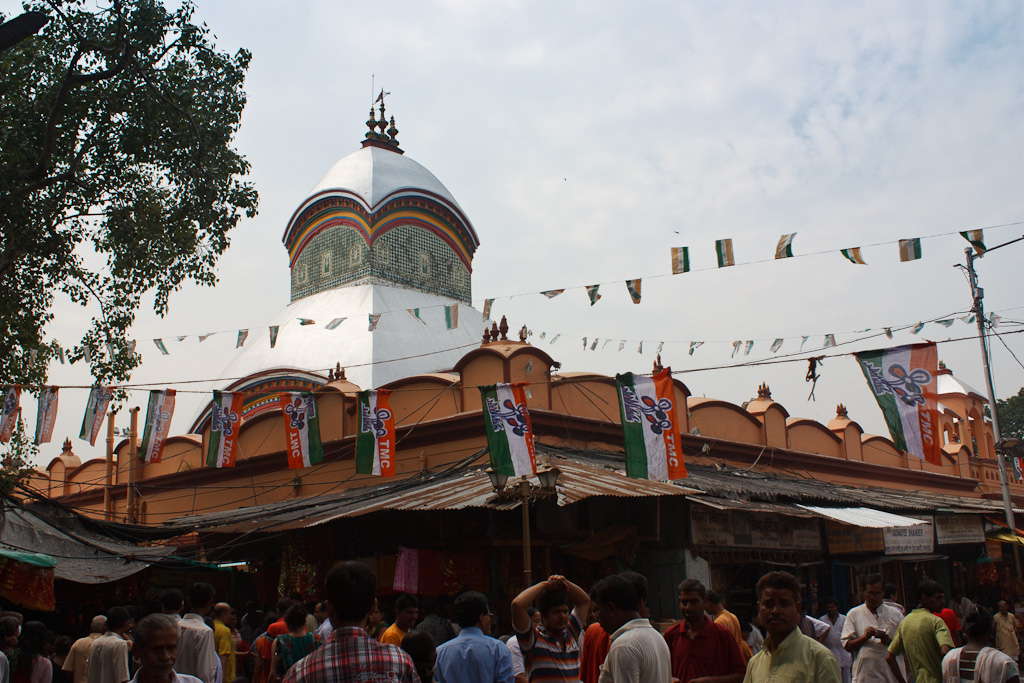
Kali Ghat Temple


Although the current building of the Kali Temple only dates back to the 19th century, it has been a sacred site for much longer. A favorite pilgrimage place for Hindu devotees, this normally busy place was especially crowded on the day of my visit. The line to pay respects to the wild -looking female deity known as Kali. During my visit in Kolkata, I would see many idols of this favorite Bengali goddess, typically depicted with blue skin, black hair, tongue sticking down, and adorned with a garland of the decapitated heads of the demons she killed. Bypassing that long, snaking line, my motorcycle guide led me to a place within the temple compound where sacrifices were taking place. A family passed its goat over to a temple person. Everyone crowded around to witness the swift decapitation. Although I was not in a position to see the gruesome action, I did see the body fly to the left, with the blood spurting out of the neck like a fountain. As we left, I spotted four black goat heads lined up on the ground. How many more sacrifices would occur that day?

Thursday, December 01, 2011

Early Morning walk in a Sunderbans Village


After being awoken at dawn by the unwelcome serenading of a mosquito, I got up and observed my surroundings from the boat’s deck. Still early, everything was quiet. Still low tide, the boat was currently marooned a fair distance on grey clay. The cement dock led to the steeply embanked clay path, over the protective embankment, and into the village. 
Within the hour, the sleepy village residents began to stir. Walking around brushing one’s teeth seemed to be in fashion. A yellow metal iron-gridded school bus trike made its way on the narrow path. A young boy led its black groat through the quiet street. Spotting a small pond with water lilies, I climbed down to its shore. From here I paused for a while, admiring the tranquil scene and several photos as the golden rising sun cast its warm colors and light on the lilies and pads. 


Sunday, November 27, 2011

Nibbling At the Roots

Much like anywhere, these goats wander through the area in search for food, nibbling at whatever might possibly be edible. These goats in the Sunderbans schlepped through the muck and appeared to nibble at  the breathing roots (pneumatophores) of the mangrove trees. (Pneumatophores help trees in these soil-poor clay soil areas to receive sufficient oxygen). The breathing roots here were quite small and likely rather tender; by contrast, some of the breathing roots I spotted elsewhere in the mangrove forest were spiky and well over a foot high.  

Thursday, November 17, 2011

Homes of the Sunderbans


A quiet canal flanked the sides of the road. To reach the homes and farmsteads, one had to walk across a tiny plank or narrow mud mounded path. Homes and barns were next to each other, with the livestock wandering around. While most structures were roofed with thatch, walls were built with cement or mud. The roof of some homes sported a satellite dish while others had a small solar panel. Such solar panel would provide enough electricity to light a bulb and TV. Saris, blankets, and nets hung out to dry on lines stretched between palm trees. Goats lazed in the shade while women worked.

Thursday, November 10, 2011

Rice Paddies of West Bengal


Reflecting the West Bengali’s steady diet of rice, the fields leading down to the Sunderbans largely contained the tell-tale green of rice plants. Along with fish, rice is a staple of many residents. Alongside the river in some towns, I saw small plots of marigolds, popular flowers in the area for festive occasions. Tied to posts  and tree trucks near the road, goats rested on the edge of the road. Motorists had to watch out for them, lazy dogs, and the ambling cow.

Tuesday, June 07, 2011

Banni Bhoonghas


The Banni villages we visited were quite clean– both inside and out. The surface was covered with a layer of cow dung, which made it easy to clean and the surface cooler. Goats freely roamed about. When a goat got too close to our shoes left right outside the door, our host shooed it away. Another bold one even tried to get inside the house. Most of the people in the village were related. Hanging from a column of a building was a round rusty container with a slit and small door that served as the village’s only mailbox. Despite the heat, children were outside playing. When they saw a certain motorcycle pull up, they dropped what they were doing and ran over to it. Their eyes widened with anticipation as the ice cream man pulled out treats for them: even in the desert, the ice cream man cometh!

Monday, May 23, 2011

Meeting the Mir Tribe Family


After resting during the heat of the day, it was now time to meet some more local people. Our first stop was to a temporary settlement of a Mir family (semi-nomadic people from Rajasthan). Certainly not their first visitors, they brought out bangles and decorative items with broken mirrors in hopes that we would purchase something. Although living in a plastic tent, the females had quite a bit of jewelry. All the children had tousled hair that hadn’t been combed in quite some time.

Time for the young goat’s feeding, one of the girls scooped up the goat and asked to have her picture taken, still clutching a cell phone.

Tuesday, April 05, 2011

Agra and the Taj Mahal


After a brief visit to Fatehpur Sikri we arrived in Agra as dusk took hold. Darkness did make it a bit more difficult to realize the true dinginess of the city. Whereas many of India’s other cities also have issues with being crowded, dirty, congested, and polluted, the main city of Agra lacks color and vibrance.

Taj Mahal
The following morning, we got an early start to arrive at the Taj when it opened. Battery-powered vans quietly rolled past, reminders of attempts at limiting pollution around the World Heritage site. Bicycle rickshaws creakily paddled up to us and asked us if we’d like a ride, unsuccessfully convincing us that the Taj was “very far.” The dense fog ruled out any chance of getting those “picture-perfect” photos of the Taj Mahal against blue skies; now just seeing it from any distance would be a goal. Along with the already-growing cluster of tourists gathering at the front gate, some four-legged critters were wandering about. Some of the animals donned “coats” made from burlap sacks. One goat completed the fashion with a knitted cap. Our bags were checked prior to entering. My friend’s 4” wooden figurine of a big-nosed Serbian wearing a traditional shajkaca cap was detected and denied entrance. When asking why, the female guard said, “bad karma.”


After the figurine was checked in at the baggage center, we proceeded inward. A few typical photos later, we walked in the mausoleum through the large door and admired the incredibly intricate marble screen around the two fake tombs briefly illuminated by camera flashes going on in the “no photo zone.” Even though I had seen the structure before, I couldn’t help but be awed by its artistic workmanship, including the flowers created by tiny pieces of inlaid semi-precious stones, and raised flowers carved from the same white marble as the rest of the structure. Letting the Japanese tourists posing in their new saris get their photos and move on, I took a few photos of the Taj, other buildings, and grounds in more creative views.

Sunday, March 06, 2011

Ranakpur to Jodhpur


Leaving Ranakpur, the landscape changed rather quickly, from the more lush hilly highlands, to flat scrubby land. Small boys tended large goat herds. The red of a turban contrasted with the beige of camels and land. Fences were formed out of rocks, a fitting material considering their abundance. Buses carried nearly as many people on top as they did inside. Occasionally we saw rather poor-looking settlements of tents, outside which young gypsy children ran. Abruptly there was a stoppage of traffic. Although people were curious, no one appeared to be overanxious or upset at the delay. The rock blast safely executed, people got back in their cars and proceeded onward. Yellow fields of mustard plants gave us brief welcomed patches of color. Small villages provided bursts of activity. Goats were herded across the street. Camels were hitched to wagons. Men squatted in the shade, drinking tea and sharing beedis (a type of local cigarette). Colorful fabric hung from the shops. Women pumped water, with bright odhani cloth draped over their head.