Showing posts with label Bosnia. Show all posts

Thursday, September 10, 2015

Yujin Qiao Bridge

Follow the east gate out of Shaxi, and you will encounter a bridge along the river.  This classic humpback stone bridge marks the same path that traders used on the tea-horse trail.

The shape of the bridge reminded me of the 400 yr old bridge in Mostar, Bosnia - the largest single-stone bridge in the world. Although both bridges are set amongst a picturesque scene, the Yujin bridge was very quiet  and was not a tragic victim of a civil war. 


Friday, April 06, 2012

Bosnia - 20 years Later

April 6 marks a grim day in the lives of citizens in Bosnia. Twenty years ago, civil war erupted in this former province of Yugoslavia. In the following 3 1/2 years, over 100,000 people were killed and nearly half fled their homes. The picturesque city of Sarajevo faced a particularly brutal siege, with over 11,000 civilians losing their lives.

While living in Serbia, I visited Bosnia twice. The first time was with my housekeeper, who took me to her beloved city of Mostar. Tanja, a Bosnian Serb, showed me where her home once stood, from which she fled before it was burned by Bosnian Muslims. Other places also showed violence, drawn on ethnic/religious lines. (Read more about this on my 2006 blog post on Mostar and Nevesijne). In 2008, I visited Sarajevo (read more in my June 2008 posts) and couldn't help but be moved by the many reminders of the brutal war that took place there. The white gravestones (Muslim and Christian) dotting nearly every green plot of this hilly town was particularly poignant.

An article I read this evening wrote from a very biased view, painting the Bosnian Serbs as the sole perpetrators. Realize that all sides were guilty of terrible things during the Bosnian War, as well as the general fighting that took place in former Yugoslavia. Nor did the Bosnian War occur in isolation.

Standing on a hill high above the old town section of Sarajevo or by the former Olympics grounds, I can't help but be moved. 

Monday, June 16, 2008

Sarajevo Travelblog - part 6: Museum Visits, Off the Beaten Path

Museum Visits
On Sunday I continued my walk, heading towards
the National and Historical museums. Near the museums was the bright yellow Holiday Inn, a recognizable structure during the city siege and headquarters of foreign journalists. The main road here was known as Sniper Alley, directly under fire from the hills. Several buildings next to the hotel still bore deep scars of the turmoil. Nearby was a modern structure, rebuilt on top of one that was destroyed. Its blue windows and modern look contrasted sharply with the rest of the city, but I guess the developers were more interested in displaying a progressive look.

My first museum of the day was the Historical Museum. The
outside of the museum was grey and shabby, and I wondered if the museum was even open. Prepared to see some graphic images of the war, I was disappointed to find out that most of the exhibits were closed. Wanting to get my admissions money out of it, I took my time looking through the historical documents, photographs, and artifacts outlining the region through the years. The other exhibition highlighted the Roma (gypsies) of the region and told a bit about the concentration camps in Eastern Europe. Curiously, it barely mentioned the large number of Serbians who died in the concentration camps.

Next door was the National Museum. Starting in the archaeology room, I saw tombs, memorials, vases, sculpture
s, and other artifacts dating back to Roman times. Quite a number of items had Christian symbols, indicating the presence Christianity once had in the region. Another room contained a large collection of ancient jewelry, coins, and other small items. In an adjacent room, fragments of Roman mosaics were displayed – nice, but not nearly as impressive as what I saw in Tunisia.
My favorite building at the museum was the Ethnographic section. On the lower floor was an exhibit of klims, traditional weavings highlighted from different regions around Bosnia and Herzegovina. A special exhibit displayed women’s long shirts, showing examples from around the country and differences between rural and urban styles. Walking upstairs, the museum was transformed into a home of a Sarajevo family during Turkish times. In addition to the period furnishings, the rooms also contained mannequins wearing traditional clothing. A display case showed a model of a typical Bosnian village. Had I not read the caption, I could have easily mistaken it for being located in the Zlatibor region of Serbia. Another reminder of how similar the people of the neighboring countries actually were. Will the bitterness for atrocities carried out by both sides ever be reconciled?

Walking through the courtyard – the museums’ botanical gardens - was tranquil, but I was hungry and decided to hurry through the last building – the Natural History section. Here one could find taxidermy-stuffed wild animals of the country, including bears, huge wild boars, a variety of birds, and small mammals. One room was dedicated to mounted insects of the region.

Near the museums was the Academy of Fine Arts, a beautiful domed building that was once an Evagelical Church.

Off the Beaten Path

Although I found the heavily visited areas such as Baščaršija to be wonderful places to visit and while away the hours, I also wanted to explore streets off the beaten path. With no particular destination in mind, I began my ascent up the steep streets into the residential neighborhood, hoping to see some traditional architecture or other interesting items worthy of photographing. Here, the streets became more irregular and angular, with a number of dead ends.

Once in a while I did spot a Turkish-style building, with its characteristic white walls and wooden slatted windowed section overhanging the narrow streets. Some were in excellent state of repair and others needed attention. I took several photos of the old metal doorknockers, casting their shadows onto the weathered wooden doors. In a few places, I could see the layers of construction of these old buildings: first a layer of wood, then a reed-like material, covered with plaster. The different colors and textures made an interesting composition. One Turkish building looked quite new, as if it had been recently constructed in the old style. Somehow the fancy car parked out in front just didn’t match.


Satisfied with my wanderings, I headed back down the hill to the Sebilj square, where I had an ice cream cone with the elderly man I met the first day. A short while later I once again met the Turkish young man. Taking a pizza from a well-known restaurant he knew, we ate it at the park overlooking the Latin Bridge. The riverside buildings and Miljacka river were cast with a pink glow of the setting summer sun. The child’s train ride next to us closed down for the night and the air became chilly. Knowing that I had to get up early the next morning to catch the 6:30 flight to Belgrade, I bade my friend goodnight and headed back to the hotel.

Perhaps there is something in the Sebilj fountain legend – those coming to visit Sarajevo will feel compelled to return.

See more photos of Sarajevo on Melissa's website

Sunday, June 15, 2008

Sarajevo Travelblog - part 5: Olympic Sites, Vrelo Bosne

Olympics Sites
Early Saturday morning, I took a personal tour to the mountains outside of Sarajevo, site of the 1984 Winter Olympics. My guide, just 12 years old when the war started, drove me the 25 km southeast of the city. At an overlook, we stopped to enjoy the mountainous view. Birds were chirping, some purple wildflowers poked their way out of the weeds, and everything seemed so peaceful. In the distance we saw a mountain that had remnants of snow – where one of the Olympic venues were held. Below us was the village of Dejčući. Farmers were bent over in the fields, working by hand. The village, with its stone barns and weathered wooden fences, reminded me of some Serbian villages, except that this one had a mosque.

Moving on, we arrived at Bjelasnica, site of the Olympic men’s downhill skiing. My guide explained that the ski lifts and buildings had been destroyed during the war, but had since been replaced. Tourists once again utilized the great slopes. He also pointed out a hotel that had been replaced, along with some flats, money diverted from rebuilding funds for personal projects by some corrupt officials. Corruption, this young man explained continued to be a problem holding back the country.

On our way to the ski jump area, we passed by a cemetery where Bosnian fighters died in hand-to-hand combat. This area, he explained, was the scene of some intense fighting. Nearby some sheep grazed in the green fields. A hotel, blackened and windowless, once housed fans of the Nordic events. Now at the ski jump area, we stopped to enjoy the view and a mid-morning snack of fresh cherries. The building, slightly worn-looking, dated back to the Olympics. Grazing sheep were led up and over the deserted ski jump ramps area. I pictured these clumsy creatures taking their turns going down the ramp, baa-ing as they somersaulted through the air. My guide said that the ramps and area had been mined, and it took some time before all the mines were cleared.

Closer to the city of Sarajevo was the Olympic stadium, site of the opening ceremony. A tall post with the Olympic’s 1984 logo greeted us as we drove towards the stadium. My guide explained that the football stadium had sustained heavy damage during the war and had been rebuilt. Right next to the stadium, the football field had been converted into a war-time cemetery. A dark, slender pointed monument marked transformation from a place of optimistic Olympic dreams to fears that occurred even while trying to bury the dead. Beyond a row of Communist-style apartment buildings was an even larger cemetery – a view as sobering as Arlington National Cemetery.

Vrelo Bosne
On the outskirts of Sarajevo is Vrelo Bosne, a beautiful park where the river Bosna begins. Clear water gushed out of the rocks, cold and refreshing on a warm day. Ducks and swans paddled in the water, under the arched wooden bridges gracing the river. People of all ages were walking around the paths, having a picnic, buying sweet treats, and simply enjoying the tranquility so close to the city. A revitalization project in 2000 has brought the river and park back to its ecological glory.

See more photos of Sarajevo on Melissa's website

Saturday, June 14, 2008

Sarajevo Travelblog - part 4: Downtown Sarajevo, Latin Bridge

Downtown Sarajevo
Once outside the Baščaršija quarter, the architecture changed. As the street changed its name to Maršala Tita, the city’s Austro-Hungarian influence was more prominent. Some were nicely restored, trimmed in a variety of colors. Cafés lined the pedestrian streets. People leisurely walked about, enjoying an ice cream cone and pushing baby strollers. Storefronts displayed the latest European fashions as well as more modern Islamic women’s dresses and headscarves.

Most buildings bore scars of the war, with some unrepaired bullet holes and others patched up. One building was still a hollow shell, giving an idea of what the area might have looked like after the war. A few buildings were new. In addition to the numerous mosques, I walked past a few Catholic churches and Serbian Orthodox cathedrals. On Sunday, their bell tolls were heard above the Islamic call to prayers, their joyous sounds reverberating throughout the city throughout the day.

Along one street, I was attracted to a red and cream striped building with yellow stars below the Moorish-shaped windows. Built in 1889 in a pseudo-Maori decorative style, the decorative structure now houses the Islamic Sciences Faculty building.

In one square, men played chess with pieces that were knee-high. Plenty of on-lookers provided advice, wanted or not. For lunch one day, I bought a sirnica (cheese pie) and took it into the nearby small park. It was one of the few areas of the town with larger trees. During the war, people cut down trees and used whatever was available for fuel. Up the slopes of the park were older gravestones, whose tops reminded me of turbans.

I also took a quick walkthrough of the Markale market place, located just outside of Baščaršija. Some question who actually committed at least one of the two bombings (one of which took 40 lives), but the second bombing (1995) resulted in the initiation of NATO military intervention. Nearby was the Eternal Flame, a tribute to the partisans who died liberating Yugoslava in WWI.

Skenderija
Crossing the Latin Bridge, I entered into the Skenderija section. I paused and looked back at the stone bridge with its slight peak at the middle. It was on this bridge on June 28, 1914, where the Archduke Fredinand of Austria and his wife Sophie were assassinated, sparking WWI. A plaque to the young Serb nationalist assassin was removed during the civil war. From between the trees of the park, the wooden dome of the music pavilion reminded me a bit of those found on a Serbian Orthodox cathedral. People gathered around the pavilion, enjoying a drink in the shade. A child’s size train wobbled along the metal tracks. Others sat on the dilapidated park benches, pausing to enjoy a refreshing bottle of water or ice cream cone.

Continuing onward, I passed the Turbeh Burial Chamber “Seven Brothers”, the Emperor’s Mosque, and down to St. Anthony’s Church. Its red steeple punctuated the clear blue sky. Next to it was the Sarajevo Brewery, also a deep red color. Along the river was a beautiful Moorish-style house with flowers overflowing on its decorative metal balcony, likely built by one of Sarajevo's Jews who came over from Spain.

Completing my tour of this section, I walked past the Inat Kuča restaurant. The owner of this building (originally a house) insisted that the city it be relocated across the river from its former location and reconstructed brick by brick after the authorities wanted to demolish it to build the City Hall. Hence the building got its name – which means “Spite House”. Although a bit pricier than the restaurants in Baščaršija quarter, the spinach pie was served in an authentic copper dish and the view of the river was pleasant. Crossing the Latin Bridge, I was once again in Baščaršija.

See more photos of Sarajevo on Melissa's website

Friday, June 13, 2008

Sarajevo Travelblog - part 3: The War Tunnel, City View

The War Tunnel
That afternoon I took a tour to the War Tunnel, located under the airport. Only a small portion of the 800 meter long tunnel was open to visitors, the rest having collapsed. Constructed in 1993, the tunnel was a lifeline to the residents of Sarajevo, bringing in needed food and medical supplies, as well as ammunition. A rail track was laid, making it easier to transport supplies and wheel the injured on special gurneys. Though dark and sometimes containing water, it was a welcome escape route, through which thousands of people traveled to the safety outside of the war zone. On the bullet-riddled museum’s façade was a memorial wreath. The building across the street known as Tunnel Ulica was equally pot-marked, a testament to how dangerous it was even when the people emerged from the tunnel.

A wordless video showed footage of the siege of the city, people dodging bullets, relentless shelling from the tops of the hills, dead bodies, and other horrors. Without food, electricity, and heat for most of the residents (generators were used in crucial parts of the hospital), it was a difficult several years.

City View
After returning to Sarajevo, I took a walk up one of the steep hills, hoping to get a good overlook of the city. The curving streets were steep and narrow, made more challenging by the heat. Along the way, I passed by a cemetery – one of the many I’d see in the next few days. Homes in the area had also sustained damage during the war, a few of which were now in ruins. According to a resident I met, people received money for their destroyed homes, with some choosing to make larger fancy homes and others being more frugal and building modest ones.

The next day I went up to the Žuta Tabija Fortress, which provided great views of the city. From here I could see the Miljaca River meandering through the city, broken up with several small bridges. Minarets and terracotta roofs dominated the skyline. A few church spires, domes and synagogues were spotted, a testament to the once communal spirit of the people of Sarajevo. The City Hall was quite visible, being one of the larger buildings. Looking around the tree-covered hills, I tried to imagine shells flying towards the city, transforming the natural beauty into a source of terror.

Just below the fortress was a cemetery. It had been converted into a park in 1878, but was reactivated during the war. Taking a closer look at a few gravestones from the sidewalk, I noticed that they all were dated 1995. Pink roses adorned one grave, bleached in the midday light.

See more photos of Sarajevo on Melissa's Website

Thursday, June 12, 2008

Sarajevo Travelblog - part 2: Svrzo's House


Svrzo’s House
Up one of Sarajevo’s hills is the museum known as Svrzo’s House, a typical Turkish Bosnian house of the urban elite. This 18th century house is one of the best examples of Ottoman architecture in Sarajevo. Walls (interior and exterior) were painted white, with ceilings, interior and exterior woodwork in dark, rich tones.


One section was the selamluk, place for domestic help and male guests. The other was the haremluk, for private and family life. In many of these homes, a hamamdžik is built, a place for washing before prayer. Large ceramic fireplaces were found in most every room. Each room in the Svrzo house was decorated with typical furnishings of the period – embroidered curtains, decorative metal lamps/chandeliers, ornate carpets, low tables, and elaborately carved closets. Lattice wood screens and shutters on the windows provided privacy and filtered out some mid-day heat. A sofa-like structure graced three walls of the rooms. On the ground floor was a kitchen with a large hearth and another room that looked like a stable. Balconies overlooked the central cobblestone courtyard.


Although I enjoyed wandering through the house and admiring the fine craftsmanship of period furnishings, I wish a guide or explanations would have enabled me to better understand and appreciate what I was seeing.

See more photos of Sarajevo on Melissa's website

Wednesday, June 11, 2008

Sarajevo Travelblog - part 1: Baščaršija


Although I had traveled extensively throughout Serbia and several other former Yugoslav countries, one of the places I had yet to visit was Sarajevo. With its well-preserved Turkish quarter, mountainous host of the 1984 Winter Olympics, and the awful events that took place there during the breakup of Yugoslavia, I knew it was one place I must try to see.
With direct daily flights between Belgrade and Sarajevo, I decided to “splurge” and fly instead of taking another long bus ride. The over 10 hour bus ride (each way) to nearby Nevesinje was still painfully fresh in my mind, making it easy to rationalize that it was better to spend that time sightseeing. With only my camera bag backpack as luggage on the short flight, I was easily able to get through the airport and to my small hotel located in the old Turkish Baščaršija quarter of Sarajevo. From the upstairs window of the small hotel, the owner pointed out the clock tower of Bey’s Mosque just a few streets away, an excellent orientation landmark.

Baščaršija
The next morning I stepped out of the hotel and onto a deserted, narrow street in the Baščaršija Turkish quarter. Across the street, early morning sunlight illuminated part of the black arched metal door. In the alley to its right, some garbage bags were piled up, awaiting city pickup. Graffiti was scrawled over the otherwise white walls of the narrow buildings. On the left side was a dilapidated store sign that looked like the shape of a baby’s pacifier. Its roof was missing and interior crumbling – one of the few buildings in the area not rebuilt after the war. Hoping to find a place to get breakfast, I headed towards the main square with the landmark Sebilj fountain I had seen the night before. Seeing that everything was still closed, I wandered through the streets for a while, peering through the store windows and taking a few architectural shots in the early light. Most of the small shops had dark wood shuttered over the window; the top part lifted up and bottom part later serving as a display shelf once opened for business. Aside from that one store near my hotel, I found the rest of the Baščaršija to be in remarkably good shape. Obviously a lot of effort had been expended to restore the Turkish quarter to its former charm.

Noticing that there were several ATM bank machines nestled amongst the traditional wooden shops, I decided to get some local money.
Walking towards the Sebilj fountain, an elderly man sitting at a café spotted me and asked if I’d like to have a Bosnian (Turkish) coffee with him. A pensioner, he supplemented his small monthly income by renting out a room in his nearby house. Although I replied that I had already booked a place for my stay, he wanted to treat me to coffee anyway. Served in traditional engraved metal containers, I added a lump of sugar, poured it into a small cup, and slowly sipped the strong coffee. A piece of Turkish Delight candy was included, and to my surprise, it was less sweet than the ones I had tasted in Belgrade. Immediately lighting another cigarette after finishing the previous one, he offered me one. I told him that I didn’t smoke. Cigarettes, he explained, were very cheap here and a vice he (and most residents) enjoyed. Hungry, I asked the man if he knew where I could find a place to eat breakfast. Turning down a nearby small street, he pointed out a place he often ate at. Serving a few varieties of soup, I selected the veal soup - a breakfast “first” for me – and had a light meal accompanied by bread. Leaving the small fast-food restaurant, we parted ways after he showed me a few good places to get some good “eats”.

Now around 9, the place was finally starting to wake up. Shop owners were arranging their wares outside their stores, the decorative embossed plates, vases, and coffee sets glistening in the morning light. On one table, gun shells were transformed into decorative souvenirs, including pens. Through the door of one shop, the rat-a-tat-tat of pounding metal broke through the tranquility of the morning. Another shop owner was hanging out shirts, flags, towels, and other items with Bosnian sports teams. Fabrics, kilims (woven rugs in traditional patterns) plants, and antiques were up for sale at other shops, now beginning to attract passersby.

Bey’s Mosque
The gate door open, I entered the courtyard of Bey’s Mosque. Built in 1530, it is one of the most significant Islamic buildings in the Balkans. On this early Friday morning, I was the only one here. Approaching the mosque, I admired the small decorative cupolas in front of the main entrance. Above the wooden door a plaque with Arabic calligraphy was prominently displayed. Carpets led up to the door and on the elevated platforms to the left and right of the door. Around the corner, I noticed a pile of woven synthetic prayer mats displaying their colorful patterns through the window. Two smaller hexagonal structures were to the left of the mosque, one the tomb of Gazi Husrev bey, considered one of the greatest military strategists and builders of Sarajevo.

In front of the mosque was a fountain covered by a wooden hexagonal structure. Built in 1893, the structure added elegance to an otherwise rather plain courtyard. Arabic writing graced the ceiling of the structure. Around the base of the fountain were water spigots, used for ritual washing. At the 1:00 prayer time, men gathered, filling the stone courtyard with mats as they worshiped and women watched through the openings within the courtyard wall.


Great Eats
For lunch and supper I also ate in the Baščaršija quarter, enjoying traditional dishes including its famous čevapi (sausages) in a pita-like bread. For extra cholesterol and taste, I included a dollop of kaymak, a buttery cream. Once again meeting a young Turkish man I had coffee with the previous day, we sat for a while and talked. The owner of the Turkish café was intrigued with my digital SLR camera, himself a former journalist and photographer during the war. Since then, he has abandoned serious photo taking. That evening after supper of more čevapi and other meat, we stopped at a Turkish pastry shop, where I sampled the baklava and another dessert that looked a bit like straw. Both were good, but not nearly as sweet as the Turkish pastries I had tasted in Belgrade. After tea, the store owner came out with pieces of cake for us, a birthday treat of one of the customers. Not that we needed anything else to eat, but we couldn’t say no….

See more photos of Sarajevo on Melissa's website

Tuesday, June 10, 2008

Sarajevo Shell Souvenirs


Amongst the typical Sarajevo souvenirs of embossed metal plates and Turkish coffee sets in the Baščaršija bazaar, this vendor turned remnants of the horrors of the civil war into a marketable art form. Metal artillery shell cases were engraved and transformed into pens, vases, and other clever items. To me, it is representative of the city's resilience, rising above the ashes and rebuilding both the city and their lives.

Monday, June 09, 2008

Bey Mosque, Sarajevo


Built in 1530, Bey's Mosque is considered one of the most significant mosques in Balkans. Its unusual clock tower, minaret, and 26 meter high dome are easily seen from most places within the Turkish Baščaršija quarter. In addition to the main mosque, there are also several domed burial sites and a wooden "sadrvan" (fountain) within the complex.

With nothing open in the early
morning hours, I wandered through the grounds of the mosque courtyard. Rugs were laid out along the entrance to the mosque, as well as the raised platforms. Through a window, I saw more prayer mats stacked, ready for the Friday prayer that afternoon. Above the wooden door was an inscription in Arabic calligraphy.

In front of the mosque is the fountain, covered with a hexagonal wooden structure. Calligraphy adorned the decorative ceiling. During the preparations for Friday prayer, men washed their feet, hands, and face from the many water spouts around the perimeter of the fountain.

Sunday, June 08, 2008

Sebilj - Pigeon Square


For the visitors of the old Baščaršija square of Sarajevo, one of the most recognizable landmarks is the Sebilj. This wooden public fountain, built in 1891 in a pseudo-Moorish style, is a common gathering place for people and pigeons alike. Legend has it that once you drink the waters of the Sebilj fountain, you can never leave Sarajevo for too long.


Saturday, June 07, 2008

Sarajevo City Hall - Majestic even in Ruins

As Sarajevo is a rather small city with its main attractions located within walking distance of each other, I passed by some sites quite often. The structure that most impressed me was the City Hall. Taking up a small city block and several stories high, the City Hall is the biggest and most representative building from Sarajevo's Austro-Hungarian period. Sadly, it fell victim during the civil war and was burned down in August 1992. Despite the boarded up windows, decaying façade and other signs of the tragedy, the building still commands passers-by to take notice.

Intended to be designed in a pseudo-Moorish style, the original architect visited Cairo twice to study buildings constructed in
 this style. Completed in 1894, the building remained as City Hall until 1949, when it was given to the National and University Library. Residents of Sarajevo I spoke to mourned the loss of so many important books and records contained inside during the fire of 1992.

The building has a triangular foundation with a six-angled center. A beautiful glass dome curves gently upward, rebuilt with Austrian donations. The façade is richly ornamented with Arabic delicate geometric designs and archways, and is
 trimmed near the top with sculptural scalloped layers. The golden late afternoon sun allowed the remaining portions of the original ochre surface and terra-cotta horizontal stripes to glow. 

According to the official Sarajevo Web Site, there were painted decorations in the main stairway, main auditorium, doorway, and central hall. Stained glass showca
ses with decorative floral patterns were found under the main stairway and under the dome, echoing the building's organic style. Following a model of many European city halls, the ground floor could be used for a courtroom or marketplace and the first floor contained a main auditorium and meeting rooms, with an extended balcony and towers used for speaking to the public. 

With such a magnificent building, I hope that the restoration efforts continue so that the City Hall can show off some of its former majesty and be enjoyed by residents and visitors alike.

Wednesday, September 27, 2006

National Geographic special on Mostar Bridge

I just finished watching the National Geographic channel special on the reconstruction of the bridge in Mostar, Bosnia. The show started with the horrible footage of the bridge collapsing after being bombed, its centuries-old huge stone blocks falling into the river below. The initial goal was to use the original blocks to reconstruct the bridge, but the ravages of war and the strong river current rendered the blocks unusable. The blocks did provide useful information in the construction of the bridge, type of limestone used, assembly (including iron rods), and type of mortar used.

The reconstruction process was not without controversy, as stone masons (and the construction company) from Turkey were used. You may recall that the Ottoman Empire had control of the Balkans for hundereds of years. In Mostar, the Turks conquered the Catholics living there. Prior to the war, it was not uncommon for intermarriages between religions to occur (such as Catholic Croats and Muslims, or Orthodox Serbs), but that all changed with the war. Such tensions were brought to the construction process as well.

It was fascinating to see how the combination of high-tech (such as making a computer 3-d model of the bridge) and centuries old traditional techniques were combined to recreate a bridge that looks much like the original one. Once again, the bridge of Mostar connects the town, both physically and emotionally.

Sunday, May 21, 2006

Mostar and Nevesinje photos

Mostar and Nevesinje

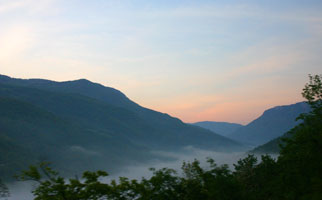
This past weekend I was invited to go to Bosnia-Herzegovina with Tanja, a native of the region now living in Belgrade. At around 11pm on Friday, we boarded the bus. Thankfully not all the seats were occupied, so most were able to stretch out a bit. I tried to sleep but it wasn’t easy, since the lights went on frequently (dropping off or picking up people, rest stops) and we had to show our passports at the border. At dawn, the beauty of the region was unveiled. Low white clouds shrouded parts of the mountains, giving a sense of tranquility. The emerging pinks and blues of the sunrise contrasted beautifully with the still-silhouetted mountains and valleys. Trees in various stages of foliage became quite dense at times. The bus moved slowly up the narrow winding mountain road which at some parts was simply a gravel road.
Nevesinje
At around 8am, we arrived in the mountain valley town of Nevesinje. Tanja and her family had lived here for about a year during the war, fleeing from Mostar, site of intense fighting between Muslims and Croats. Tanja’s friend Anica and her sister Gordana were now living here and had invited us to stay with them for the weekend. They lived in the upper part of an old farmhouse out in the country. All the buildings in her small farm community were created out of rough stone. As soon as we arrived, the petite old woman who lived downstairs greeted us, introducing herself to me very loudly and excitedly. In no time the entire community knew that the visitors had arrived, including an American. After a breakfast of yogurt, local bacon, boiled eggs, bread, and the mandatory cup of strong Turkish coffee, it was suggested that a quick nap might be in order. Knowing that I didn’t have much time here, I declined.
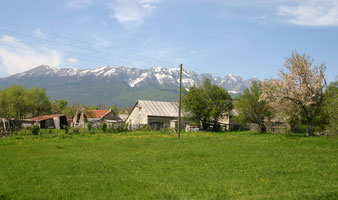
While Anica went off to plant potatoes in the fields, Tanja and I went walking through the fields and area once quite familiar to her. She showed me the small house where her family had lived – now just a shell and rubble. An abandoned unfinished house belonged to a Muslim family who had yet to return. Wildflowers in yellow, purple and white colors dotted the grassy areas and meadows. In one direction was a mountain whose name means “worm mountain”, which keeps some snow all year round. In the fields one could see people hunched over, also planting potatoes by hand.

In the afternoon, we stopped at the nearby Nevesenje Lake, framed by trees and mountains. The frogs’ loud croaking broke the otherwise silent surroundings. In the shores of the cold lake, one could see scores of tadpoles just waiting for the chance to join the chorus. In the town of Nevesinje, we drove around the main parts and stopped for a few minutes in the old Serbian Orthodox Church. When we arrived back at the farm, I decided to take advantage of the lighting of the late afternoon sun and took some more photos of the local architecture. Most of the homes had a small connected structure called a summer kitchen. The barns all had a small wooden-shuttered window in the upper portion, providing beautiful textural contrast to the stone. Inside Anica’s barn was a solitary cow, mooing to be pastured outside. Some of the fencing was made from vine branches, interwoven like the sides of a basket. Sheep were now being herded back into their fenced-in areas for the night after grazing in more open areas during the day. Next to the sheep pen, Anica’s downstairs neighbor drew some water from the well for use in the home. After Anica finished the evening milking, we headed out in the star-filled sky to enjoy a drink (coffee) at a café in town.

Region of Mostar

The next morning we began our journey towards Mostar, stopping in Nevesinje to pick up Danka, a friend of Anica’s and in a tiny mountain village to visit Anica’s ailing grandmother. Her home had been destroyed in the conflict but had been rebuilt by the UN. We then stopped at Blagaj. Here we saw 200 meter cliff wall from which an underground karst river flows and single-handedly creates the Buna River. Right next it a tekija (Turkish monastery) was built for the Dervish cults in the 16th century. I was amazed at how quickly the river picked up in speed. Knowing we had a lot to see and do that day, we skipped entering the building (and all the tourists) and walked back to the car. Along the riverbank we could see a trout farm (didn’t look that active though) and a restaurant specializing in fish.

Moving onward, our next destination was Pocitelj, a UNESCO World Heritage site. High on a hill stood the fortress Sahat-kula, visible from a distance. Pocitelj is a picturesque Turkish village, built up the steep hill and overlooking the Neretva River. It was partially destroyed in August 1993 by Croat forces, followed by ethnic cleansing. Recent reconstruction has restored the village. As soon as we parked the car, children and adults descended upon us, offering their cherries, oranges, and dried fruits for sale. Entering through an arched gate, we began walking up the stone-covered walkways. Reaching the large mosque built in 1563, we turned right and continued up the path towards the fortress. The original fortress was built by the Hungarians in 1444 and was taken over by the Ottoman Empire in 1471. At that time the castle was fortified and the town was built in the valley below. I climbed up the tower, slowly ascending the short, steep steps in darkness. Once at the top, I was welcomed to a panoramic view of the city, river, and rugged mountains. It was easy to see why Pocitelj was of strategic importance to the Turks, who used the position to extract tolls on travelers using the Nereteva River as one of the few easy routes through the mountains.

On the way to Mostar, we stopped at a small church and monastery. Like other religious institutions, this one was destroyed to the ground during the bloody conflict in the area. A wedding had just occurred, with everyone socializing outside the church. A local band played its bright music, with brass instruments, an accordion, and bass string instrument dominating. Not wanting to disturb the celebration, we quickly slipped inside the church. Inside, you could still smell the incense. The walls were very bare and white. Did the original structure have frescoes? The altar had paintings that looked fairly old. Perhaps they were able to rescue it before the fire consumed the building. As we left the church, I stopped to admire the new doors, elaborately carved with crosses and floral designs.

We now arrived in Mostar, parking in a newer section of the city. It was starting to sprinkle, so I was glad that I brought along my umbrella. A short distance away was the Turkish quarter. Small shops in traditional buildings lined the cobblestone walkway, displaying Turkish-looking crafts and souvenirs for sale. The street was filled with tourists, a positive sign for this formerly besieged city. While we paused for Tanja to get some film for her camera, I looked more closely at the buildings. Even here, many bore the pockmarked signs of bullets and fighting. Up one street, I could see that one was just a shell, with weeds and vines overtaking most of it.
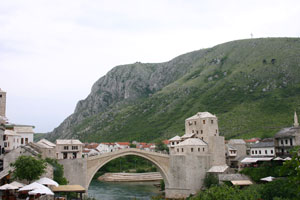
A bit further, we stopped to take some photos of the famous bridge up ahead. Built over 400 years ago, the Stari Most bridge, the longest single stone span in the world, connected the Old Town (mostly Muslim) and largely newer town on the west bank (mostly Catholic). The bridge had symbolized the bond that the multi-ethnic and religious connections (Muslim, Catholic, Jewish, Serbian Orthodox) that the citizens of Mostar had espoused for over 500 years. In 1995, Croats bombed the footbridge, with the citizens staring in disbelief and shock. A few years later, a multinational force began reconstructing the bridge, pulling up the stones out of the river and using building techniques as close as possible to that of the original Ottoman structure. (see http://www.saudiaramcoworld.com/issue/199805/hearts.and.stones.htm for a good article).

We now stopped for lunch at a restaurant just past the bridge. We all ordered cevapci, a mildly seasoned skinless beef sausage and specialty of the region. Served in a pocket of flat bread, the portion was enough for two people. Next to us was a fountain, with the water trickling out of old Turkish pots. A few cats wandered around the courtyard, hoping for handouts. Other tourists opened their guidebooks and discussed their next moves.

After lunch, we walked down some stairs near the restaurant to get a view of the bridge from the other side. A lot of people were now at the top of the bridge. At the peak of the bridge, a young man climbed over the rail and prepared to dive. Although gesturing as if to dive, he did not follow through with the dive. Tanja explained that he was waiting for more “dare money” before going through with the dive – something she had witnessed many times when living here. Realizing that it might take a few minutes before enough money was collected, we decided to head back and move onward. Before leaving Mostar, we drove through the western part of town. Here entire areas were destroyed, blocks of rubble, shells of buildings, or heavily pockmarked. Many of the business and homes in use also bore signs of attack. It would take a long time before all of this would be restored. Up a steep road outside of the city center, we drove to the home of Tanja’s father, which also was being rebuilt. Expecting us for lunch, she had prepared a large bowl of cevapcis for us as well, but we all were too full to eat any. After Tanja had some time with her family, we drove back to Nevesinje, about a 50-minute drive through the Velež Mountains.

Before we boarded the bus that night, we thanked our hosts for their generosity and hospitality. My new friends from Bosnia-Herzegovina wanted me to come back to visit them, and already had planned out some places we could visit. It is such experiences in being with the local people that makes living overseas so much richer than simply being a tourist.