Showing posts with label Taj Mahal. Show all posts

Saturday, February 06, 2016

Water Castle - a Perfumed Garden No More

Still within the Kraton palace grounds about 2km south, we visited what is known as the Water Castle - Taman Sari. The driver explained that through that white decorative gate was a bathing complex. At one time, it was just a small part of the 59-building palace complex, complete with 18 water gardens, pavilions, mosques, and was surrounded by an artificial lake. Following a devastating earthquake in 1867 as well as destruction by the invading British in 1812, Taman Sari was abandoned by the sultanate. Since then, the complex has become overrun with squatters who settled and constructed buildings on the dry lake bed. 
A naga greeted us at the gate
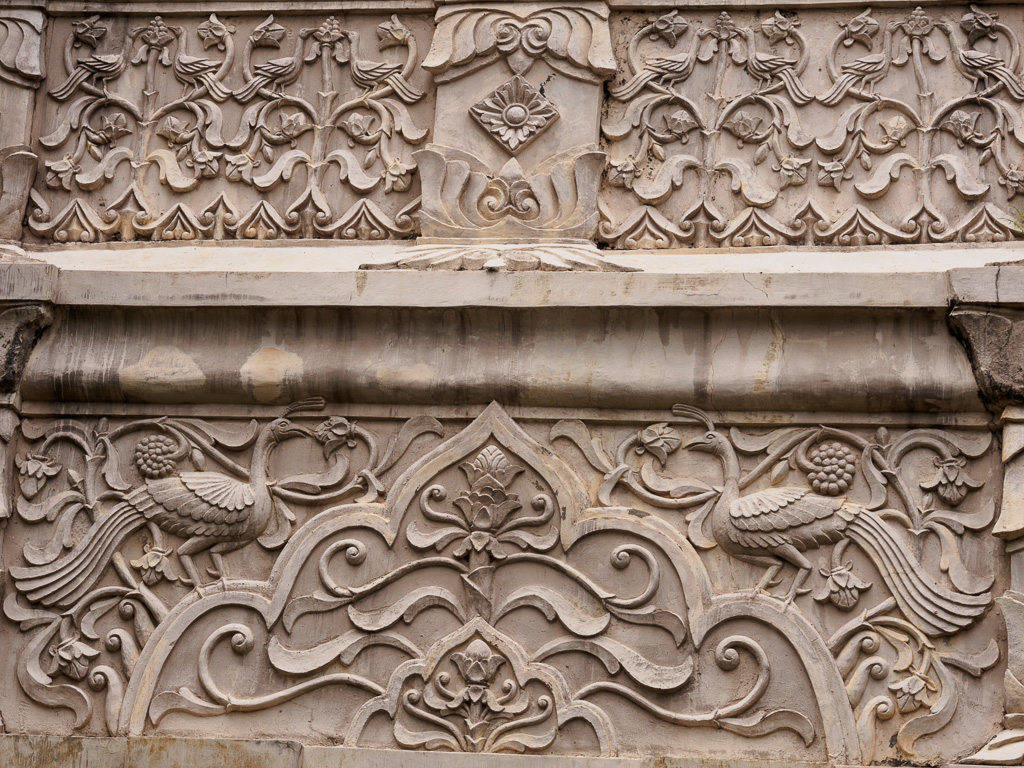
 The floral designs and peacock-like birds brought me back to India, particularly the Taj Mahal in Agra. How splendid this place must have looked at one time, harkening back to the meaning of its name - garden of beautiful flowers.
Once through the gate however, I was saddened to see the state of this partially restored section. The pool, once used by concubines of the sultan, was blackened and dingy. Oh how I wanted to drain the water, scrub the bottom and repaint/tile it. The buildings walls were equally dingy. In 2004, Taman Sari was placed on the World Monuments Watch endangerment list. Another devastating earthquake two years after that further damaged the site and has increased the urgency for preservation of this culturally and historically significant site. Despite the series of natural & man-made disasters that have befallen the complex, it is considered one of the best examples of 18th century Javanese architecture and landscape design. While it is quite doubtful that the complex could ever be restored to its former glory, the WMF would love to see more funding to make some attempts at preservation.
With the guidance of the people I was with, we went past some squatter's homes and found the underground tunnel that led to the Sumur Gumuling, an water mosque. Reminding me of a real-life Escher staircase Relativity artwork, four staircases met on an elevated platform in the middle of the building. On the ground level was a pool (now drained) that once served for ritual ablution.

Although I found it a bit difficult to fathom the grandiosity the Taman Sari complex must have once possessed, even the encroachment buildings had their own flavor. Had I more time, I would have liked to wander through the alleys, catching a glimpse of life on what once was a garden of beautiful flowers.

The Taman Sari, along with the Sultan's Palace, was listed as a tentative UNESCO World Heritage site. Although I've seen some UNESCO sites that also feel neglected, perhaps a full acceptance onto the esteemed list would provide some needed funding and awareness.


Friday, April 08, 2011

Agra Fort


Built by the Emperor Akbar between 1565 and 1573, this UNESCO World Heritage site is another of Agra’s jewels amidst the grime. In true fortress fashion, it has high walls (70 feet - 21 m), double ramparts, battlements, massive gates, circular bastions and a moat. Entering through the imposing Amar Singh Gate, today’s visitors see only a small mount of Akbar’s original structures; some were destroyed by Akbar’s grandson Shah Jahan and others by the British who used the fort for barracks. Parts of the fort are still used by the Indian military, visitors focus on the area closest to the Yuma River.

Despite portions of the fort being closed off to visitors, there are quite a number of beautiful buildings to see. The Diwan-i-Aam was an arcaded hall that reminded me of a similar royal public audience hall in the Delhi’s Red Fort. Nearby was the Anguri Bagh, a series of geometrically arranged gardens in alternating plant colors of green and deep burgundy. The Khas Mahal, built in a style so typical of Shah Jahan, is an elegant white-marble hall with brightly painted ceilings and twin golden pavilions. The Diwan-i-Khas is perhaps the most beautiful structure there, with its exquisite pietra dura work of flowers, vines, and designs covering columns and archways. In this open hall, the emperor would meet his court. From the double-storeyed profusely-decorated octagonal tower named the Musamman Burj, Shah Jahan had a direct view of his beloved Taj Mahal. Ironically it was this tower where Jahan spent the last eight years of his life, imprisoned there by his son. Walking back to the gate, we passed by the Bengali Mahal, constructed out of red sandstone. Its decorative architectural style reminded me of that at Fatehpur Sikri (Akbar’s planned capital city and palace), with its intermixing of Hindu and Islamic elements in the same red sandstone.

Thursday, April 07, 2011

Itimad-du-Daulah


Described as a “jewel box in marble,” this tomb of the “Lord Treasure of the Mughal empire under Shah Jahan is also nicknamed the “Baby Taj.” Predating the more famous structure, the Itimad-du-Daulah signals a change in Mughal architecture, away from the massive red sandstone structures to the more elegant structures such as the Taj Mahal. Highly symmetrical, the squat building had a minaret at each corner. Colored mosaic patterns of geometric and floral designs covered the outer surface and the interior floor. Window jail screens of complex geometric patterns were carved out of single pieces of marble. Inside, floral paintings were in various states of preservation were framed in arched niches on the upper half of the walls. The painted ceiling must have also looked rather beautiful with its incised patterns, relief textures, and golden accents. Not nearly as visited as the more famous structure in Agra, it was much quieter here, giving us ample opportunity to wander around the various rooms with tombs and admire the decorative architecture.

Wednesday, April 06, 2011

The Black Taj


Our next destination was directly across the river from the Taj, but rather long to get there due to the traffic congestion, long divided roads with no/few U-turns, and the required bridge a distance away. Paying a small fee, we walked through orchards of fruit and flowering trees until we neared the Yuma River. From here, we had an alternate, less crowded view of the Taj Mahal, still looking rather placid against the foggy, grey sky. We stood amongst remnants of the foundation of a structure situated directly opposite the Taj. Legend has it that Shah Jahan wanted to build a replica of the Taj he had built for his beloved wife - except with black marble. With the emperor’s finances severely strained due to the hugely expensive white structure, Jahan’s son halted its construction.

Tuesday, April 05, 2011

Agra and the Taj Mahal


After a brief visit to Fatehpur Sikri we arrived in Agra as dusk took hold. Darkness did make it a bit more difficult to realize the true dinginess of the city. Whereas many of India’s other cities also have issues with being crowded, dirty, congested, and polluted, the main city of Agra lacks color and vibrance.

Taj Mahal
The following morning, we got an early start to arrive at the Taj when it opened. Battery-powered vans quietly rolled past, reminders of attempts at limiting pollution around the World Heritage site. Bicycle rickshaws creakily paddled up to us and asked us if we’d like a ride, unsuccessfully convincing us that the Taj was “very far.” The dense fog ruled out any chance of getting those “picture-perfect” photos of the Taj Mahal against blue skies; now just seeing it from any distance would be a goal. Along with the already-growing cluster of tourists gathering at the front gate, some four-legged critters were wandering about. Some of the animals donned “coats” made from burlap sacks. One goat completed the fashion with a knitted cap. Our bags were checked prior to entering. My friend’s 4” wooden figurine of a big-nosed Serbian wearing a traditional shajkaca cap was detected and denied entrance. When asking why, the female guard said, “bad karma.”


After the figurine was checked in at the baggage center, we proceeded inward. A few typical photos later, we walked in the mausoleum through the large door and admired the incredibly intricate marble screen around the two fake tombs briefly illuminated by camera flashes going on in the “no photo zone.” Even though I had seen the structure before, I couldn’t help but be awed by its artistic workmanship, including the flowers created by tiny pieces of inlaid semi-precious stones, and raised flowers carved from the same white marble as the rest of the structure. Letting the Japanese tourists posing in their new saris get their photos and move on, I took a few photos of the Taj, other buildings, and grounds in more creative views.

Wednesday, February 23, 2011

Taj Mahal Slated for Demolition?


Did you know that legend has it that in 1830, Lord Bentinick (governor of India) actually proposed to demolish the Taj Mahal? He wanted to dismantle the Taj Mahal and sell the marble and was stopped only when he was unable to find buyers. Whether or not this story about this known penny pincher is actually true, what definitely is known is the looting and destruction that occurred on the Taj and other sites by the British. On the Taj, carpets, jewels, and silver doors were removed. Soldiers chiseled out the precious stones and lapis lazuli out of the walls. Visitors also chimed in, using hammers to remove chunks containing carnelian and agate from the floral designs. In the mid 19th century, the Taj had become a pleasure-resort, with the mosque and symmetrical building being used as a honeymooner suite. Indeed, the Taj Mahal had become a sorry sight.

Around 1904, Lord Curzon (Viceroy of India) demonstrated his love for culture and heritage by passing an Act to protect the Taj and other monuments. In 1908, he initiated the restoration work on this heritage site. The interior received a large replacement lamp, outdoor canals made to work again, and gardens restored  - but in a more British style.

In the 20th century, India sought to protect the Taj against potential bombing during several wars, but then let pollution heavily degrade it, leaving the monument again in an imperiled state in the late 1990's. Since then, factories have been moved away and no vehicles (besides electric and bicycle rickshaws) being allowed within a certain radius of the site.


Source: http://www.thetajmahalindia.com/mahal-taj1.html

Thursday, March 04, 2010

The Taj Mahal: Study in perspective

Looking at this photo reminds me of my high school art class days. From the patterned tilework of the pavement to the designs of the Taj Mahal itself - what an excellent example and study of one point perspective!

Sunday, January 10, 2010

Agra Fort


Another UNESCO World Heritage Site, the Agra Fort was built between 1565 and 1573 by the Emperor Akbar, who also built Fatehpur Sikri. The enormous complex is also built of red sandstone. The entryway was rather unique. Instead of a straight, flat drawbridge entrance, the Agra Fort employed a slight ascent and a 90° turn between the outer and inner gates. This made it impossible for elephants (used in attacks) to gain momentum. A deep moat, once containing water, surrounds the walled fort. Much has changed since Akbar built the fort. His grandson Shah Jahan (who built the Taj Mahal) tore down many buildings and replaced them with more opulent ones, including some made from white marble and inlaid with semi-precious stones. The British also made some additions in the 19th century, when they used some areas for barracks. From the marbled double-storeyed octagonal tower called the Sheesh Mahal, Shah Jahan was placed under house arrest by his son. From the tower one has a clear view of the Taj. It is here that Akbar spent his last 7 years of his life.

Thursday, January 07, 2010

Fatehpur Sikri - The Sacred Complex


Following the tour of the Royal Complex, we entered into the Sacred Complex, walking through the main gateway known as the Buland Darwaza (Victory Gate), as it was built to commemorate Akbar’s conquest over the Deccan in 1601. The largest gate in India and one of the highest in the world, it stands at 172 feet (53m). Similar stylistic elements such as the massive archway, stylized battlements, domed kiosks, and turrets were noted in other Mughal buildings in Agra, including the Taj Mahal complex. Lacking an entrance fee (this religious section is not under the governmental juristiction), many more people were inside this area. Many were near the white marbled building containing the tomb of Sheik Salim Chisthi, the revered Sufi mystic who predicted the birth of Akbar’s son. While not a particularly large building, the marble carving is incredibly fine and exquisite. Like the windows on the Taj Mahal, this structure has window “screens” carved from marble, letting in dappled light. In the middle room is the Sheikh’s tomb. Here pilgrims left offerings and tied strings to the interior marble screened window. If their wish came true, the person was to come back and untie the string.

Outside the marble building was a section of the courtyard containing tombs of the holy man’s family and another spot for his disciples. An elderly man sat cross-legged next to a tomb with rose petals placed on it, appearing to be in a state of contemplation or meditation.


The story of Fatehpur Sikiri according to my guide: The childless Akbar had a dream in which he was told that his desire for a child would be fulfilled if he went to the small stone village of Sikri and met a holy man there. So he walked the 40 km to Sikri and sought out Seikh Salim. Rather than answering (or barely acknowledging) him right away, the Seikh commanded Akbar to return to Agra. After the seventh time walking to Sikri, the Seikh finally asked Akbar to pray for a son from his Hindu wife. Indeed, this wife was the only one to bear a son – just as the Seikh predicted. 

For more information and a virtual tour of Fatehpur Sikri, visit http://www.tracyanddale.50megs.com/India/Rajasthan/HTML/fsikri.html#Virtual%20Tour

Sunday, January 03, 2010

More info on the Taj Mahal

I had a knowledgeable guide to accompany me for the day. This is what he told me about the Taj Mahal:

Mumtaz Mahal was near the end of her pregnancy when her husband asked her to accompany him in Buran-Pur, located about 900 km north of Agra. Although it was cooler up in Buran-Pur, Mumtaz originally declined the request even though it was cooler, concerned about traveling so late in her pregnancy. Upon Shah Jahan’s insistence, she relented and began the journey. While en route, she developed complications and delivered prematurely. Recognizing her grave state, Shah Jahan was immediately summoned. Grief-stricken and likely feeling guilty for convincing her to travel, Jahan expressed feelings of suicide. The 39-yr old Mumtaz told him not to kill himself, but instead asked him to promise her a few things. He was not to remarry. Jahan was also to erect a building of lasting love. Six months later, the architect was chosen, his design rendered with a brush and blood. Built to resemble the Islamic garden of paradise, the complex cost nearly 41 million rupees and 500 kg (1,102 lb) of gold. The Taj Mahal is 243 feet (74 m) high in the front and 253 feet (77 m) high in the back, behind which the Yumana River flows. The 144 ft (44 m) high double dome is capped with a Muslim finial symbol. On each corner of the Taj Mahal’s courtyard is a minaret, accentuating the perfect symmetry of the complex. Each is 131 feet (40 m) high and crowned by an open octagonal pavilion. My guide told me that the pillars actually were designed to lean outward slightly to ensure they would not topple onto the main building if they fell.

On the other side of the Yumana River were the foundations of the Black Taj building, intended by Shah Jahan to be his resting place. One of Jahan’s sons had that project stopped, saying that it would be way too expensive and would draw unnecessary, exorbitant costs from the emperor’s subjects. This son had Jahan placed under house arrest and into a tower of the Agra Fort, where he died at age 76 of old age.


For a virtual tour of the Taj Mahal, visit http://www.tracyanddale.50megs.com/India/Rajasthan/HTML/tajmahal.html

Saturday, December 19, 2009

Melissa's photos of Agra

This past week I visited Agra, home to India's most famous landmark - the Taj Mahal. On my Flickr page you will find some photos of the Taj Mahal, Sikandra, the Agra Fort, Jami Masjid, artisans, and the people of Agra. Writings about my trip are still to come...
http://www.flickr.com/photos/melissaenderle/sets/72157623028832542/