Showing posts with label South Korea. Show all posts
Showing posts with label South Korea. Show all posts
Sunday, October 28, 2018


Wednesday, November 01, 2017
Upcoming Exhibit - you're invited!
If you're in the Madison, WI area, come to the opening reception of my art show. At 6pm, I will be delivering a presentation on my artwork and travels. Fresh homemade cookies will be served and Michael Sullivan will be performing live music.
The art show will be up from November 1-30 at the Lakeview Library.

Saturday, May 06, 2017
A little Spring in Downtown Madison

One sunny day, I headed downtown to check out its spring clothes. Although it wasn't as pretty as Yonsei University's (in Seoul, Korea) campus, the UW Madison campus had some pretty spots as well.


I then walked towards the capitol. Some of the trees were beginning to bloom as well.
Monday, January 30, 2017
Snowy Tiled Patterns

Fondly remembering the beautiful patterns created by snowfall on the tiles of a Buddhist temple in Seoul.
Thursday, January 19, 2017
Kenneth Bae – A Modern Paul
Traveling and living overseas has created a heightened sensitivity and awareness of events that happen outside the border of my home country. Not only am I more knowledgeable about where those events are occurring, but there is a personal connection.
Having lived in South Korea for four years, I have read quite a few books pertaining to the Koreas on both side of the 38th parallel. My collection of read books (and documentaries) on North Korea is getting quite large. Each of the books, such as Barbara Demick's Nothing to Envy and Yeonmi Park's In Order to Live enlightened me on a slightly different aspect of the people and country called North Korea. My latest book I read on the "Hermit Kingdom" was Not Forgotten: The True Story of My Imprisonment in North Korea had an entirely different perspective. Instead of trying to escape the horrible prison labor camps such as in Escape from Camp 14, Kenneth Bae's true story mainly focuses on the transformations which occurred while a "prisoner of Jesus Christ" in North Korea.
Although I highly encourage you to read the book, here is a basic summary. Kenneth, an American missionary of Korean descent, was arrested after a portable hard drive was discovered in his bag when his tour group arrived in the country from China. Even though he admitted to being a missionary who had made the mistake of accidentally leaving the backup hard drive in his bag, the North Korean government convicted him of the highest level of treason against the country.
Sentenced to 15 years of hard labor, Bae originally prayed and hoped for quick release - even though he knew he was being used as a political pawn. Now he was forced to manual labor from 8am-6pm out in the extreme elements and then subjected to the political brainwashing of the TV in the evening. Prior medical conditions exacerbated the already difficult situation, along with isolation and uncertainty. It wasn't until he asked the Lord to do His bidding and use Bae while "in chains" that things turned around for Bae. This was such a parallel with the Apostle Paul, who while imprisoned for witnessing about Christ, shared the Gospel with the prison guards. A sense of peace enveloped Bae, known as Prisoner 103; "Once I accepted this place as God's will for my life, and I started praying, God use me, instead of God, save me, doors opened". The guards took note and asked why he was so happy and where his hope came from, to which he responded, "God has me in here because he cares for you and all of North Korea. He wants to you to know who he is and how much he loves you."
A citizen of the US but a native South Korean, Bae had a unique opportunity. He was able to communicate directly to the guards and develop special insight. "My two years in North Korea also taught me what it means to have compassion for those who live in darkness. People in North Korea have no access to information from the outside world, no freedom to travel, no freedom to speak their minds, and now way to choose their own religions."
He realized that there was a special sense of safety within a totalitarian regime, and that those who raise questions about the societal structures is a direct threat to the nation. In North Korea, the Kim Jun family is their god.
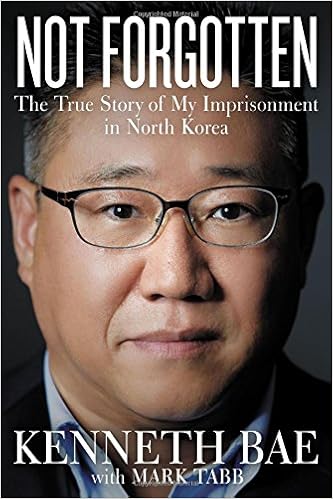
Kenneth Bae recounted multiple instances of where God seemed to directly intervene or send strong messages that He had not forgotten His missionary. For example, there were times when Bae was at a low point in the hospital when he was craving and had prayed for a particular food; for the next meal, that exact food was brought in from a special restaurant, even though he had not verbalized any request. This happened over 40 times. At the prison, Bae's planted field was spared the flooding that affected all the other fields. When initially held in a cold detention room, his left hand suddenly became warm and the Spirit's presence was felt. At another low point while in the hospital, the Disney movie "Finding Nemo" was on instead of the usual shows venerating the Kim family, providing Bae a connection with America. Also, since it was known that Bae was a pastor and the government wanted to convey to the world that they were being merciful, he was allowed to keep his Bible. Two years after he was arrested, Bae woke much earlier than usual and heard the Spirit of God direct him to open the Bible to Zephaniah 3:20 (Bae had no idea what it would be) - and read: At that time I will gather you; at that time I will bring you home. Four days later, Bae was released.
In the end, Kenneth Bae spent 735 days in detainment - the longest held of any American since the Korean War.
Some interesting things I learned:
I was amazed how Bae did not hold animosity towards the North Korean government. With a reframing of his outlook, he saw the period of detainment as a wonderful opportunity to witness for Christ, to a nation in the dark about their Savior. Bae continues to pray for the people of North Korea and hopes that one day, the spiritual wall that surrounds the country will fall. "More than a billion people worldwide still have not heard the gospel. We must remember them, pray for them, and build a bridge to them through which we can share God's love and compassion. May God be their God, and may they be his people."
Having lived in South Korea for four years, I have read quite a few books pertaining to the Koreas on both side of the 38th parallel. My collection of read books (and documentaries) on North Korea is getting quite large. Each of the books, such as Barbara Demick's Nothing to Envy and Yeonmi Park's In Order to Live enlightened me on a slightly different aspect of the people and country called North Korea. My latest book I read on the "Hermit Kingdom" was Not Forgotten: The True Story of My Imprisonment in North Korea had an entirely different perspective. Instead of trying to escape the horrible prison labor camps such as in Escape from Camp 14, Kenneth Bae's true story mainly focuses on the transformations which occurred while a "prisoner of Jesus Christ" in North Korea.
Although I highly encourage you to read the book, here is a basic summary. Kenneth, an American missionary of Korean descent, was arrested after a portable hard drive was discovered in his bag when his tour group arrived in the country from China. Even though he admitted to being a missionary who had made the mistake of accidentally leaving the backup hard drive in his bag, the North Korean government convicted him of the highest level of treason against the country.
Sentenced to 15 years of hard labor, Bae originally prayed and hoped for quick release - even though he knew he was being used as a political pawn. Now he was forced to manual labor from 8am-6pm out in the extreme elements and then subjected to the political brainwashing of the TV in the evening. Prior medical conditions exacerbated the already difficult situation, along with isolation and uncertainty. It wasn't until he asked the Lord to do His bidding and use Bae while "in chains" that things turned around for Bae. This was such a parallel with the Apostle Paul, who while imprisoned for witnessing about Christ, shared the Gospel with the prison guards. A sense of peace enveloped Bae, known as Prisoner 103; "Once I accepted this place as God's will for my life, and I started praying, God use me, instead of God, save me, doors opened". The guards took note and asked why he was so happy and where his hope came from, to which he responded, "God has me in here because he cares for you and all of North Korea. He wants to you to know who he is and how much he loves you."
A citizen of the US but a native South Korean, Bae had a unique opportunity. He was able to communicate directly to the guards and develop special insight. "My two years in North Korea also taught me what it means to have compassion for those who live in darkness. People in North Korea have no access to information from the outside world, no freedom to travel, no freedom to speak their minds, and now way to choose their own religions."
He realized that there was a special sense of safety within a totalitarian regime, and that those who raise questions about the societal structures is a direct threat to the nation. In North Korea, the Kim Jun family is their god.
Kenneth Bae recounted multiple instances of where God seemed to directly intervene or send strong messages that He had not forgotten His missionary. For example, there were times when Bae was at a low point in the hospital when he was craving and had prayed for a particular food; for the next meal, that exact food was brought in from a special restaurant, even though he had not verbalized any request. This happened over 40 times. At the prison, Bae's planted field was spared the flooding that affected all the other fields. When initially held in a cold detention room, his left hand suddenly became warm and the Spirit's presence was felt. At another low point while in the hospital, the Disney movie "Finding Nemo" was on instead of the usual shows venerating the Kim family, providing Bae a connection with America. Also, since it was known that Bae was a pastor and the government wanted to convey to the world that they were being merciful, he was allowed to keep his Bible. Two years after he was arrested, Bae woke much earlier than usual and heard the Spirit of God direct him to open the Bible to Zephaniah 3:20 (Bae had no idea what it would be) - and read: At that time I will gather you; at that time I will bring you home. Four days later, Bae was released.
In the end, Kenneth Bae spent 735 days in detainment - the longest held of any American since the Korean War.
Some interesting things I learned:
- In 1907, Pyongyang was known as the "Jerusalem of the East" for having more churches than anywhere else in Asia. Now, there is only one "token church" that is under total control of the government. North Koreans have no knowledge of Jesus. One guard said he had heard of a God, but not this Jesus, asking where Jesus lived - China or North Korea.
- The Bible is viewed as a dangerous weapon. North Korea even has a Bible on display at an anti-American propaganda museum that is filled with weapons the US has used against them in the Korean War.
- Everyone is expected to contribute to the common good, including manual labor. For instance, Bae witnessed tens of thousands of people (including women with children on their backs) clearing the 200 mile long highway to Pyongyang with snow shovels. Even at the labor camp, the guards had to plant and tend their own fields for their food.
- The guards had no conception of how families in South Korea or the USA could own both a car and a home. Years ago, the North Korean government provided families with a modest home, but now that is not typical.
I was amazed how Bae did not hold animosity towards the North Korean government. With a reframing of his outlook, he saw the period of detainment as a wonderful opportunity to witness for Christ, to a nation in the dark about their Savior. Bae continues to pray for the people of North Korea and hopes that one day, the spiritual wall that surrounds the country will fall. "More than a billion people worldwide still have not heard the gospel. We must remember them, pray for them, and build a bridge to them through which we can share God's love and compassion. May God be their God, and may they be his people."
Wednesday, December 07, 2016
Artwork: Haegeum Player, Changdeokgung Palace (Watercolor)
In anticipation of an art exhibition, I wrote a short story about each painting, as if written by the person in the painting. These are all real people, and the stories are based on experience, observation, and representative/factual information typical of someone from that region/profession. Some of these paintings are still available, so if you are interested in purchasing one, please contact me.

A lover of music, the prince has invited his guests into the garden area of Changdeokgung Palace for a concert. The other musicians and I sit on embroidered mats arranged on the grass between the prince’s dwellings. With my legs in a lotus position, I balance the barrel of my instrument on my right foot and anticipate my entry with a hint of nervousness. Taking a deep breath, I rest my left hand over the neck and its two silk strings, while the right hand deftly grasps the horsehair bow. Easing a bit of tension, I gently glide the bow over the strings in order to create a delicate sound. Soon my haegeum is transported into a bird.
See more artworks on www.melissaenderle.com.
Wednesday, November 30, 2016
Artwork Stories: Male Fan Dancer, South Korea (Watercolor)
In anticipation of an art exhibition, I wrote a short story about each painting, as if written by the person in the painting. These are all real people, and the stories are based on experience, observation, and representative/factual information typical of someone from that region/profession. Some of these paintings are still available, so if you are interested in purchasing one, please contact me.


As a young boy, I loved to hear the stories told by my grandfather. Now I am a pansori singer. Accompanied by a drummer who strikes a rhythmic pattern on his buk, I sing narratives based on popular tales. Performing on this festive Chuseok harvest festival, my excitement is apparent in my dynamics and the way I manipulate the fan with crisp, fluid movements.
Sunday, October 09, 2016
Lanterns of China and Seoul
When walking through the Chinese Lights display at the Boerner Gardens, I couldn't help but compare them to the Lanterns I had seen in South Korea. I went through some of my MANY photos of the lantern festivals I had seen in South Korea, and paired them up here with ones similar at Boerner Botanical Gardens.
 |
| Chinese Dragon, Boerner |
 |
| Korean Dragon, Seoul |
 |
| Fish, Boerner |
 |
| Fish, Seoul |
 |
| Pandas, Boerner |
 |
| Pandas, Seoul |
 |
| Flute Player in Lotus Flower, Boerner |
 |
| Amongst the Lotuses, Seoul |
Wednesday, October 05, 2016
China Lights in Wisconsin

When living in Seoul, South Korea, I eagerly looked forward to the Lantern festivals which took place at the Cheonggycheon stream as well as the parade of the Lotus Lantern Festival. I loved seeing how illuminated sculptures formed from wire frames and hanji paper could display such elegant beauty.

Upon hearing that the Boerner Botanical Gardens was having a China Lights Festival, I knew I must attend. Despite the rain, my friends and I traveled from Madison to Hales Corners (near Milwaukee); by the time we arrived, the rain had just stopped. In compensation for the cancellation of some opening events and muddy pathways, we were allowed to hold onto our tickets and return another time. Being hardy paid off!

When we began to walk through the gardens, it was still rather light outside. It enabled us to see the natural flowers and landscaping, but the colors of the silk-covered displays were not as dynamic.

Soon, the night darkness arrived, enabling the China lights to shine forth in glory.
Saturday, September 24, 2016
Fire Monkeys, Olbrich Gardens

One of the most popular artist installations within the GLEAM exhibition at the Olbrich Gardens, "The Fire Monkeys" is the creation by local artists Laurie Rossbach & Jennika Bastian. According to the Chinese (and Korean) zodiac, it is the year of the Monkey.

The installation hearkened me back to the beautiful lanterns I saw while in Korea, in the Lotus Lantern Parade, at the Jogyesa Buddhist Temple, and at Seoul's annual fall Lantern exhibit. The Fire Monkeys were also created out of paper (in Korea it was called hanji paper), wire, and paint.

While walking around the gardens at night, I heard the yelping monkey sounds well before I arrived at the willow tree. Each of the monkey sculptures glowed as if on fire, which is one of the four purified elements within Buddhism.
Wednesday, September 07, 2016
Burnay Pots and the 50 m long kiln

The town of Vigan is well known for its burnay pottery, which is characterized by its dense, watertight and unglazed earthenware. Burnay pottery was established by Chinese immigrants who made the typically small-mouth jars to store food and water and ferment food such as brown sugar, sugarcane vinegar, sugarcane wine, and fish sauce. Even prior to the Spanish colonial period, there were many burnay pottery workshops in the region; now there are only a few, mostly located within Vigan. We visited the pottery place known as Vigan Burnayan. right off of the main Calle Crisologo street.

The clay is gathered locally and is combined with fine sand and then is kneaded by two water buffalo trampling over it. After that, impure particles are picked through and removed. The pieces are formed on a large kick wheel; some pieces are so large that two people are needed to form them. Due to the materials, process, and thickness, the pieces are typically very sturdy and quite heavy. Dried pieces are placed inside the large kiln, known as a dragon. Kindling wood is used to generate heat in this 50 meter long brick kiln. Gradually these massive brick kilns are being replaced by electric kilns. Imagine how long it must take to load such a kiln! The process and structure of the kiln reminded me a lot of the one I saw in Icheon, South Korea.

While burnay pots are still being used for domestic use, the pottery places also depend on purchase of smaller souvenir pieces.
Read more about the Burnay pots of Vigan on this website.
Saturday, September 03, 2016
Mary Delivers

As ubiquitous as McDonald's is, I love how it adapts to the unique features of the host country. In South Korea, McDelivery mopeds were happy to bring Bulgogi burgers to your door.

In Bangalore, India, after one walked past the flower-covered bronze oil lamp, one could enjoy a veggie Maharaja burger.

In Vigan, Philippines, the Virgin Mary got in the act, delivering its crispy chicken fillet with rice in colorful tricycles.

Ronald in Chiang Mai wishes you a pleasant day. Sawatdee krup!
Tuesday, July 19, 2016
Through England and France at the Centennial Gardens

The Allen Centennial Gardens contains several areas, each with their distinct look. In one section, there was a pond, complete with waterlilies and a small wooden bridge, which temporarily transported me to Monet's gardens in Giverny or the Taikobashi Bridge of Dazaifu. It did have some cattails and milkweed, which reminded me that I was indeed in Wisconsin.

Beyond a high hedge was a European-style garden, complete with manicured shaped hedges and sculptures.

With some tweaking on the gazebo, I could have been at the Garden of the Morning Calm near Seoul.

It was fun watching the koi and other fish swim in schools. Such a common sight in Asian gardens.

All in all, a beautiful place to enjoy on a Sunday afternoon!
Thursday, June 09, 2016
Melons and a Meow

Monday, June 06, 2016
Heunginjimun Gate, Seoul

While waiting for nightfall when the LED roses would light up at the Dongdaemun Design Plaza, I walked with a friend across the street to the Heunginjimun Gate. What a contrast - from the spaceship-like ultramodern steel building of the Plaza to the stone and wood structure of the gate.

Meaning "Great East Gate," Heunginjimun Gate was the major Eastern gate for the wall that surrounded Seoul during the Joseon Dynasty. Now it sits amidst the ultramodern skyscrapers, huge electronic displays, and a plethora of markets.

As written on the sign in front of the gate:
Heunginjimun was the east gate of the capital city of Seoul and was built in 1398. The current gate was rebuilt in 1869. This large gate in the east was inscribed with the letter "ji," meaning wisdom. An arch type passage was created in the embankment linked to the fortress wall, and a fortress gate was built at the gatehouse erected on the passage. The gatehouse is a two story building of a type which can only be found at Sungnyemun and Heunginjimun, among the fortress gates of Seoul. The gatehouse was where the commander stayed to hold the gate and was used as a command post in times of emergency.

Walls built with bricks and windows made of wooden plates were installed outside the gatehouse to defend the city against its enemies. The gatehouse of Heunginjimun clearly shows the architectural characteristics of the 19th century which includes a simple structural assembly and various decorations. In addition, a crescent shaped revetment was built in front of the gate to defend against invaders, and this revetment can only be found in this gate in Seoul.
The Heunginjimun Gate, also known as Dongdaemun Gate, is the Korea's National Treasure No. 1.
Saturday, June 04, 2016
The Sun Sets in the East

The apartment is as bare as it was when I arrived. My belongings are in the suitcases, ready for tomorrow's long journey back to Wisconsin. After four years in Korea and sixteen years overseas, it's time to say goodbye. Lots of hugs, some tears, and plenty of dinner gatherings have taken place these last few weeks. Packers have quickly wrapped up and boxed the many mementos I have carefully collected during my many travels to over 32 countries. The numerous to-do lists have been completed and the art room is all tidy, ready for the next art teacher to inspire creative minds at SFS.

The last sunset I will see at SFS has come and gone. This beautiful campus has been such an inspiration for so many photos, transformed in the change of seasons. I will forever cherish the memories that I have of the splendid people and places at SFS, Seoul, and South Korea. I hope to return someday. For now, the sun has set in the East of my world.
Wednesday, June 01, 2016
Rainbows All Around Me
 |
| Reflection of the lanterns and a large Buddha statue through the window of the temple |
Jogyesa Temple is a magical place in early May. This is when the place is all decked out for Buddha's birthday. In addition to the large hanji lantern sculptures and flowers, the courtyard is bathed with a rainbow canopy of lanterns. Some are arranged in striped rows of colors, while others help spell some words in hangeul. Tags dangle from the lanterns, bearing the name of donors. Such color to behold!
 |
| Rainbow canopy through the big tree |
 |
| Lanterns framing a central pagoda |
 |
| Canopy with hangeul lettering |
Monday, May 30, 2016
Lanterns for Buddha
I love the variety of lanterns that line the temples and streets during Buddha's Birthday. Many are made from hanji rice paper. Some of the lotus lanterns below are decorated with silk or tissue paper petals. While pretty during the day, the full beauty may be appreciated when illuminated at night.
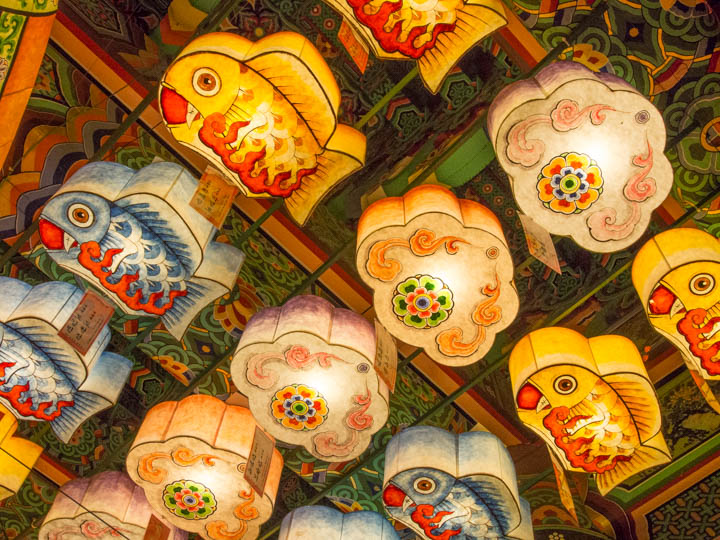
The entrance gate to Jogyesa Temple

On the street near Jogyesa

On the street near Jogyesa, suspended from bamboo poles

A display of children's lantern submissions, next to Jogyesa Temple
Subscribe to:
Posts (Atom)