Showing posts with label Andong. Show all posts

Sunday, December 07, 2014

Goseong Ogwangdae - Scene Three: Bibi Dance

My favorite scene of the Goseong Ogwandae is also known as the Bibi Masked Dance. In it, Bibi, a rather playful creature who loves to eat anything, taunts the noblemen. Bibi loves to leap at and jump from behind, scaring the wealthy scholar. In between, Bibi stops to play with and wag his tail between his legs.


I did not see the character Bibi appear in the masked dance at Andong.

Friday, December 05, 2014

Goseong Ogwangdae - Scene Two


In the second scene of the Goseong Ogwandae masked dance, Malttugi (servant) enters on stage, dancing with the noblemen and poking fun at them.
The Hahoe masked performance also featured a yangban aristocratic nobleman.
Yangban aristrocratic mask from Andong


Wednesday, December 03, 2014

Goseong Ogwangdae Masked Dance


When it was still warm out, I attended a free masked performance in downtown Seoul. Having already attended a Hahoe mask performance down in Andong, I had some idea of the basic structure of Korean masked dances. A brochure was provided, but unfortunately was only in Korean and Japanese. I would have to be a careful observer to try and figure things out. As in the Hahoe mask performance, the Goseong Ogwandae (from the southern coast of Korea) masked dance is broken up into distinct scenes - five in total. Ogwandae indicates that five clowns appear in the play. Like the Hahoe mask performance, Goseong Ogwandae is rather satirical and pokes fun at certain people in society. Goseong indicates the region of Korea where it originated, located by the southern coast. Originally, the Goseong Ogwandae was performed on the first lunar month of the year, but later it was danced in the spring and summer.  
Unlike the masks of the Hahoe in Andong which were constructed out of wood, these masks were papier mâché. The Goseong masks appeared to me to be less refined and simpler.


The first scene is known as the Mundung clown dance, so named as the noble descendant the was suffering from mundung disease (leoprosy). Both angry and sad for not being able to succeed in life, the nobleman complains that his disease is the result of his ancestors' sins.

Read more about the Goseong Ogwandae and other masked dances of Korea at http://www.mask.kr/coding/english/sub08.asp

Wednesday, October 29, 2014

Chrysanthemum Festival, Jogyesa Temple

Fall is not just about leaves in Korea. Another colorful symbol of fall is the chrysanthemum flower. The Jogyesa Buddhist Temple in Seoul holds an annual festival in October featuring this Korean autumn flower. Even some trees get decked out with mums. 


The "flower tree" in the background cascades with clusters of yellow and burgandy mums, but it also looks a bit spider-like. Just as in the temple's lantern festival, tags stick out of the displays, recognizing contributors. It is also a testament to the labor of love for those involved with the festival.

When I traveled to the Andong region, I saw fields of chrysanthemums being harvested. Many will adorn temples and parks within the country. Chrysanthemums are also dried and used to make tea.

Monday, February 10, 2014

Can't Forget the Cow

Although not one of the masked Hahoe performers in Andong, I believe that the cow deserves some attention as well. This character in the performance (actually made possible by two performers) is quite straightforward. It meanders about near the beginning of the performance, even stops to take a bathroom break, and unfortunately succumbs to the knife of the butcher. 

Sunday, February 09, 2014

Kaksi Mask, Korea

The final Hahoe mask I will write about is Kaksi (or Gaksi). She represents a young newly-married woman. Still a common practice in Korea, she lives with her in-laws, where she must be humble, discreet, and non-judgmental towards her new family. The only masked Hahoe figure to have firmly closed lips, this connotes her need for endurance during those first challenging years of marriage. With slightly downcast eyes and gentle twisted hair, she walks with light, but unwavering steps. Kaksi is the only Hahoe mask to be portrayed in a more heroic, non-hypocritical manner.
Read more about Kaksi and other Hahoe masks at the Hahoe Mask Museum website.

Friday, February 07, 2014

Sonbi Mask, Korea

Another one of the traditional Hahoe masks from Korea is Sonbi (or Seonbi). A scholar of noble heritage, the stern looking Sonbi is seen in the performance squabbling with the aristocratic Yongban over which had the higher status. Its bulging eyes indicate excessive reading, and the high checkbones and hollow upper lids connote someone who is so absorbed in his studies he couldn't look after his household. Hollow cheekbones are typical of other masked figures who have hardship, but Sonbi's are somewhat intentional and self-inflicted due to his complex thoughts. Overall, his look is one of personal dissatisfaction. In the play, Sonbi competes with Yonban over wooing the woman Pune.

Read more about Sonbi and other Hahoe Masks at the Hahoe Mask Museum website.

Wednesday, February 05, 2014

Choraengi Mask, Korea

Yet another one of the twelve original Hahoe masks is Choraengi. A servant of the aristocratic Yongban, Choraengi is haughty and disrespectful towards his master. Its protruding brow is symbolic of one who is obstinate, and its short wrinkled nose is indicative of one who is unable to accumulate property and is quick-tempered. Choraengi also has hollow-looking cheeks (much like Halmi the old woman and Sonbi), indicating a life of hardship.
Read more about Choraengi at the Hahoe Mask Museum website.

Monday, February 03, 2014

Paekchong Mask, Korea

Paekchong (or Baekchong) is the butcher in the Hahoe mask performance. Like other societies, its meat-handling profession put it in lowest class in Korean society. Its facial features including pointed eyes, furrowed wrinkled brow, protruding lip, cheek lines, and an overall rough look connotes a certain amount of wickedness and ruthlessness. Like the Chung (monk) mask, the character has a small lump on its forehead, connoting gloom. However, Paekchong does feel guilt for the taking of life. In the play I saw, Paekchong battled with the cow, killed it, promptly butchered it and removed the heart and testicles, which he first offered to the audience and then sold to the Yangban character.

Saturday, February 01, 2014

Imae Mask, Korea


Imae, a servant of the aristocratic character Seonbi, is depicted as the village idiot or fool. Good natured (symbolized by drooping eyes), Imae bears the brunt of his master's temper. Just as Imae's nose is crooked, other parts of his body are deformed, including a limp arm and twisted leg. Although Imae's disabilities were much more pronounced, other Korean masked characters also include illnesses and deformities. Unlike many of the Hahoe masks, Imae is missing a lower jaw. According to legend, the original mask maker Ho died while making the Imae mask, leaving it incomplete.
Read more about Imae and other masks on the Hahoe Mask Museum website.

Thursday, January 30, 2014

Chung Monk Mask, Korea

The Chung (or Jung) mask represents a monk who has wandered and transgressed. Without financial status and likely no children, the apostate character also has a lump on his forehead, often associated with gloom. However, when he saw Pune (she was urinating), he became turned on and later on even abducts her. With his wide, scrunched nose, squinty eyes, and wrinkled forehead, Chung is depicted as being sly, lewd, and lustful. Even his jerky steps connote deceitfulness and cunning behavior.
Read more about Chung mask on the Hahoe Museum website.

Tuesday, January 28, 2014

Pune Mask, Korea

The Pune (or Bune) Hahoe mask from Korea is historically seen as a widow. With a gentle smile hinted at by the mouth and eyes, as well as crescent-shaped eyebrows and a thin high nose, the Pune depicts classical beauty according to traditional Korean standards. She is usually seen in performances with the Yongban and/or Sonbi, who boast of their high status and education in order to seduce her. Through actions and gestures (the character never speaks), Pune is somewhat flirtatious.
Read more about Pune on the Hahoe Mask Museum website.

Sunday, January 26, 2014

Yangban Mask, Korea

Prompted by a request from a friend about Korean masks, I decided to devote the next few blog posts on the topic. Featured here is the Yangban mask. This masked figure represents the aristocratic class during the Joseon Dynasty. With its happy, gentle expression, this wooden mask with a hinged jaw is perhaps the most popular of the Hahoe style masks.  When watching the Hahoe mask performance at Andong, the masked actor seemed to portray a slightly haughty disposition. The depiction of the aristocrat connoted in a somewhat mocking way that this higher class should be a bit more humble and approachable. Read more about the Yangban and other Hahoe masks at the Guide to the Hahoe Masks and the more academic writing from the Hahoe Museum.

Monday, December 30, 2013

Buddhas and Persimmons

I found this collection of Buddhas behind one of the temple buildings at Bongjeonsa Temple near Andong, South Korea. Behind the colorful and often jolly figures, some fruit including, an Asian pear and persimmon, was carefully placed.   

Saturday, November 23, 2013

Neutrals and Brilliants

Gathered stalks from the harvested rice proudly stood, vying for attention against the brilliant hues of the chrysanthemums.

Thursday, November 21, 2013

Sloped Roofs and Amber Glow

The tiled roofs of the Buddhist buildings at Bongjeongsa Temple sloped gracefully, set amongst the gentle haze of a foggy fall morning.

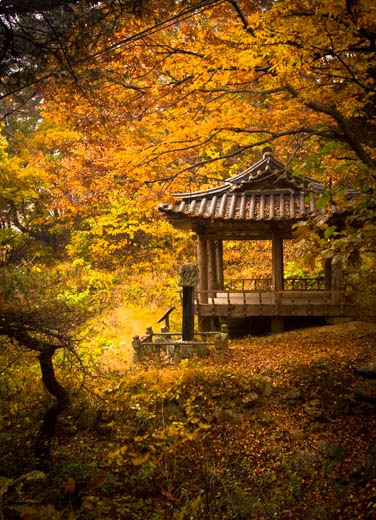
Nestled amidst the amber glow of the forest on the way back down from the temple was this peaceful little pavilion. What a perfect place for reflection and inspiration.

Tuesday, November 19, 2013

Bongjeongsa Temple Bell, Andong

Overlooking a hill at the Bongjeongsa Temple in Andong, this beautifully textured bell commands a closer look.


Friday, November 15, 2013

Geuknakjeon Hall, Bongjeongsa Temple


Built during the Silla Dynasty during the reign of King Munmu (661-681), the temple has been rebuilt several times during the Joseon Dynasty (1392-1910). Nestled on the hill amongst old twisted trees are the temple buildings, pagodas, pavilions, and hermitages that are part of Bongjeongsa. Geuknakjeon (National Treasure No. 15) is the oldest wooden building in Korea, dating back to the 12th-13 century. Although it has seen several repairs (1363, 1625, 1972), it is considered to be the original building. The temple hall with its stunning original Joseon murals is also a National Treasure, as is the three-story stone pagoda dating back to the Goryeo Dynasty (918-1392) and a few other halls.


Wednesday, November 13, 2013

Samcheong Seoktap, Bongjeonsa Temple


Tangible Cultural Property No. 182
As inscribed on the sign "This 3.18m high three-story pagoda was erected in the Goryeo period. It is standing in front of the Geungnakjeon Hall of the Bongjeongsa Temple. Part of the foundation is broken, and the finial is missing. However, it is almost a perfect three-story stone pagoda. The pagoda is believed to be erected at the same time that the Geungnakjeon Hall was constructed in the middle of the Goryeo Period."

Monday, November 11, 2013

Bongjeongsa Temple Arrival

After about a 3 1/2 hour chartered bus ride from Seoul, we arrived at Bongjeongsa Temple near Andong. After a quick chrysanthemum tea sample tasting, we walked through the temple entrance Ilju Gate and headed up the autumn forested hill. A foggy morning, it was slightly disappointing that brilliant hues of autumn leaves would evade us, but at least it wasn't raining.
Ilju Gate

Small gate leading up to what looked like a residential quarters

Located at the southern foot of the Cheondeung Mountain, the Buddhist temple site of Bongjeongsa dates back to 672 AD. According to a memorial writing for the construction, its location was selected after saint Eusangdaesa's paper crane that he threw landed at the site. All total there are ten buildings in the main temple site, along with a couple small annexed temples.
Even the bathroom facilities, located prior to the temple area, blended in nicely.