Showing posts with label traditional. Show all posts

Wednesday, March 03, 2021

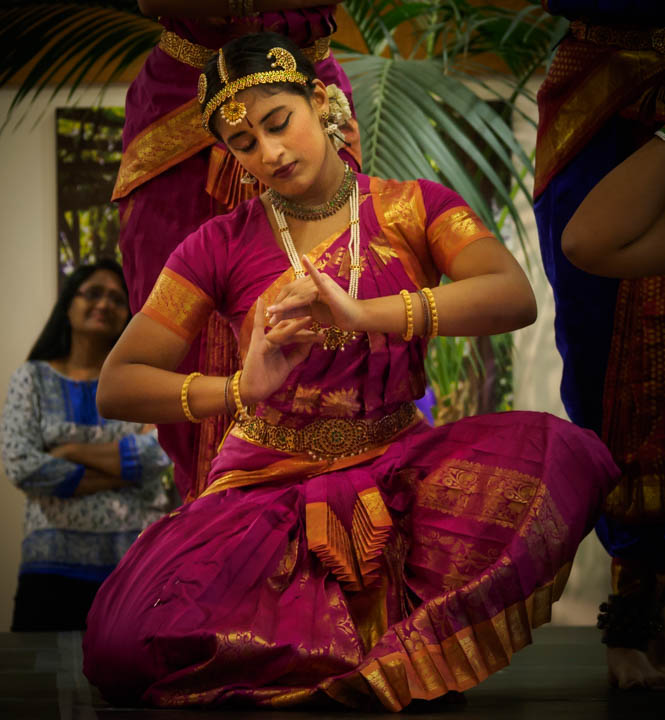
Manipuri Dancer: My latest artwork


Manipuri Dancer

Pastels on PastelMat paper
Chennai, India
©2020 Melissa Enderle

The full moon is out tonight. I am playing the role of Lord Krishna as we perform at the Kalakeshetra Fair in Chennai, India. The crowd always loves seeing the love between Lord Krishna and Radha being reenacted. Just like the Bharatanatyam dancers of Tamil Nadu, much emphasis is placed on the hand and upper body gestures I make. We don't wear anklet bells or perform such forceful footwork though. The tube-skirted Radha and I dance gracefully, accompanied by kartal cymbals, a barrel Pung drum, and singers chanting beautiful Sanskrit poetry. As I move about in our courtship dance, the feathers from my headdress and tassels affixed to my arms sway in the humid air. Did our Lord Krishna have as much fun when he courted Radha? I wonder.

Monday, December 03, 2018

Old pit loom weaver, Rajasthan


This old man demonstrated weaving in a pit loom, which was located in his home in a village outside of Jodhpur, Rajasthan (India). In addition to demonstrating the weaving process, he also showed me a tree where he got his brilliant pink dye. A couple of years later when I revisited his village, I heard he had passed away. 

Saturday, November 17, 2018

Xingqing Park - with a swoop of a brush

A plethora of activities occurred in all parts of Xingqing park. Two of my favorites included the use of a brush.
In one part of the park, people gathered around a man doing traditional Chinese brush painting. The man worked with confidence as he laid down broad brushstrokes without the aid of an initial drawing. It was quite obvious that he had painted many such horses before.
After his energetic horse was painted, he wrote vertical columns of calligraphy in the space above, also with black ink. Folowing that, he pressed several signature chops into red ink pads.
The artist with his completed horse ink brush painting. Notice the ink, brushes, and stamp pads in the lower portion of the photo. 


Sunday, November 11, 2018

Dancing with the Uyghurs

While strolling through Xingqing Park in Xi'an, I came across these Uyghur ladies. The Uyghurs are a Muslim minority ethnic group found mostly in northern China and the Hunan province. Attracted to their colorful costume, I inquired (by gesture) a request to photograph them. Immediately they grabbed me, signaling that I was to be in the photo with them. Soon a bunch of photos were being taken from multiple cell phones. 
After my photo session was over, I managed to snap a few photos of the dancers before they went off to practice. 

I stayed for a few minutes, enjoying their dancing amidst the autumnal setting.
Nearby, a few couples were also dancing. The sheer joy on this man's face made me smile. Have fun dancing!

Sunday, November 04, 2018

A Stroll along Xingqing Lake


This weekend, I went to Xingqingong Park in Xi'an to see the autumn colors there. This park, the largest public park in Xi'an, is built on the site of the Xingqing Palace of the Tang Dynasty (616-907 AD). Walking through a traditional-style gate, we took a path leading to the main lake. Although it was overcast and hazy, the autumnal colors reflected nicely on the water's surface. Several traditional-style buildings peeked in between tall willow trees.
Traditional-style buildings along Xingqing Lake
Although it was fairly early in the morning, the park was already alive with people. Many others chose to take the path circumnavigating the lake.

Colorful boats, some styled with childhood characters, were parked along the shore. I can imagine that the lake would be dotted with them in the warmer weather.
In the distance, skyscrapers from a modern Xi'an contrasted sharply with the elegant traditional park structures.
Now that I've found this park, I am eager to return to it in the different seasons. It reminds me of my walks around the beautiful pond at Changgyeonggung Palace in Seoul.

Tuesday, February 13, 2018

Two of My Favorite Things

I wrote a story to accompany the color pencil artwork I just finished. We met this family of the Mir ethnic group on our way back to Dasada, Gujarat. (Read my blog post on our encounter). Note the red flip phone that she is clutching, along with the goat "kid." Like other Mir families who have settled in the Rann of Kutch region of Gujarat, her family lives in poverty. Nowhere near their "tent" (a plastic tarp propped up with skinny logs) could I see access to potable drinking water, electricity, or toilets. 
The elaborate background in this piece is of Mutva mudwork known as Lippan Kaam, seen in some homes in the Kutch region.
See more of my artwork at www.melissaenderle.com.
With the heat beginning to let up, I climb over my sleeping brother and lift up the flap of our plastic tarp. Time to play a bit with the baby goats before their feeding time! I’m glad that our mamma goat had some babies. It gets a little boring living out here in the dry, flat region of Gujarat called the Rann of Kutch. I would like Papa to move our tent closer to the town of Dasada, because then I would have more kids to play with– besides my brother and three sisters. Plus, we might even get electricity so we could charge our cell phone more easily. Papa says our location is just fine because it is right along the highway. That way, more tourists can stop to buy our bangles. Oh, wait! Here comes a car right now! Gotta go!

Sunday, February 19, 2017

Bharatanatyam Meets Madison


When I read an announcement that Bharatanatyam Dancers were going to be performing at Olbrich Gardens in Madison, I jumped at the opportunity to see this oldest of classical Indian dances, right in my neighborhood. Although it was not hot and sticky like it often was when I attended the performances in Chennai, the unusual spring-like February temperatures were just fine for me.

I arrived around the same time as some of the younger dancers. Unzipped winter jackets revealed the colorful costumes. A mother quickly "painted on" the finger designs with a colored Sharpie in place of customary henna. Artificial jasmine had to suffice instead of the customary fragrant floral strands adorning the plaited hair.

An instructor of the local Bharatanatyam Dance school introduced the girls (ages 5-16) and gave the audience a brief intro to what they were about to see. She explained how the eyes and hands were a highly integral part of conveying emotions in the expressive dances. Some of the younger students
The sophistication of footwork, hand gestures, and eye/neck movements increased with the age levels. Poses hearkened to the gods celebrated at Hindu temples, such as Krishna and Shiva. An enjoyable Saturday morning in Madison!

Saturday, January 28, 2017

Artwork: Naxi Woman with Blue Shawl (Color Pencil)

In anticipation of an art exhibition, I wrote a short story about each painting, as if written by the person in the painting. These are all real people, and the stories are based on experience, observation, and representative/factual information typical of someone from that region/profession. Some of these paintings are still available, so if you are interested in purchasing one, please contact me.

For eighty-three years I have trod through the narrow lanes of my small village--first to my parents’ home, and then to my azhu's family farm. I loved living with my nai nai; now I get to enjoy the laughter of my grandchildren as they run through the family courtyard or play with the kittens. Even though my son says I don’t have to go to the market to sell vegetables, I quite like it, for it gives me something to do and a chance to chat with the other women. With a basket securely fastened to my cape, I slowly make my way to the tiny market, chatting with friends along the way.

See more artworks on www.melissaenderle.com.

Monday, January 02, 2017

My latest Artwork: Bhunga and Bandhani, Gujarat (Color Pencil)


Here is my latest artwork, a color pencil composition of a Gujarat woman inside a Bhunga home in the Gujarat, whose walls were covered with mirror-work known as Lippan. She was wearing a heavy silver necklace, anklets, bangles, and gold earrings and nose ring. Her clothing is in Bandhani tie-dye. 

Wednesday, May 25, 2016

Leeum Museum, Seoul

Itaewon in Seoul is much more than just its plethora of restaurants. Follow one of the meandering lanes beyond the busy main street, and the wonderful Leeum Samsung Museum awaits your visit.
In 2004, the Leeum museum opened its branch in the Itaewon/Hannamdong area. It is located in a neighborhood with high-end homes and embassies. In a megacity, such individual homes are rather rare.

Comprised of three buildings, the Leeum Museum has a section for traditional, contemporary art, and another dedicated to youth education. I went to the permanent exhibit, which featured many pieces of traditional Korean art, some dating back to the 5th century. Everything was very well displayed and dual-signposted in Korean and English. Photography was not allowed in the exhibits themselves, but we were able to photograph the architecture.

One floor was dedicated to Buddhist art and metalware. The second floor contained traditional paintings and calligraphy. The upper two floors had ceramics, of both the Celadon and Buncheong styles. Quite a number of pieces were indicated as national treasures. You can see much of the collection on the museum's website.


Sunday, May 15, 2016

A Tour of the Icheon Traditional Korean Kiln

My dear Korean friend and I took the bus today to the 30th annual Icheon Ceramics Festival. When I stopped to take a photo of the large traditional kiln, a man immediately came up to us and invited us to go with him for a personalized tour. With near giddy excitement, he eagerly shared with us (in Korean) some information about the traditional Korean kiln firing process. Through my friend Hae Jung who interpreted for me, I learned that the firing process is about 20 hours and gets to around 1,200°C.
Our guide was an assistant to a Korean ceramics master. He explained that pine wood is used to heat the kiln. It sounded like the sap of the pine wood is particularly conducive to the firing process. The mounded shape enables air to naturally circulate. The kiln is sloped upward, so as to draw the smoke up the chimney. After the kiln section is loaded with pieces, the opening is closed with bricks. An opening enables checking of the temperature. He was very partial to the traditional kiln firing method and believed it resulted in higher quality ceramics. He also added that the Chinese were very impressed by Korean ceramics and during the Goryeo dynasty, the Chinese came over to Korea to learn about its advanced ceramics techniques.
After a little while, some people began gathering near the kiln. Many were wearing gloves and eagerly watched on as one man took a knife to loosen the bricks around one opening. After the bricks were removed, a man went inside and began unloading the kiln. Gloved artists were giddy with excitement as their pieces were pulled out.

This man inspected one of his master's pieces, which was damaged by high temperature. 
Thankfully, most fared much better. These white porcelain pieces reminded me of the revered baekja pieces dating back to the 14th century.
Our guide remarked that during his visit to the USA, he was treated with kindness and found Americans to be very helpful. He wanted us to come again so he could give us an even more thorough tour and even meet his ceramics Master, followed by lunch. Alas, as my departure is just a few weeks away, I don't think this will be possible. I'm grateful for this tour and will add it to my list of wonderful experiences in Korea.

Monday, May 09, 2016

A Two Day Journey Around the World

This afternoon, I went to the Seoul Friendship Fair. Held since 1996,  this fair is celebrates the sister cities of Seoul from various places around the world. Considering my love of cultures, the lure of traditional music, costumes, as well as traditional food and handicrafts was too much to pass up. For a few hours in the afternoon, I sat on the grass by Seoul City Hall in the bright May sunshine and soaked up not only sun rays, but some wonderful performances.

Belarus
Their costume and singing reminded me of some of the performances I saw in Serbia. Some songs were very happy and one was more somber. The accordion player was very energetic and the roh player was able to get a variety of tones out of the animal horn.


Japan
The Shamisen player from Japan played a few lively, energetic pieces. Two puppeteers also performed a few skits, including one with a lion and some butterflies. The lion reminded me of a larger version seen in some Korean performances.
Lion and human marionettes manipulated by a skilled Japanese puppeteer
Uzbekistan
As there was no shade on this very sunny day, I didn't want to push being too long out in the sun. However, when I saw the beautiful costumes from Tashkent, I decided to stick it out a bit longer. We had to wait for the drumset and other instruments to be assembled and set up, but it was worth it. A clarinet player myself, it was fun to hear the different tones and melodies produced from such common instruments. The male singer was both forceful and tender. The dancers, however, stole the show. In the four or five pieces, different costumes were worn for each one. The dancing and music had a more Middle Eastern feel to it. The dancers were very particular with their hand and arm positions, and their twirling and footwork was great. Imagine twirling and dancing in high heels! 


Each of the dancers had their hair in long braids, which twirled like ribbons as they spun around.

It was an enjoyable afternoon at yet another Seoul festival! #visitseoul

Sunday, March 13, 2016

Out for a Test Drive

On the way to the UNESCO World Heritage Site of Prambanan, we came across this short procession. My driver said that these bullock carts were going to be used for an upcoming celebration, and so the drivers needed to get experience navigating on the public roads. I certainly didn't mind this colorful Indonesian traffic hold-up. 

Friday, September 18, 2015

Residents of the Lashi Village

After another rainstorm, I went for a walk in the Lashi village. It was a very quiet, local village - no tourists to be seen. Splotches of manure and straw dotted the paved and unpaved narrow lanes. Roads meandered in different directions, making it important to make note of my route so I could get back to the guest house. No business card (or even address) to show anyone. Thankfully I have a good sense of direction.

Even in this small village, gates were a prominent feature. Some walls had painted murals, while others were on ceramic tiles. 

I saw several older people sitting near a large gate - perhaps it was the gathering place for locals, or maybe it was a place to catch local transport. I spotted several people I was interested in photographing. After a smile and gestured greeting, I pointed to my camera and asked if I could take their photo. What kind faces. I wish I would have had some language skills to talk to them.


Sunday, September 06, 2015

Sunday, August 02, 2015

Appliqué work of the Yi People

In addition to having lacquerware in the shop, Yi ethnic member Joel Zheng also had a display of the traditional Yi clothing. 

Yi clothing typically consists of contrasting, bright colors such as dark red, black, green, yellow, and blue. The skirt is long and pleated, with black, red, and yellow being the most typical colors. At a young age, Yi girls are taught how to do cross-stitch and other sewing techniques such as appliqué. Women also do the weaving of the cloth.
Floral and fern-like designs are commonly featured on women's clothing. Some of the designs reminded me of those I saw on Hmong cloth - as was the pleated skirts. Silver jewelry and ornamentation adds a decorative touch. 

The cone-shaped baubles on this head piece reminds me of the Lisu people I had met in Thailand.
Spinning of the thread for weaving

Appliqué steps

Designs found on Yi clothing
The clothing on display was quite elaborate and of fine craftsmanship. Nowadays, the level of the typical costume isn't quite at this level, particularly if it is purchased.

I was also shown some shawls that were felted. The natural wool color pieces were plain, but very practical.

This article had quite a bit of detail on the clothing of the Yi people in Sichuan, the province where Joel Zhang is from.