Showing posts with label India. Show all posts

Friday, September 10, 2021

Pastel Artwork: Snuggles and Simple Pleasures

 My latest pastel portrait, "Snuggles and Simple Pleasures." ©2021 Melissa Enderle


After finishing Sunday morning chores and creating a fresh kolam in front of my humble home, I sit down to enjoy a cup of hot filter coffee.  Our alley is filled with the squeals of laughter from young neighborhood children playing together. As the coffee warms my insides, the sun's early rays warm my thin skin. Soft fur brushes against my legs. It's my favorite kitten, coming for a visit. As I snuggle with him, I see what looks like a smile emerging from this contented creature. In this poor Chennai neighborhood, we might not have much, but it's these simple pleasures that keep me happy.

See more of my artwork on my website

Wednesday, March 03, 2021

Manipuri Dancer: My latest artwork


Manipuri Dancer

Pastels on PastelMat paper
Chennai, India
©2020 Melissa Enderle

The full moon is out tonight. I am playing the role of Lord Krishna as we perform at the Kalakeshetra Fair in Chennai, India. The crowd always loves seeing the love between Lord Krishna and Radha being reenacted. Just like the Bharatanatyam dancers of Tamil Nadu, much emphasis is placed on the hand and upper body gestures I make. We don't wear anklet bells or perform such forceful footwork though. The tube-skirted Radha and I dance gracefully, accompanied by kartal cymbals, a barrel Pung drum, and singers chanting beautiful Sanskrit poetry. As I move about in our courtship dance, the feathers from my headdress and tassels affixed to my arms sway in the humid air. Did our Lord Krishna have as much fun when he courted Radha? I wonder.

Thursday, December 17, 2020

Playing for the Maharaja


 "Playing for the Maharaja"

Color Pencil. Jaisalmer, India

©2020 Melissa Enderle


It is the day of the Gangaur festival in this ancient city of Jaisalmer. I'm doubly giddy about the festival celebrating our goddess of love and marriage this year since my granddaughter is in the procession of other eligible young females eager for love. She looks so beautiful and grown-up in her new dress and jewelry. Plus I'm one of the musicians selected to perform. Both me and my trusty kamaycha instrument are a bit worn but we both will sing out our best today. I've already performed some songs that beseech the goddess Gauri to bless these young women with prosperous marriages. Behold! The Maharaja has arrived! I quickly switch to a song singing the praises of His Highness. May he and his family live a long, prosperous life! The Golden City of Jaisalmer loves you!

See more of my artwork from India and other places on my website.

Monday, December 03, 2018

Old pit loom weaver, Rajasthan


This old man demonstrated weaving in a pit loom, which was located in his home in a village outside of Jodhpur, Rajasthan (India). In addition to demonstrating the weaving process, he also showed me a tree where he got his brilliant pink dye. A couple of years later when I revisited his village, I heard he had passed away. 

Monday, November 19, 2018

Di Shu, Water Calligraphy in the Park

In several spots within Xingqing Park, I spotted some people, mostly elderly gentlemen, doing a curious form of painting. At the end of a metal rod was a flexible piece of foam shaped to a point, just like a paintbrush. With a dip of the foam brush into water from a cutoff bottle, the man begins his temporary art form. Known as Di Shu, which means writing on the ground/Earth, this art form has gained in popularity since the 1990's, spreading to parks all over China.

The process seemed to be several things at once –meditation, exercise, art, literature, and conversation.  For some, it is a way to celebrate brush calligraphy in an era where most writing occurs on a keyboard. At times, the man was in his own little world. At other times, he engaged with onlookers. After a short discussion, he went back to adding more characters. After a short while, the once glistening characters would have faded, evaporating to invisibility. This reminds me of another beautiful temporary art form of south India - the kolam. Interestingly enough, I didn't see any of the Di Shu calligraphy artists photographing their writing. This further contrasts it with ink calligraphy, which prides itself with long-life. 

Would you expend energy making such impermanent art?

For more information on Di Shu water calligraphy, check out this and this article.

Monday, July 02, 2018

Kathak Dancer, India

My latest painting of a Kathak dancer. I saw her performance in Chennai, India
Kathak Dancer
Pastels on PastelMat paper

It is my turn to be on stage. The scent of jasmine from the previous Bharatnatyam dancer still lingers in the air. After giving a salutation and paying respects to my guru and accompanying musicians, I begin the thath sequence with slow movements - first with the eyebrows and neck. I bend one elbow and extend the other arm, making elegant but gentle movements with my upturned wrist and fingers. At this stage of the dance, the scarf covering my head is limp. Sensing the quickening pace of the music, my eyebrows move up and heavily-lined eyes widen. The small Ghungroo bells on my ankles collide as I rapidly stomp my feet on the stage floor in perfect syncopation with the music. As my feet movements become lighter and more complex, I pick up speed and execute a series of turns, causing my skirt to lift like that of a whirling Sufi. 

Friday, March 30, 2018

Thursday, March 01, 2018

Artwork: Just Me and My Goat

My latest artwork, a watercolor of a little girl from Gujarat, India
Just Me and My Goat
Watercolor
Dasada region, Gujarat, India
©2018 Melissa Enderle

Since I finished helping my sister carry water for cooking, I finally get some time to play with our baby goat. He is a lot less wiggly now because he just finished drinking from his momma. I like carrying our baby goat. It is fun and will help make me strong. Then it will be easier for me to help carry more wood for our cooking fire. I also have to watch and make sure that the baby goat doesn’t walk too close to the road. Daddy says that the goat is not so smart yet and might get runned over. I feel important when I can help my family.


See more artwork on my Facebook page - Melissa Enderle Artwork  or my website www.melissaenderle.com 

Thursday, February 15, 2018

Mirrorwork Murals of the Kutch


About 63 km north of Bhuj lies some remote Banni villages in the Kutch region of Gujarat. We made the dusty drive there to appreciate the architecture and handicrafts of the people living here. Many of the people still live in these circular bhoonga (also spelled bhunga) huts, whose shape and mud walls are conducive to counteracting the oppressive heat of the region. In direct contrast to the drab surroundings, the exteriors of these conical dwellings are painted with brilliant colors. Traditional bhoongas have thick mud walls and conical thatched roofs, but some of the ones rebuilt after devastating earthquakes in 2001 were constructed from cement. 

Enter these bhoongas, and you'll be treated to some intricate mirrorwork murals. This mud relief mirrorwork is known as Lippan kam or Chittar kam. There are variations of this relief mudwork in various communities throughout the Kutch region. Equal mixtures of dung (either from wild ass or camels) is mixed with finely sifted clay. Men traditionally are in charge of gathering the clay and hauling it to the village. Some use millet husks, which provides a natural repellent to termites. Very fine coils are rolled on top of fresh slabs of clay. Round, diamond, or triangular mirrors known as aahbla are interspersed. Muslim artists generally constrain their motifs to geometric or floral designs. Women, often working together, form communal bonds as they work on the creative process, much like our quilting bees.

Lippan Kam is also functional. When placed on the outside, it acts as an insulator by reflecting heat. interior work helps magnify the effect of limited light sources. Imagine even how a single candle could magically light up an entire room, reflected by all the mirrors! 
A Rabari woman demonstrates how to make Lippan kam
A Banni woman with Paako embroidery

Interior of a Muslim Mutwa home

Lintel above a doorway
Mutwa embroidery
The designs of the Lippan kam are strongly reminiscent of their highly intricate embroidery. Beauty times two!


The Lippan Kam mirrorwork has currently appeared in two of my artworks, seen below.
Two of My Favorite Things. Color pencil, 2018 by Melissa Enderle

Bhunga and Bhandani. Color Pencil, 2017 by Melissa Enderle

See more of my artwork at www.melissaenderle.com.

Tuesday, February 13, 2018

Two of My Favorite Things

I wrote a story to accompany the color pencil artwork I just finished. We met this family of the Mir ethnic group on our way back to Dasada, Gujarat. (Read my blog post on our encounter). Note the red flip phone that she is clutching, along with the goat "kid." Like other Mir families who have settled in the Rann of Kutch region of Gujarat, her family lives in poverty. Nowhere near their "tent" (a plastic tarp propped up with skinny logs) could I see access to potable drinking water, electricity, or toilets. 
The elaborate background in this piece is of Mutva mudwork known as Lippan Kaam, seen in some homes in the Kutch region.
See more of my artwork at www.melissaenderle.com.
With the heat beginning to let up, I climb over my sleeping brother and lift up the flap of our plastic tarp. Time to play a bit with the baby goats before their feeding time! I’m glad that our mamma goat had some babies. It gets a little boring living out here in the dry, flat region of Gujarat called the Rann of Kutch. I would like Papa to move our tent closer to the town of Dasada, because then I would have more kids to play with– besides my brother and three sisters. Plus, we might even get electricity so we could charge our cell phone more easily. Papa says our location is just fine because it is right along the highway. That way, more tourists can stop to buy our bangles. Oh, wait! Here comes a car right now! Gotta go!

Thursday, November 30, 2017

Churches of India

Inspired by an article in the current issue of  Culturama, I decided to post some my favorite photographs of churches. South India, particularly the states of Tamil Nadu and Kerala,  has a large number of churches, as does Goa. (Northeastern states such as Mizoram have an even greater percentage of Christians - up to 90%, but I never traveled there). Christianity came to South India around 52 AD via the disciple Thomas. He was martyred in Chennai twenty years later. While the colorful Hindu temples of Tamil Nadu are spectacular, the regional churches are also majestic. A variety of architectural styles can be seen, influenced largely by origins of missionaries. 

Read the article in Culturama for information about these and other churches.

Which is your favorite? Do you have other noteworthy Indian churches to share?
Velankanni Basilica, Tamil Nadu

Church of the Immaculate Conception, Pondicherry


Church at Little Mount, Chennai (Tamil Nadu)

Church of the Sacred Heart, Pondicherry
Sacred Heart exterior, Pondicherry

Idaikattur Church, Tamil Nadu

Church along the backwaters of Kerala


San Thome Basilica, Chennai (Tamil Nadu)

Oriyur, Tamil Nadu

St. Philomena Church, Mysore (Karnataka)


Wednesday, November 01, 2017

Upcoming Exhibit - you're invited!

If you're in the Madison, WI area, come to the opening reception of my art show. At 6pm, I will be delivering a presentation on my artwork and travels. Fresh homemade cookies will be served and Michael Sullivan will be performing live music. 
The art show will be up from November 1-30 at the Lakeview Library. 

Thursday, September 21, 2017

Steeple Workers

Early in the morning, the workers were already busy performing exterior cleaning and maintenance to a local church. Reaching the roof and steeple was a quick and easy process. I immediately was reminded of a scene I had seen in Kerala, India. 

This worker utilized ropes (likely coir ropes locally made from coconut fibers) and simple scaffolding to climb up and around in order to do some maintenance work. Keeping it simple, he donned a lungi and went barefoot. 
I'd have to say, the Kerala steepleworker made a much more interesting photo....

Tuesday, August 29, 2017

Sportin' a new haircut - Post "Bob Ruff"


via Instagram
Still a pup, Marly was fairly patient when getting the rest of his body buzzed, but not so with his face. My sister finally abandoned the process when she realized that the furball had enough. We're hoping to snip a few stray hairs here and there when Marly is in a chillin' mood. Anyone up for the challenge?
Marly prior to his haircut
He was getting to look like a famous artist. Bob Ruff, anyone?


Thursday, June 01, 2017

Block Printing of India

A video shared by my friend reminded me of why I love the textiles of India so much. Each step reveals the artistry and intricacy that is so lovingly performed.                                                                    

The textile lover that I am, the Anokhi Museum in Jaipur was a perfect place to visit when in the Pink City. Along with informative displays on the history of block printing in India, they had a few craftsmen doing demonstrations.
I especially enjoyed watching the man carving the wood block. It amazed me how such intricate, narrow lines could be formed by such simple tools. Each stroke was made with confident precision. Definitely not a beginner piece!

Holding up a finished block
Floral block detail with chisels
Three blocks that are needed to form one print. Precision is needed for both the carving and in alignment of the inked blocks.
Printing on a small handkerchief cloth

Stamping on a resist (in Gujarat, India)

In addition to printing with multiple blocks, a resist might be added, the cloth immersed in a dye bath, and the cloth washed, dried, and re-printed multiple times. So next time you see a hand-printed piece of fabric, you'll appreciate the artistry and understand why it is more expensive than that commercial knock-off.

Saturday, March 18, 2017

Arches of Baby Taj

Right now, I've been following some of the travels through India by some of my friends who are on spring break. In addition to the more famous Taj Mahal, one can also visit the also Itmad-ud-Dulah, known as the Baby Taj. Built prior to the Taj Mahal, this highly ornate but smaller mausoleum represents the first phase of monuments built in the Mughal Style. This photo was taken from the archway of the main building and frames the entry gate.

Read my previous post on the Baby Taj.

Sunday, February 19, 2017

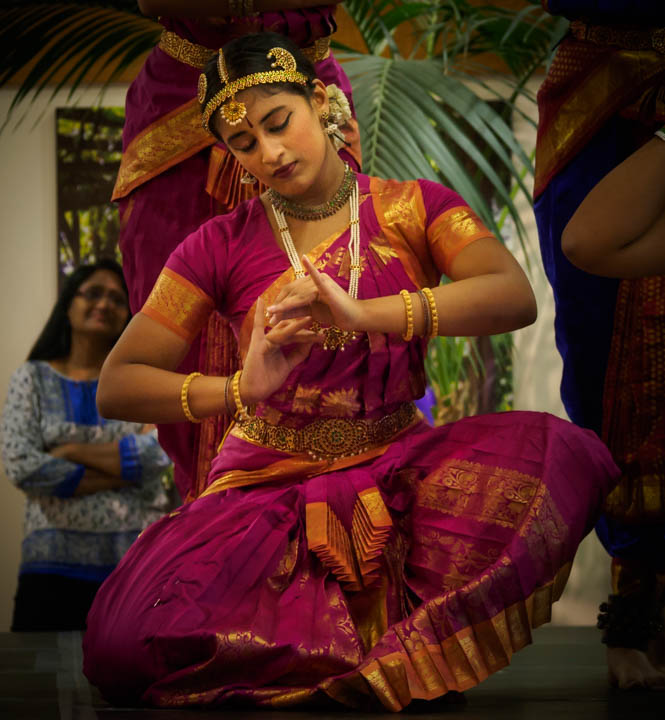
Bharatanatyam Meets Madison


When I read an announcement that Bharatanatyam Dancers were going to be performing at Olbrich Gardens in Madison, I jumped at the opportunity to see this oldest of classical Indian dances, right in my neighborhood. Although it was not hot and sticky like it often was when I attended the performances in Chennai, the unusual spring-like February temperatures were just fine for me.

I arrived around the same time as some of the younger dancers. Unzipped winter jackets revealed the colorful costumes. A mother quickly "painted on" the finger designs with a colored Sharpie in place of customary henna. Artificial jasmine had to suffice instead of the customary fragrant floral strands adorning the plaited hair.

An instructor of the local Bharatanatyam Dance school introduced the girls (ages 5-16) and gave the audience a brief intro to what they were about to see. She explained how the eyes and hands were a highly integral part of conveying emotions in the expressive dances. Some of the younger students
The sophistication of footwork, hand gestures, and eye/neck movements increased with the age levels. Poses hearkened to the gods celebrated at Hindu temples, such as Krishna and Shiva. An enjoyable Saturday morning in Madison!

Monday, January 02, 2017

My latest Artwork: Bhunga and Bandhani, Gujarat (Color Pencil)


Here is my latest artwork, a color pencil composition of a Gujarat woman inside a Bhunga home in the Gujarat, whose walls were covered with mirror-work known as Lippan. She was wearing a heavy silver necklace, anklets, bangles, and gold earrings and nose ring. Her clothing is in Bandhani tie-dye.