We also had the opportunity to walk around the riverfront and a bit of Phnom Penh's downtown. Numerous weddings were taking place on side streets. Similar to tradition in India, cut banana plants and flowers adorned the weddings, whose festivities averaged around $5,000. One could see fewer people walking and certainly less busses than in Chennai, but motorcycles remained popular, as did (more comfy-looking) rickshaws pulled by motorcycles. The riverfront became a hub of activity at nightfall. Buddhist devotees lit incense, brought flowers, and placed placed candles inside hollowed-out coconuts, chanting to music by a temple. Further onward, both young and old were doing line dancing to various music styles emanating from large speakers. For those wanting even more action, exercise equipment was available. Not exactly your average playground! After a pleasant dinner at a restaurant located in a well-kept colonial building, we went into a few of the many cute shops. ATM machines abounded, spitting out US$, the preferred currency of the country.
Melissa Enderle's travelblog on her travels to Mali, Tunisia, Serbia, Eastern Europe, India, South Korea, China, and other places around the world.
Showing posts with label Phnom Penh. Show all posts
Saturday, January 28, 2012
Tuesday, January 24, 2012
S21: From School to Prison
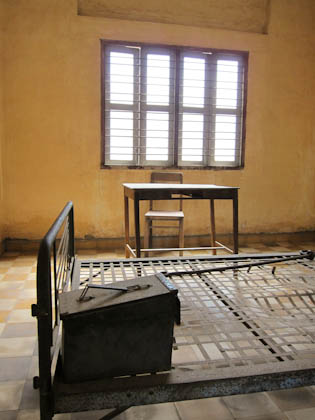
While in Phnom Penh, we visited a very sobering site known as S21. Just years after it was built as a school (Tuol Svay Prey High School), the Khmer Rouge transformed the site into a prison where "Enemies of the Revolution" were detained, tortured, and killed. Aside from the barbed-wire meshed fence covering some entrances and balcony openings on the second floor, it still retained the resemblance of a school. Upon entering a classroom, however, things looked much different. In place of desks and chairs, several rooms contained a single bed, a box for bodily functions, and iron devices used to secure the hands and feet to the bed. Some also contained a chair and desk, from where a member of the Khmer Rouge would meticulously document about the current prisoner, including the torture process.
In another room, large panels displayed the photos of some of the 12,000 -20,000 individuals that went through the prison. Amongst the stark black&white photos were the faces of children. Hanging on the walls of some rooms were large photos of the decomposing bodies of tortured prisoners still shackled the bed when the prison was liberated, with pools of dried blood staining the floor beneath. Corners of the rooms also bore signs of torture, as did the blood spatters on the ceiling. Going up a very normal school stairway, we walked though rooms subdivided into crude cells the width of a toilet stall and other rooms subdivided with bricks.
According to our guide, the barbed wire covering the balcony openings was to prevent prisoners from jumping to kill themselves. In another room I read some of the excerpts written by the seven survivors, including an art teacher who believed he was answering the request for an art professor position. Of the two alive today, one was on-site, selling his book. One can only imagine the horrors he experienced within these walls.
Location:
Phnom Penh, Cambodia
Monday, January 23, 2012
National Museum, Phnom Penh
Our next stop was to the National Museum, located just north of the Palace. Although photography of most objects was not allowed, we did enjoy viewing the Hindu statues (some dating back to the 6th century), a statue of the leader responsible for some of the grandest structures within the Angkor period, and some post-Angkor Buddha figures. Wings of the museum opened to a central garden, complete with water gardens, tropical vegetation, and a Buddhist sculpture in the middle. Although the museum was interesting to look at and contained information in English, it would have had more impact had we come after touring Angkor Wat.
Labels:
ancient,
Angkor Wat,
architecture,
Asia,
Buddhism,
Cambodia,
Hindu,
museum,
Phnom Penh,
travel
Location:
Phnom Penh, Cambodia
Sunday, January 22, 2012
Royal Palace, Phnom Penh
With blue skies and pleasant sunshine, the morning started in a positive way by visiting the Royal Palace grounds in Phnom Penh. One of the dominating buildings in the well-maintained grounds was the Throne Hall. On top of the colonnaded concrete structure (replaced the wooden one built in 1866) was a tall golden spire with four faces, reminiscent of those at Bayon in the Angkor Thom complex. Another building, the Silver Pagoda, so-named for the 5,000 silver tiles each weighing 1 kg lining the floor, is equally popular. Carpeting covers most of the floor surface, so only a small number of these are visible. Two main Buddhas are found inside - the Emerald Buddha made out of Baccarat Crystal, and a life-size one made out of gold and decorated with over 9,500 diamonds. Within the palace grounds, I also enjoyed the extensive mural scenes depicting the Ramayana and the well-manicured bushes, some in the shapes of whimsical animals.
Location:
Phnom Penh, Cambodia
Saturday, January 21, 2012
Off to Cambodia
For Christmas break, I traveled with two friends through the. Countries of Cambodia and Myanmar (Burma). I was looking forward to see the countries' ancient sites, natural beauty, and hopefully meet some local people.
After flying from Chennai to Bangkok and then to Siem Reap, we left the cute airport there reminiscent of traditional Cambodian architecture and headed into the town to pass some time while waiting for the flight into Phnom Penh. Here we toured a workshop where village people learned apprenticeship for traditional crafts in wood and stone carving, painting on silk, lacquer designs, and tooling on copper.
Location:
Siem Reap, Cambodia
Subscribe to:
Posts (Atom)