Showing posts with label nature. Show all posts
Showing posts with label nature. Show all posts
Friday, January 31, 2020


Wednesday, August 07, 2019
Pastel: Splashes of White and Violet

My latest artwork, a pastel of spring flowers at Olbrich Gardens in Madison, Wisconsin. Painted on PastelMat paper.
Thursday, November 09, 2017
Not Quite Giverny

Friday, August 18, 2017
Sunshine at the Sunflower Farm
A friend and I were eager to visit the sunflowers at the Pope Conservancy Farm, located just a short distance from Madison. Upon entering the parking area, I was already impressed; the large swath of grassed land was trimmed and had white lines painted to show denote parking spaces. A traffic attendant directed people to available parking spots. Signs indicated where we were to proceed. A few sprinkles on the windshield, we grabbed our rain jackets – just in case. As we walked up the slight incline to the sunflower field, I noticed a weak patch of blue amidst the very overcast skies. Perhaps things will change, I thought....

Neatly clipped paths led us along the outer perimeter of the sunflower fields. Every so often, some short sections of the field were cleared so visitors could walk into the field just a bit and take photos. Some took photos of their family; others selfies, and still others focused on the sunflowers. The nearly 500,000 plants were just waiting to be photographed, their heads proudly facing the sun. As we were putzing around taking photos (it's nice to be along with a fellow artist; both are eager to explore and take photos, rather than being bored after a minute or two), I noticed that the sky became increasingly more blue.

Soon, the clouds had dissipated, and the sun was free to cast its glow on the yellow petals. The nine acres of sunflowers made such a beautiful sight. What a great place for sneaking in a photo of myself!

Bees were busy flitting from sunflower to sunflower, whose heads were heavily laden with pollen and ripe with nectar. Zooming in gave opportunities for capturing other views.

The clipped paths led visitors along fields of corn, soybeans, and prairie.

A few monarchs were spotted fluttering about, landing on various wildflowers.

What a great place to spend the morning with a friend!
When talking with some volunteers at the site, I learned that the Conservancy is a popular place for school trips. Students (grade 4 is a popular year, as this grade focuses on Wisconsin history) have many opportunities to learn about how Native Americans and early settlers used the land and the types of crops they raised. Some thematic gardens had informative signs and some artifacts were also present. I learned that the seeds from the dried plants are harvested in late November or early December.

The Friends of Pope Farm Conservancy help the farmer (see farm in the distance) through the sale of sunflower seeds to the public. Interestingly, nearly a third of the crop will have already been eaten by birds prior to harvest – nearly 4,000 pounds of snitching!
There still are a few more days left to Sunflower Days (Aug 12-20). If you're in the area, come and visit! Great for the whole family!
Saturday, April 29, 2017
Change is in the Air
In the last two weeks, I've visited Olbrich Gardens three times. After a rainy spell these past several days, a slight break (at least for a few hours) enable me to check the local botanical gardens yet again. Last week's warm weather and blue skies brought out lots of people; today, the overcast skies, brisk wind, and cool temps meant a smaller crowd. A week ago today, the cherry blossoms were singing. Today, few petals remained; Their tune was over. I walked away from the area from the area where I had photographed the cherry blossoms and magnolias last week, searching for new subjects.


The wooden bridge crossing the Starkweather Creek was my spot of choice for today. Here, the redbuds provided a colorful contrast against the overcast sky.

Next to the bridge, three painted turtles vied for a spot on the grassy section of a log.
What changes are you observing in your area?
Wednesday, March 29, 2017
A Walk Through the Desert Wildflowers at Catalina State Park

I timed my trip down to Arizona this spring so I could see the desert wildflowers. The area had received ample rainfall this winter, so the flowers were happy. We took a drive about 1 1/2 hours away and visited the Catalina State Park near Tucson.

I was surprised to see how green much of the park was. The leaves of many of the trees were emerging, and grasses of different sorts looked very fresh - unlike the wild grasses near Apache Junction which have already dried up. The creek going through the park definitely helped.

In addition, the area was dotted with various wildflowers, in various intensities of yellow, white, orange, red, orange, and blue. Some were so tiny and appeared to be very fragile. They reminded me of some of the tundra flowers higher on a mountain.

Some of the flowers played hide-and-seek, peeking out between the cacti. Many of the cacti themselves were beginning to blossom as well. I suspect that in a few weeks, rocky hills and mountains in this park will look very different yet again, with these fragile rainbows all dry and withered up, hoping to reappear next year.
See more of my photos from Catalina State Park on my Flickr Site
Sunday, February 05, 2017
Shadows in the Snow

Having finally spotted the sun, I happily bundled up and went for a photowalk. With the addition of a strong light source, the snow glittered and objects became more dimensional. It also created some wonderful shadows.

Wednesday, February 01, 2017
Crooked Branches and Leaning Trees

Despite the overcast skies, I was determined to get out and take some photos featuring the overnight snowfall. With the flat lighting, I would have to focus on other elements. These branches evoked a stark, but beautiful quality with their dynamic, wiggling lines.

These trees provided some nice diagonals, echoed with the opposing diagonal of the open waters at the shoreline.
See more Winter in Wisconsin photos on my Flickr album
Wednesday, January 25, 2017
Out for a Quick Cactus Snack

Monday, January 16, 2017
Crested Saguaro - Cactus with Flair

While walking through the Desert Botanical Gardens in Phoenix, this saguaro demanded my attention. On the top of the main trunk was a fan-like protuberance. It stood so regally amongst the other plants in this desert landscape. When one of the garden volunteers came by, I asked him about this formation.

This cactus, he said, was known as a crested saguaro. This beautiful, but rare occurrence, is still a bit of a mystery to scientists. Some say the cresting is due to a genetic formation; others suggest that it is a result of frost or lightning strike. Inquiring online, I found that there even is a Crested Saguaro Society. Its members have been documenting each crested cactus it finds. One passionate veteran of the society theorizes that the cresting is due to a hormone that causes the number of pleats on a cactus to go out of control, observing that some return to normal after years of cresting. Through the society's diligent tracking, they claim to have found over 2, 200 crested saguaros.
Susceptible to frost and poaching, the crested saguaros are highly protected by the Arizona Department of Architecture.
During my time in Arizona, I spotted only one other crested saguaro, located on a trail in Apache Junction near Meridian Drive.
Friday, December 30, 2016
The Saguaros of Arizona

If there was one symbol that defined the Sonoran Desert of Arizona, it would have to be the Saguaro. (Yes, that's me in the photo above, hugging the saguaro. Not something I'd normally do, but this one's base was decaying and had lost its needles).

Here are some interesting facts about the saguaro. Although the cactus can reach up to heights of 40-60 feet (12-18 meters), it is actually rather slow-growing. In its first 8 years of life, the saguaro might only be 1 1/2 inches (3.81 cm) tall. It often starts its life under the protection of an ironwood or mesquite "nurse tree." Once it begins growing, it absorbs the nutrients and water from the nurse tree, thus killing it. The Saguaro has a very shallow root system (4-6 inches), with one root stem going two feet. The root system typically is as wide as the height of the cactus. It can weigh up to 4,800 pounds (2,177 kg).

A Saguaro typically grows its first "arm" at around 50-70 years of age. Up to 25 arms may be found on a saguaro. It first bloom appears around 30 years. At only around 125 years of age is it considered and "adult" saguaro. They generally die around 150-175 years of age, but may reach 200 years. Once the cactus dies, its interior woody ribs can be used to build furniture, fences, or roofs.
Wednesday, December 21, 2016
Texas Meets Arizona

The Superstition Mountains of Arizona are quite picturesque and have many hiking opportunities and of varying levels of difficulty.
Despite less-than-optimal weather conditions, we went further on our hike and were rewarded with some pretty scenes.

Near the end, we saw several longhorn cattle freely roaming about within the park lands. It made me feel like I should have been in Texas! I wondered what the process was for rounding up all the cattle - and what precautions the ranchers must take to protect themselves against those horns. Somehow, within all those prickly cactus and scrubby bushes, the cattle (who looked very well-fed) must find enough to eat. Gosh, if that would have been the Holstein cows we had on our farm in Wisconsin....

Monday, December 05, 2016
Into the icy water
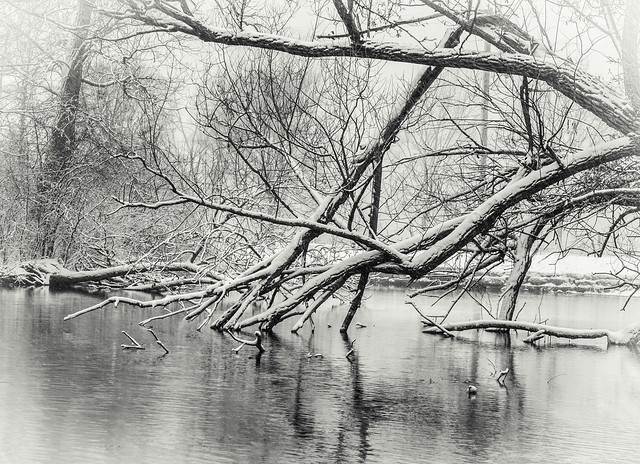
What a difference a few months makes. Tenney Park is now a stark winterland, the branches of the fallen tree blanketed in snow and a bit timid about dipping its tips into the frigid waters.

Tuesday, November 22, 2016
A Few Leaves Left

Wednesday, October 19, 2016
Framed by Yellows and Oranges

Shortly after I started my walk yesterday morning, the clouds gave way to reveal the sun. A great opportunity to take a few photos of the changing colors in my neighborhood.

If only the colors would last!
Thursday, September 29, 2016
Pointillist Night Walk


The round-ish leaves appeared stippled, creating a pointillist scene of alternating cool hues. Coupled with the echoes of monkeys from the nearby fire monkey lantern sculptures, a subtle, but exciting mood was established.
Thursday, September 15, 2016
Elephant Ears and Gold Foil

It's comforting to know that when I have a need to feel transported back to Asia, I can go for a walk from my Madison condo and visit the Thai pavilion at Olbrich Gardens. Between the ornate details such as the pavilion's gold foil columns and the broad elephant ear leaves nearby, I get a temporary whiff of Thailand.

Hard to believe this is Madison, eh? I'll be returning once the autumn leaves start to appear, and again when it is snowing. Now THAT will be a scene unique to tundraland...
Wednesday, June 29, 2016
Bushes A'Plenty

All decked out with pants, a light jacket, and a liberal dose of mosquito spray, my parents and I headed out into their woods to pick wild blackberries. Wild turkeys and a variety of birds serenaded us as we walked to our intended destination. Scattered throughout the woods were patches of the berries, just waiting to be picked by the brave. Just beyond the tangle of grapevines, sharp thorns of the canes, and swarms of menacing mosquitoes and horseflies were bunches of the sweet berries. Even with the extra bonus obstacles of stinging thistles, sticktite weeds, and burdocks, we weren't deterred. Our reward: enough wild blackberries for a dessert and plenty more for eating fresh.
Sunday, May 22, 2016
Curvy Pines and Hammocks

In a city of over 10 million people, it's reassuring to know that forests are not far away; perfect for a late afternoon (or morning) hike. The curvy pines along this path always intrigue me, the way the dappled light interplays with the irregular trunks.

In addition to the well-worn dirt paths, the mountain near our school also has some boardwalk paths. Hikers of all ages enjoy the forest's many paths, outdoor exercise equipment, and badminton courts.

After a hike up the hill, these hammocks were an inviting place to take a break.

What a great view from the hammock!
Monday, May 02, 2016
A Little Symphony at the Pond

One of the places that I was keen to visit within the Garden of the Morning Calm was the pond with pavilion. This area wasn't a part of the winter lighting festival in which I attended this past January. Such an area combines some of my favorite elements; bridges, traditional architecture, a pond, surrounded by spring plant life.

Instead of dragons or lions heading the beginning of the bridge, it sported some stone frogs. Soon this choice would become more evident. I had heard loud croaking but assumed that it was probably piped frog sounds coming from some speakers scattered throughout the pond's edges (I've been to other Korean sites where music is projected from speakers concealed as rocks).

Lo and behold, it was the real deal! Near the shorelines were some rather long-limbed frogs, blissfully croaking away. It was fun watching them puff out their cheeks like symmetrical barbells. The frogs didn't seem that concerned about the curious onlookers. Perhaps it was mating season and they were more concerned about attracting some lovely lady frogs.
Subscribe to:
Posts (Atom)