Showing posts with label Shuhe. Show all posts

Wednesday, August 19, 2015

Baisha Naxi Embroidery Institute

After walking around Shuhe, we drove a few kilometers to the small town of Baisha. 
Our main destination was the Baisha Naxi Embroidery Institute, created to preserve and develop Naxi embroidery. Due to the Cultural Revolution (embroidery making was banned, and some practitioners were even imprisoned) and the rise of machine embroidery, this handicraft is endangered. At the Institute, local women can train at no cost. Students are exposed to consistently more difficult projects that are designed by their teachers. One of the students gave me a tour of the institute, including the gallery.
A Master embroider at work. 
My student guide eagerly pointed out her teacher, who was intensely focused on her own embroidery. The teacher obliged in briefly pulling up the cloth covering her embroidery, revealing a shimmering lotus pond design with subtle variations of tightly packed shorter stitches. After a moment or two, she silently covered it back up again and continued working. My guide explained that the silk thread was separated into further strands, the amount varying according to the embroiderer's skills and design. Whereas beginners might use 1/8 of the thread, master embroiderers might use only 1/32 of the strand seen on the blue cloth covering.
My student guide at the Institute
An embroidery piece of Koi made into a screen, displayed in the gallery
 A well-laid out gallery displayed pieces, most of which were for sale. Each piece had a label that included the creator's name, title, price (if applicable), and number of days it took. Simpler student ones sold at more affordable prices and may have taken as little as a week (working 8-hour days), all the way up to a year. Many pieces were way beyond the pricing on a teacher's salary, but would definitely make a great purchase for a collector. In a country where quality traditional handicrafts are becoming harder to find, this was a breath of fresh air.

Photography was not allowed in the gallery. You can see some examples here.

In 2006, Naxi embroidery was listed as an intangible heritage by UNESCO. It is the goal of the Institute that 30% of all Naxi women in the area would be knowledgeable on this embroidery style, 60% by 2030, and that by 2040, Naxi embroidery would once again become the Naxi national industry.

Old embroidery examples on display in the museum area
 Some other rooms held some nicely displayed embroidery pieces created in the past. One was the robe of the Mu family clan leader. Embroidered with blue dragons, the robe lacked the yellow color reserved for the emperor.
Robe of the Mu family clan leader

Appliqué work


Baisha is located about 8 km north of Lijiang. 

Monday, August 17, 2015

A Funeral with Watermelons and Turbans

On our way out of Shuhe, we suddenly encountered a mass of people. A member of the Naxi ethnic group, my guide instantly recognized the reason for the gathering - a funeral. As I quickly closed the doors of the car, I saw some large floral wreaths being carried away (see bottom photo for a glimpse of the back end of one wreath near its upper left side). Instead of a hearse, the pallbearers carried the blanket-covered body through the street. Some of the mourners wearing white turbans knelt on the street right next to where I quickly had positioned myself. I spotted a framed B&W photo of a Naxi woman in her traditional clothing, presumably the deceased. 

Women were together in a line, and men formed another.  Snacks were available, such as watermelon and sunflower seeds. A woman even came up and offered some of the refreshing summer fruit to me. 

Carrying the body through the street
Funeral procession, with the floral wreaths in the distance and blanketed body near the center

Almost as quickly as the procession had arrived on the street, it had moved onward. It was time for us to drive to the nearby Baisha town to see the embroidery.

Saturday, August 15, 2015

Three Wells

Clean water was a highly regarded resource to the Naxi people in Yunnan, China. In its villages where I visited, streams and canals were a dominant feature. When walking through the village of Shuhe, I saw these three pools/wells with a signpost. Streams were guided by farmers into the village, where they were diverted into three small pools; the first one for drinking/cooking, second pond for washing food, and the third for washing clothes. 
Nowadays, most homes have their own indoor water, but some people (as this woman) still make use of these public pools. Even now, the water looked rather clear.
How different this scene is to what I recalled from my time in India, particularly the Adyar River which flowed close to my apartment in Chennai. How fitting that The Hindu, one of India's main newspapers, wrote and compared the waterways of the Yunnan region to that of the main rivers in India. 
Adyar River, Chennai

Sunrise silhouettes obscures some of the garbage strewn along the fowl-smelling Adyar River


Tuesday, August 11, 2015

Beyond Stick Men

Naxi pictograph on a wall in Shuhe
The figures on this wall in Shuhe may be overlooked by passers-by as decorative stick-figures. My guide, a proud member of the Naxi ethnic clan, told me that these are actually pictographs from Shuhe. When asked to read a bit, he haltingly shared a few parts he discerned. (Over 1,000 known pictographs are present in a language built around 1,000 years ago). Priests of the Naxi, known as Dongba, devised this visual language to write their scriptures. These Dongba still use this script, making it one of the only living pictograph languages still in use. 

Pictograph above a door on building ourtside of Lijiang
When I asked my guide how many people can read or use this script, he lamented that very few young people could make sense of it, and it is declining even amongst older people.

Sunday, August 02, 2015

Appliqué work of the Yi People

In addition to having lacquerware in the shop, Yi ethnic member Joel Zheng also had a display of the traditional Yi clothing. 

Yi clothing typically consists of contrasting, bright colors such as dark red, black, green, yellow, and blue. The skirt is long and pleated, with black, red, and yellow being the most typical colors. At a young age, Yi girls are taught how to do cross-stitch and other sewing techniques such as appliqué. Women also do the weaving of the cloth.
Floral and fern-like designs are commonly featured on women's clothing. Some of the designs reminded me of those I saw on Hmong cloth - as was the pleated skirts. Silver jewelry and ornamentation adds a decorative touch. 

The cone-shaped baubles on this head piece reminds me of the Lisu people I had met in Thailand.
Spinning of the thread for weaving

Appliqué steps

Designs found on Yi clothing
The clothing on display was quite elaborate and of fine craftsmanship. Nowadays, the level of the typical costume isn't quite at this level, particularly if it is purchased.

I was also shown some shawls that were felted. The natural wool color pieces were plain, but very practical.

This article had quite a bit of detail on the clothing of the Yi people in Sichuan, the province where Joel Zhang is from. 


Saturday, August 01, 2015

Tuckered Out at the Shop

I spotted this cute dog at one of the shops selling textiles in Shuhe, Yunnan (China). Perhaps it had been a long day for this fashionable friend, tired after experiencing lots of women coming in to eye the handiwork. At least the dog has found a comfortable place to snooze!

Wednesday, July 29, 2015

Part of the Dumpling Gang

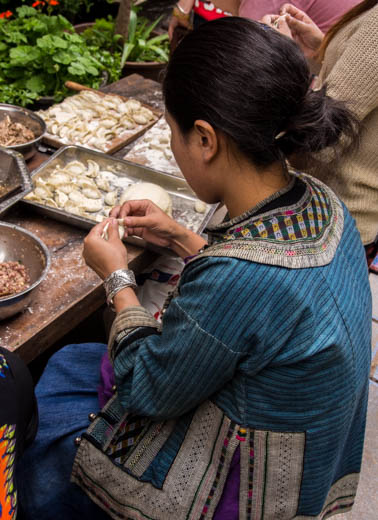
While in the Yi lacquerware shop in Shuhe, I was invited to help participate in the making of dumplings. Wednesdays were the night that several Yi families would gather to make communal dinner. I was asked to help with stuffing and then closing the dumplings. After observing one woman expertly doing this process, I attempted to copy her steps. I have to admit that mine were rather easy to spot, not nearly as neatly crimped as those of the other women. 


I'm rather easy to spot in the photo above - the only redhead of the dumpling gang.
I loved how everyone helped out in the process, whether it be rolling out the dough, chopping up the ingredients, steaming the dumplings, or distributing the finished meal and drinks. 

Melissa and Paul, owner of the Azeala lacquer shop
Despite my substandard dumpling making skills and language challenges, I was made to feel a part of the group. One of the young women asked me to give her an "American" name - I selected the name Ruth, reminiscent of the strong Biblical female. They then gave me the Chinese name "Malisha," as it was close to my American name. 

Melissa "Malisha" and my new friend "Ruth"


Monday, July 27, 2015

Choose Your Tea Type

 Tea is a big deal in China. Both Hangzhou and the province of Yunnan where I visited are known for their tea. Entire trade routes were set up here and through treacherous paths to Tibet for trading tea. The shops posted here contained a huge variety of tea, with a bewildering variety of packaging, preparation types, flavors, and prices. I did see a few people purchasing items, but lacking the knowledge of the tea itself and the labeling (most was in Chinese only), I decided to purchase the tea for my cousin elsewhere.

What beautiful patterning at this store in Shuhe
More tea stores in Shaxi
Most restaurants I visited, as well as some of the guest houses, provided complimentary tea. In the picture above, that large silver thermos at my guesthouse was filled with hot water and intended solely for me. Dried tea leaves were already placed in the cup, to which my host continued to pour hot water. Its delicate flavor was enjoyed without any additions such as milk or sweetener - much different than the tea I had in other countries, particularly India (I do love chai), Tunisia (sweet and served with pine nuts), and Mali (sweet "gunpowder" tea).

Saturday, July 25, 2015

Lacquer Art of the Yi Ethnic Group

As I meandered through the streets of Shuhe, I spotted a decorative gate through which more shops were located. The hand-painted red, yellow and black bowls caught my eye; these were not cheap-looking mass-produced touristic crap pieces. I felt compelled to enter the shop and look around. Shortly thereafter, a kind man from the store approached me and patiently showed me around, answering my many questions. Joel Zheng was one of the people who ran the shop. Although there are many people in the Yunnan province who are also from the Yi ethnic group, he came from a smaller village in the Sichuan province and came to Shuhe hoping for a larger market. 

The bowls and vases that had caught my eye were lacquer pieces. Lacquerware making of both utensils and art pieces dates back between 1,700 and 1,600 years in the Yi ethnic group. The pieces Joel had in his shop were made from Azalea wood, which grows well in the higher altitudes of his village. 

The process of making the lacquer pieces is more complex than what the finished piece might initially appear to be. The bowls above show fourteen different stages. According to Joel, a bowl might take between 40-50 days, due to the number of stages and drying time. To my surprise, the bangles took 50-60 days - which helped explain why their prices were higher than I would have expected for a bangle. 
Lacquer art in the Yi ethnic group is usually done by men. The brush bristle is made from the tail of a sheep. The background color is typically black, made from ash. It represents the earth, and may also symbolize dignity and decency. The red color, made from minerals, represents fire and connotes bravery and enthusiasm. Yellow is the third color typically used. Also made from minerals, yellow represents the sun and symbolizes beauty and brightness.

Designs are directly painted on the piece, without the use of stencils or even preparatory sketching. Such an approach requires many years of experience, practicing first on substandard pieces. Many of the patterns are derived from nature.  One would find patterns representing nature items such as mountains, sun, waves, rivers, cocks combs, ferns, flowers, fires, fishnets, and the bull/cow eyes. 

The swirls on this bowl represent the eyes of a cow

Mouse over the image to see a few symbols
The lacquer art of the Yi has been placed on the state-level Representative list of Intangible Cultural Heritage due to its unique process and cultural value.

Read more about the Yi lacquerware