Showing posts with label tradition. Show all posts

Saturday, May 01, 2021

Artwork: Naxi Erhuang Musician

 My latest artwork: Naxi Erhuang Musician

Lijiang, Yunnan province, China

©2021 Melissa Enderle


It's another humid summer evening in this ancient town of Lijiang. In the air-conditioned of the Naxi Ancient Music performance hall, I sit amongst my fellow musicians all clad in purple embroidered silk robes. Although I am the oldest member, a few of the wizened beards belong to those in their 80's. Next to me is a young disciple of mine who has been most eager to learn how to play the Erhuang. Behind me is a young Pipa player, already confident with the ancient solemn tunes of Dongjing music. Most of the audience members have come to this UNESCO World Heritage town from other parts of our motherland, China. It is reassuring to see that they, like the young members of our band, are expressing interest in the traditional music of my Naxi people. Hopefully, they will help keep this most ancient of music alive, much like I helped ensure it survived during the tumultuous Cultural Revolution. We have just begun a slow, fluid, pentatonic melody. As my eyes begin to close, I am transported to the days of yesteryear when I performed beside my revered father.

See more of my artwork at www.melissaenderle.com

Monday, July 02, 2018

Kathak Dancer, India

My latest painting of a Kathak dancer. I saw her performance in Chennai, India
Kathak Dancer
Pastels on PastelMat paper

It is my turn to be on stage. The scent of jasmine from the previous Bharatnatyam dancer still lingers in the air. After giving a salutation and paying respects to my guru and accompanying musicians, I begin the thath sequence with slow movements - first with the eyebrows and neck. I bend one elbow and extend the other arm, making elegant but gentle movements with my upturned wrist and fingers. At this stage of the dance, the scarf covering my head is limp. Sensing the quickening pace of the music, my eyebrows move up and heavily-lined eyes widen. The small Ghungroo bells on my ankles collide as I rapidly stomp my feet on the stage floor in perfect syncopation with the music. As my feet movements become lighter and more complex, I pick up speed and execute a series of turns, causing my skirt to lift like that of a whirling Sufi. 

Monday, June 06, 2016

Heunginjimun Gate, Seoul

While waiting for nightfall when the LED roses would light up at the Dongdaemun Design Plaza, I walked with a friend across the street to the Heunginjimun Gate. What a contrast - from the spaceship-like ultramodern steel building of the Plaza to the stone and wood structure of the gate. 
Meaning "Great East Gate," Heunginjimun Gate was the major Eastern gate for the wall that surrounded Seoul during the Joseon Dynasty. Now it sits amidst the ultramodern skyscrapers, huge electronic displays, and a plethora of markets.  

As written on the sign in front of the gate:
Heunginjimun was the east gate of the capital city of Seoul and was built in 1398. The current gate was rebuilt in 1869. This large gate in the east was inscribed with the letter "ji," meaning wisdom. An arch type passage was created in the embankment linked to the fortress wall, and a fortress gate was built at the gatehouse erected on the passage. The gatehouse is a two story building of a type which can only be found at Sungnyemun and Heunginjimun, among the fortress gates of Seoul. The gatehouse was where the commander stayed to hold the gate and was used as a command post in times of emergency. 

Walls built with bricks and windows made of wooden plates were installed outside the gatehouse to defend the city against its enemies. The gatehouse of Heunginjimun clearly shows the architectural characteristics of the 19th century which includes a simple structural assembly and various decorations. In addition, a crescent shaped revetment was built in front of the gate to defend against invaders, and this revetment can only be found in this gate in Seoul.

The Heunginjimun Gate, also known as Dongdaemun Gate, is the Korea's National Treasure No. 1. 

Thursday, December 03, 2015

Kanggang-Suwollae Dancers, Korea


Another dance performance observed at school. I loved the playful interweaving of the girls as well as the synchronized, flowing circular movements.

Kanggang-Suwollae, meaning Moon Dance, traditionally took place on the full moon of the first and eighth lunar months. At this time, women, wearing a blouse & skirt and hair tied back with ribbons, gathered in the field and joined hands to sing and dance. Performed only by women, the dance sought to bring about a good harvest. The dance begins rather slowly incorporating a solo call and choral response,  but the pace quickens to a whirlwind pace at the end.

Tuesday, December 01, 2015

Gakshi-Choom Puppet Dancers

These traditional Korean dancers performed at our school. According to my Korean colleagues, the dance is a variation of the Gakshi-Choom performance. Traditionally, the Gakshi-Choom dance is a duet puppet dance, in which the performers playfully dance to light, lively music.


Thursday, November 12, 2015

Seoul Lantern Festival 2015

Yesterday evening I attended the Seoul Lantern Festival with some friends. Although I don't typically like to attend events during a school night, past experience convinced me that this was the only feasible time to go to such a popular event. 

When we arrived prior to dusk, I was so pleased to see that we could walk right in the entrance and down to the Cheonggyecheon Stream. Contrast that to last year, when the decision to attend on a Friday night resulted in a packed wait in line for well over an hour and a mob of people pushing down by the stream. Not a very ideal photography scenario!

This year, we started at the far end where the first set of hanji paper lantern sculptures were geared towards kids. Cartoon characters popular in Korea, as well as some of a more international flair. 
There were also some lantern displays with an advertising component and still others of different countries, including one of Mount Rushmore. It felt a bit out of place, but rather interesting to see such an iconic piece of Americana down in Seoul.

My favorite ones were of a traditional theme. The throne room of Deoksugung Palace was particularly impressive, in its scale, detail, and sculptural aspects. 

If you're in town this month, do be sure to come and visit the Seoul Lantern festival. The display will be up until November 22.

Thursday, October 29, 2015

Paper Cranes and Flower Trees

My favorite part of the display at the Jogyesa Chrysanthemum festival was located near the back of the complex. Set next to the already graceful curved tiled roof and dancheong patterns of the temple buildings, the display added additional color. Floral sheep appeared to be nibbling the grass; a tiger also made from chrysanthemums seemed less ferocious. Undulating mounds of flowers turned into mountains of Seoul. Cranes made from hanji paper flew overhead, with the silvergrass below gently moving in the breeze.

With the skyscrapers jutting out in the background, I was reminded that I actually was in a huge metropolitan city. Traditions of Buddhist Korea set against the modern society.

 If you attended the Chrysanthemum festival, which display was your favorite?

Tuesday, June 23, 2015

Presenting the Wedding Duck

No traditional Korean wedding ceremony would be without a pair of ducks (or geese). Knowing that ducks mate for life, a wedding couple would be presented with a carved set. Traditionally, the ducks would be carved by an honorable friend who would carry out the task without payment and pass his fortune (wealth, health, good wife, many sons, and divorce-free family) to the new couple through the gift. These "five fortunes" attributes were more important than the carving skill of the man. Wedding ducks are comprised of two parts - the head/neck and body. The bill of the female is sometimes tied with red thread, symbolizing the Confucian belief that a wife must obey their husband. Above we see the male duck being presented, wrapped in a bojagi called a gireogibo which has embroidered symbols of happiness on the top.

The day prior to the wedding ceremony, the groom went to the bride's home to meet the parents. He presented the duck to the family as a token of his lifelong loyalty to their daughter. The mother of the bride would place it on the bed chamber for the next day; if it stayed upright, it meant that the firstborn would be a boy. Even after marriage, the position of the ducks were symbolic; if facing bill-to-bill, it signified that all was well. If tails faced each other, discord might be amiss.

Thursday, May 28, 2015

Seoul Lotus Lantern Festival - Pencil Lines and Brush Strokes


Although I find the night illuminated lanterns to be magical, I still enjoy looking at them during the daylight. Such viewing enables me to see the brilliant paint carefully applied on the delicate, but strong hanji paper. Pencil lines revealed the hand-drawn nature of the patterns. A slight bulge of the supportive framework is also noted.


All lined up as if parked at the Jogyesa Temple.

Lantern display at night in front of the Jogyesa Temple

Daytime view

Sunday, February 08, 2015

Golden Lotuses

Besides the wau bulan kites, another display that caught my attention at the People's Museum in Melaka was of the lotus shoes. I had first read about this Chinese practice when reading the excellent book Snowflower and the Secret Fan. Looking at these tiny but beautifully embroidered silk shoes, it was difficult to imagine that an ideal size of an adult female - known as a golden lotus -  was around 3 inches in length. What pain these young girls and women must have endured - often at the hands of their own mother! Such dainty feet were highly desirable and could enable even non-wealthy girls to marry into much higher status homes.
Although the animal head on the pink shoes above is likely a bat (a Chinese symbol of good fortune), it reminds me of a mouse. 


Friday, February 06, 2015

Wau Bulan Kites


One of Malaysia's national symbols is the Wau Bulan Kite. Its name means "moon" and refers to the crescent shaped lower portion of the kit. Wau Bulan kits are constructed from a bamboo frame over which tissue is delicately stretched. Intricate floral and leaf patterns decorate the surface. Due to the rather large size of the kite, these symmetrical designs are visible even when the kite is fairly high in the sky. The kites are typically flown by men with its path being a figure eight. 
The Wau Bulan kite is depicted on Malaysia's 50-cent coin. I saw these beautiful artistic forms on display at one of Melaka's many museums - a great place to visit when it was raining a bit heavily!


Wednesday, April 09, 2014

Seonamsa Temple Stay: Buddha's Breakfast


Following the schedule, 5:40 marked the start of Buddha's Breakfast back at the dining hall. Instead of eating at the low tables as we had the night before, we would be partaking of a more formal ceremony with our bowls on spread on a cloth on the floor. Forming two lines, we quietly waited our turn to pick up a nested set of bowls and some folded cloths, tied neatly with a grey strip. Seated on the heated flooring, we were spaced apart to ensure enough area to eat properly, and also be neatly aligned with those ahead (and/or behind) us.

We then were instructed to untie the strip, then unfold the large square grey cloth, making sure that our "placemat" aligned with those of others in our row. The nested bowls were carefully placed in clockwise order on the cloth, the functions of each being explained. The end person from each row poured some water in the upper right bowl, after which we placed our spoon and chopsticks into  it. The next person placed one spoonful of rice into each person's rice bowl and then came around again, allowing each person to remove or add as desired, but reminded that we should not waste anything. Another came with the soup kettle, allowing the two people seated between the placed kettle to scoop their own soup. Side dishes followed in the same protocol. I saw even more sparse portions than the night before, indicating some rather picky eaters. As instructed, we were told we had to eat all we had in our bowls, down to the last grain of rice. The fourth person in line came and poured hot water in one of our bowls, which we used to wash and wipe the other bowls (a white cloth was provided in our tied bowl kit for this). Because no oil was used in the preparation of the foods, the monk explained that no soap was needed for washing. Each monk would have his (or her) own designated bowl set and was always responsible for keeping them clean. After a final rinse of the bowls and utensils, the water was poured into a large bucket. The buckets would be brought to the head monk for inspection; if any food particles were seen, that row of monks would have to drink the water - or at least that's what we were told. 

Monday, March 31, 2014

Seonamsa Templestay: Etiquette basics


In our Templestay orientation, we were reminded of some of the etiquette basics (with those pertaining to eating being revealed in the dining hall). There were more, but the decorative nature of the temple hall interior commanded my attention. Here are some of them:

  • Practice Noble Silence. In areas where the Buddha is enshrined, refrain from idle talk; instead, use the time for introspection.
  • Sit in designated areas in the temple and follow the signals of the moktak (wooden handbell)
  • Always take off your shoes before entering buildings. Line them up neatly and carefully.
  • Wear your temple uniform, don't drink or smoke, and no rowdy behavior.
  • Walk in a gentle heel-to-toe style, not shuffling or making noise. Try to keep your hands in a folded  "namaste-style" gesture up by your chest.
  •  When passing someone, smile and perform a hapjang half-bow; do the same when passing by or entering a room with a Buddha statue in it.
  • When eating, try to maintain silence and eat quickly. Don't slurp or make noises with your utensils. Give thanks for your food, placing the bowl up by your eyebrows. Don't complain about your food and avoid waste.
  • Actively participate in communal work.
  • Don't bother others in the rest areas.

Monday, October 21, 2013

His & Her Luggage - Traditional Korean Style

Bringing up the rear to the traditional Korean wedding at the Folk Village in Suwon were two men, each with a large bundle strapped to his back. Matching the colors I saw of the fabric wrapped around the wooden ducks at the wedding ceremony, the wrapped bundles looked like his & her luggage.What was contained within the packages - belongings of the new couple? wedding gifts?

Thursday, October 17, 2013

Traditional Korean Wedding, Suwon

On my visit to the Korean Folk Village in Suwon, I attended a reenactment of a traditional Korean wedding ceremony. Similar to the table set at the Chuseok Thanksgiving festival, food (particularly fruits) were carefully arranged in the center of the happenings. Also on the table was a stuffed hen and rooster - a change to the last time my friend came, when live poultry was used. On a low table, a wooden pair of ducks, symbolizing the idea of mates for life, was carefully enveloped in cloth. The groom and other males stood on one side of the table, while the bride and two attendants stood at the other. 

Two cups (I presume rice wine) were poured by a man and offered up by the bride - one in a wooden-looking container (above) and another that appeared to be made out of a gourd. Following the ceremony, the bride was escorted into a palanquin while the groom rode on a horse. 

Monday, August 05, 2013

Djenné, City of Mud


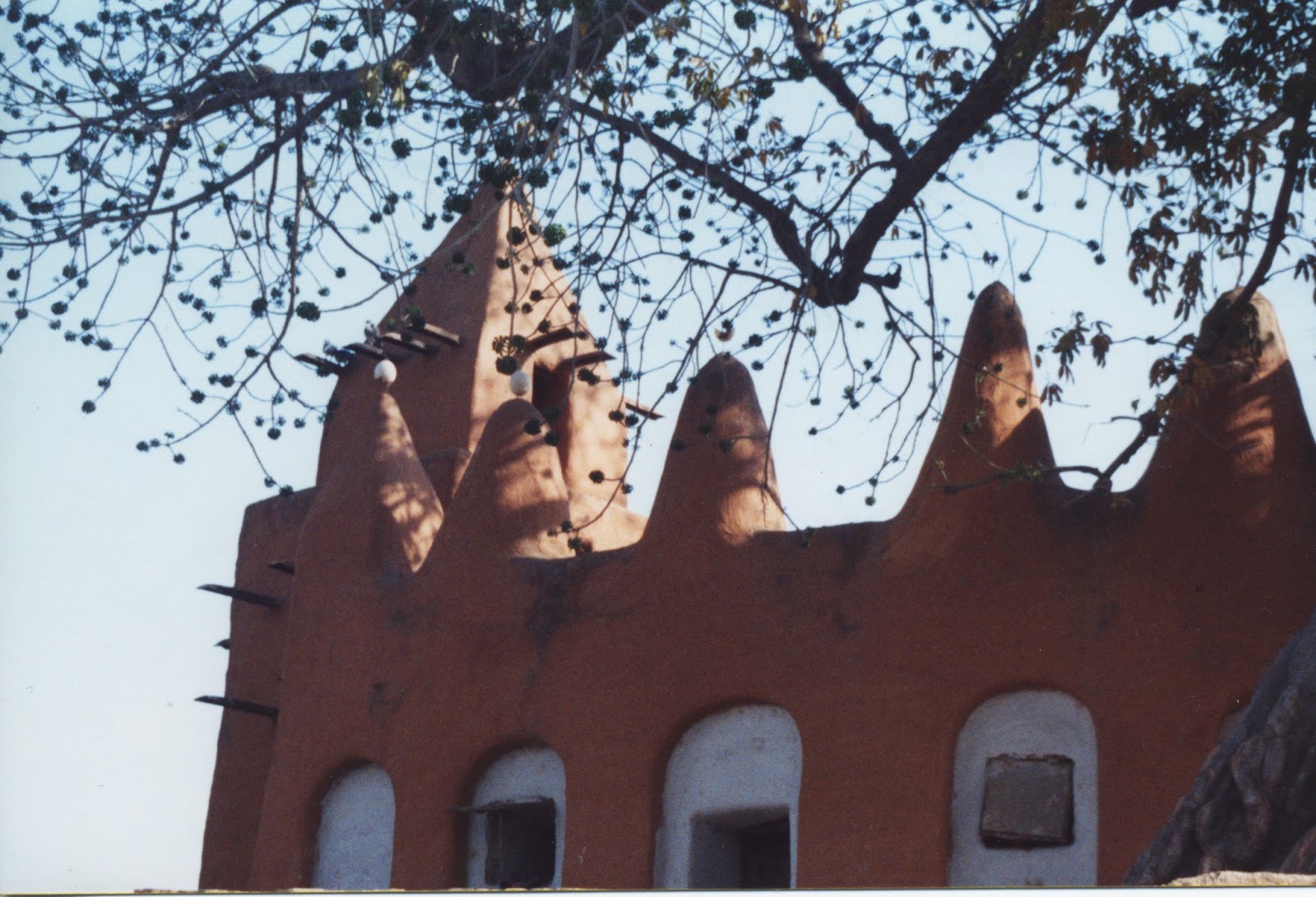
Situated on an island in the Niger Inland Delta with a population of around 10,000, Djenné is one of Mali's pre-eminent tourist attractions. Named a Wold Heritage Site in 1988, the city has taken great care to preserve the mud architecture, including the world-famous mosque. You can easily feel what sub-Saharan Africa must have felt like a century or more ago. At one time, Djenné was competing with Timbuktu as the western Sudan's pre-eminent center of trans-Saharan trade and Islamic scholarship. Now it is more of an agricultural (and tourist) town. 
Djenne Mosque and Marché  - watercolor by Melissa Enderle

Djenne's most famous (and dominating) site is the mosque. It is actually the third mosque built at the site. The first mosque was built by the Soninke king Koi Kounboro who destroyed his palace in the 13th century for its construction. The second mosque was built in 1834 after the first one was left to ruin after it became "contaminated" by evil practices. The present mosque, built in 1905, is in the style of the original mosque. Three towers, each 11 meters high and topped with an ostrich egg, can be seen from quite a distance. In fact, the mosque is the worlds' tallest mud building. It was built in two years with handmade mud bricks, formed with a banco mixture of soil, water, and straw/grasses which become ripe after one month. Wooden beams protruding from the building serve an aesthetic purpose as well as scaffolding, to repair the building after the rainy season. Every year the surface of the mosque is resurfaced with a fresh layer of mud. Other buildings typically are resurfaced at least every other year. Efforts are being made to help preserve or restore architecturally significant buildings.

We arrived in Djenné on the day of the Ramadan feast. Everyone was wearing their new boubous, hats, and had their hair intricately done. Men had clean new haircuts, while the women and girls braided their hair, often with beads and other ornamental decorations. After walking through the narrow alleys, we climbed up to the top of a few buildings to get an aerial view of the city. From that vantage point, we could see the bustling crowds, the city's many goats, and the mud architecture, either of Moorish or Tukulor types of the Sudanese style. The tops and windows of the buildings were especially impressive. In addition, the Tukulor houses have an overhang over the door, presumably to protect it from the rain.

Djenné was one of my favorite villages in Mali. I would love to return and meander through the narrow streets, surrounded on both sides with its distinctive mud architecture. Visiting Djenné on the Monday market day is recommended for an extra vibrancy. Most visitors stay overnight at one of the five hotels/guest houses.

In 1988, the old city of Djenné and the historical site of Djenné-Jeno were added to the UNESCO World Heritage List.
UNESCO video on Djenné, City of Clay
Read more about Djenné's mud architecture construction at National Geographic


Djenné, City of Clay

Saturday, August 03, 2013

Where the Bambara Kings Once Ruled


December 26, 2001
A small village about 10 km away from Segou along the road to Bamako, Segoukoro is the original site from where Bambara kings ruled a kingdom that stretched for thousands of kilometers across West Africa in the 18th century. A typical Malian Bambara village, composed of walled mud brick houses, the village has around 1500 people. I was surprised to see how simple the village was, being that it had such an important role. Aside from Biton Coulibaly's tomb (founder of the kingdom), there were few signs to indicate the village's importance. We met the chief, a descendant of Coulibaly. Walking through the village, we saw the village's three mosques, one built by Coulibaly for his Islamic mother (the king himself was animist). The newest mosque is used by the people for worship only on Fridays. 

Friday, July 26, 2013

Stumbling Upon a Wedding

November 5, 2000
The day started off peaceful enough, but soon emerged to be a day filled with culture. In the morning, I heard some drumming (which is not unusual). First it sounded rather novice, as if someone was simply plunking on the drum. I continued what I was doing in my home, continuing to keep an ear out just in case there were further developments. Later,the drumming sounded more significant and refined, peaking my interest. With a small digital camera in my hand (just in case), I proceeded to start walking towards the nearby-sounding drumming. After the second turn, I heard my name called out. Here it was Wasa, the downstair teacher's housekeeper. It was not the Wasa I was accustomed to seeing though. Instead of the plain purple overlay that she typically wore, Wasa was dressed up in her finest. A dark green dress (West African style) with multicolored ornamental decorations and a U shaped neck was worn. Around her shoulders draped a white veil-like scarf Most impressive was Wasa's head. Each small section of hair was wrapped in glistening black coils, forming a decorative pattern. By the ears the coils also revealed small golden-yellow small balls, about 4 or so cascading down in an ornamental fashion. In her ears were beautiful gold earrings and around her finger was a matching ring. A headwrap from the same fabric as the dress covered a fair amount of her hair. Around the headwrap was a woven band that I had seen before. Instantly, I knew Wasa was involved with a wedding. Wasa invited me to join her at the wedding and asked me if the downstairs teacher was awake. 

I quickly went home to the duplex to get the downstairs teacher and her 4th grade daughter. This time with two cameras, I went back towards the source of the music. Like Wasa, the women were all wearing their finest clothing and jewelry, with the addition of a special hairdo. Underneath the large tent, women began gathering for their portion of a wedding celebration. After we were introduced to several women, Wasa encouraged us to sit down. For the next several hours, I witnessed women celebrating their portion of the wedding celebration under the tent. I will need to find someone who can explain all what occurred, but I will now present my observations. Several other women were also wearing the striped woven band, just as Wasa did. The middle part of the long narrow band which was tied around the forehead revealed the woman's name, carefully woven in capital letters. The bands were golden yellow with another contrasting color such as black, purple, or maroon. 


Two female singers and three male drummers provided the music. I am assuming that the singing was either general wedding music or words specifically directed towards the bride, etc. Women would get off their chairs and join a procession of women, already forming a line towards the music. Typically the "train" would repeat its course and go towards the music a few times before the women once again took their seat. Sometimes a few women would then begin doing the energetic West African dancing. It appeared as if the main drummer's hands and the dancers were talking to each other. Typically one woman danced at a time, before the next woman took her short time in the spotlight. Interspersed throughout the time of celebration that I witnessed were a few women who directed some words towards the crowd. I think they might be part of the griot family, which does the storytelling and recounts memories/events. During this talking, the arm of one of the women wearing the bands would have their arm raised by a neighbor, evidently recognizing that person. There was a lot of socializing occurring, women "sharing" the darling little ones with other women, and even some passing of money to a select few women. Some of that money appeared to be given to the drummers, but I'll have to inquire more. I'm sure a lot of the subtleties (and perhaps the not-so-subtle parts of the ceremony) passed by without my knowledge of what I was seeing or perhaps not seeing it at all.

Monday, July 22, 2013

Walking Past the Voodoo Market

September 2000
On the way to the Artisan's Market in Bamako, we walked past a street-side display of wares known as the Voodoo Market. Here, sellers had skulls, fur, skins, porcupine quills, and other items on display. Superstition is very much a part of Malian culture and many people still adhere to animist beliefs. Apologies for not getting a better picture, but this was a quick "hip" shot.

Sunday, June 16, 2013

Jongmyo Daeje Royal Ancestral Rite - an Expat's Reflection


Observing the rites and ceremonies happening at both the Yeongnyeongjeon and Jeongjeon halls at Jongmyo Shrine was a mixture of fascination, confusion, and frustration. The highly prescribed rituals were very strict and solemn. I was happy to see the young dancers and musicians of various ages who were eager to learn the music, dance, and songs in order to preserve this national treasure and tradition. Some of the traditional instruments used in the ceremony were unique and those I had not seen before. Elaborately carved and painted, form and function were equally important. With the large expansive courtyard separating the viewers from the main action taking place under the sheltered chamber area, it was difficult or next to impossible to really see what was going on.


 The cameramen with their massive equipment went back and forth, documenting the ceremony but also obscuring any view of spectators. Some wore a blue uniform making them slightly less distracting, but many others wore jeans - marring any photographic shot of the events. Announcements were made throughout the ceremony, but everything was in Korean, so foreigners were even more clueless as to the events and their meanings. To the untrained ears and eyes, things could look and sound rather repetitive and monotonous. The singing was more like chanting and the rhythms and melodies of music very different than that of Western music. This definitely was no farmer or folk masked dance. Still, I understand that the ceremony is not about nor is it for the spectators. This is a deeply traditional cultural ritual with a very solemn tone that needs to be respected and preserved.