Showing posts with label Sunderbans. Show all posts

Tuesday, February 21, 2012

Kampong Phluck Floating Village


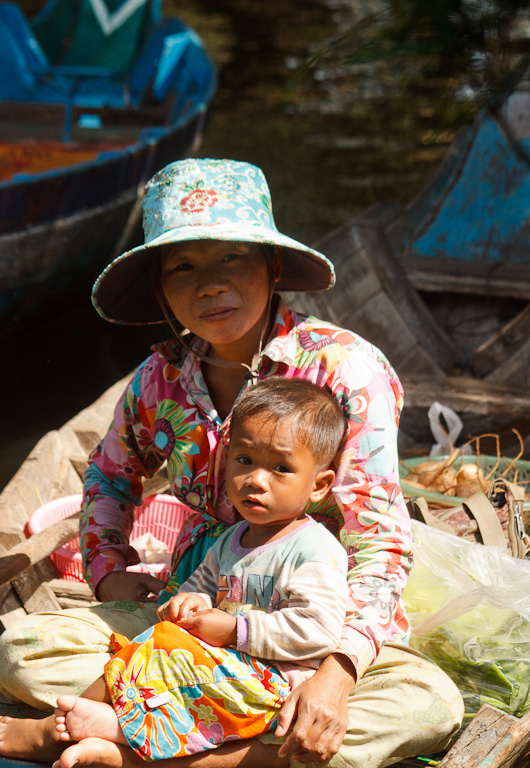
As part of our tour, we visited the village of Kampong Phluck. Located in Ton Le Sap lake, a motorized boat took us to this floating village. Homes here were built on tall stilts or floating foundation. Getting into a boat and going from place to place looked as natural as getting into a bus. Children dressed in uniforms hurried down the steps of the school to reach the waiting boats at the pier below. Our boat buzzed past stilted homes made out of palm frond thatch, monks getting their head shaved by the river edge, and women rowing boats heavy laden with vegetables just purchased from the small market. 

Chickens clucked about and pigs lazed around in floating cages. Underneath some homes were large collections of rather small fishing traps. Not surprisingly, most of the 3,500 villagers are fishermen. The collection of stilt buildings soon gave way to scattered ones, after which the mangrove trees became more common - but no where as dense as those in the Sunderbans. After a bit, we were in the main Ton Le Sap lake - the largest freshwater lake in South Asia. Of interesting trivia is that that the Ton Le Sap River flows north for about half the year and south the rest of the year, as dictated by the floods of the monsoon rains.
Friday, December 09, 2011

Leaving the Island


Our boat trip now done, a bicycle taxi once again picked us up and pedaled us through the island to pick up the boat taxi. This driver was rather “horn-happy,” squeezing the bulb horn as a regular communication tool. Others chimed in, dinging their bicycle bells or more robust motorbike horn. With several simultaneously honking, it could have been part of an Indian symphony. With evening soon setting, a fog began to descend over the rice paddies. Older girls and women carried water to their homes. A small child held his mother’s hand, skipping along the narrow dirt path past the rice paddy near their home. The small market area was bustling with those buying produce or picking out the choice firecrackers. Music blasted from the temples and small shops. Men played cards in near darkness. The homes of many now disappeared in the darkness. Others were lit by a single kerosene lamp or light bulb (some powered by solar electricity). The single bell at a church clanged, inviting worshippers as we departed the island. The taxi boat made its way in virtual darkness, guided by experience and the lights coming from the distant shore. 

Thursday, December 08, 2011

Stilts and Tusks


The roots of the mangrove trees fascinated me. The long Rizophora stilt roots made it appear as if the tree could suddenly get up and walk away. The roots of other trees snaked along the muddy surface. The abundant breathing roots grew upward out of the anaerobic mud to breathe, peppering large swathes around the tree with finger-like projections. Some of these breathing roots were taller, resembling curved tusks. 

Wildlife at Low Tide


The boat chugged its way through some of the five interconnected rivers as well as a few smaller ones. As the water receded once again, I could see how an understanding of the river topography would be invaluable in successful navigation. What was completely flooded several hours ago was now a steep mounded bank. An egret stood in the remaining trickle of water flowing in the clay valley. Several types of colorful crabs and conical shelled creatures abounded on the shores. Shore birds such as the curlew and Indian Pond Heron combed the mud for tasty morsels. Other animals spotted included several Ganges River dolphins, wild hogs, wild roosters, and spotted deer.

Tuesday, December 06, 2011

Patiently Waiting

Although even larger than the monitor lizard, the crocs in the Sunderbans were also difficult to spot. (Estuarine crocodiles can reach up to 10 m - 32 feet in length). It amazed me how they could hold perfectly still and then suddenly bolt, running on their short feet towards the river, perhaps for a tasty fish snack. It may also prey on large animals. The Estuarine crocodiles are critically endangered due to habitat loss and hunting.

Monday, December 05, 2011

Leaping Lizards!

Perfectly camouflaged with the clay soil, it certainly would have been a lot easier to spot the monitor lizards had they done a bit of leaping. This lizard was likely going on a feeding frenzy, enjoying all the crustaceans crawling about - along with the occasional fish, eggs, and perhaps even some ground birds. From this photo it is difficult to visualize its size, but the Bengal monitor lizard can reach a size of 175 cm - about 5 3/4 feet!

Sunday, December 04, 2011

High Tide Wildlife

During high tide, all I spotted were a few monkeys and some birds. After a few hours, the stilt roots of the Rizophora trees began appearing. The lower leaves revealed the typical high tide level, now tinted a lighter color with salt deposits. As the clay ground emerged, so did more animals. 

Saturday, December 03, 2011

High Tide!


As I made my way back to the boat, I was shocked to see how vastly the scene had changed in an hour. The tide had come in, flooding the area, submerging trees up to their lower branches. The boat had drifted a bit, so they had to pole it in in order for me to board. After breakfast and a short stop at a visitor center, the boat motored down the river. Our guide explained that there were 102 islands (mostly forested) in the Sunderbans, with 54 of those inhabited. Some are kept exclusively for wildlife. Covering an area of 18,000 sq. km (6,950 ft), the  Sunderbans (a portion in West Bengal and the rest in Bangladesh) is both a UNESCO World Heritage site and a Tiger Reserve. I didn’t expect to see any of the illusive Bengal tigers, but would simply enjoy the natural beauty of the mangroves. 

Thursday, December 01, 2011

Early Morning walk in a Sunderbans Village


After being awoken at dawn by the unwelcome serenading of a mosquito, I got up and observed my surroundings from the boat’s deck. Still early, everything was quiet. Still low tide, the boat was currently marooned a fair distance on grey clay. The cement dock led to the steeply embanked clay path, over the protective embankment, and into the village. 
Within the hour, the sleepy village residents began to stir. Walking around brushing one’s teeth seemed to be in fashion. A yellow metal iron-gridded school bus trike made its way on the narrow path. A young boy led its black groat through the quiet street. Spotting a small pond with water lilies, I climbed down to its shore. From here I paused for a while, admiring the tranquil scene and several photos as the golden rising sun cast its warm colors and light on the lilies and pads. 


Tuesday, November 29, 2011

Canoe Ride in the Sunderbans


Once in the canoe, we were rowed past small fishing boats with a short semi-circular shelter. Kingfisher birds of varying colors perched on top of poles and branches. From the muddy shores, birds such as Indian pond herons searched for fish, tadpoles, and crustaceans. Crabs merrily scampered along the muddy beach. In the calm waters, tiny fish skipped across the surface. The sky now changing from a warm orange to pink, a few fishermen were spotted, casting their nets from the muddy shore. Flocks of birds flew across the sky, mere silhouettes at dusk. With the light rapidly fading, our expert rower navigated to the large boat that would be our abode for the night and tour vehicle the next day. After some live entertainment by several local Bengali musicians, we headed below deck for the night. 


A Marooned Boat and a Mudskipper


Near where the goats were happily nibbling away on the breathing roots of some mangrove trees, a canoe lay marooned on the bed of very mucky clay. A very wet zigzag led down to the river, indicating that even this height would be underwater come high-tide. At this time though, it seemed to be improperly placed.

Walking carefully on the raised mud path, I spotted a mudskipper fish below, successfully walking on the mud with its pectoral fins and looking rather muppet-like with its closely-placed beady eyes.

Sunday, November 27, 2011

Nibbling At the Roots

Much like anywhere, these goats wander through the area in search for food, nibbling at whatever might possibly be edible. These goats in the Sunderbans schlepped through the muck and appeared to nibble at  the breathing roots (pneumatophores) of the mangrove trees. (Pneumatophores help trees in these soil-poor clay soil areas to receive sufficient oxygen). The breathing roots here were quite small and likely rather tender; by contrast, some of the breathing roots I spotted elsewhere in the mangrove forest were spiky and well over a foot high.  

Saturday, November 26, 2011

Adding a Fresh Layer of Mud

Despite the recurring destruction of cyclones in the Sunderbans area (four years ago, a devastating cyclone destroyed virtually all mud homes in the village, with people fleeing to the tops of concrete buildings), many people still build their homes with mud. It is cheap, plentiful, and keeps the interior much cooler than concrete. This woman was spending her late afternoon putting a fresh layer of mud on the exterior. I wonder how she reaches the area near the top....

Thursday, November 24, 2011

Just Hangin' Around With My Friends and My Toothbrush

I've seen this many times- people in India seem to like to walk and brush. While curious as to the red-haired visitor to their quiet island village, the girl quick got in a few brushes in between posing for the camera. Quite the four-some!

Monday, November 21, 2011

Bonbibi and the Honey Collector

Walking through the village of Pakhirala, we were shown a small enclosure along the side of the road. Inside were several clay figures. Our guide explained that in the Sunderbans, a sort of folk religion was practiced - superstition combined with Islam and Hinduism. The clothed female figure was Bonbibi, a goddess of the jungle. Islanders believe that she protects the fishermen, woodcutters, and honey collectors from attacks by tigers.
Our guide said that this boy (below) was also involved with the honey collecting protection/success. Looking up information using the name he gave me was unsuccessful.


Read more about Bonbibi at http://infochangeindia.org/environment/features/maa-bonbibi-in-the-land-of-tigers.html

Thursday, November 17, 2011

Homes of the Sunderbans


A quiet canal flanked the sides of the road. To reach the homes and farmsteads, one had to walk across a tiny plank or narrow mud mounded path. Homes and barns were next to each other, with the livestock wandering around. While most structures were roofed with thatch, walls were built with cement or mud. The roof of some homes sported a satellite dish while others had a small solar panel. Such solar panel would provide enough electricity to light a bulb and TV. Saris, blankets, and nets hung out to dry on lines stretched between palm trees. Goats lazed in the shade while women worked.

Monday, November 14, 2011

A Pole With a View

Camera strapped around my shoulder, I instantly had it ready when I spotted these two guys up on what looked like an electrical pole, here on the island of Gosaba in the Sunderbans. They seemed very happy up there, waving and sending me a greeting as I passed by - probably with a rather shocked look on my face. Note the safety harness, hard hat, and protective footwear....

Thursday, November 10, 2011

Gosaba Island Taxi

No fancy ferries to get to the Sunderbans and the island of Gosaba! Instead, we took this island taxi. For five rupees (about 10 cents) it took all who could crowd onto the boat to and from the island. Most people, including the grannies, sat along the edge of the boat, perched rather precariously on an edge that was about two inches in width. Not wanting to risk my DSLR camera (or embarrassment), I chose to buck the trend and sit inward.

The taxi "driver" steers the boat

Rice Paddies of West Bengal


Reflecting the West Bengali’s steady diet of rice, the fields leading down to the Sunderbans largely contained the tell-tale green of rice plants. Along with fish, rice is a staple of many residents. Alongside the river in some towns, I saw small plots of marigolds, popular flowers in the area for festive occasions. Tied to posts  and tree trucks near the road, goats rested on the edge of the road. Motorists had to watch out for them, lazy dogs, and the ambling cow.

Monday, October 31, 2011

The Sunderbans - Mangrove Forest


This past week for our October Diwali break, I traveled to West Bengal. The first location I visited was the Sunderbans, situated in both West Bengal (India) and Bangladesh. Famous for its Bengal tigers, the Sunderbans is a UNESCO World Heritage site and is the world's largest tropical Mangrove forest.


See my photos at:
http://www.flickr.com/photos/melissaenderle/sets/72157627895455813/