Showing posts with label Delhi. Show all posts

Tuesday, February 24, 2015

Kapitan Keling Mosque

Yet another mosque in historical Georgetown is the Kapitan Keling Mosque. It was built in 1801 to serve the area's Muslim South Indian community. Much of its current style was achieved during the mosque's major enlargement in 1916. Indeed, the Moghul-styled architecture felt like the building could easily have been in Agra or Delhi, reminding me of buildings such as Agra's Jami Masjid, the Taj Mahal or the Humayun's Tomb in Delhi. 

The single minaret, which seemed more like a small building, is from where the call to prayer is announced. 
The Kapitan Keling Mosque is located on what is known as Harmony Street, as it contains buildings serving the community's varied faiths including Islam, Taoism, Hinduism, Christianity, Buddhism, and Confucianism. 

Sunday, June 24, 2012

India Reflections


So now my four years in India are over. I've met such wonderful, warm people, both at school and within communities around the country. I've had the opportunity to experience glimpses all over "Incredible India" –from the temples and churches of Tamil Nadu to the lush coconut backwaters of Kerala, to the deserts & fortresses of Rajasthan to the snowy mountains of Kashmir. I've been fortunate to have witnessed a variety of handicrafts being made. It never ceases to amaze me how India's artisans are able to transform simple threads into masterpieces; zardosi, silk saris, bandini tie dyeing, ikat weaving, and endless types of embroidery. Such a rich artistic heritage. Reflecting back though, I would have to say that India's greatest wealth is its people. I will miss the many citizens of India who were my colleagues for four years, as well as the many others I have met while living and traveling in the incredibly diverse subcontinent.

Thursday, February 17, 2011

The Long Way to Delhi

After a pleasant early morning walk, we returned to the hotel where our taxi was waiting to take us to the airport. To our dismay, a message on my cell phone from the airlines revealed that our flight was canceled. We had heard that sometimes the airline cancels flights when it doesn’t have enough passengers; for a rather expensive domestic flight, we had hoped that this wouldn’t happen to us. With only one flight by this one airline per day, the only way we would catch our upcoming flight from Delhi to Udaipur would be to take a taxi. Pooling our rupees together, we came up with enough to pay for the very long taxi ride. It would enable us to see more of Himachal Pradesh, Punjab, and Haryana. As we traversed the countryside, we saw many more Seikhs wearing various colored turbans, cowpies stacked neatly against the side of simple buildings, women carrying large bundles of sticks, veggies, and grasses on their heads, and numerous colorful trucks, carts pulled by horses or bullocks, and overflowing buses. Finally, at about 11:30 pm, we arrived in Delhi after nearly 12 hours of driving. We were at the airport with PLENTY of time to spare.

Friday, January 28, 2011

Paharanj Area, Delhi


Although not a posh area by any means, the Paharganj area of Delhi where our hotel was located was bustling with energy. In true Indian fashion, it was rather chaotic, but alive. Bicycle rickshaws pedaled their way through the narrow streets. Cows ambled their way through the crowd, leaving behind presents. Vendors cooked right along the sides of the streets. Cloth, sandals, produce, and other goods were laid out for those willing to bargain. In the windows or openings of narrow shops, psychedelic baggy pants, shawls, textiles, jewelry, and other goods catering to tourists were prominently displayed. Young backpacker tourists sported their newly purchased outfits. For the more practical traveler, toilet paper and bottled water were also given their space. Due to the “chill” in the air, knitted caps and scarves, along with mittens, jackets and sweaters were brought out to the front, hoping to catch the eye of both tourists and locals alike.

Tuesday, January 25, 2011

Republic Day in India

January 26 is a national holiday in India. On this date in 1950, the country's Constitution came into force and India became a sovereign nation. For Gandhi and those who fought bravely for the nation, some goals and dreams were finally realized. As part of the celebrations, a major parade is held in New Delhi and some major cities. While going for a walk this morning, I spotted these flags and garland of flowers over a gate. Happy Republic Day, India!

Sunday, January 23, 2011

India Gate


By the time we reached the India Gate, the moon was prominent and the gate in a warm illuminated glow, contrasting with the cool colors of dusk. The area around the memorial (commemorates British and Indian soldiers who died in WWI and a few other wars) was a popular hangout destination for locals. A large number of vendors vied for attention, from the balloon seller, those selling light-up wands, devil horns, wooden flutes, and cotton candy. Off to one side were rows of ice cream vendors and those selling various vegetarian snacks.

Saturday, January 22, 2011

Humayun's Tomb, Delhi


Late in the afternoon we arrived at Humayun’s Tomb in Delhi. Built in the mid 16th century by the second Mughal Emperor Humayun, the tomb is a superb example of early Mughal architecture. It is now considered a World Heritage Site. Many of its architectural elements were later used in the Taj Mahal. The golden light of the setting sun warmed up the red stone of the gate and tomb even further. Surrounding the tomb are spacious gardens and a pool with fountain, which reflected the structure just as in Agra. Symmetry is a major component of the structure layout at Humayun’s tomb, just as it is at the Taj Mahal. Inside the tomb, the marble lace-like jali windows cast long decorative shadows on the wall and floor. The light illuminated the white marble central sarcophagus just enough to see portions of it, and yet to retain a bit of serenity. High above, the radial design on the domed roof lent a feeling of spaciousness.

Off to the other side of the complex was the octagonal tomb of Isa Kahn and the Nila Gumbad, monument with a blue dome. Portions of the Nila Gumbad still contained colorful mosaics; how beautiful it must have once been.


Friday, January 21, 2011

Lotus Temple, Delhi


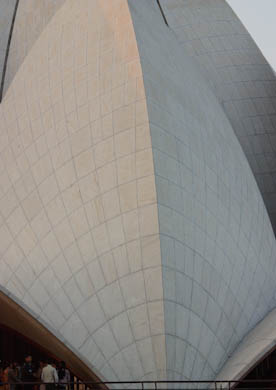
Following a day of sightseeing and shopping at Fab India, we arrived at the Lotus Temple (Baha’i House of Worship) as the sun was setting. This modern-looking structure was completed in 1986 for the Baha’i religious sect, but welcomes people of all religions to meditate and attend its short services held throughout the day. As its nickname reveals, the temple consists of 27 white marble lotus petals beginning to unfurl. Even at this time of day, a long line of people gathered to visit the temple. True to most Indian lines, queuing was not a strong point, but some temple officials did try to maintain some order. Along the main path and lining the manicured lush (92 hectares – 227 acres) lawns were rows of flowers including some mums. As we waited, the sun descended behind the temple, bathing the marble in violet. Surrounding the large temple are nine shallow chlorinated pools, adding to the tranquility. Once inside (shoes not allowed), people were invited to sit on the wooden benches, each of which had a lotus symbol carved in it. Looking upward, the expansiveness of the structure was felt. A floral symbol was seen at the top, radiating.
See more photos of Delhi on my Flickr page

Wednesday, January 19, 2011

Qutb Minar, Delhi

One of my favorite places in Delhi to visit is the Qutb Minar Complex. On its massive grounds, this UNESCO World Heritage site contains a treasure trove or archaeological masterpieces, dating back from between 1193 and the 13th century. Dominating the skyline is the Qutb Minar itself. Tapering from a width at the base from 14.3 meters to 2.7 meters at the top, subsequent additions by different rulers (from 1192-1388) was physically apparent. Loving detail, I am attracted to the gorgeous Kufi-style calligraphy and the ornate balcony. It is the tallest brick minaret in the world.

Elaborate calligraphy can also be found in places such as the Alai Darwaza gate and Quwwat-ul-Islam mosque. Looking closer at the carvings on the columns and other portions of the mosque’s ruins, one can easily see how portions of Jain and Hindu temples were repurposed. Although in ruins now, the archways in front of the mosque and leading to the Qutb Minar had particularly elegant calligraphy. Currently, restoration work is being done inside the Alai Darwaza.


http://melissaenderle.blogspot.com/2009/05/delhi-qutb-minar-and-humayans-tomb.html
Delhi Flickr page http://www.flickr.com/photos/melissaenderle/sets/72157616866717048/

Tuesday, January 18, 2011

Scales of Justice, Red Fort

On the itinerary of most visitors to Delhi is the Red Fort. One of its many buildings is the Khas Mahal, which contained the emperor's royal apartments with special rooms for private worship and for viewing. Inside its Robe Room is a wonderful marble jali screen window containing the scales of Justice. This motif is seen in many miniature paintings, made famous in Udaipur. Pigeons flew in and out through the broken portions of the jali emphasizing the delicate nature of the carving. It would be one of many beautifully carved windows on the trip that I'd admire.

Read more about the Red Fort on my previous trip to Delhi http://melissaenderle.blogspot.com/2009/04/red-fort-delhi.html

Monday, January 17, 2011

Birla Mandir, Delhi

Prior to visiting the Red Fort in Delhi, we stopped at the Lakshmi Narayan Mandir Temple, known more commonly as the Birla Mandir. This Hindu temple is built in the Orissan style and was completed in 1938. Dedicated to the goddess Lakshmi (goddess of wealth and prosperity), the chanting of Om Lakshmi could be heard while we were touring the temple. Swastikas, lotus flowers, and elephants were some of the many symbols noted (photography not allowed inside). Throughout the interior, inscriptions from the Ghita and Upanshad holy books were placed, revealing virtues of life. Paintings and reliefs of various gods and goddess adorned the wall, along with Hindu mythology scenes and marble etchings. Devotees carried small plates of marigolds and coconuts, placing them by altars within the temple. The marble floors were cool on our feet. Inaugurated by Mahatma Gandhi, the temple’s stipulations open it to people of all castes, including the untouchables. With the calm chanting and serene atmosphere, it was a great way to start our tour of Delhi.

See more photos on my Delhi Flickr set

Sunday, January 16, 2011

Trip to North India - Dec 2010

In December of 2010 I met three of my friends in Delhi to start our trip through Northern India. Two came from Serbia and were former colleagues of mine, and the other flew from Wisconsin, a former art professor and elementary art teacher of mine. Our journey would take us from Delhi to Dharamasala, back to Delhi, on to Udaipur, then to Jodhpur via Ranakpur, Jaipur, Shekhawati region, back to Jaipur, then on to Fatehpur Sikri, Agra, and finally back to Delhi. In this series of blog entries, I will attempt to highlight some of our experiences.

You may find more of my photos on my Flickr site.

Saturday, September 05, 2009

Chepauk Palace


I had seen a photo of the Chepauk Palace in a guidebook and knew approximately where it should be, but that didn't prevent me from almost missing it. As the taxi drove by a clustered bunch of buildings, I caught a brief glimpse of the tower, nearly obscured from view. When the Chepauk Palace was built in 1768, the area was quite wide open and spacious. Now, the small driveway with an unpretentious entrance, tiny grounds (actually, a pathetic stubble of grass along with dirt) and no signage seriously underscores the significance of the building in the history of Indian architecture. It is considered to be the forerunner of the Indo-Saracenic style which spread from Chennai to the rest of the Indian subcontinent. The tower had a Mughal feel to it, reminiscent of some of the buildings I had seen in Delhi. Its stripes reminded me of some of the Islamic architecture I had seen in Sarajevo. Sadly, there is a feeling of forgottenness and abandonment, the buildings and grounds in disrepair. Still, if you are in the area, it's still worth a visit to see this still-beautiful building.

Tuesday, May 12, 2009

Delhi - Qutb Minar and Humayan's Tomb

Humayun's Tomb
Having several hours before our flight, we decided to see a bit more of Delhi. Our taxi drove us through tree-lined streets with floral islands, grassy areas, and parks. Not quite the Delhi we had expected to see. Our first destination was Humayun’s Tomb. Built by wife of the second Mughal Emperor Humayun, this tomb (built in the mid-16th century) is a superb example of early Mughal architecture. With its high arched entrances, bulbous dome, squat building, and gardens lining a wide path, it is a predecessor to the more famous Taj Mahal. Latticework of the window cast patterns onto the marble floor next to the tomb. Out of the sun’s reach, it was remarkably cool inside. The complex also contained several other tombs, each housed in special buildings. Carved Arabic calligraphy covered many of the walls. A worthwhile place to visit.

Qutb Minar
After an enjoyable meal at a local restaurant, we visited the Qutb Minar. I had read somewhere that it was a good place to visit, but wasn’t quite sure what we’d see. We first encountered the Tomb of Altamish, whose red sandstone with calligraphy and pointed arches contrasted against the blue sky. Next to that was the Alai Mina, the incomplete tower of victory that would have been twice as high as the original Qutb Minar tower. I felt like I was walking through Roman ruins as I passed arched and columnar ruins. The Quwwat-ul-Islam Masjid (Might of the Islam Mosque), first mosque in India, was built in 1193 on the foundations of a Hindu Temple. An inscription over the east gate indicated that the mosque was built with materials obtained from demolishing ’27 idolatrous temples.’ Indeed, some of the blocks had Hindu symbols on it. I was curious to see how the Muslims dealt with the figurative carvings on the Hindu and Jain columns. Looking closer, I noticed that the figures’ faces and other parts were obliterated. Strangely enough, others were left alone. In the courtyard of the multi-arched mosque was a smooth 7m-high (23 feet) pillar. It dates long before the mosque - dedicated to Chandragupta II who ruled from 375-413 AD. Constructed of exceptional pure iron, scientists are still baffled how the iron has never rusted.

The main star of the show was the Qutb Minar itself. Constructed in 1193 as a tower of victory, it celebrated the defeat of the last Hindu kingdom in Delhi. Standing at 73 m high (240 ft), the column is an impressive site. The tower has five distinct storeys, each containing an ornate, projecting balcony. The lower three are made of red sandstone in a vertical zigzag fluted pattern, while the smoother 4th and 5th levels are from marble and sandstone. Arabic calligraphy banded the lower levels. Despite earthquakes and multiple lightning hits, the column still stands as a sight to behold.

After tea at our guide’s house, we headed over to the nearby airport. Surprisingly the flight agent didn’t even flinch when she saw our baggage; weight didn’t seem to matter. Smiling for our good fortune, we went through security. The camel skull drew lighthearted conversations by the security people, but all was fine. As we stepped off of the plane in Chennai, the heat and humidity hit us, even at 11 p.m.. No more were we in the dry desert-like climate. After two weeks in magical Rajasthan, were back in our South Indian home.

See more photos of the Qutb Minar and Humayan's Tomb on Flickr

Monday, May 11, 2009

Train Ride to Delhi

After a bit more shopping and the purchase of an extra duffel bag, we went to the train station for our 5 ½ hour ride to Delhi. When the late train finally arrived, people mobbed the door, crowding and pushing to get on. Our now-heavy baggage made it harder to get on, but we managed. While the baggage was now a curse, we knew the purchased items would be appreciated later. Into a sleeper car section intended for 8, people continued to crowd in. At one time we had up to 22 people in our seats, with more filling the aisle. Thankfully people were rather jovial and very flexible, seemingly unfazed by the crowded conditions. Vendors traveled through the aisles, selling chai, samosas, and snacks. Occasionally the smell of the bathroom permeated the air - unpleasant but temporary. Outside the moon shone in the dark night, a full ball glowing an eerie orange. At one stop we saw the interior of the first-class sleeper car of another train. It had provided linens, was quiet, air-conditioned, and definitely not crowded. We looked on with longing.

Our taxi honked its way over to our reserved hotel, asking directions every block or so. We were actually put up in a slightly nicer (and quieter) hotel, as the first one was overbooked. We didn’t mind the inconvenience.

Sorry, no photos on the train. I was too crowded to even attempt to get my camera out from under the seat.

Wednesday, April 22, 2009

Train Ride to Jaisslamer

Grabbing some fruit & water from the train station, we boarded into the 2nd class non-AC sleeper car. On schedule, the train rocked into motion, bound for its final destination of Jaisalmer. Bordering the train tracks were small, shabby-looking dwellings - a large contrast to the tree and flower-lined spacious boulevards and stately buildings we saw a few hours earlier. As evening descended, the windows were closed to prevent the mosquitoes and dust from entering. The fan above only operated at a high speed, so I was particularly grateful for the bedsheet I had brought along. Despite the repeated stops (Express doesn’t mean direct without stops), noise, occasional smells from the bathroom, and requests to show our ticket, we somehow managed to get a few hours of sleep.

The emerging colors of dawn beckoned me to sit up. Before us was a vastly different landscape. The green of Delhi was replaced by brown barren-looking earth, interrupted by occasional scrubby trees or huts constructed of stone slabs or mud. Carefully piled stones or fences made out of the same vertical stone slabs demarcated the fields. Wheat grew in some fields, with the mostly female workers harvesting by hand, gathering bundles together likely in much the same way as they did in Biblical times. The train stopped for various intervals, with the train begging to empty as we neared our desert destination. A life-blood of these Indian towns, the small train stations enabled us to glimpse part of its events: a young woman brightly clad in a odhni scarf and matching sari talking on her cell phone with her bonnet-clad infant looking up at her with his eyeliner-decorated eyes, two wrinkled men wearing red turbans chatting as they sip sweet tea, and a woman patiently squatting on the platform with a watch peeking through the large collection of bangles around her wrist. To one side of the track I see men already taking their first tea break of the day, pausing from their labor of constructing a track using concrete railroad ties. As the train once again begins, we pass by a truck carrying a mound of colorful mattresses. Children run towards the train and wave, excitedly pointing as we wave back.

Monday, April 20, 2009

Indira Ghandhi Museum and other Delhi Sights


Back in Old Delhi, we passed by small shops lining the street. A tangled mess of wires left us wondering how safe this antiquated phone/electrical system really was. Hungry, we settled on a rather uninspiring lunch. We then visited the Indira Gandhi Memorial Museum, housed in her former residence. The extremely informative exhibit comprising of newspaper clippings, personal belongings, letters, photos, and explanations enlightened us to the commitment her family had towards India and the incredible hardships they all faced, including multiple assassinations and imprisonment. Outside the house was a path covered in crystal, including a very touching clear glass portion marking the spot where she collapsed when shot by a Sikh bodyguard. We left there, moved and in reverence. With some time to spare, our driver took us to the India Gate and nearby Secretariat buildings.

Sunday, April 19, 2009

Red Fort, Delhi


In Old Delhi, our first destination was the Red Fort, completed in 1648. Successfully using our employment papers, we were able to get in with the drastically reduced local ticket price. We followed the tourists through the Lahore Gate, so-named because it faces the city of Lahore. The vaulted archade known as Chatta Chowk contained quite a few shops selling goods from Rajasthan, but we ignored them, knowing that there would be plenty of authentic shopping opportunities once in Rajasthan. We then quickly visited the Diwan-i-Am (Hall of Public Audience) and wandered through the Diwan-i-Khas (Hall of Private Audience), admiring the graceful white marble arches with their delicate inlaid designs. We peered through the window of the hammam, the cool marble reflected by window light. We glimpsed the domes of the Pearl Mosque (1659), whose structure was otherwise obscured by a high wall. Disappointed that the restaurant did not serve food until later, we headed back towards the Lahore Gate, passing by some ugly barracks constructed by the British.