Showing posts with label agriculture. Show all posts

Thursday, July 14, 2016

Dean's Residence, 10 Babcock Drive

This past weekend, I revisited the Allen Centennial Gardens in Madison. In addition to the beautiful gardens, the UW Madison landmark includes a stately Victorian Gothic house that was once the home of the first four agricultural deans of the university. 

Built in 1889, the house is now on the list of the National Register of Historical Places. Placement on the historical registry helped save the building from the encroaching claws of the ever-expanding university. The structure is currently undergoing renovation and will be repurposed as a student center.


The exterior still has some beautiful details such as this window. I wonder how much of the original interior ornamentation still exists. I hope that when the interior is completed, it will be open to tours. 


Sunday, January 03, 2016

Dots in the Rice Fields

While some rice fields had solitary workers, others felt more communal. Everyone was pitching in, doing their part in the labors.
Two people carried large bundles of grasses on their heads, probably for cattle.
Some fields had small shelters dotting the land. Although simple and crude, they likely provided a little respite from the sun and rain when working.


Friday, January 01, 2016

Rural Landscape of Central Java


Although the train passed by some smaller towns, much of the landscape to Yogyakarta was quite rural. Most of the land was quite flat and fertile, enhanced by volcanic ash. Rice was the dominant crop, with fields in different stages of the process. Corn, papayas, and veggies also were grown.

The pace of life was a bit different in the villages. Boys fished with cane poles in muddy waters. Goats, sheep, geese, chickens, and ducks wandered about. 

Some were digging in the rice fields by hand, while others worked up the land with two-wheeled tractors. 

Some homes were brightly painted, while most were quite simple - sometimes not much more than metal and bricks.
At times, the skies became very heavy, unloading rain with intensity. A little while later, patches of blue sky could be seen.
As we neared Yogyakarta, some lands became hillier. I was looking forward to seeing even more terraced rice fields when I went to Bali.

Friday, January 17, 2014

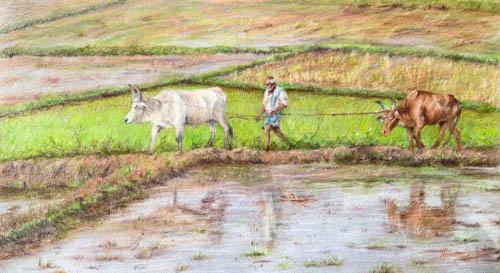
Through the Paddy Field

Through the Paddy Field
Color Pencil
by Melissa Enderle

Paddy fields such as this are very common in South India. I loved seeing the brilliant green of a lush field. Each paddy is rather small and is bordered by a raised mound of dirt. In this color pencil drawing, a farmer leads two of his cows on the narrow raised border of a Tamil Nadu field. Distorted, but discernible reflections of each is found in the flooded field in the bottom portion of the drawing. Measuring only about 24x44 cm, this rather small drawing made it a bit more challenging to render the figures. It did fit well into my suitcase back to Korea though!

Monday, January 07, 2013

Tonto Cliff Dwellings

On one of our day trips from Apache Junction, Arizona, we visited the Tonto Cliff Dwellings (Tonto National Monument), located near the Roosevelt Dam. Situated between the northern Colorado Plateau and southern Sonoran Desert,   the Tonto Basin is home to a diverse selection of animals and plants and was farmed by ancient inhabitants. Lower elevations, are home to a variety of cactus-like plants including the famous saguaro, cholla, prickly pear, agave, and jojoba. In higher elevations, oak, juniper, pinyon, and ponderosa pines dot the hills. 

During the 13th-early 15th centuries, the Salado people (derived from the name of the Rio Salado - Salt River that flows through the area) made the area home, including the cliff dwellings that are preserved still today. It was fun walking through the remaining rooms, imagining what life in these cramped quarters must have been like. Blackened walls and ceilings (some of the original timbers and ceilings are still intact) still bear the signs of cooking and wood fires. Some hand/fingerprints from the Salado applying mud over the adobe can also be found. The visitor center has a nice, but small collection of weavings, polychrome pottery, yucca-woven sandals, and other artifacts from the site.


Friday, February 24, 2012

Pajamas and Watermelon Seeds


Climbing aboard carts drawn by water buffalo and a bullock, my two traveling companions and the other volunteers enjoyed a dusty ride out into the field. Our presence attracted the children of the village, with uniformed children at the school playground waving and smiling. One young boy ran to our car and followed us to the field, holding on to the back as if he was undertaking a very important job. He only stopped momentarily when he ran to pick up a yellow object he had spotted in a field - a spool of thread. We were taken to our first task - planting watermelon seeds for an illiterate farmer and his wife. They had already mounded the sandy soil, all we had to do was scoop a shallow hole and place five seeds inside, then covering it up. The wife then used her sprinkling can to water the freshly planted seeds, drawing water from the adjacent rice paddy. Village women were working in the rice paddy, planting rice. Despite being dressed in comfy looking pajamas (we found that walking around in pajamas was fairly common in Cambodia), their work looked far casual.

Wednesday, October 05, 2011

Ganesh Teaches the Mice

My friend bought this cute kolu set. Although Ganesh was a popular figure in the many displays we had already viewed, this one caught our eye. How appropriate is it to find the beloved elephant god seated in the front of an invisible room, while his pupils with their paper diligently listen. Look closely and you will notice each of these mice students each have a shock of black hair running down their back - female students! 

Thursday, May 19, 2011

The Little Rann of Kutch - The Cotton and Salt Workers


The following morning, the owner of the resort took us in his Jeep towards the flat, stark, expansive area known as The Little Rann of Kutch. Along the way, we saw several women in bright clothes and a few men picking cotton. The women giggled in shyness as they continued picking the cotton by hand, placing it in large cloth bundles. Once the bundle was full, it was carried to a truck, a ready containing quite a bit of the white fluff. Shortly after that, the land became quite desolate looking.
 
In the distance, we saw some action near large white piles that looked like snow. In fact, these words helped flats, created during the monsoon season when the sea and rivers flood the region. Underground water in this area is also very salty, making it unsuitable for farming. Instead, the enterprising Indians ever used this area to harvest salt for domestic and some export use. Our driver turned off the road and onto the cracked land until we reached the salt workers. A few men scooped up dried salt into shallow bowls, which they then placed on top of the heads of women. The women then carried the bowl weighing about 20 kg (44 lb) and dumped the salt onto large piles. They would toil like this in the hot sun from about 8 AM to 2 pm every day during the 6 to 8 months of harvest. During this time, they would live and work in the flats. Noticing a few children, I inquired whether they went to school. According to our driver, about 40% do get an education, but NGOs are helping to improve this. No harvesting would occur during the monsoon. For every 50 kg bag, workers would get between 14 and 18 rupees ($0.30-$0.40). About 7,000 metric tons of salt are produced in this area.

Thursday, December 03, 2009

Like Beads on a String


Like most women in Tamil Nadu, these paddy workers wear saris even when out in the field, doing construction, etc. It amazes me how they can work in 6 meters of cloth that is simply tucked here and there. I never tire observing the beautiful patterns and bright colors on saris, whether the cloth is an inexpensive cotton or the most expensive silk piece.  From my vantage point high up on Gingee Fortress' Rajagiri Hill, the colorful hunched backs of these women working in a row reminded me of beads on a string.

Farm Work the Old-Fashioned Way


When nearly to the top of Gingee Fort in Tamil Nadu, India, I took some time enjoying the beautiful rural landscape, including the paddy fields below. From this height, the farmer and his two cows looked like little specks, preparing the field for rice. I'm not sure how long they were working, but the cows didn't seem like they wanted to be working. The farmer took breaks as well, perhaps partly because he also was tired, and also because the cattle weren't very willing. In a field nearby, women were working distributing bunches of rice stalks, bending over and also working by hand. How very different agriculture is when working with these methods, versus the huge tractors and equipment with fancy gadgets!

Thursday, November 26, 2009

Up to Rajagiri Temple, Gingee Fort

The steps began leading us around the hill and slightly down, only to rebound and move upward once again. Nearing the top, I had a great view of the surrounding countryside. In the rice paddies below the colorful saris of women bent over in the fields created a curved line. In another, a farmer herded his yoked pair of cattle through the brown earth.

After walking over a wooden bridge through a natural moat and then through a mandapa (pillared hall), I was now at the top of the hill. Here one could find the main citadel, a Hindu temple and several related structures, granary, and several smaller buildings. Compared to the buildings on Gingee Fort’s Krishnagiri Hill, these were very plain. Hanging from a tree were some colorful rags as well as some rocks tied to the tree. Some bangles were also attached. Our conjecture was that these were fertility-related. Just down a small path from the citadel was another canon. From here, I had a panormaic view of the Kalyana Mahal and other structures at the foot of the hill, Krishnagiri Hill and the wall snaking up the rocky hill, Chandrayandurg Hill with its smaller structure on top, the modern town in the distance, and of course lots of paddy fields. I could hear the Call to Prayer, a reminder that some of its citizens are descendants of the Mughals who once dominated the region. 

Overhead, the dark clouds began to form. Occasionally a few sprinkles cooled us. After a quick look inside a granary at the base of the hill, we drove over to the Venkataramana Temple and then proceeded towards Chennai. Our day trip had drawn to a close.

Monday, November 23, 2009

Gingee Fort - Kalyana Mahal

After a late breakfast meal of traditional South India eats such as idly, dosa, and sambhar, we arrived at Gingee Fort by mid-morning. The landscape had changed from nearly all flat land to one punctuated by large hills of rocks. Some looked like collections of large rocks piled by giants, interspersed throughout the otherwise flat land. Green paddy fields dominated the rural landscape, nearly glowing with the recent monsoon rains.

It was my second time visiting this fortress complex – one of the few remaining forts in the state of Tamil Nadu known mostly for its temples. Last time we had visited the Krishna temple and Durbar Hall on Krishnagiri Hill. Now our goal was to climb the second of three hill citadels – Rajagiri Hill. Whereas Krishnagiri Hill had a gentler slope, the top portion of Rajagiri Hill appeared to suddenly erupt vertically from its base.

Several groups of children were also visiting the fortress, clad in their school uniforms. Some of the older boys enjoyed swinging from the hanging roots of the immense banyan tree, completely trusting that the vines would sustain their weight.


Located at the foot of the Rajagiri hill amongst green-landscaped grounds is the Kalyana Mahal and related buildings, constructed between the 15th and 16th centuries. A square hall built for the ladies of the court, it has a white pavilion with seven stories capped with a pyramidal roof.  Also present were rows of enclosure for the royal staff, the King’s audience hall and private chambers for holding meetings, a palace complex, and a massive tank named Elephant’s Tank. Traces of natural springs and tanks that supplied the citadel with an abundant supply of water were still evident. Also on the grounds were several granaries and the 17th century Venkataramana Temple complex.

Tuesday, November 03, 2009

Araku Valley Tour

The bus took us to our first destination, the Tribal Museum. The spiral walkway inside the small museum took us past diorama type displays of life-sized tribal people, tribal tools. jewelry, and musical instruments. The bus then ushered us to a rather disappointing botanical garden with a toy train, and then to a hotel for lunch. After a traditional South Indian meal eaten with our fingers, we went outside and watched a Dhimsa dance performed by one of the 17 indigenous tribes of the region. It was rather challenging photographing the dance, as the women dancers wove in and out, abruptly changed directions, and alternated between full height and nearly crouching. Capturing the faces of the fast-paced tribal women was further complicated by the tourists who joined in the dance.

Moving onward, we stopped at a scenic vista to absorb the view of the valley and then drove past coffee plantations along the steep sides of the road. The yet-unripe coffee was shaded by trees. Was this co-existence needed for the coffee or was it simply a way of maximizing land use with multiple crops? Also present were groves of cashew nut trees. Located about 29 km from the Araku Valley were the Borra Caves. One of the largest and deepest caves in the country (80 m depth), the opening of the cave was impressively wide. A paved path and well-maintained series of steps led visitors through the cave, with its varied sizes of stalactites and stalagmites illuminated by carefully spaced lights. Contrary to most caves I’ve been in, the temperature inside wasn’t noticeably cooler.  With several minutes to spare, I sat on a plastic chair and enjoyed the picturesque valley with its fast-moving stream below.

With the light quickly fading, we boarded the bus once again and headed towards Vizag. Considering the severe turns, narrow road and size of the bus, the driver moved at a rather fast pace through the mountain roads. At around 8pm, we finally were back to Vizag. It had been a long, but enjoyable day.

Thursday, October 29, 2009

Train Ride to Vizag

Safely aboard the Howrah Express Mail Train bound northward towards Vizag, I settled into my berth in the 2-tier AC sleeper car. Ah, this was so much better than the non-AC 3-tier traveling that we had done in Rajasthan; no desert sands spewing in, a climate-controlled environment, less people, and even a pillow and bed sheets provided! Checking out the bathrooms, I was pleased to see a fairly clean (by Indian standards) Western toilet with toilet paper – a big step from the scary toilets in the 2nd-class non-AC trains we previously took! I turned on my iPod, hoping that the music would drown out the cell phone talking by the two men in the upper bunks, one of who switched between two phones.
The train rocked back and forth during the night, crossing the Tamil Nadu border and into Andhra Pradesh. Every once in a while the train would stop, rather briefly in small villages and longer at larger stations. Dawn revealed a serene landscape, the soft glow of the emerging sun behind the fog rolling over the paddy fields. Palm trees silhouetted against the increasingly warm-colored sky. Already in early morning, farmers were out in the fields, with rice being the dominant crop. The train tracks went past thatched huts with cows in the yard and mounded piles of hay in the fields. Men bathed in rivers and pools of water. Women washed clothes by hand in the rivers, laying out the cloth on the nearby fields.

Soon the vendors began walking through the aisles of the moving train, calling out chai, coffee, omelet, and other Indian breakfast items. As the train continued northward, it relieved itself of more passengers, with a few boarding. Finally, around 1pm, we arrived at the railway station of Vizag, otherwise known as Visakhaptnam.

Saturday, June 06, 2009

Nothing Runs Like a Deere


When visiting a Tamil Nadu farm during the harvest festival of Pongal, a young girl was all to eager to show us their John Deere tractor. Having been raised on a farm where we owned John Deere tractors, I immediately took notice. It wasn't the first trademark green & yellow tractor I had seen in India. Indeed, John Deere has a manufacturing plant in the Western India city of Pune. This should help make the price of the tractor cheaper (vs. importing) and also make parts more available - that is, if they are needed.