Showing posts with label Korea. Show all posts

Saturday, September 24, 2016

Fire Monkeys, Olbrich Gardens

One of the most popular artist installations within the GLEAM exhibition at the Olbrich Gardens, "The Fire Monkeys" is the creation by local artists Laurie Rossbach & Jennika Bastian. According to the Chinese (and Korean) zodiac, it is the year of the Monkey. 
The installation hearkened me back to the beautiful lanterns I saw while in Korea, in the Lotus Lantern Parade, at the Jogyesa Buddhist Temple, and at Seoul's annual fall Lantern exhibit.  The Fire Monkeys were also created out of paper (in Korea it was called hanji paper), wire, and paint. 

While walking around the gardens at night, I heard the yelping monkey sounds well before I arrived at the willow tree. Each of the monkey sculptures glowed as if on fire, which is one of the four purified elements within Buddhism.

Wednesday, October 29, 2014

Chrysanthemum Festival, Jogyesa Temple

Fall is not just about leaves in Korea. Another colorful symbol of fall is the chrysanthemum flower. The Jogyesa Buddhist Temple in Seoul holds an annual festival in October featuring this Korean autumn flower. Even some trees get decked out with mums. 


The "flower tree" in the background cascades with clusters of yellow and burgandy mums, but it also looks a bit spider-like. Just as in the temple's lantern festival, tags stick out of the displays, recognizing contributors. It is also a testament to the labor of love for those involved with the festival.

When I traveled to the Andong region, I saw fields of chrysanthemums being harvested. Many will adorn temples and parks within the country. Chrysanthemums are also dried and used to make tea.

Wednesday, October 08, 2014

Fish on the Roof

 Having already seen some traditional buildings in (Dazaifu) Japan with ornamental rooftop decoration, it didn't at all surprise me to see mythical ceramic elements at the palace in Kumumato. This creature is known as a Sachihoko, with the body of a carp and head of a tiger. According to Japanese folklore, this the Sachihoko could cause the rain to fall. With fire being a constant danger for such wooden structures, the rain-inducing Sachihoko were believed to provide needed protection.


The placement of the Shachihoko on palace tiles reminded me of the dragons and dolkkaebi on Korean palaces, such as at Gyeongbukgung Palace in Seoul.

Dragon at Gyeongbukgung Palace
Dolkkaebi tile at Seonamsa Buddhist Temple


Thursday, October 02, 2014

Kumamoto Castle, Japan

Main Castle tower and smaller tower
 During my recent trip to Japan, I visited the national historical site of Kumamoto Castle. Considered one of the premier castles of Japan, Kumamoto Castle (named after the city in which it is found) has some impressive architecture, interior decoration, and a museum. Although its construction dates back to 1601 many of its structures were lost by a considerable fire just three days before a siege in 1877. Some parts were never rebuilt, while others were reconstructed as recently as 2005.

Detail - tower
Turret and walls

With its curved stone walls and wooden overhangs designed to repel ninja, it was considered to be a fairly impregnable fortress. The architect Kiyomasa also helped design some castles in Korea.

Monday, September 29, 2014

Critters at the Shrine


With the sculptures of various creatures around the shrine (including the ox previously featured), it felt a bit more like the many Hindu temples of India. True, the creatures at Hindu temples often were of gods or their avatars, but their presence at both added a little dynamism to the scene.

The entrance at most Shinto shrines are guarded by stone statues of a Chinese-like lion or Korean-like dog. Typically appearing in pairs, the curly "dog" with its mouth open is supposed to spit out good luck, while the other paired member has its mouth closed to catch evil.  

Thursday, June 19, 2014

There's a Tiger out the Window!

Lattice windows on Bongwonsa Temple in Seoul
I love visiting the Buddhist temples in Korea. Even the newer ones have beautifully painted beams and wooden lattice windows with carved nature scenes. The tiger is a popular motif in Korean culture and is seen as a symbol of courage and power. Cranes, seen in the panel next to the right tiger one, are a symbol of longevity. Roosters are a symbol of intelligence and trust, and carp are associated with reproduction. The lotus flower is a revered symbol of creation and prosperity, while chrysanthemums signify elegance. Bamboo signifies fidelity and the pine tree is associated with longevity.

Even more symbols can be found on the walls of the Buddhist temples. I'd love to have someone explain about their many stories and meanings.


Friday, May 02, 2014

Springtime Exercising

Strolling through the blossoms or having a picnic under the petals isn't enough for some Koreans. Getting a little synchronized exercising under the canopy of the cherry blossoms made for an extra enjoyable time. Note how everyone is geared up in their special hiking gear.

Sunday, November 17, 2013

Seoul Lantern Festival, 2013

This past Tuesday,  I attended  the Seoul  Lantern Festival.  Since 2009,  this festival has been taking place at the Cheonggyecheon Stream in downtown Seoul.  It’s amazing to think that all  that all these sculptures were created from hanji, traditional Korean handmade paper. Although they were pleasant to look at during the day, their illumination at night breathed new life into these works of art. The stream was a popular destination at night for young and old alike, but especially so for young couples.  Despite the large number of people, movement was orderly. speakers  set up by the Jongmyo Daeje sculptures emanated traditional Korean music.


See more photos at http://flic.kr/s/aHsjCMGUFR. 

Saturday, November 09, 2013

Chrysanthemums in Korea - More than a Pretty Flower


 On the way back down from the Bongjeongsa Temple, we stopped for a few minutes to look at the Chrysanthemum Festival located just before the main entry gate to the temple forest. Around this time of year, festivals for this ancient of flower (Chrysanthemums were cultivated in this region of Asia for over 3,000 years) dot the Korean landscape. Closely related to the chamomile flower, the leaves and flowers of the chrysanthemum are still used for both culinary and medicinal purposes. The tea I sampled was tasty and a welcome free treat on a cool morning. Chrysanthemums are also used to flavor a type of rice wine known as gukhwaju. A late-blooming flower, chrysanthemums are often used as offerings on Buddhist altars. Symbolic of the yang energy, it is seen as good luck. Although the original chrysanthemums were yellow, hence its name etymology of "chrys" meaning golden and "anthemion" meaning flower.  When reading more about the symbolism of Chrysanthemums, I found it interesting to read that the white mums are associated with lamentation, death and grief. The Japanese see the chrysanthemum as a symbol of the sun, with the unfolding of the petals to represent perfection.


Monday, September 30, 2013

Traditional Dancer in Red

As part of the Chuseok festivities, traditional dances were performed at Deoksugung Palace in Seoul. In this particular dance, the woman with the red hanbok took the lead, in a slow, but commanding style. I'd love to learn more about the symbolism of the dances and costumes worn - including the multi-striped extension over the hand. 

Wednesday, August 28, 2013

Mugunghwa - the Hardiness of the Koreans

During the heat and humidity of summer, the blooms of the Hibiscus known as Mugunghwa, or the Rose of Sharon, quietly adorn Korea. The ancient Chinese nicknamed Korea as "the land of the gentlemen where Mugunghwa blooms." Considering the number of times that Korea has resiliently stood against various invasions and hardships, it is fitting that Korea has chosen the Mugunghwa  - a hardy plant whose flowers withstand even transplanting or cuttings for floral arrangements - for its national flower. It symbolizes the country's wish for national development and prosperity.

In addition to dotting the lands of Korea, the Mugunghwa can be found in China, Japan, and northern India.

Saturday, August 17, 2013

Cookin' with the Kitty

A cartoon character may be considered popular when its image appears on T-shirts and stationery. (See my previous posting on a Hello Kitty shop at Namdaemun). When it is featured on its own airplane and cookware, then it's made it to the big scene. Yes, while at the Tokyo airport, I spotted a Hello Kitty airplane. Hello Kitty fans are encouraged to pitch their boring T-fal cookware and cook with the Kitty. Imagine how much more fun cooking and washing dishes must be when you can stare the cute feline on the bright pink (or magenta) cookware.

If you still haven't had enough of the kitty, or perhaps your cooking made you a bit queasy in the stomach, the Pink can follow you in the "little room" as well. 

Sunday, October 21, 2012

Gyeongbok Dragons

Throughout the expansive palace property of Gyeongbokgung and other palaces, one can find imagery of dragons. A common mythological creature of Korea and neighboring countries, the dragon known as yong has three forms, one protecting the sky, another one on earth, and a hornless one in the ocean. Typically containing four claws (Chinese dragons have five and Japanese ones have three), the Korean dragon has the head of a camel, horns of a deer, eyes of a rabbit, ears of an ox, neck of a snake, belly of a frog, scales of a carp, claws of a hawk, and tiger's feet.
During the lengthy Joseon Dynasty (1392-1910), only the king could use the dragon in the palace as his symbol. It is seen as a symbol of power, dignity, and majesty. The robes of a king often contained a dragon in its ornamentation.

Below are a few images of dragons found in the Gyeongbokgung Palace.


Thursday, September 06, 2012

Locks of Love

Want to publicly profess your undying love for someone while in Seoul? Come to the Seoul Tower, which has evergreen trees and a special wall just for you. As you attach your lock with its message written on it, take a peek at some of the notes already present. Some of the locks were getting rather rusty. I wonder what a rust-eaten attachment signifies. 


Saturday, September 01, 2012

Kimchi Traditional Storage

While in the Insa-Dong neighborhood of Seoul, our long-time Seoul resident (a teacher who lived in Seoul with her missionary parents since childhood) pointed out this ceramic pottery set, located next to a restaurant. This, she explained, is a traditional jar in which Korea's national dish, Kimchi, is stored. Such preserving storage was especially advantageous during the winter months. For those of you uninitiated to Korean cuisine, Kimchi is a fermented vegetable dish, mainly comprised of cabbage. It comes in (according to the Kimchi museum in Seoul) 187 different varieties. Not a big fan of the pickled taste, the I've tasted so far haven't sparked an enthusiastic awakening of taste buds, but I'll try some more. Couldn't say to a Korean that I'm not a fan of their favorite dish! 

Sunday, August 19, 2012

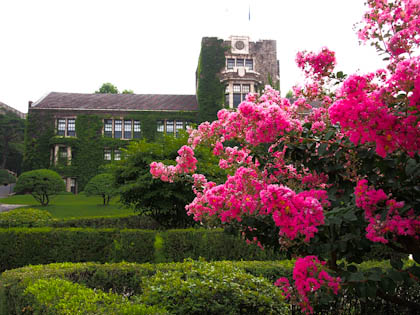
Yongsei University, Seoul

Down the slope of the hill from Seoul Foreign School is Yongsei University. Here we see a brilliant pink flowering tree in front of one of the university's Tudor-style buildings. It's a pleasant walk though well-maintained grounds. I anticipate taking many walks through this campus in different seasons.

Friday, August 17, 2012

Ewha Women's University area - shopping for shoes

Like in most countries, Korean women love shopping for clothing and shoes. The area around Ewha Women's University is no exception, boasting of streets lined with clothing, shoes, and accessories particularly geared towards the female gender. With such a large display item and color to match, no doubt the store next to this mega shoe beckons the average female in search of footwear. Too bad they don't carry my size...

Monday, August 13, 2012

Lotuses at the Bongwonsa Temple


Adorning the grounds of the temple complex were large pots containing lotuses. These were brought here for a special lotus festival. A very common symbol in both Hinduism and Buddhism, it represents spiritual perfection, mental purity, enlightenment, and wisdom. The beauty of the buds, greens, and blooms definitely enhanced the beauty of the place.


Sunday, August 12, 2012

Bongwonsa Temple - Destruction and Reconstruction


Although the Bongwonsa temple was founded in 889 AD, wars and fires resulted in the destruction of several subsequent temples. The main Judgement Hall was built in 1994. Inside this building, some of the 50 resident monks were engaged in a ceremony. A smaller building contained white ceramic oil lamps, neatly arranged. Yet another contained statues of several male figures with pointed beards. Photos of people (perhaps deceased) lined the altar. From the ceiling, papers containing what I presumed were written prayers dangled from the ceiling. 


Saturday, August 11, 2012

Bongwonsa Buddhist Temple


Although it was hot and very humid, a group of colleagues from school went for a hike to visit a nearby Buddhist temple. Traversing through the woods in the hilly area quickly made me feel like I wasn’t in the middle of a megacity. 

The Bongwonsa Buddhist temple contained a series of buildings whose style differed quite a bit from the Buddhist structures I had seen in other countries such as Thailand, Myanmar, and Cambodia. Reminding me of photos I had seen of the Korean palaces, the temple buildings were brightly painted and had roofs that seemed to fan upward. Such beautiful details! I clicked away and captured at least some of the decorations and patterns before the group wanted to move on forward.