Showing posts with label garden. Show all posts

Saturday, April 29, 2017

Change is in the Air

In the last two weeks, I've visited Olbrich Gardens three times. After a rainy spell these past several days, a slight break (at least for a few hours) enable me to check the local botanical gardens yet again.  Last week's warm weather and blue skies brought out lots of people; today, the overcast skies, brisk wind, and cool temps meant a smaller crowd. A week ago today, the cherry blossoms were singing. Today, few petals remained; Their tune was over. I walked away from the area from the area where I had photographed the cherry blossoms and magnolias last week, searching for new subjects.
The wooden bridge crossing the Starkweather Creek was my spot of choice for today. Here, the redbuds provided a colorful contrast against the overcast sky. 
Next to the bridge, three painted turtles vied for a spot on the grassy section of a log. 

What changes are you observing in your area?

Wednesday, April 19, 2017

Spring Awakens at Olbrich Gardens


Having photographed (at least according to my sister) all the flowers in Korea, it was high time that I began to document those spring beauties in Wisconsin. Spring in Wisconsin is a few weeks behind that of Korea, so I had to be a bit more patient. Finally (as my eyes and sinuses also revealed), the warmer temperatures have awakened spring in the area. After completing my online teaching, I took advantage of the pleasant temperatures and non-rainy late morning to walk to the Olbrich Gardens. It was the first time that I had visited Olbrich in spring, so I was eager to see what it would look like.


Other people, young and old, seemed to have had the same idea, strolling around the grounds (free admission) to see what firstfruits of spring were present. While many areas still looked rather dormant, sections were sprinkled with color. Blue Stars carpeted the ground, interspersed with daffodils. Magnolias and cherry blossoms added to the color palette, offering variation in size and color. I crouched low to the ground to get some shots, immediately getting dirt on my freshly laundered jeans. Oh, the price that a photographer must pay! 

Needless to say, it wasn't difficult to quickly rack up quite a few shots. I'll have to return in a week or less to see what further changes there will be. The folks (including many volunteers) were busy with spring cleaning and preparing many areas. I can't wait to see the fruits of their labors!

Wednesday, October 05, 2016

China Lights in Wisconsin

When living in Seoul, South Korea, I eagerly looked forward to the Lantern festivals which took place at the Cheonggycheon stream as well as the parade of the Lotus Lantern Festival. I loved seeing how illuminated sculptures formed from wire frames and hanji paper could display such elegant beauty. 

Upon hearing that the Boerner Botanical Gardens was having a China Lights Festival, I knew I must attend. Despite the rain, my friends and I traveled from Madison to Hales Corners (near Milwaukee); by the time we arrived, the rain had just stopped. In compensation for the cancellation of some opening events and muddy pathways, we were allowed to hold onto our tickets and return another time. Being hardy paid off! 

When we began to walk through the gardens, it was still rather light outside. It enabled us to see the natural flowers and landscaping, but the colors of the silk-covered displays were not as dynamic.
Soon, the night darkness arrived, enabling the China lights to shine forth in glory. 

Thursday, September 29, 2016

Pointillist Night Walk


While walking through the night exhibit at Olbrich Gardens, one of my favorite parts was this pathway. The white birch trunks were a wonderful canvas for the cool lights, which also cast their glow onward. The archway of branches leaning towards each other contrasted with the night void.
The round-ish leaves appeared stippled, creating a pointillist scene of alternating cool hues. Coupled with the echoes of monkeys from the nearby fire monkey lantern sculptures, a subtle, but exciting mood was established.

Wednesday, September 21, 2016

Olbrich Gardens GLEAM Installation

Last night I took advantage of the pleasant evening to attend the photographer's session for the GLEAM exhibit. This exhibition features illuminated installations in Madison's excellent Olbrich Gardens. The exhibit is a collaboration between local artists and regional lighting designers.

Some of the installations incorporated existing structures such as this one at the Rose Garden Pool, entitled "Yahara Waters: Yahara Clouds." 
Entitled "Ignis Fatuus," this sculpture incorporates glowing orbs, some of which were embellished with crocheted patterns made from recycled plastic shopping bags.

A star casts its illuminated colors on a small pond.
The sculpture "Portal" by the Sunken Gardens echos the sapphire blue twilight sky.

This was my venture into doing some night photography using manual exposure.


Monday, September 12, 2016

After the Rain

In Wisconsin, we've been getting quite a bit of rain these past few weeks. Although the Madison area did not have the flooding that occurred last week in other areas of the state, it still affected things. With the skies temporarily absent of precipitation, I decided to walk over to the nearby Olbrich Gardens. I loved the way the night's weather transformed the petals, leaves, and spiderwebs.

The petals here reminded me of the scales on a dragon's wing.

Raindrops beaded up along the veins of the elephant ear plant.

Friday, July 22, 2016

Lilies And More at the Centennial Gardens

The Allen Centennial Gardens contains a wide variety of lilies, lovingly tended by a special club dedicated to lilies. Below are some photos of the garden's lilies that I took, along with a few other types of plants and flowers.


Tuesday, July 19, 2016

Through England and France at the Centennial Gardens

The Allen Centennial Gardens contains several areas, each with their distinct look. In one section, there was a pond, complete with waterlilies and a small wooden bridge, which temporarily transported me to Monet's gardens in Giverny or the Taikobashi Bridge of Dazaifu. It did have some cattails and milkweed, which reminded me that I was indeed in Wisconsin.
Beyond a high hedge was a European-style garden, complete with manicured shaped hedges and sculptures.

With some tweaking on the gazebo, I could have been at the Garden of the Morning Calm near Seoul.
It was fun watching the koi and other fish swim in schools. Such a common sight in Asian gardens.

All in all, a beautiful place to enjoy on a Sunday afternoon!


Thursday, July 14, 2016

Dean's Residence, 10 Babcock Drive

This past weekend, I revisited the Allen Centennial Gardens in Madison. In addition to the beautiful gardens, the UW Madison landmark includes a stately Victorian Gothic house that was once the home of the first four agricultural deans of the university. 

Built in 1889, the house is now on the list of the National Register of Historical Places. Placement on the historical registry helped save the building from the encroaching claws of the ever-expanding university. The structure is currently undergoing renovation and will be repurposed as a student center.


The exterior still has some beautiful details such as this window. I wonder how much of the original interior ornamentation still exists. I hope that when the interior is completed, it will be open to tours. 


Friday, June 17, 2016

Period Garden Park, Madison

On this cloudless summer morning, I set out to visit the Period Garden Park. Located at the intersection of Gorham and Pickney in the Mansion Hill District of Madison, the small park is on land that was once the front lawn of the Elisha W. Keys House. This house, pictured above, was built between 1853-1854. 

In 1972, the plot (which at the time was a parking lot) was slated to be redeveloped as a 30 unit efficiency apartment building, which surely would have hidden the newly-designated historical landmark of the Keys house. Members of the community along with funding by the city and state governments helped secure the purchase of the land for a park.
Through the work of volunteers, the garden has been maintained. Over $10,000 worth of perennials, shrubs and trees have been added since 2007. 

The park has been designed to look like a typical garden that the neighborhood once enjoyed. Wrought iron from the time period was moved from a cemetery to the location. The sandstone steps are listed as original, and are typical of that era, as are the brick walkways. 
If visiting the Capitol area, the Period Garden Park is a pleasant, quiet reprieve in the heart of a historic neighborhood.

Monday, May 02, 2016

A Little Symphony at the Pond


One of the places that I was keen to visit within the Garden of the Morning Calm was the pond with pavilion. This area wasn't a part of the winter lighting festival in which I attended this past January. Such an area combines some of my favorite elements; bridges, traditional architecture, a pond, surrounded by spring plant life.
Instead of dragons or lions heading the beginning of the bridge, it sported some stone frogs. Soon this choice would become more evident. I had heard loud croaking but assumed that it was probably piped frog sounds coming from some speakers scattered throughout the pond's edges (I've been to other Korean sites where music is projected from speakers concealed as rocks). 
Lo and behold, it was the real deal! Near the shorelines were some rather long-limbed frogs, blissfully croaking away. It was fun watching them puff out their cheeks like symmetrical barbells. The frogs didn't seem that concerned about the curious onlookers. Perhaps it was mating season and they were more concerned about attracting some lovely lady frogs.


Sunday, April 24, 2016

Springtime at Garden of the Morning Calm


This past weekend, I went with a few friends to the Garden of the Morning Calm. Sure, I had plenty of things to do, but visiting this beautiful garden in spring was on my Korea "bucket list." I first visited this place in January during the winter Lighting Festival. Part of the garden was not included in the winter event, and I wanted to see its springtime transformation. Korea gets gardening right.
The 330,000 sq m. garden is open year round; during the higher season (mid-March - November), it is open from 8:30-sunset. Located about 40 km northeast of Seoul, it is an easy day trip. We took the subway from Hongik University, transferring once and arriving at Cheongpyeong Station. Although a city tour bus was available, we decided to pile into a taxi and shave off a little time, arriving at the entrance about 20 minutes later. Although it was fairly busy, the large area provided ample space to spread out and get some shots without hordes of people. As with any Korean destination, arriving earlier is best. 

Within the grounds, there are 20 different themed areas. Some areas were very manicured, and others felt more natural. Pavilions and other Korean-styled buildings provided shelter, picnic spots, places to eat/drink, purchase plants & gifts, and bathroom facilities. 
One could easily spend half a day, particularly if enjoying all the different paths, boardwalks, greenhouses, and facilities.

I'll be posting more on the garden. For now, here is the link to my Flickr album.

Saturday, February 06, 2016

Water Castle - a Perfumed Garden No More

Still within the Kraton palace grounds about 2km south, we visited what is known as the Water Castle - Taman Sari. The driver explained that through that white decorative gate was a bathing complex. At one time, it was just a small part of the 59-building palace complex, complete with 18 water gardens, pavilions, mosques, and was surrounded by an artificial lake. Following a devastating earthquake in 1867 as well as destruction by the invading British in 1812, Taman Sari was abandoned by the sultanate. Since then, the complex has become overrun with squatters who settled and constructed buildings on the dry lake bed. 
A naga greeted us at the gate

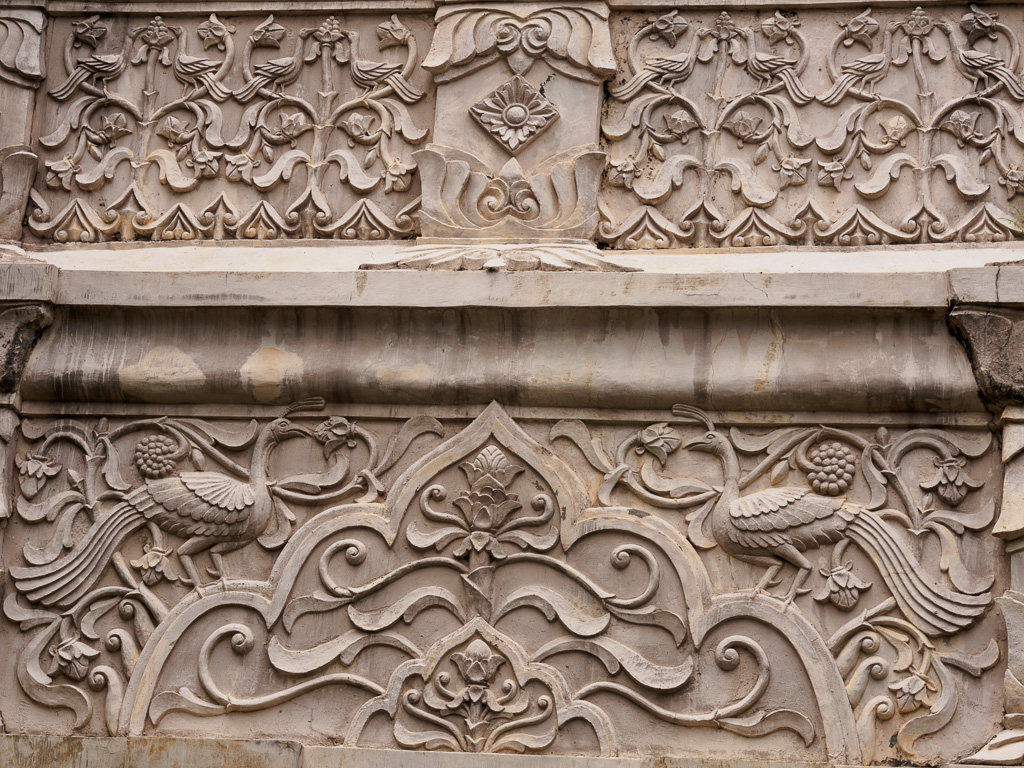
 The floral designs and peacock-like birds brought me back to India, particularly the Taj Mahal in Agra. How splendid this place must have looked at one time, harkening back to the meaning of its name - garden of beautiful flowers.
Once through the gate however, I was saddened to see the state of this partially restored section. The pool, once used by concubines of the sultan, was blackened and dingy. Oh how I wanted to drain the water, scrub the bottom and repaint/tile it. The buildings walls were equally dingy. In 2004, Taman Sari was placed on the World Monuments Watch endangerment list. Another devastating earthquake two years after that further damaged the site and has increased the urgency for preservation of this culturally and historically significant site. Despite the series of natural & man-made disasters that have befallen the complex, it is considered one of the best examples of 18th century Javanese architecture and landscape design. While it is quite doubtful that the complex could ever be restored to its former glory, the WMF would love to see more funding to make some attempts at preservation.
With the guidance of the people I was with, we went past some squatter's homes and found the underground tunnel that led to the Sumur Gumuling, an water mosque. Reminding me of a real-life Escher staircase Relativity artwork, four staircases met on an elevated platform in the middle of the building. On the ground level was a pool (now drained) that once served for ritual ablution.

Although I found it a bit difficult to fathom the grandiosity the Taman Sari complex must have once possessed, even the encroachment buildings had their own flavor. Had I more time, I would have liked to wander through the alleys, catching a glimpse of life on what once was a garden of beautiful flowers.

The Taman Sari, along with the Sultan's Palace, was listed as a tentative UNESCO World Heritage site. Although I've seen some UNESCO sites that also feel neglected, perhaps a full acceptance onto the esteemed list would provide some needed funding and awareness.