Melissa Enderle's travelblog on her travels to Mali, Tunisia, Serbia, Eastern Europe, India, South Korea, China, and other places around the world.
Saturday, October 22, 2011
Wednesday, October 19, 2011
Of Deities and Yallis
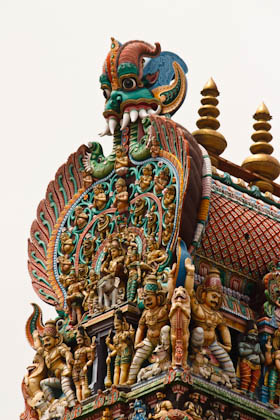
The towering four gateways of the Meenakshi Temple in Madurai are totally covered with protruding statues of brightly painted deities, mythical and real animals, and monsters. On the top, menacing faces of guardian deities known as yallis with their protruding eyes, horns, teeth, and long mustaches stare at those who come near. A feast for the eye, the temple’s twelve gopuras beg for extra viewing and zoom lenses.
Labels:
architecture,
Asia,
Hindu,
India,
religion,
South India,
Tamil Nadu,
temple
Location:
Madurai, Tamil Nadu, India
Tuesday, October 18, 2011
Meenakshi Temple - Heart of Madurai
Located in the southern Indian state of Tamil Nadu, the city of Madurai is synonymous with it fabulous Hindu temples, most notably the Meenakshi Temple. The Meenakshi Sundareshvara Temple was originally built by the Pandas who reigned during the 7th-10th centuries and received extensive additions by succeeding dynasties, particularly during the 14th and 18th centuries. The current structure, mostly rebuilt in 1559 AD, is considered a splendid example of South Indian Dravidian architecture. Surrounded by high walls, the massive temple complex (45 acres) has four entrances - one at each main cardinal point. To enter, visitors walk through one of the massive pyramidal gopuras, each with a height of more than 50 m (164 ft), with the tallest rising to 52 m (170 ft). It is the of the few temples on Tamil Nadu to have entrances at each of the four cardinal points.
Even today, the Meenakshi Temple is both the geographic and religious center of Madurai.
Labels:
architecture,
Asia,
Hindu,
India,
religion,
South India,
Tamil Nadu,
temple
Location:
Madurai, Tamil Nadu, India
Sunday, October 16, 2011
Poondi Matha Basicilica
Our final place of pilgrimage in Tamil Nadu was to the small village of Thiruvaiyaru Taluk. Amidst the emerald green paddy fields rose the large basilica known as Poondi Matha (meaning mother in Tamil). Erected in the late 18th century, this white structure of Gothic and French style was elevated to the status of minor basilica by Pope John II in 1999.
Like other churches along the pilgrimage path with Velankanni, Poondi Matha attracts large numbers of visitors around the time of the festival in Velankanni. The basilica has been enlarged due to donations and even contains an upstairs room that is air conditioned - a definite incentive to meditate! Masses were held on a rotating basis in multiple languages, accommodating the various places of origins for these Indian visitors. More housing and eating facilities have been erected to try to accommodate the swell of visitors. Some still elect to cook and/or sleep outside - which is fine until the downpours come!
The Poondi Matha houses a tiny fragment of what it claims to be a piece of the cross of Christ. People kissed the glass in front of the relic as they walked by, then spending more time in front of the large statue of Mary and infant Jesus. Once again, Mary was clad in a silk sari (several more were draped in front of the display - gifts of devotees), gold chains given by people, and floral garlands. More garlands were tied in front of the display, constantly refreshed by people. Off to the side, a worker took off some still-fresh garlands and began (much to my horror) ripping them apart and tossing the roses and other flowers in what looked like a waste basket.
Like other churches along the pilgrimage path with Velankanni, Poondi Matha attracts large numbers of visitors around the time of the festival in Velankanni. The basilica has been enlarged due to donations and even contains an upstairs room that is air conditioned - a definite incentive to meditate! Masses were held on a rotating basis in multiple languages, accommodating the various places of origins for these Indian visitors. More housing and eating facilities have been erected to try to accommodate the swell of visitors. Some still elect to cook and/or sleep outside - which is fine until the downpours come!
The Poondi Matha houses a tiny fragment of what it claims to be a piece of the cross of Christ. People kissed the glass in front of the relic as they walked by, then spending more time in front of the large statue of Mary and infant Jesus. Once again, Mary was clad in a silk sari (several more were draped in front of the display - gifts of devotees), gold chains given by people, and floral garlands. More garlands were tied in front of the display, constantly refreshed by people. Off to the side, a worker took off some still-fresh garlands and began (much to my horror) ripping them apart and tossing the roses and other flowers in what looked like a waste basket.
Parade by the Pieta
Devotees gather near the chariot of Mary, being paraded past the grotto of Mary and a copy of the Pieta at the Poondi Matha Basilica.
Thursday, October 13, 2011
Coming in With Mary
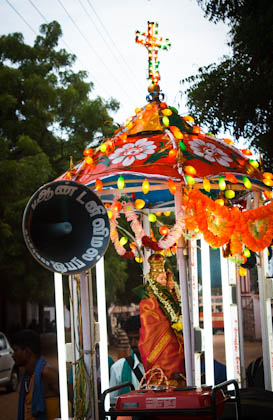
On our way to the Idaikattur Church in Tamil Nadu, we passed by a fair number of religious pilgrims walking alongside the road, all bare-footed. Most carried few possessions - typically what they could carry in a small bag. One group proudly pushed along a religious "chariot." Except for the cross on top, one could at a distance forgive it for being for a Hindu ceremony. Loudspeakers, powered by a large battery, broadcast praises of Mary to Christian and Hindu households alike.
Wearing a silken sari, garlands made of fragrant flowers, and a large crown on her head, the statue of Mary dominated the chariot interior. Struggling to emerge amidst the cloth was the child Jesus.
Now nearing dusk, the colorful decorative lights adorned the roof and cross. People gathering around the chariot began singing in unison, accompanied by drums. The positive energy was strong, evidence of the passion and devotion of all gathered.
Labels:
Christianity,
church,
Hindu,
India,
religion,
South India,
Tamil Nadu
Location:
Kattur, Tamil Nadu, India
Tuesday, October 11, 2011
Kolu gods display
A closeup of a few of the god dolls on display for Kolu, a Hindu festival. Rekha (the hostess) has arranged the figures by size, with the largest on the top stair.
Labels:
Chennai,
festival,
Hindu,
India,
South India
Location:
Besant Nagar, Chennai, Tamil Nadu, India
Sunday, October 09, 2011
Kolu Display and Host
A friend of a colleague of mine invited us to see the kolu display in her flat. Rekha's display of just stone-colored gods was a bit different than the colorful (and sometimes whimsical) figures I had seen in Mylapore. She explained that this more somber style was more representative of the type of display that would be found in a temple. Every year she sets up a different themed display. Imagine the storage needed for such collections!
Thanks again Rekha for being such a gracious hostess!
Location:
Besant Nagar, Chennai, Tamil Nadu, India
Thursday, October 06, 2011
Banana Leaves and Sandalwood Paste
At the colorful stands where the "pimping" of the rickshaws takes place, loud music jubilantly announces the presence of the decorating service. This stand was set up on the side of the road going past Chennai's many IT parks.
Wednesday, October 05, 2011
Ganesh Teaches the Mice
My friend bought this cute kolu set. Although Ganesh was a popular figure in the many displays we had already viewed, this one caught our eye. How appropriate is it to find the beloved elephant god seated in the front of an invisible room, while his pupils with their paper diligently listen. Look closely and you will notice each of these mice students each have a shock of black hair running down their back - female students!
Labels:
agriculture,
Chennai,
education,
elephant,
Hindu,
India,
Mylapore,
religion,
South India,
Tamil Nadu
Location:
Mylapore, Chennai, Tamil Nadu, India
Ayudha Puja - Remembering the Tools
Seeing cut stalks of banana plants alongside the road and more vehicles than usual with garlands and sandalwood splatter, I correctly guessed that today is Ayudha Puja. I love how items related to your labor are honored, through careful cleaning and decoration. Flower sellers love this day, as people buy garlands of aesthetic or fragrant flowers to adorn everything from their vehicle (including bicycles, rickshaws and motorcycles) to cement mixers and shop entrances. Palm leaf decorations hang from places, broken dyed green pumpkins litter the road sides, and splats or "v" shaped patterns made from sandalwood paste + vermillion powder adorn windshields and other flat surfaces.
By worshipping the tools of one's profession, it helps point to the divine force behind working behind the tool to help carry out a successful performance. Ayudha Puja is celebrated in different ways around India and is usually celebrated in Tamil Nadu on the 9th day of Navatiri - usually at the end of September or beginning of October.
Visit previous posts from years past on this Hindu festival - 2009 and on the rickshaws, 2008 #1 and #2
Monday, October 03, 2011
Of Gopurams and Dolls
With the impressive gopuram of the Kapaleeshwarar (Mylapore) temple in the background, these sari-clad women stop to look at the display of kolu dolls on sale for the Navatiri festival. See yesterday's post for a close-up of one display.
Location:
Mylapore, Chennai, Tamil Nadu, India
Sunday, October 02, 2011
Krishnas to Villagers
Once again, kolu dolls fill the streets surrounding the Kapaleeshwarar Temple in Mylapore, Chennai. Stall after stall sells these colorful dolls during the festival of Navartiri. From whimsical blue Krishnas and Hindu chariot processions, to village scenes and family members all gathered around a TV, shoppers could find at least some items that they didn't yet have in their collection. Because each stall had slightly different ones (and of varying painting quality), it was helpful to visit at least a few stalls before making a decision.
I made this image a bit larger so you can peek around the stall. Which one(s) would you buy?
Labels:
celebration,
Chennai,
festival,
Hindu,
India,
Mylapore,
religion,
South India,
temple
Location:
Mylapore, Chennai, Tamil Nadu, India
Friday, September 30, 2011
Oriyur Church, Tamil Nadu
One of the other churches we visited for a short time was the shrine in Oriyur, erected at the site where missionary and saint John De Britto was martyred in 1693. A Portuguese Jesuit priest, De Britto devoted his life to bringing the Gospel to the people of Tamil Nadu. After his beheading, the sand at the site is said to have turned red. Devotees believe that by applying the sand on their bodies, they will be relieved of incurable diseases. (Truthfully, I did not notice anything unusual about the sand). After praying to the saint at the church, childless couples are said to be given a child.
One of the churches visited during the September pilgrimage season, Oriyur receives over 25,000 pilgrims (Christians, Hindus, and Muslims alike) during this time period of a couple of weeks. Visitors from Tamil Nadu and neighboring Kerala make up the bulk of those that come to worship and pray at the Portuguese style church.
Labels:
Christianity,
India,
religion,
South India,
Tamil Nadu
Location:
Oriyur, Tamil Nadu, India
Wednesday, September 28, 2011
Ponki and other Kolu Dolls
For the festival of Navartiri in South India, each state has a different type of doll. For example in Andhra Pradesh, dolls of village life and deities are made of soft wood and are known as Poniki wood dolls. In the city of Thanjavur in Tamil Nadu, the delightful Tanjore dancing dolls move their heads and waists as any proper bobblehead would. Dolls in Rajasthan are made of colorful cloth and wood. In Karnataka near Bangalore, colorful wooden dolls are made, some depicting life in a village.
Above is an example of a Poniki wooden toy made in Andhra Pradesh.
Labels:
Andhra Pradesh,
celebration,
Chennai,
festival,
Hindu,
South India,
Tamil Nadu
Location:
Chennai, Tamil Nadu, India
Tuesday, September 27, 2011
Kolu Dolls of South India
In South India, Hindu homes in this time of the year celebrate the festival of Navartiri with Kolu dolls. Literally meaning an assembly, special dolls are arranged in stairstep displays of odd-numbered steps (1,3,5,7, 9, or 11). During this nine-day festival, the goddess Mahishasuramardini is remembered for her slaying of the devil Mahishasura. The first steps are typically dedicated to gods and goddesses. The next steps are for saints and demi-gods. Following that in succession are marriage, businesses and crafts, and traditional wooden dolls.
Women love to show off their kolu display and invite friends, relatives, and neighbors to their homes. Sweets and small gifts will be given to the guests.
![]() |
| Even grocery stores get in the action! |
Labels:
Asia,
celebration,
Chennai,
festival,
Hindu,
India,
religion,
South India,
Tamil Nadu
Sunday, September 25, 2011
Idaikattur Church, Tamil Nadu
The current church was built in 1866 by a French priest. Funding for the church was made by a French woman who was cured from a heart ailment and wanted to show her gratitude by having a church built in the missionary country of India. One of her conditions was that the building must be a replica of the Rheims Cathedral in France. The structure at Idaikattur is built in the Gothic style, with a vaulted roof supported by columns with cantilevers. Between the two roofs are small openings, which helps with circulation. Inside are 153 angels, some on the altar, others as sculptures around the church, and still others in stained glass windows. In addition, there are relics of 40 saints. Unlike most depictions of the Sacred Heart of Jesus which have the heart placed in the middle of the chest, this church has the heart in the left chest, just like humans. This human quality is attractive to pious visitors. The Sacred Heart of Jesus statue is one of three made, with the other two being placed at the convent of St. Margret and another in Rheims.
The church is one of the sites on the pilgrimage tour. It is believed that the petitions of the pilgrims are granted within one month from the time they are raised. In particular, relief from all kinds of psychological and heart ailments, to have happy marriages, to have children, get prompt employment, become debt-free, have family peace, excellent education for one’s children, and return to health.
Notice in the interior photo that there are but a few pews. The rest of the people sat, squatted, or kneeled on the cool, marble floor, except for a few elderly/physically limited individuals seated in a few plastic chairs scattered near the edge of the church. Such an arrangement certainly enabled more pilgrims to cram into the space!
Labels:
architecture,
Christianity,
festival,
Hindu,
India,
religion,
South India,
Tamil Nadu
Location:
Kattur, Tamil Nadu, India
Rabari Farmer, Gujarat
Here is the watercolor painting I just finished of a farmer. Like most farmers in the region, he is wearing all white. My dad (who was a farmer) couldn't get over how these men could keep their clothes so white over the course of a day. Note the large earrings in the middle part of his ears.
Thursday, September 22, 2011
Tsunami Miracle at Velankanni
On December 26, 2004, over 2,000 pilgrims were taking part in a Mass in the main basilica. Along with other coastal areas of Tamil Nadu, the small coastal town of Velankanni was not spared, devastating the entire town. The only building that escaped destruction was the basilica, sparing all those lives. This is particularly remarkable considering that buildings on the same elevation, located even further inland, were destroyed, while the inside of the basilica remained completely dry. Many consider this a miracle, performed by the loving, protective hand of God.
A similar incident occurred in Chennai, near Marina Beach. St. Thomas Basilica, located right by the sea, was spared from the tsunami, with the devastating waters parting just before reaching the church’s backside. While the church was untouched, the waters spread past the road further inland.
![]() |
| St. Thome Basilica, Chennai |
Labels:
Asia,
Chennai,
Christianity,
church,
religion,
South India,
Tamil Nadu,
water,
weather
Location:
Velankanni, Tamil Nadu, India
Wednesday, September 21, 2011
Velankanni Night Splendor
Velankanni Basilica, lit up at night, as seen from the hotel window
Oh, how tranquil it looks! Not visible (but present): throngs of people camping out at night, still worshipping within the different chapels, stalls selling goods and making food, and much more.
Labels:
architecture,
Asia,
Christianity,
church,
South India,
Tamil Nadu
Location:
Velankanni, Tamil Nadu, India
Tuesday, September 20, 2011
A Dip in the Holy Water
After making my way through the crowds, I arrived at the beach of Velankanni. Although early in the morning, it already was rather crowded. With the mass of people now in the small town, whose lodgings are unable to accommodate all (or those who choose to sleep outside), the sea was the perfect place for a dip - or a bath. Since this is more conservative South India, women walked in the water with their saris or salwars. Out of respect for the bathers, I did not take such close-up shots.
I did find this scene rather fascinating though. Everyone in the area was wearing orange - the color of penitent pilgrims. The way they interacted with the water made me wonder if some holy or healing status was being applied to the sea by Velankanni. Much like that of the Hindu's holy Ganges River.
Labels:
Asia,
beach,
Christianity,
Hindu,
India,
religion,
sea,
South India,
Tamil Nadu,
water
Location:
Velankanni, Tamil Nadu, India
Monday, September 19, 2011
Walking to the Beach, Velankanni
In true India style, this mass of people are making their way to the beach at Velankanni. Along the way, they can get snacks, cheap Chinese toys, or even shave their heads. I knew that the beach and ocean had to be that way, but with the crowds, it was impossible to see. I eventually did make it to the beach - without being tempted by any of the goods, services, and head-shaving opportunities.
Labels:
Christianity,
Hindu,
India,
religion,
South India,
Tamil Nadu
Location:
Velankanni, Tamil Nadu, India
Sunday, September 18, 2011
Wishes and Requests
Hanging from trees near the chapel by Mary’s Tank were colorful bundles of cloth and folded pieces of paper. Inquiring about this to my Chennai Christian friends who had invited me to go with them to Velankanni, I was told that the bundles of cloth were tied by people seeking the birth of a child. On the pieces of paper all strung together, people would write prayers and requests.
The scene reminded me of the strings tied at the tomb of the Sufi saint in Fatehpur Sikri (near Agra). When a prayer has been fulfilled, the person would return to untie the string.
![]() |
| Fatehpur Sikri |
Labels:
Asia,
Christianity,
festival,
Hindu,
India,
Islam,
religion,
South India,
Tamil Nadu
Location:
Velankanni, Tamil Nadu, India
Saturday, September 17, 2011
Buy your Candles (and Body Parts) Here!
A Catholic pilgrimage place would not be complete without places to purchase candles. This stall sells candles of varying colors and sizes, hoping to attract those of most any budget. Amongst the rainbow of colors, you will also find body parts for sale. Available are metal (perhaps even silver) squares with relief impressions of body parts, vital organs, children, and others. Likewise, white moulded arms, legs, and children hang above. Those seeking to have a baby might purchase the child piece. Hoping to get your bum knee healed? Bring the leg piece as an offering. I saw the same types of purchases available at a Hindu temple in Gujarat.
Labels:
Christianity,
festival,
Hindu,
India,
religion,
South India,
Tamil Nadu
Location:
Velankanni, Tamil Nadu, India
Friday, September 16, 2011
Get Your Heads Shaved Here!
Finding a place where you could get your head shaved was not a problem in Velankanni. I love the sign in front of this crudely made station. Despite the fancy jewelry, fair skin, and large "shades" to entice potential customers with the resulting beauty, I still did not feel compelled by any means to give it a try.
Labels:
Asia,
Christianity,
fashion,
festival,
Hindu,
India,
religion,
South India,
Tamil Nadu
Location:
Velankanni, Tamil Nadu, India
Thursday, September 15, 2011
Bald is Beautiful
When visiting the various churches including Velankanni on our short trip, one could definitely come to this conclusion. Men, women, and children all sported the slick look. A paste made out of sandalwood covered some newly-shaved heads, large handkerchiefs protected others from the sun, and still other heads were proudly sported in all their bare beauty. Christians and HIndus alike carried out this practice, considered to be a huge sacrifice, particularly for Indian women who cherish beautiful, long hair. For some, hair is offered in exchange for certain favors received, or thanks given for one’s answering of prayers. Even if one has no money for which to give (or to buy gifts for the religious deity), a devotee can make this ultimate gift. Read more about Why Indians Shave Their Heads
Labels:
Christianity,
fashion,
Hindu,
India,
religion,
South India,
Tamil Nadu
Location:
Velankanni, Tamil Nadu, India
Tuesday, September 13, 2011
Along the Path to the Tank
The path between the chapel at “Our Lady’s Pond” (site of the first appearance of Mary) and the main Basilica is filled with sand. Some devotees crawl or walk on their knees all or part of this distance as a way of showing gratitude, showing penance, or making a request. Others walk on foot, chanting, fingering rosary beads, and praying. Along the way, sculptural Stations of the Cross and Stations of the Rosary provided reflecting points. Thankfully, this path is kept quite clean and the middle part less crowded, making it easier to embark on the journey.
Labels:
Christianity,
church,
India,
South India,
Tamil Nadu
Location:
Velankanni, Tamil Nadu, India
Monday, September 12, 2011
Each According to Their Own Faith
Visitors of all faiths come to the Basilica of Our Lady of Good Health hoping to be cured of medical ailments, resolve fertility issues, and receive blessings. Much as I saw in a Hindu temple in Gujarat, devotees can buy a silver, gold, or tin offering in the shape of the affected body part.. Garlands of flowers to drape over statues of Mary were popular purchases. Some also brought gold chains and saris. Hindus could be seen carrying platters of coconut halves, camphor, bananas, and flowers. In one chapel, they brought in baby coconut trees as an offering for fertility. Of course, money, placed in large locked boxes near the front of the chapels, is always welcomed. As people inch their way up to the altar or while sitting on the crowded floor, ritual actions are made, each according to his/her religion. Even during a Holy Mass, people of various faiths are present; it may not be until the distribution of the Lord’s Supper that one can distinguish the Christians from non-participating others.
Labels:
Christianity,
church,
Hindu,
India,
religion,
South India,
Tamil Nadu
Location:
Velankanni, Tamil Nadu, India
Sunday, September 11, 2011
They All Go to Velankanni
I was one of over three million people descending upon the small (5,000 residents) southern Tamil Nadu town of Velankanni during the nine day festival which just ended on Sept. 8. People from all over India and elsewhere travel by train, plane, boat, car, and foot to reach this famed place called the “Lourdes of the East.”
During the nine day festival which culminates on Sept 8 - the day of Mary’s birth and also the date when the sailors were saved from the storm - various forms of worship such as Holy Mass, blessings of the sick, and prayers & meditation occur in the basilica and chapels. Depending on the time of day, visitors can hear services in one of nine languages of India, including English.
Mary is reported to have made several appearances in this area. Around 1560, she first appeared to a Hindu milk boy (whose pot of milk overflowed after giving some go the infant Jesus) , then to a lame boy selling buttermilk (who was healed), and then to save Portuguese sailors from a dreadful cyclonic storm. Chapels were then built on these sites and were subsequently expanded.
Visiting Velankanni during the eight-day festival or other special occasions such as Christmas is not for the faint-hearted. It is chaotic, crowded, intense, color - in other words - so India.
More to come!
More to come!
Labels:
Christianity,
church,
festival,
Hindu,
India,
religion,
Tamil Nadu
Location:
Holy Path, Velankanni, Tamil Nadu, India
Pampering Ganesh
Finally have some time to write about the photos I've taken in the last week.
India once again is celebrating Ganesh Chaturthi, the birthday of one of the most revered Hindu gods. Now in the last days of the 10 day festival, many Hindu devotees have already worshipped and placed their idol into the nearest body of water.
These photos, taken in Madurai, Tamil Nadu, depict the level of devotion and type of offerings presented to the beloved elephant-headed god. In return, Hindus hope for much prosperity and good fortune for the year ahead.
Previous year's posts recount the making of the clay idols, creation of elaborate floral floats, parade, umbrellas and other items for sale, and many more. Look for additional posts around the beginning of September or end of August.
India once again is celebrating Ganesh Chaturthi, the birthday of one of the most revered Hindu gods. Now in the last days of the 10 day festival, many Hindu devotees have already worshipped and placed their idol into the nearest body of water.
These photos, taken in Madurai, Tamil Nadu, depict the level of devotion and type of offerings presented to the beloved elephant-headed god. In return, Hindus hope for much prosperity and good fortune for the year ahead.
Previous year's posts recount the making of the clay idols, creation of elaborate floral floats, parade, umbrellas and other items for sale, and many more. Look for additional posts around the beginning of September or end of August.
Labels:
celebration,
festival,
Hindu,
India,
Madurai,
South India
Location:
Madurai, Tamil Nadu, India
Friday, September 02, 2011
Outside the Bedding House
While it's not uncommon to see people snoozing outside in India, this scene made me take a second look. Here we have a man sleeping on some dirty mattresses in front of a door with a bedding house sign above it. I sure hope anything the place sells looks better than those!
Labels:
Chennai,
India,
poverty,
Tamil Nadu
Location:
Chennai, Tamil Nadu, India
Thursday, September 01, 2011
Quite a Handful
Firmly clenching several chickens, this man has just left the poultry selling shop. Are all these mangy-looking chickens destined to land on his home's dinner plates?
Subscribe to:
Posts (Atom)