Wednesday, March 11, 2015

Stonework of the Khoo Kongsi Temple

Due to generous donations to the clan, the Khoo Kongsi Temple includes some magnificent stone carvings. The stones were imported from the Fujian province in China. With just a hint of color, the rather neutral stonework contrasted with the brilliant gold and reds of the hall's interior. Ventilated windows came in round, octagonal, and rectangular shapes, each placed according to the hierarchal order of the Souther Fujian architecture. In addition to being decorative, the stone carvings filling the walls of the temple are full of symbolism and depict stories.

One of two lions facing towards the main hall, playing with two coins.

Stone child symbolizing beckoning of wealth
Read more about the stonework of the Khoo Kongsi Temple.

Monday, March 09, 2015

Khoo Kongsi Clan Temple

Due to clan ceremonies that were taking place in the morning, we had to return after lunch to visit the Khoo Kongsi temple. Thankfully, the extra time and even admission fee was worth it. A narrow, rather simple alleyway entrance suddenly gave way to a wide square. 
According to the official website, the Khoo Kongsi consists of an administrative building, opera stage, meeting hall, and 62 units of terrace houses and shophouses. The dense conglomeration of buildings with the three not-so-obvious entrances really evoked a sense of defensive protection as well as the communal closeness of the clan. Just as in the souks I had visited in Tunis and Sousse, it would take a bit of effort for unwanted visitors to reach the heart.  Located in the heart of historic Georgetown, this elaborate temple is a popular tourist attraction. 

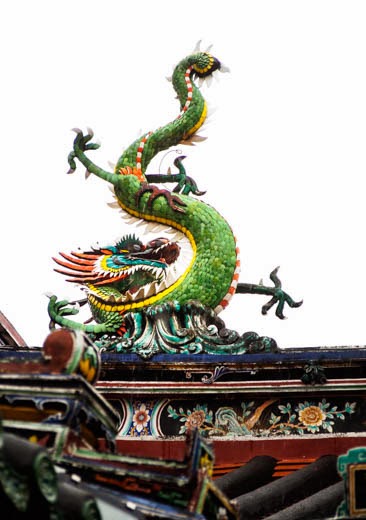
 The Leong San Tong temple was by far the most decorative of the buildings, with the current structure completed in 1906. The temple's intricate wood carvings and richly ornamented beams were created by the finest craftsmen from China. 
Once again, we were on visual overload. Every single view was a feast for the eyes. I could have easily taken many more photos of just the main temple, not to mention wander around the complex and capture some of the architectural beauty of the rest of the buildings. Lack of time (and of course the ever-present rain) meant that we had to move on.
Note the dragon "gargoyle"
If you are interested in learning more about the Khoo Kongsi Temple, do visit its comprehensive website.

Friday, March 06, 2015

Chein Nien of Han Jiang Teochew Temple

Chien Nien porcelain mosaics and figures on the rooftop of the Han Jiang Teochew Temple in Georgetown. With its fairly recent restoration, the fragile artwork was still in good repair. Photography was marred by the heavy rainfall, in terms of contrast, color, and number of photos. Fiber optic lighting helps illuminate the workmanship at night.


Wednesday, March 04, 2015

Doors of the Han Jiang Teochew Temple

The doors of the Han Jiang Teochew Temple are noteworthy, not only in their size (13 feet/4.1 meters - tallest main temple doors in Georgetown) but also their beauty. The main entrance has three sets of paneled doors.

Quin Shu Bao
 On the main door are the martial Door Guardians - Qin Shu Bao and Yuchi Gong, who were generals of the Tang dynasty. These two warriors wear armor containing the dragon and phoenix motifs. Their helmets are embossed in gold. In their hands are rare weapons.

Robe detail of the martial Door guardian
Civil Door guardians
On the side doors are the Civil Door guardians. Their head gear and held wine cups connote aspirations for official ranks. Two servant women fan the men.  


Monday, March 02, 2015

Han Jiang Ancestral Temple, Penang


Also known as the Teochew Temple, the Han Jiang Ancestral Temple was built (1870) to serve the early Teochew settlers from the Guangzhou district in China. It is the only temple in Georgetown of the Teochew style. The temple houses an altar to the patron Taoist god of the North as well as ancestral tablets of deceased Teochews. 

Like many of the temples and other old buildings of the area, Han Jiang Ancestral Temple fell into disrepair, wear and tear, and unaesthetic additions, particularly when used as a school. In 2002, a committee was formed to begin restoration. Extensive funds were raised, research on the original structure conducted, and skilled craftsmen were brought from China. The temple's conservation of tangible and intangible heritage was recognized with a UNESCO World Heritage Conservation award in 2006.
Panels, murals and altar


Dragon mural near the entrance

Beautiful geometric tiles grace the floor
I enjoyed reading about the conservation work at the temple and looking at its superb craftsmanship. Knowing that there were so many other places to see, we knew we had to move onward.

Saturday, February 28, 2015

Hock Teik Cheng Sin Temple, Penang


One of my favorite Chinese temples in Georgetown, Penang, was the Hock Teik Cheng Sin Temple.
From the narrow entrance, I was rather surprised at how much more spacious the interior felt. I was equally impressed with the incredible renovation that was completed in 2006 after two years of intense work by over 20 artisans. 


What a beautiful collection of a varied art forms - chien nien porcelain mosaic work, embroidery, sign carving, and lanterns- all just in this photo.
I enjoyed seeing the curtain of lanterns, as seen from the courtyard (note the once again rainy scene).


Ceiling beams. This temple was built without any nails.

Corner of entrance


Details of the intricate door paintings


From the sign on the front of the temple:

Officially registered with the Chinese Protectorate of Penang on 11.10.1892, the Hock Teik Cheng Sin Temple has had a checkered history colored by the segmentary traits of Southern Fujians. It is essentially a community temple devoted to the workshop of Twa Peh Kong (Da Bagong). 
Historically the origin of the Hock Teik Cheng Sin Temple can be traced back to early 19th century while the Khoo Teeau Pang was the founding head of the Kean Teik Tong which was formed in year 1844. The land of 14,865 square feet of Lot 10 (now known as Lot 466), section 21 was was granted to Khoo Teeau Pang in (the) year 1850. The temple building and nine shophouses could have been built between the year 1850 and 1867.  In (the) year 1867, the Penang Riots took place between the two feuding parties, which were Kean Teik Tong and Ghee Hin Secret Society.
The organizational structure of the Hock Teik Cheng Sin Temple is unique. Hock Teik Chen Sin Temple does not function as a "mother institution" but the Board of Trustees holds the temple for the use of the four brotherhood societies...the temple is at present the physical apex religious society of all the allied bodies." 
Sin Long Siang Tay figure and candle
It is also known as the Hokkien Tua Pek Kong Temple, after its patron deity, the Taoist god of prosperity.  The temple was once the headquarters for a secret society, which would perform rites in front of the deity. 
The temple is the only one in Malaysia that has a Kuan Kong figure on its roof, a deity synonymous symbol for the secret societies of royalty. 

Read more about the Hock Teik Cheng Sin Temple


Thursday, February 26, 2015

Indian Breakfast in Georgetown

With Georgetown's large South Indian population, we spent quite a few of our meals enjoying South Indian cuisine. One morning we ate at this small street side stall. For around $2, we had our fill of comfort food such as appams and rotis as well as fresh juice. The stall was a busy one, with many people stopping long enough to order their meal and have it taken "to go," with the sauces packaged in plastic bags. True, the rather strong rainfall made the plastic tarp rather noisy when eating, but we didn't mind. 


Tuesday, February 24, 2015

Kapitan Keling Mosque

Yet another mosque in historical Georgetown is the Kapitan Keling Mosque. It was built in 1801 to serve the area's Muslim South Indian community. Much of its current style was achieved during the mosque's major enlargement in 1916. Indeed, the Moghul-styled architecture felt like the building could easily have been in Agra or Delhi, reminding me of buildings such as Agra's Jami Masjid, the Taj Mahal or the Humayun's Tomb in Delhi. 

The single minaret, which seemed more like a small building, is from where the call to prayer is announced. 
The Kapitan Keling Mosque is located on what is known as Harmony Street, as it contains buildings serving the community's varied faiths including Islam, Taoism, Hinduism, Christianity, Buddhism, and Confucianism. 

Sunday, February 22, 2015

Seollal New Year's Celebration - Year of the Sheep

The roadways of Korea are likely quite congested right about now, with many people trying to inch their way back home. Traditionally, Seollal (Lunar New Year) is a time when families gather at the home of the oldest male relative to perform ancestral rituals, eat special foods, and play traditional games. Years ago, all businesses typically closed down during this three day festival and even now, many doors were shuttered on February 19 - the most important day. It is a birthday celebration for all Koreans, each turning one year older during Soellal. Gifts are traditionally given (although money is often preferred nowadays). Elders bestow blessings on the younger generation, while the young people pay respect to older members of the family.

On Friday, I joined a few colleagues to attend the free performance held at the Folk Museum in downtown Seoul. On this pleasant winter day, the downtown area was a busy area, with many others taking advantage of the time off of work/school.   
  
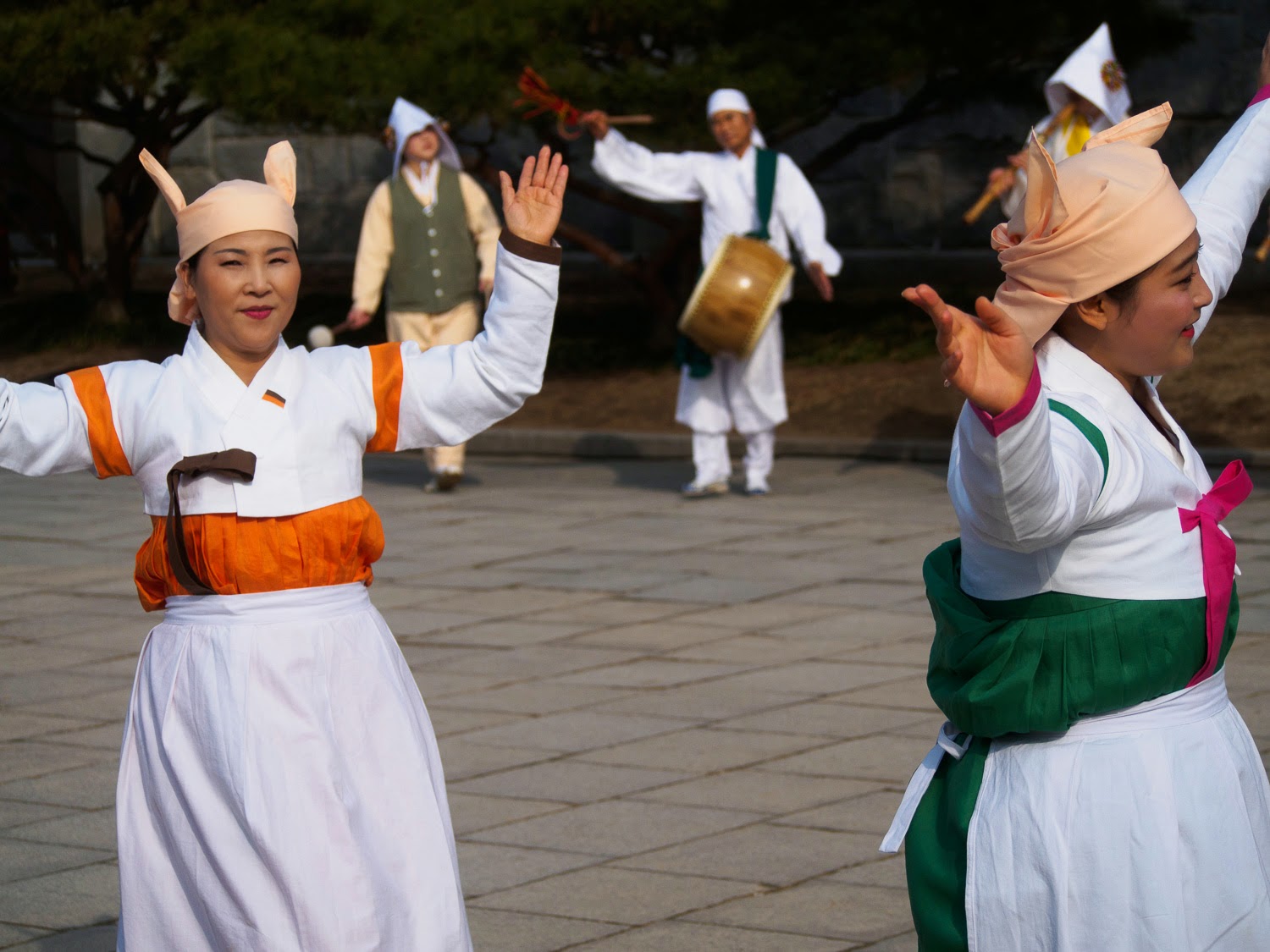
Musicians playing bamboo flutes and drummers began with a rather tranquil piece, fitting for the Year of the Sheep.

Some women dancers then joined the ensemble.

My favorite was the lion dancers. Two young men formed each lion, whose shaggy yarn fur reminded me of creatures from Sesame Street such as Barkley or even Snufalapogus. At one point, a lion "ate" a rabbit, with the stuffed animal disappearing in its wide wooden mouth. 
Later, some children (several of whom were wearing traditional hanboks) were invited to join in, dancing and even riding on top of the lions. Nearby, some children flew small, colorful kites.


Friday, February 20, 2015

Masjid Melayu Lebuh Acheh

A very short distance from the Yap Kongsi Temple, we decided to pay the Lebuh Acheh Mosque a very quick visit. Founded in 1808 by a wealthy individual from Acheh known as Tenku Syed Hussain bin Adul Rahman Aideed. This mosque was a center of Haj travel during the 19th century, attracting devotees from as far away as Sumatra and Thailand. Descendants of the early Hadhrami Arab settlers still live in the surrounding 19th century bungalows.
Compared to the nearby Chinese temples, the mosque exterior felt quite plain.

Wednesday, February 18, 2015

Chien Nien mural work at Yap Kongsi

Although the scaffolding did obscure the wider view of the Yap Kongsi Temple in Georgetown, it did provide a glimpse into the process of the chien nien artistry adorning it and many other local Chinese temples.
Literally meaning "cut and paste," chien nien utilizes broken pieces of special porcelain bowls from China. While typically a brilliant glazed color on the outside, the bowl interiors tend to be unglazed, enabling bonding to the cement to be strengthened. The thinner the porcelain, the more desirable the bowls are for this art form. Chien nien can be found in such murals and the often highly decorative rooftops. The technique is also used to cover more sculptural pieces.
A rather fragile art worn down by time and weather, restoration work is a frequent need. Throughout Penang and Melaka, chien nien in various states of repair were noted.


Monday, February 16, 2015

Yap Kongsi Temple


Located in the heart of the historic quarters in Georgetown at the intersection of Cannon and Armenian Streets is the Yap Kongsi Temple. Built in 1924, it served the Yap clan from Southern China. It had some beautiful stone carvings on its façade and columns. Scaffolding and netting currently obstructed a good view of ornate the roof.


Saturday, February 14, 2015

Heritage Shophouses of Penang

The streets of Georgetown in Penang are filled with heritage shophouses. Certain traits (as listed in a very helpful brochure) such as in the air vents, doors, and windows help date the buildings to a specific style. Dating from between the 1790's and 1850's, the Early Penang style shophouses were very simple and low - either one or perhaps two stories. I don't think we went past many of these - or perhaps they were more dilapidated and I didn't notice them.
Those from the Southern Chinese Eclectic Style typically dated from the 1840's -1910's. These had a mixture of Chinese (carved wooden door, air vents, gable end) as well as European & Indian influences (full-width timber louvered shuttered windows and U/V shaped terracotta roof tiles). This seems to describe the green shophouse in the photo above.


Walkways in front of the shophouses were covered and had thick arches. Obstacles between the shops were common though, forcing us to step over and into the rain.

Fueled by the tin mining industry, Straights Chinese people began making more improvements in their homes (1890's-1910's). Such shophouses still have carved wooden doors, air vents, and air wells of the Chinese influence, but also began including full-length shuttered windows, and geometric patterned colored clay floor tiles. Although faded, these two shophouses in the photo above are quite beautiful and seem representative of the Early Straights Eclectic Style.


In the Late Straits Eclectic Style (1910's-1930's), the European influence became greater (full-length shuttered windows, plaster relief, geometric patterned floor tiles, dado panel tiles below windows). Carved doors and air vents were formed some of the Chinese influence. Many of such homes were built by Straits-born Chinese trying to emulate their European counterparts. Expensive imported materials were financed by the booming rubber industry. 

Also present were buildings of the Art Deco style (1930's-1960's) and the Early Modern Style (1950's-1970's) Such buildings included curved concrete façades and metal-framed glass windows.