
Saturday, September 28, 2013
Folded Up for the Day


Thursday, September 26, 2013
With Great Care

The careful stacking of the food reminded me of the common scenes at markets in India, also emphasizing the bounty and increasing the attractiveness of the produce. I wonder how long it took for the market vendor to arrange those carrots....

Tuesday, September 24, 2013
Celebrating Chuseok in Style

Sunday, September 22, 2013
Chuseok at the Lee Family Residence
Chuseok -the Harvest Festival
Under the full Harvest moon, Koreans this past week celebrated Chuseok. During this 3-day harvest festival, people in Korea travel back on horrendously clogged roads back to their ancestral hometowns to celebrate with friends and family, as well as pay respect for deceased relatives. In preparation for the festival, traditionally people would visit the graves of relatives, carefully cleaning up the area around the tombs and offer food, drinks, and crops to their deceased ancestors.
Preparing the feast
One of the teachers, a long-time American resident of Seoul married to a Korean, invited me to to see how song-pyeon, a special treat for the harvest festival, was made. To simplify things this year, the dough, made primarily from finely ground new rice, was purchased instead of being made from scratch. The kneaded dough was rolled into a small ball, representing the full moon. They then were filled with either slightly ground sesame seeds or red beans, now taking the shape of a half-moon. The song-pyeon cakes, placed on top of pine needles, were steamed in a large kettle on the stove, with the slight aroma of pine needles filling the air. As one woman of the Lee family attended to the stove, another woman sat on the floor, expertly rolling a ground beef mixture into perfectly round patties the size of a half-dollar. Another woman dunked the patties into a large bowl of eggs, then into flour, and onto an electric skillet. Along with the patties, slabs of tofu were fried.
 |
| The prepared Jesasang ceremonial table |
 |
| Rice wine - one cup per family member, along with incense |
Charye Ceremony
Early the next morning on the day of Chuseok, both male and female members of the Lee family were already busy preparing the Jesasang, a ceremonial table setting for the celebration. Fruit such as a honeydew, apples, oranges, Korean pears, and local dates had already been neatly placed in the front part of the table setting. Just as I had seen in a display the day before at an ethno village, all fruits that contained a peeling or rind had their tops neatly peeled in a circle. Added to the table were peeled chestnuts, dried and grilled pollock fish, other meats, soup, kimchi, the tofu and ground beef patties, song-pyoung treats, puffed rice snack, and a few other sweets. Each item was carefully arranged in a particular place on the table, according to the traditional rules of the ceremony. For the Lee brothers’ grandparents, a framed paper with the names of the parents (they didn’t have any photos) was prominently placed in the back center of the table. Incense was lit. The ceremony included things such as pouring rice wine three times and offering it to the sprits of the deceased; each time the family members bowed down to pay their respect. Later, the process was repeated for the Lee brothers' parents, and then Mrs. Lee’s parents, with a photo of the parents. For Mrs. Lee, bananas were added to the table, signifying something her parents liked (just as the puffed rice snack was a favorite of Mr. Lee’s mother).
 |
| Performing the pouring and rotation of the wine cup |
The Thanksgiving Meal
After the charye ceremony was over, some of the foods were removed and prepared for serving. To my surprise and delight, I was invited to stay and join the Lee family for the meal. Fish replaced the American turkey, and kimchi stood in for stuffing. A sweet rice tea was served after the meal. My first Thanksgiving eaten with metal chopsticks, it was a splendid way to experience some more of Korean culture. Many thanks to the Lees for inviting me!
Tuesday, September 17, 2013
Buying those Chuseok Gift Boxes
For those detesting long checkout lines and crowds in stores, they best avoid entering a store in Korea this week. Families all over the country are preparing for Chuseok, the harvest festival. As part of this festival (one of the three most important holidays in Korea), gifts are exchanged. Particularly for busy professionals, presenting an expensive, beautiful gift box is an attractive solution.
Presented here are a few of the gift boxes I spotted while going EARLY to the grocery store on Saturday. I have included their dollar equivalents in the captions below each photo.
Which would you buy?
Presented here are a few of the gift boxes I spotted while going EARLY to the grocery store on Saturday. I have included their dollar equivalents in the captions below each photo.
Which would you buy?
 |
| SPAM - care for the box at $40 or $49? |
 |
| Not sure what this is - ginseng? $89 (a "bargain" from its regular price of $110) |
 |
| Precious apples - $42 or $55 |
Wednesday, September 11, 2013
Kolams of South India
Below is a video I just created on the kolams (also known as rangolis), a beautiful traditional art form of South India. During my four years living in Chennai, I never grew tired of watching women transform the white rice flour or colored powder into incredible radial designs - only to sweep them away and do it again the next morning.
The blog post South Indian Kolams; Radial Symmetry of Powder goes through a bit more of the process in how I created the video. All photos, video footage, and artwork is that of my own.
Wednesday, September 04, 2013
Twisted Topiary

Sunday, September 01, 2013
Summer Pink Blossoms of Seoul


Friday, August 30, 2013
Yonsei Grill

Wednesday, August 28, 2013
Mugunghwa - the Hardiness of the Koreans

In addition to dotting the lands of Korea, the Mugunghwa can be found in China, Japan, and northern India.
Sunday, August 25, 2013
Preparing the Fibers - Watercolor

Preparing the Fibers - Suwon, South Korea
Watercolor
© 2013 by Melissa Enderle
My newest painting of a basket maker at the Suwon folk village in South Korea
Thursday, August 22, 2013

Saturday, August 17, 2013
Cookin' with the Kitty
A cartoon character may be considered popular when its image appears on T-shirts and stationery. (See my previous posting on a Hello Kitty shop at Namdaemun). When it is featured on its own airplane and cookware, then it's made it to the big scene. Yes, while at the Tokyo airport, I spotted a Hello Kitty airplane. Hello Kitty fans are encouraged to pitch their boring T-fal cookware and cook with the Kitty. Imagine how much more fun cooking and washing dishes must be when you can stare the cute feline on the bright pink (or magenta) cookware.


If you still haven't had enough of the kitty, or perhaps your cooking made you a bit queasy in the stomach, the Pink can follow you in the "little room" as well.

Thursday, August 15, 2013
Let the School Year Begin
This year marks my 20th year of teaching - hard to believe!
Below are some photos of my art room at Seoul Foreign School where I teach art to students aged 3 through grade 5. Today was our first day of school. Lots of returning, familiar faces as well as about 90 new ones at the school. You're welcome to visit our Artsonia online gallery. There are some very talented kiddos!
 |
| Entrance to our spacious, 4th floor room |
 |
| Yes, ten sinks! |
 |
| New this year: a couch and carpet by an area I'm developing as a center |
 |
| SmartBoard and carpet area, where we begin every class |
 |
| My crayon monitor system, scrap paper trays, and lots of natural light |
 |
| Entrance at the elementary school |
 |
| Looking down the stairs. Being on the 4th floor = good exercise! |
Sunday, August 11, 2013
Early Morning in Seoul

Early yesterday morning, the temps and humidity was actually ok, so I went for a nice walk in the mountain by school. Although the cone flowers and others planted here were pretty much done, the soft early morning light against the green still made for a tranquil scene.
Friday, August 09, 2013
Mopti, City on Three Islands
December 29, 2000

Built on three islands connected by dykes, Mopti is the country's major route intersection. Peoples from many groups call Mopti home, including the Bambara, Songhai, Fula, Tuaregs (and their former slave - the Bellasha), Moors, Bozos, and Dogon. Once a Bozo fishing village, it has the largest river port in what was the French Sudan and now has about 100,000 people. Pirogues and their larger counterparts, pinasses, carry goods up and down the Bani/Niger River. Transport is even possible to Timbuktu during and after the rainy season. While in Mopti, we walked over to the busy port. Here we saw slabs of salt and other items that had come from Timbuktu. People were boarding pinasses and pirogues, for either transportation or fishing.

The Niger river as well as the converging Bani river is much higher than what the Niger is in Bamako. Fishing continues to be of great importance. We also walked through the older part of Mopti. While it too had mud architecture, neither the mosque or houses were as impressive as those in Djenne. On the second day we took a pinasse to the opposite side of the Niger River, to a Tuareg slave village and then to a Bozo village. Drying fish were spread out over the sandy shore. Like children at other villages, the Bozo children followed us, full of curiosity. However, their energy levels and demands for bics (pens) and bonbons far overshadowed any others. In the evening, we were treated to a glorious sunset while traveling by river back to the hotel.

Wednesday, August 07, 2013
Djenné-Jeno, Ancient City

Just 2km from the town of Djenné lies the ancient town of Djenné-Jeno - site of the original Djenné. Although it is difficult to see much more than some remnants of the handmade bricks of a building and tons of pottery shards, the site is the oldest known sub-saharan city - dating back to the third century BC. A highly developed society of about 10,000 inhabitants, the site was mysteriously abandoned in the 14th century. Archaeological excavations reveal a highly urbanized society with domestication of animals and iron production as early as 900 BC. Djenné-Jeno is known for its excellent rice cultivation, signature mud brick architecture, and its finely crafted sculpture, of which I purchased replicas (pictured above).
Prior to visiting the site, we went to the Mission Culturelle, where we saw informative displays including examples of pottery, sculptures, and iron, which helped give an idea of what was discovered at the site in 1977. Although pottery shards dotted the ground at the archaeological site, it was expressly forbidden to remove any of them. Djenné-Jeno has long been a site for looting, with sculptures, pottery, and beads being some of the items taken.
Monday, August 05, 2013
Djenné, City of Mud

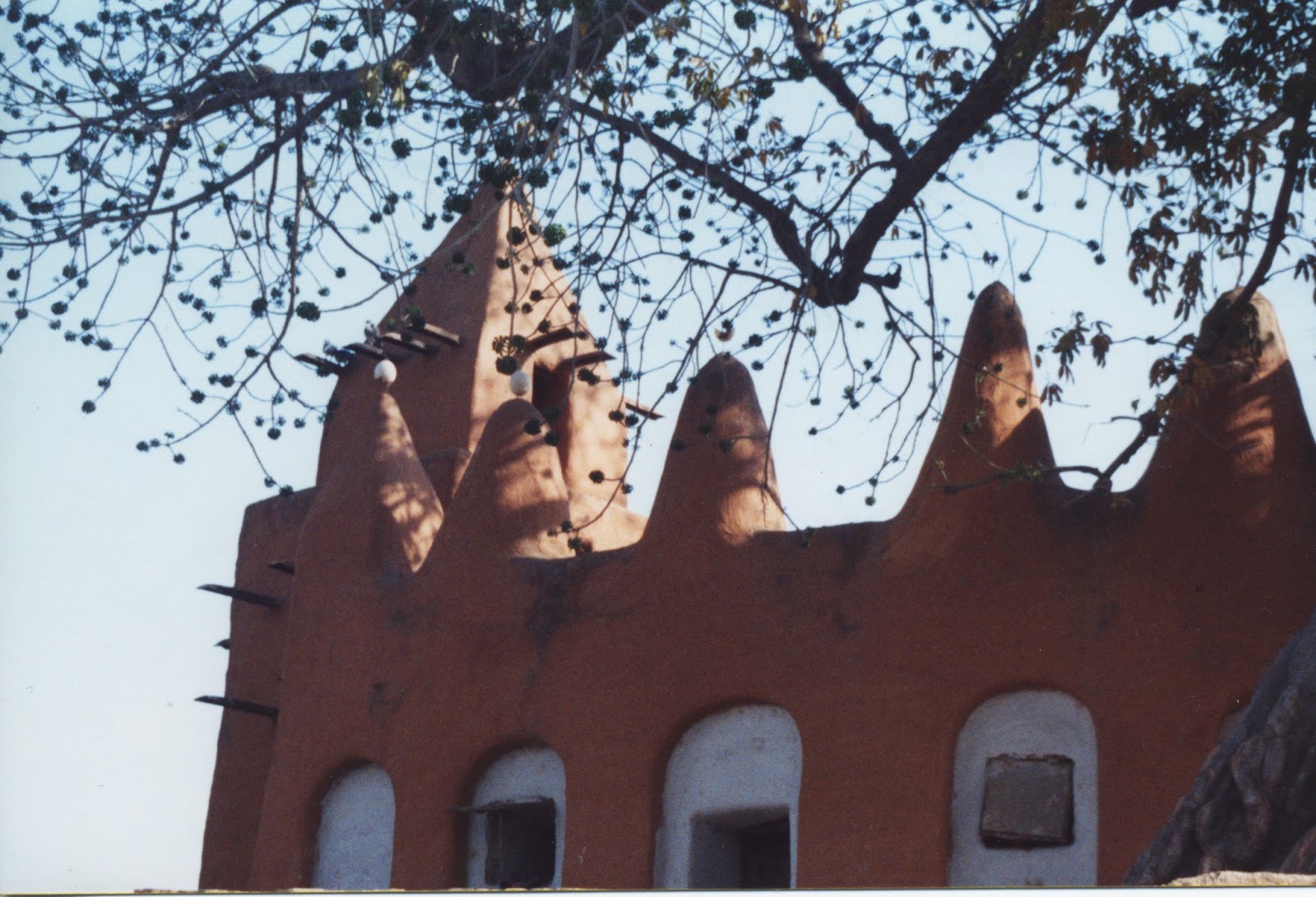
Situated on an island in the Niger Inland Delta with a population of around 10,000, Djenné is one of Mali's pre-eminent tourist attractions. Named a Wold Heritage Site in 1988, the city has taken great care to preserve the mud architecture, including the world-famous mosque. You can easily feel what sub-Saharan Africa must have felt like a century or more ago. At one time, Djenné was competing with Timbuktu as the western Sudan's pre-eminent center of trans-Saharan trade and Islamic scholarship. Now it is more of an agricultural (and tourist) town.
 |
| Djenne Mosque and Marché - watercolor by Melissa Enderle |
Djenne's most famous (and dominating) site is the mosque. It is actually the third mosque built at the site. The first mosque was built by the Soninke king Koi Kounboro who destroyed his palace in the 13th century for its construction. The second mosque was built in 1834 after the first one was left to ruin after it became "contaminated" by evil practices. The present mosque, built in 1905, is in the style of the original mosque. Three towers, each 11 meters high and topped with an ostrich egg, can be seen from quite a distance. In fact, the mosque is the worlds' tallest mud building. It was built in two years with handmade mud bricks, formed with a banco mixture of soil, water, and straw/grasses which become ripe after one month. Wooden beams protruding from the building serve an aesthetic purpose as well as scaffolding, to repair the building after the rainy season. Every year the surface of the mosque is resurfaced with a fresh layer of mud. Other buildings typically are resurfaced at least every other year. Efforts are being made to help preserve or restore architecturally significant buildings.

We arrived in Djenné on the day of the Ramadan feast. Everyone was wearing their new boubous, hats, and had their hair intricately done. Men had clean new haircuts, while the women and girls braided their hair, often with beads and other ornamental decorations. After walking through the narrow alleys, we climbed up to the top of a few buildings to get an aerial view of the city. From that vantage point, we could see the bustling crowds, the city's many goats, and the mud architecture, either of Moorish or Tukulor types of the Sudanese style. The tops and windows of the buildings were especially impressive. In addition, the Tukulor houses have an overhang over the door, presumably to protect it from the rain.

Djenné was one of my favorite villages in Mali. I would love to return and meander through the narrow streets, surrounded on both sides with its distinctive mud architecture. Visiting Djenné on the Monday market day is recommended for an extra vibrancy. Most visitors stay overnight at one of the five hotels/guest houses.
In 1988, the old city of Djenné and the historical site of Djenné-Jeno were added to the UNESCO World Heritage List.
UNESCO video on Djenné, City of Clay
Read more about Djenné's mud architecture construction at National Geographic

Djenné was one of my favorite villages in Mali. I would love to return and meander through the narrow streets, surrounded on both sides with its distinctive mud architecture. Visiting Djenné on the Monday market day is recommended for an extra vibrancy. Most visitors stay overnight at one of the five hotels/guest houses.
In 1988, the old city of Djenné and the historical site of Djenné-Jeno were added to the UNESCO World Heritage List.
UNESCO video on Djenné, City of Clay
Read more about Djenné's mud architecture construction at National Geographic
Saturday, August 03, 2013
Where the Bambara Kings Once Ruled
December 26, 2001
A small village about 10 km away from Segou along the road to Bamako, Segoukoro is the original site from where Bambara kings ruled a kingdom that stretched for thousands of kilometers across West Africa in the 18th century. A typical Malian Bambara village, composed of walled mud brick houses, the village has around 1500 people. I was surprised to see how simple the village was, being that it had such an important role. Aside from Biton Coulibaly's tomb (founder of the kingdom), there were few signs to indicate the village's importance. We met the chief, a descendant of Coulibaly. Walking through the village, we saw the village's three mosques, one built by Coulibaly for his Islamic mother (the king himself was animist). The newest mosque is used by the people for worship only on Fridays.
Thursday, August 01, 2013
Segou, River City in Mali
December 26, 2000
Segou
About 235 km east from Bamako, Segou is one of Mali's larger, more important cities. Located on the Niger River, Segou has the potential for economic importance. It was the capital for French occupation, the location for the Office du Niger. This project sought to provide France with raw materials such as cotton. Although a dam was built, the canals (which were dug by forced labor) were never finished; cotton was abandoned, with rice and sugarcane being planted in its stead. Segou seemed much less busy than Bamako. Donkey carts hauling sacks of grain were quite common on the streets. Fewer cars and mopeds were present. Especially near the wharf and river, there were several small shops and vendors wanting to sell you arts and crafts, including imitation Dogon pieces. Tuareg vendors were especially prevalent on the streets, wanting to sell small boxes and knives. In the evening we went to the wharf where we saw a rather nice sunset.


Subscribe to:
Posts (Atom)