We then visited the Chhatri of Thakur Sardul Singh. From a distance, the white domed structure looked like nothing special. Looking up at its interior, we were treated to a visual feast. Dating back to the mid-18th century, the well-preserved images were painted with natural pigments – whereas most of the frescoes we had seen on buildings were done with artificial pigments. The deep reds, rich blacks, and tans provided a harmonious color palette. Following the curved contour of the dome were incredibly detailed battle scenes of the Hindu epic Ramayana, local noblemen, and the love story of Dhola Maru. Of similar style is the Gopinathji Mandir temple, built in 1742. Legend goes that the son of the nobleman who had the Chhatri built chopped off the hand of the artist (hoping that would prevent him from completing the temple paintings and retain exclusivity of the artist’s work), but the undeterred artist completed the temple paintings with his feet.
Melissa Enderle's travelblog on her travels to Mali, Tunisia, Serbia, Eastern Europe, India, South Korea, China, and other places around the world.
Friday, April 01, 2011
Old Frescoes of Parsurampura
We then visited the Chhatri of Thakur Sardul Singh. From a distance, the white domed structure looked like nothing special. Looking up at its interior, we were treated to a visual feast. Dating back to the mid-18th century, the well-preserved images were painted with natural pigments – whereas most of the frescoes we had seen on buildings were done with artificial pigments. The deep reds, rich blacks, and tans provided a harmonious color palette. Following the curved contour of the dome were incredibly detailed battle scenes of the Hindu epic Ramayana, local noblemen, and the love story of Dhola Maru. Of similar style is the Gopinathji Mandir temple, built in 1742. Legend goes that the son of the nobleman who had the Chhatri built chopped off the hand of the artist (hoping that would prevent him from completing the temple paintings and retain exclusivity of the artist’s work), but the undeterred artist completed the temple paintings with his feet.
Thursday, March 31, 2011
Nawalgarh, Shekhawati
After a breakfast prepared from ingredients grown in the pension owner’s garden, we headed out into the muddy streets to begin our haveli tour, aided by a map indicating the location of some of the main sights. Some of the places were closed, so we could only enjoy their frescoed exteriors. Others, such as the Uattara Haveli were open (small admission fee), giving us a chance to experience more of its glory. Entrance was usually through a tall, rather fortified-looking door framed by an archway. With the really tall entrances, a smaller normal-sized could be opened within it for normal use. An outer formal courtyard, typically single-storyed, was used for attending guests and conducting business. The real beauty was in the inner courtyard, typically more spacious and multiple-storyed. This is where the women spent most of their time. Fluted arches framed the courtyard. Some framed intricately carved doors or shuttered windows. Others led into small rooms with thick walls. Adorning nearly every square inch of wall space were frescoed murals. Framed by floral motifs were scenes of Krishna and Rama, interspersed with paintings of red-uniformed soldiers, locals riding elephants, women milking cows, etc. In some havelis, one could find scenes of local merchants driving a car, locomotives (some painted rather naively), gramophones, and bicycles.
Also of note in Nawalgarh was the Bala Quila with its mid-19th century room filled with mirrorwork, large portraits, and painted domed ceiling. Had there not been a sign out in front of the rather plain-looking building, we would have walked past it. The Ganga Mai Temple, dating back to 1868, also has some fine floral motifs on the fluted archways of the courtyard.
The state of condition of the havelis varied greatly. Some appeared to be recently restored, with its murals very bright in color and structure intact. Murals on other havelis were fairly intact, but rather faded. In many, the lower portion of the building’s exterior no longer contained images, instead replaced by plain plaster, exposed bricks, or graffiti. Some of the havelis were still used as dwellings; others were bricked up or abandoned, sadly falling apart. Others were stripped of their intricate carved wooden doors and shutters, sold as antiques or made into tables. We were told that most of the owners no longer lived in the Shekhawati region and of these, too few seemed to care enough to pay for any upkeep or maintenance on the buildings. We saw some havelis being torn down, probably being replaced with more bland, modern buildings. How sad that these historical national treasures are literally and physically crumbling before our eyes, with little being done about it!
Wednesday, March 30, 2011
Samode, Shekhawati Region
A series of narrow rural roads took us to the various selected villages. On our way, we passed through stretches of countryside with rather bare scrubby trees, thatched conical huts, homes made from mud brick or cement, and ploughed flat land.
About 50 km from Jaipur, we stopped at the town of Samode. Our objective was to visit the 19th century palace, now converted into a rather luxurious hotel. Walking through the arched gateway, an employee stopped us and said that the hotel was closed, due to preparations for a 3-day wedding for around 400 guests being held there. Although disappointed, I spotted some colorful piles of flowers being used for the wedding decorations and asked if we could at least go there to take photos. Sensing our interest, he made a phone call and told us we could come in. To our surprise, we were given a tour of the palace’s main rooms. In true Rajasthani style, each room was lavishly decorated with contrasting colors and patterns. Even the ceiling contained floral patterns and portraits. Through an archway, the reflective mirrors of the Diwan-i-Khas room sparkled, begging us to enter. Inside, we admired the mirrorwork covering most of the walls and ceiling, as well as naturalistic and figurative murals near the bottom. Back out in the courtyard, several men were draping long garlands of marigolds and jasmine to form a canopy. Another created designs out of different flower petals arranged along the path leading up to the main door. Scents of rose and jasmine filled the air. No doubt it would be a beautiful wedding!Tuesday, March 29, 2011
Anokhi Museum, Jaipur
Monday, March 28, 2011
Amber Fort, Jaipur
On our way to the Amber Fort, we stopped briefly at the pink Hawa Mahal “Palace of the Winds” building, and the Jal Mahal palace that seemingly floated in the middle of the lake. At the Amber Fort, colorfully painted elephants carried tourists up through the Suraj Pol gate and into the main courtyard. Some of the entrances such as the Ganesh Pol were beautifully restored, containing intricate floral patterns with the elephant god above the door. The Aram Bagh comprised of a geometric maze made out of carefully trimmed bushes. The splendid Sheesh Mahal room contained inlaid mirrors along with arabesque and floral designs. The bottom portion comprised of relief flowers in white marble, reminiscent of the Taj Mahal. Perched high up, we had a great (although misty) view of the Kesar Kyari Bagh ornamental garden below, surrounded by water.
Sunday, March 27, 2011
When it Rains in Jaipur, Go Shopping!
Saturday, March 26, 2011
Train to Jaipur
A big thanks to my travel partner Pat for these photos
Friday, March 25, 2011
Ivory Scenes and a Silver Gangaur
Out of the rain, I admired the bamboo screen whose individual vertical strands were meticulously wrapped with silk thread, forming an overall pattern. In one corner was a large 19th century cosmetic box with intricate scenes carved out of ivory. Near it were ladies’ dumbells, decorated with inlaid wood, ivory, and lacquer. The Hindu goddess Gangaur commanded attention with her “skin” made from silver, ornamentation out of gold, and bright fuchsia dress.
Thursday, March 24, 2011
Mehrangarh Fort - Howdah Seats and Jharokas
Towering over the predominantly blue buildings of old Jodhpur is the Mehrangarh Fort. Although I had visited this fort before, its architecture, royal collection, and excellent guided tour made it worth a second view. The musicians were in their same spot, playing their traditional instruments. Passing through the elephant gate and past the sati hand impressions, I once again entered the palace grounds. The view of the “Blue City” below was diminished due to the light rains and overcast sky. The Howdah elephant seats once again impressed me with their details and skilled silver embossing. We saw the open palanquins that carried men and the covered ones that carried the royal women. Out in the courtyard, I once again took my share of photos of the jharokas (overhangs inspired by those of huts) shading the jali (lattice-like carved) windows.
Wednesday, March 23, 2011
In the Narrow Streets of Old Jodhpur
Tuesday, March 22, 2011
Jodhpur City - Back to the Bustle
After the tranquil time spent in the rural areas around the Bishnois villages, Jodhpur brought us back to the chaotic, colorful part of India. In the Sadar Market area, lots of buying and selling was taking place. Some were selling plastic containers, while others were rearranging their vegetables or brooms in hopes of attracting customers. Women selling bangles called to foreigners and locals alike, wanting to encourage them to try on a few. Fluorescent-colored turban materials were piled high in the “souk” area of the market. Shoes and leather slippers filled other shops. Glittering sari material draped in the front of stores, with groups of women sitting cross-legged inside, surrounded by piles of cloth. Near the entrance of the market, women were promoting a sale of 100 rupees for sari material, popular with tourists and some locals. Their children were even better salespeople, with tourists buying the cloth just to get rid of the persistent (or pesky) kids. Spice touts came up to tourists, encouraging them to visit their spice shop, the place to buy the “best spices in Rajasthan.” Due to the rains, the pavement was now a slippery muddy mess. This didn’t seem to deter many, with commerce continuing to go on as usual.
Monday, March 21, 2011
Recycled Textile Art
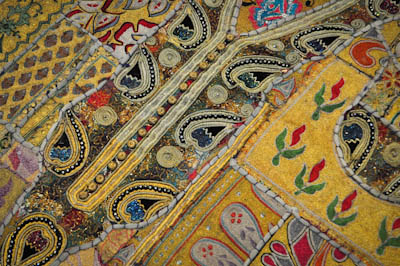
Having seen a fair amount of textiles in Rajasthan, the shop outside of Jodhpur provided a different twist. Although it also sold new pieces such as mirrored bedspreads and pillowcases along with the ever-present Kashmiri scarves, the shop specialized in a type of recycled art. It bought up old dresses from Rajasthan and Gujarat and employed women to take them apart and sew new textile pieces out of them. Many of the dress pieces were made into wall hangings and looked like a crazy quilt of a similar color. The intricate embellishments of the dress pieces (the “U” of the neck area was a common element) and varying patterns was impressive. Although one could find cheaper ones, these imitations could not match the intricate work and character found on the older dress fabrics.
Sunday, March 20, 2011
The Opium Ceremony
We stopped at one house to view a ceremony. Opium, still commonly used in the region, is seen as a way to relax, particularly during the monsoon season. It is also used to welcome people. This opium is grown in Chittor, located in the southern part of Rajasthan. The opium pieces were crushed, after which water was added. The opium liquid was then filtered twice through a funnel-shaped cloth. The first drops are offered to the gods.
Shepherds around Jodhpur
According to our guide, the original sheep of the region were a gift from the Maharajas who worked for the rulers but have since gained independence. Many of the shepherds here are nomadic with the animals, moving them to the central area of India during the dry season. A typical shepherd will have between 30-35 sheep, along with a few cattle. Women are also shepherds and can be identified by their short skirts.
Super moon Vishnu Procession in Mahabalipuram
Photos from a procession with the Hindu god Vishnu held at dusk of yesterday's "super moon" in Mahabalipuram, Tamil Nadu
Tuesday, March 15, 2011
The Dhurry Weavers
Our next stop was to the home of dhurry weavers. Of the Prajapati caste, these weavers were Hindu. Their homes were round, designed to protect against the winds of summer. Erected on poles reaching above the conical thatched roofs were small solar panels that provided some power for electricity. These panels were provided by the government as a way of helping keep craftsmen and rural people in the area. On the cow dung surfaced courtyard (which helped keep the surface cooler and cleaner) was a large kolam. Their woven dhurries are traditionally used as ground covering, but are now popular with tourists. One weaver was quick to demonstrate how compact a rug could be folded, making it easy to pack. Materials used for their hurries include camel hair and sheep wool (both traditional), and now cotton, silk, and jute. It takes two people ten days to weave a 3x5 m (10x16 ft) rug and an additional two days to set up the loom. Nowadays, factories are threatening the handloom industry.
Sunday, March 13, 2011
Chippa Block Printer
Next door, we met a Chippa block printer, also Muslim. He was busy stamping with a wooden block (the same print I saw him work on last time) a resist made of clay, soap, and cooking oil. Prior to this, a yellow color was stamped, made from tumeric. The cloth was then boiled with salt, lemon, oil, and leaf from a berry, after which the color turned red. After stamping on the resist, the cloth is immersed in dye made from indigo. This cloth will be used for men’s clothing by the Patel farmer caste.
Ornamentation, Norbulingka
Watercolor of a building at the Norbulingka Institute outside of Dharamsala, India. Painting done with only one brush and no friskets/masks of any kind.
Saturday, March 12, 2011
Kaki Village Muslim Potter
Thursday, March 10, 2011
Migratory Birds...and a TV Camera
Prior to visiting the villages, our guide wanted us to visit a spot where migratory birds liked (or used to) stop. We saw some sandpipers, coct ducks, stilt birds, and white herons, but were few in number. While explaining the reason, an army helicopter swarmed overhead, followed by another a couple of minutes later. Indeed, it was understandable why the birds were disturbed with all that noise. While we were discussing this, a truck pulled up and out piled out a reporter and camera crew from a local TV station. The microphone thrust at us, I was asked to give our opinion the wildlife situation before us. Hoping it was the right thing to say, I expressed my opinion on what saw and suggested that perhaps the army could find a different place to practice their flight tests. This is the third time I’ve been on TV while traveling in India!
Wednesday, March 09, 2011
Bishnois Safari - part 1
After an early breakfast, a jeep stopped in front of our Jodhpur hotel to take us on a safari tour of the region where the Bishnois people lived. Thought to be the original “tree huggers,” (after a woman was beheaded in 1730 as the tree she was trying to save was cut down) this sect of nature worshippers live mostly in the central desert plains of Rajasthan. Our guide, a native of the region, explained that this community is more accurately called the Vishnois, because they worship the god Vishnu.
The jeep took us over bumpy terrain and narrow dirt roads, with the rather chilly morning December air blowing through the jeep leading us to zip up our layers and put on hoods. The flat, scrubby land was another reminder that we were in the desert. On the “main” road, trucks with overstuffed hauls of goods and grasses precariously passed each other. Men wore turbans and baggy pants known as “jodhpur” and carried a staff. Even in the distance, the pink turbans (indicative of the Jodhpur region) could be spotted. Women covered their faces.
Short acacias were the dominant trees in the area. It was hard to imagine that these gnarly spiny trees were a major source of wood in the region. Occasionally we stopped to view the Chinkara and other types of small gazelles, present in numbers but still rather distant.
Upon seeing some men hauling steel containers strapped to their motorcycles, we inquired about the dairy industry in the region. Each family typically has one or two cows, and one water buffalo. Cows are milked twice a day. The average cow produces 10-12 liters per day - about half of what Holstein cows in the US produce. If the family has extra milk, a “milk man” comes around to collect the milk in steel containers.
The jeep took us over bumpy terrain and narrow dirt roads, with the rather chilly morning December air blowing through the jeep leading us to zip up our layers and put on hoods. The flat, scrubby land was another reminder that we were in the desert. On the “main” road, trucks with overstuffed hauls of goods and grasses precariously passed each other. Men wore turbans and baggy pants known as “jodhpur” and carried a staff. Even in the distance, the pink turbans (indicative of the Jodhpur region) could be spotted. Women covered their faces.
Short acacias were the dominant trees in the area. It was hard to imagine that these gnarly spiny trees were a major source of wood in the region. Occasionally we stopped to view the Chinkara and other types of small gazelles, present in numbers but still rather distant.
Upon seeing some men hauling steel containers strapped to their motorcycles, we inquired about the dairy industry in the region. Each family typically has one or two cows, and one water buffalo. Cows are milked twice a day. The average cow produces 10-12 liters per day - about half of what Holstein cows in the US produce. If the family has extra milk, a “milk man” comes around to collect the milk in steel containers.
Sunday, March 06, 2011
Ranakpur to Jodhpur
Leaving Ranakpur, the landscape changed rather quickly, from the more lush hilly highlands, to flat scrubby land. Small boys tended large goat herds. The red of a turban contrasted with the beige of camels and land. Fences were formed out of rocks, a fitting material considering their abundance. Buses carried nearly as many people on top as they did inside. Occasionally we saw rather poor-looking settlements of tents, outside which young gypsy children ran. Abruptly there was a stoppage of traffic. Although people were curious, no one appeared to be overanxious or upset at the delay. The rock blast safely executed, people got back in their cars and proceeded onward. Yellow fields of mustard plants gave us brief welcomed patches of color. Small villages provided bursts of activity. Goats were herded across the street. Camels were hitched to wagons. Men squatted in the shade, drinking tea and sharing beedis (a type of local cigarette). Colorful fabric hung from the shops. Women pumped water, with bright odhani cloth draped over their head.
Friday, March 04, 2011
Ranakpur - Worth the Stop
Although it would have been quite a bit cheaper to take the train (or bus) directly to Jodhpur, I recommended to my friends that we take a taxi so we could stop in Ranakpur for a few hours. Just slightly under 100 km (56 mi) NW of Udaipur, this small town in the valley of the Aravalli Hills is home to the Adinath Temple. This 15th century Jain temple complex (dedicated to the god Adinath) is one of the five of the great holy places for the Jain religion. While one could rightly marvel at its scale (29 halls and four separate entrances), its sheer beauty carved in white marble makes it so remarkable. In contrast to the smooth marble floor, the rest of the interior is a feast for the detail-lover’s eyes. A forest of columns (1,444 in all - no two of which are alike) pushed upward on the corbellled ceilings with their radial depth. Sunlight poured through openings and courtyards, radiating the interior with a peaceful glow. Soft chanting and the ringing of bells could be heard in the otherwise quiet complex. Such serenity and beauty - definitely worth the stop.
Wednesday, March 02, 2011
Jag Mandir, Island Palace
As a Christmas Day treat to ourselves, we booked tickets and took a boat trip on Lake Pichola to the island palace of Jag Mandir. With all on board (including some rather spoiled Indian children) wearing the required life vests, the boat’s motor began, headed towards the middle of the lake. Once on the lake, we had a great view of the beautiful buildings on the shore, as well as daily happenings occurring there. In areas where there were long steps leading down to the lake, people were washing clothes, beating clothing with what looked like a cricket bat, washing dishes, and even bathing. Far enough away from the wake caused by the boat, the shore waters created great reflections of the yellow City Palace. On our way to the Jag Mandir, we passed by the Jag Niwas, otherwise known as the Lake Palace. This royal retreat, built between 1734 and 1751, is now a posh (and very expensive) hotel, made famous by its inclusion in the James Bond movie Octupussy. (Hotels including ours held nightly showings of the movie).
A pleasant ride later, we docked at the Jag Mandir, island palace of Shah Jahan (before he became Mughal emperor) while he took refuge from his father after rebelling. Built in 1620, the buildings were very well preserved and contained elements of Mughal architecture I’d seen in Agra and Delhi, including the scalloped windows and domes. The well-manicured gardens were particularly inviting. Although the drinks were overpriced, they provided a great excuse to stay longer, enjoying the view through the curtained openings and watching some rather animated squirrels. It was fun to imagine what it must have been like for the prince as he stayed here, as well as giving us just a little sampling of what the travel experience must be like for the wealthy. Boarding another boat near one of the eight stone elephants, we headed back to shore, with the sun beginning to set on another wonderful day.
Tuesday, March 01, 2011
Udaipur Parade/Political Rally/?
While peering at shops rather narrow, but busy street, we heard a band approaching, led by a handsome young man on a decorated horse. Following the band was a decorated truck with Jain priests and a unclothed standing marble figure of a god. In front of the procession of the crowd was a cart with horn-shaped amplification and a man shouting out what sounded like a political rally. With the music playing, an older man in bare feet began dancing and shaking a percussive shaker with silver streamers in his hands. While it seemed rather incongruous to us, it must have made sense to the local onlookers.
Subscribe to:
Posts (Atom)