Monday, November 15, 2010

Sigiriya Rock Summit


About an hour and a half after beginning my ascent, I had arrived at the summit. The foundations of many buildings and pools remained, giving an idea of how extensive the place was. A stone bench looked quite tempting to sit down on, but a sign forbade it, saying it was a royal throne. From here, there was an uninterrupted view of the landscape below – and what a spectacular view it was! Past the heavily forested land with small lakes and then a mountain lay the city of Kandy. Just barely visible in another direction was the Gold Buddha statue of Dambulla.

After soaking in the surroundings and climbing up and down some of the buildings’ stairs, I headed back down. Along the way, I stopped by Cobra Hood Cave with a remnant of decorative fresco, a platform that was an audience throne, and through a natural arch. Much quicker than expected, I had reached the bottom and had plenty of time to swim and relax at the hotel.

Sunday, November 14, 2010

Sigiriya Lion

After turning around an incredibly windy corner and up more stairs, I arrived at a flat area. From here, I had a great view of the surrounding jungle as well as the gardens below. I had already climbed a lot of stairs, but I could see there were many more still to go. Against the base of the main rock were the two giant brick lion paws, remnants of the Lion from which gave the rock its name. At one time, the stairway led between the lion’s paws and up into its mouth, but the brick head fell off a long time ago, probably due to its support being constructed out of wooden beams. How imposing it must have once looked! A lot of steps were still to go. A few people motioned me to pass them in these narrow sections, making me particularly glad that I had gone up early before the crowds came.

Saturday, November 13, 2010

Sigiriya Mirror Wall

Back down the spiral staircase and continuing up the path towards the summit is the Mirror Wall. This highly polished (and protected by threat of large fine and/or imprisonment for those who touch or vandalize the surface) wall contains the graffiti inscriptions of visitors from between the 6th and 14th centuries who made their remarks about the rock & palace – and particularly the women frescoes, written in rather poetic and descriptive manners. A large number has been studied, deciphered, and published in a two-volume book. The markings also help document the evolution of the Sinhalese script and language. I’m glad someone had the patience and ability to decipher the ancient writings from modern defacing covering it.

Friday, November 12, 2010

Sigiriya's Fabulous Frescoes


Partway up the steps to the summit was a spiral staircase leading to a sheltered gallery. Protected from the sun were some exquisite frescoes of partially clothed females. The jewelry, facial expression, eyes, and hand gestures were particularly well-executed. The brushstrokes were still visible, adding a more lyrical look. It is believed that these figures represent celestial nymphs –or asparas.. Out of perhaps as many as 500 portraits, only 22 remain today. How beautiful the rocks must have looked with these colorful women adorning their surface!

Sigiriya Nature, Drive to Colombo


Late that afternoon, I went for a walk on the dirt road outside the hotel. Monkeys sat on the branches of the large trees that looked like a tangle of vines and flowing roots. Others were busy trying to find mangoes that were at least somewhat fleshy. Although I didn’t know what lay at the end of the road, I hoped to see at least a clearing in between the trees; perhaps I’d see some elephants in the nearby fields. Alas, a local on a motorbike told me to turn around, because wild elephants had been spotted there yesterday at that time. Knowing that wild elephants can be unpredictable and dangerous, I conceded and walked back to the hotel.

The next morning, I woke up to pattering and thumps on the roof of my room. Looking out the window, I saw langur monkeys jumping between trees and onto the roof. Like the monkeys I saw yesterday, they were enjoying a morning snack of green mangoes. It was interesting to watch, but I don’t know how long that novelty would last, particularly early in the morning.
I left Colombo just before 8am, headed for Colombo, the final leg of my trip. The drive was through a large number of towns and villages, some still rather sleepy, and others already adjusting to morning activities. Once again, I saw mosques, churches, Buddhist temples, and perhaps a Hindu temple on the same street. Farmers were busy in the muddy paddy fields. Multiple workers were busy using a large hoe-like tool. A few used tiny garden-size tractors with hand controls and special metal wheels protruding from the rubber ones, designed to work in the paddy fields. Children in their crisp white uniforms were already at school, some gathered around the shady trees in the schoolyard.

The road was shared by lots of buses, pimped-up rickshaws, Massey-Ferguson tractors, pulling wagons of people, colorful trucks pulling loads of veggies, coconuts, and other produce. Spanning the width of the road and tied to the trees were large signs of politicians. Like in Tamil Nadu, these politicians must have loved to have seen pictures of themselves. Alongside the road, men were whacking grass with a tool the size of a golf club; a lawn mower would have been SO much faster. Signs announced the names of towns, along with its elevation, and not its population.

Thursday, November 11, 2010

Sigiriya UNESCO site, Sri Lanka - History and Gardens

History and Introduction
After a wonderful early morning breakfast buffet at the hotel, I headed to the massive rock of Sigiriya that dominated the view from the hotel swimming pool. At 7:20 AM, the temperature was still pleasant. The sun was trying to peek up over the top of the flat-topped rock jutting 200 m over the flat land of north central Sri Lanka. We drove past a large pond filled with lotus flowers. At the entrance, I showed my UNESCO Cultural Round Ticket ($50) that was also good for Polonnurawa and Anuradhapura (which I wasn’t going to visit). Meaning Lion Rock, the unique geological mass is actually the hardened magma plug of an extinct volcano.

According to legend, the palace and gardens were built by King Kasyapa (AD 477-495) who fled here after killing his father and usurping the throne. After climbing up the 1,202 stairs to the summit, I can see how he would think that building on top of the summit would be a safe location. There is also evidence that points to the area serving as an ancient Buddhist monastery, particularly in the caves. It is quite apparent from the remaining structures and gardens that the city was planned and quite sophisticated, even including sub-surface hydraulic systems. After Kasyapa’s reign, the area reverted back into being a Buddhist monastery, lasting until about the 13th or 14th century.

Moat

Gardens
Passing through the well-preserved outer moat (which still has water), one first encounters the equally well-preserved symmetrical water gardens. How beautiful it must have looked at one time, with the fountains going and well tended gardens with flowers and shrubs – all against the majestic rock. Up past a series of stairs are the boulder gardens. Some of the boulders were used as bases of buildings.
Symmetrical water gardens

Wednesday, November 10, 2010

Polonnaruwa Archaeological Site - Thivanka Image House


North of that was the Lotus pond with its five concentric rings of petals and the Thivanka Image House. Inside this large structure were some exquisite frescoes of figures (including Buddha and some gods) in various states of preservation, but with its red, yellow and green colors still quite visible in places. The outside was enclosed in scaffolding, making it difficult to see the carvings of dwarfs and other figures. This restoration (including working on the roof) should help ensure that the building not only is structurally sound enough for years to come, but also protect the fragile frescoes from the elements.

Tuesday, November 09, 2010

Polonnaruwa Archaeological Site - Gal Vihara


For many, the Gal Vihara is the highlight of the Polonnaruwa site. Here, one feasts their eyes on four Buddha images, carved from the massive granite rock there. The standing Buddha measures 7 m in height and is beautifully carved. Its expression is quite marked, perhaps a bit sad. The most massive sculpture is of a reclining Buddha and measures 14 m. The incorporation of the rock grains was quite remarkable. Despite the rigid hard material, there were details such as the slight indentation of the pillow made it almost seem as made of a more pliable one.

Monday, November 08, 2010

Polonnaruwa Archaeological Site - Rankot Vihara

Shiva Devala 2
We then went past several Shiva Hindu temples (some still used), a dagoba, and through a jungle area with many trade stalls. Judging from the number of stalls, the city must have been quite large during its peak. Columns and mounds of foundations jutted up, struggling against the destructive trees, roots, vines, and grasses of the jungle that threatened (and many times won) visibility and preservation. It made me wonder how much more still remained, unexcavated. In the northern area, we saw the Rankot Vihara, a dagoba 54 m in height – the largest one in Polonnaruwa and 4th largest on the island. Like the ones I saw under construction in Thailand, this one had ground covered by a brick mantle and plaster. A 12th century hospital (very little remaining) contained some surgical tools at the time of excavation, bearing strong similarity to modern ones.
Rankot Vihara

Sunday, November 07, 2010

Polonnaruwa Archaeological Site - Quadrangle Section

Vatadage with Moonstone
Guardstones

After lunch, we went to the Quadrangle section. One of the main structures (and my favorite) was the vatadage. Due to its religious significance, we had to take our shoes off, making walking on the carved stone a challenging affair with the hot noon sun. In the second terrace were four entrances, each with beautifully carved guardstones on each side. Almost like a doormat (the guide said part of the function was actually to help wipe the feet), the semi-circular relief carved moonstones were quite beautiful, nicely framing the stairway up to the Buddhas at the top. One of the four Buddhas was made out of marble.
Sathmahal Prasada

Across from the vatadage was the Sathmahal Prasada, an unusual pyramidal stupa. Its style resembles those seen in northern Thailand. A few Buddha relief sculptures could be seen in the front.
60-days Tooth-relic chamber

A tooth-relic chamber, built in 60 days, was nearby, in direct line to the vatadage. It also had some guardstones and a larger Buddha statue at the far end.
Gal Pota

Off to one side was the Gal Pota, a stone book measuring 9 m x 1.5 m wide, with a thickness between 40-66cm. On it were stone inscriptions – the longest in Sri Lanka, as well as relief carvings of elephants and birds that resembled geese.

Saturday, November 06, 2010

Polonnaruwa Archaeological Site, Sri Lanka pt. 1

Drive to the Site
Early the next morning we began the downward drive from Kandy to the UNESCO site of Polonnaruwa. Some of the towns we passed through were predominantly Muslim, its men wearing white caps, loose clothing, and donning henna beards. The dress of women varied from jeans to the burqa. Occasionally I spotted the orange robe of a Buddhist monk. Buddha statues of differing sizes and materials were lined up in front of some stores and stands, waiting for the eager buyer. The occasional church added some variety. Along the way, we also passed by numerous signs touting spice gardens or hotels. Over four hours later, we were in Polonnaruwa, the second capital of Sri Lanka after Anuradhapura was destroyed in 993 AD.

Royal Palace
Archaeological Museum
Prior to visiting the archaeological site, I decided to visit the museum. It gave a good idea of how the structures once looked, especially those that had wooden upper portions. Most where destroyed by Chola invaders, leaving very little remaining. Black & White photos of some structures as they were just prior to restoration illustrated just how destructive the jungle can be, particularly trees and vines. I was surprised by how Chinese many of the buildings looked, but learned that Chinese architects and workers were involved in the construction – a testament to global trade, even in ancient days. The museum also had artifacts taken from the site, such as some beautiful Hindu bronze statues, coins from various countries (found in the trading stalls), pottery, and jewelry.
 
On the way out of the museum, we drove past the huge tank that looked more like a lake. Remnants of two brick walls, constructed to protect the inner and outer city, were visible in some places.
Audience Hall

Royal Palace Group
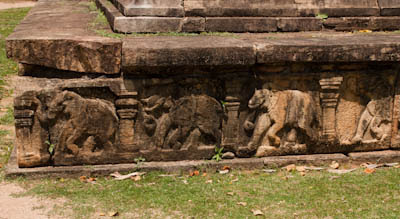
The first set of buildings we visited is known as the Royal Palace group. It included the Royal Palace, built during the reign of Parakrambahu I. Measuring 31x13 meters, at one time it supposedly had seven storeys. According to the scale model of the palace seen in the museum, the palace’s top floors were made out of wood. Hence, after the South Indian invaders set fire to the place, nothing remained except the brick ground floor walls (now charred) with holes to receive floor beams of the next level. Portions of plaster on the wall still remained in some places. Nearby was the Audience hall, which had a great row of elephants carved in relief on the bottom row, lions on the top, and remnants of columns. We also visited the Bathing Pool, whose water was provided from the large tank and channeled down through clay piping. A small circular fountain still occupied the middle of the pool, once spouting forth with water.
Bathing Pool

Friday, November 05, 2010

Pinnawala Elephant Orphanage

The morning of the following day, I headed down the forested hills and arrived at Pinnawala about 40 minutes later. In some parts, the road was completely shaded by the tall trees in the forest, reminding me of walks I’ve had in the woods. Overripe sweet corn, bottled water, coconuts, and decorative inflated figures including Scooby Doo were sold here along the roadside. In the distance, unusual rock formations emerged in between the thickly wooded hills. Although the drive was pretty, the winding roads, huge number of buses, and eager passers required close attention to the road. With a sudden increase of hotels and even a “safari ride,” I knew we were close to the orphanage.


After paying the 2,000 rupees (nearly $18 – a price even higher than that of the Taj Mahal) vs. 100 rupees for locals, I headed towards the area where young elephants were being bottle-fed. A larger elephant was eating leaves, stripping them with their curved trunk from the cut branch held down by a foot. Nearby, a large number of elephants were gathering, both young and old. They new bath time was coming soon. While visitors could get up close to the elephants and even touch their rough skin, the mahouts were always close with their pole with a sharp end, just in case any elephant got out of control. No fences were around, but it still felt very touristy and artificial. People then began walking across the road towards the river, past a slew of tourist junk stalls. Paper made from elephant dung was also sold. From the balcony of a hotel, visitors had a good view of the river. Soon, the elephants began their parade to the water. Some quickly immersed themselves in the water, but others seemed more determined to the cross the river to the other side. A few elephants were chained and made to lie in the water for their bath. Interesting to watch, but not worth the money in my opinion. I hope at least the money does indeed go to elephant care.

Happy Diwali, Chennai-Style

The picture of Diwali normally portrayed in literature is one where families light small lamps, perhaps even sending them floating down the river. Families are wearing their new glittery outfits, indulging in sweets of all kinds. Ah, such a scene of tranquility.

Then there's the true picture in Chennai. From early in the morning to late in the evening, firecrackers are going off, filling the air with smoke, the streets with confetti and discarded firecracker boxes, and all within any vicinity with at least some level of (hopefully temporary) hearing loss.

The amount of firecrackers consumed in Chennai shouldn't be much of a surprise. After all, the Tamil Nadu town of Silvaski has over 8,000 fireworks/cracker factories in it, producing over 90% of the country's booms.

Regardless of how you celebrate it, happy Diwali, India!

Thursday, November 04, 2010

Temple of the Tooth, Kandy

One of the most sacred sites for Sri Lankan Buddhists is the Temple of the Tooth, otherwise known as Sri Dalada Maligawa. According to legend, a tooth of the Buddha was snatched at his funeral pyre and smuggled into Sri Lanka, hidden in the hair of a princess. After being moved from place to place in the country and then temporarily brought back to India by army invaders, it achieved its final resting place in Kandy. The current structure housing the tooth was built within the royal palace complex from 1687-1782 and is surrounded by a deep moat that still contains water. In 1998, a bomb detonated by the Tamil Tigers during the civil war damaged part of the building, of which some evidence remains. For example, there are gouge marks in the colorful 18th-20th century paintings through the front door hallway depicting the life of Buddha.

When I was there, the gold dagoba (stupa) was veiled by a cloth, so the relic’s container was not to be seen. Three pairs of large elephant tusks flanked the front of the shrine. Rich painted figurative and floral designs adorned the top of the shrine. Another side had beautiful carved columns with animal and mythical creature designs. Devotees came in cupping lotuses, purple flowers, and jasmine in their hands.

Above one curtained door was a Buddhist mythical creature, consisting of the trunk of an elephant, mouth of a crocodile, ears of a pig, body of a fish, tail of a peacock, eyes of an eagle, and legs of a lion. In addition to several smaller rooms, a newer and larger shrine hall contained Buddhas in various materials and sizes, donated by different countries. A gold-colored statue of a seated Buddha was in the front center of the room. Multiple sets of tusks curved inward towards the center of the room. Also in the complex was an open air pavilion with carved stone columns and the Rajah Tusker Hall which contains the taxidermy stuffed figure of the beloved elephant Rajah who died in 1988, as well as photos and other mementos of the creature in procession.

Wednesday, November 03, 2010

Kandyan Art Association & Cultural Center


That evening I attended a show at the Kandyan Art Association & Culture Centre. Featured were traditional drummers, dancers in various costumes, vibrant bird & cobra masked dances, walking over hot coals, and fire eating.

The next day I went and saw a few artisans at work, weaving fibers from a sort of yucca plant, another decorating wood sticks with lac, and another doing metal repoussé.

Tuesday, November 02, 2010

Peradeniya Botanic Gardens, Kandy

Located 6 km from Kandy, this is the largest botanic garden of Sri Lanka and covers 60 hectares. Although popular with both residents and foreigners alike, there was a much higher representation of Sri Lankans (including school groups), partly due to the great differences in price between the two admission tickets. In addition to taking quite a few photos in the orchid house, it was pleasurable wandering the paths of the well-manicured gardens and tree-covered areas. Young affectionate couples sat at the base of massive tree trunks. School groups ate a snack under the massive Javan fig tree on the expansive lawn.

Avenues specialized in specific types of trees, including one for cannonball trees, cabbage palms, and the avenue of double coconut palms. Those coconuts were massive and deformed-looking, weighing from 10-20 kg (22-44 lbs). Near the meandering Mahaweli Ganga River, bamboo burst forth in bunches. Also present was a small Japanese garden, jungle-like spice garden, and some sausage trees.

Monday, November 01, 2010

Macwood's Tea Estate

Around Nuwara Eliya (elevation 2,000m), we stopped at Mackwood’s Tea Estate for a tour. Founded in 1841, this company includes 27,000 acres of plantations consisting of 17 tea and rubber estates. In addition to exporting vast quantities of tea, it also exports essential oils, organic/biofoods, coconut/fiber geotextiles, and rubber. After some sampling of the orange pekoe tea, I went on a short tour of the factory.


The first step in tea is plucking. Only women do this job, as their hands are considered more nimble. These women deftly pick two leaves and a bud. About 10,000 kilos per day of leaves are picked on 1,200 acres. According to my guide, each bush yields about ½ kilo per pick. Each woman picks approximately 10-15 kilos per day and makes between 500-600 rupees ($4.40) a day. The company does provide health care, education, and other services for the families. Four times a month a bush can be picked again. About 1,000 workers are employed – most of whom are women. Men do work such as pruning (every five years a bush is pruned, after which plucking can be done in three months), weeding, and factory work. A natural tea bush can last 100 years. Macwood’s uses cloned ones, which last only about 60 years but produce a much higher yield.


The second step is withering. After about 14 hours, over 50% of the moisture from the leaves is gone. The crushing machine then takes about 250 kg of leaves at a time. Then the leaves are rolled for about 20 minutes, which twists the leaf and brings the juices to the leaf’s surface. Fermentation, the fourth step, takes about two hours. The tea is further dried for about 20 minutes in a special firewood kiln which reaches 105°C (220°F). Only about 2-3% of the moisture remains at this point. The extractor then separates the fiber from the leaves, with the leaves being graded by size and shape. Taste tests are conducted and the tea is packed in large bags, which are hauled to Colombo where they are auctioned. 80% of Mackwood’s tea goes for export. Asian and Arab countries are common destinations.


More costly tea grades such as silver tips follow a slightly different process, with the leaves drying in the sun. Seven kg of leaves yields only 1 kg of tea for this process. More expensive teas are flavorful by themselves and are not served with milk or sugar.