While in Bagan, we also visited a workshop where Myanmar’s famous lacquerware was being made. It was fascinating to see how the pieces started with moulded bamboo (or woven with horse hair, then covered with black resin paste and dried, washed, polished, given additional layers of lacquer and then engraved with a stylus. The showroom had beautiful pieces for sale, ranging from small simple cups to large accordion screens, completely decorated with daily life scenes in traditional red, green, pale blue, and yellow.
Melissa Enderle's travelblog on her travels to Mali, Tunisia, Serbia, Eastern Europe, India, South Korea, China, and other places around the world.
Thursday, March 08, 2012
Wednesday, March 07, 2012
Hidden Beauty of Bagan
During that day, we would visit many ancient wonders. Some of the most beautiful were off-limits to photography. For example, the 1,000 yr. old frescoes of the underground Kyin Sidha meditation cave would have suffered ill effects from bright light of a flash. Other places that had beautiful frescoes included the Gubyikgyi temple (1086 AD) and the Ananda Phaya. Though small in size, the Ananda Phaya contained beautiful 13th century frescoes of daily life, rendered in natural pigments from indigo, tumeric, mud, and several others. A flashlight was provided so we could catch fleeting views of the detailed scenes. Other sites such as the Ananda Phaya seemed to focus on the idea that bigger is better. Inside the 51 meter high structure are four 9.5 meter standing Buddhas, one of which seems to change from sad to happy, depending on the viewer’s distance from it.
Our guide also brought us to a monastery constructed from wood. Much of its most beautiful features required the viewer to look upward towards the ceiling and on the roof. Considering the destructive nature of termites in the region, I'm glad that this monastery was rather intact, enabling visitors to enjoy its richly carved ornamentation.
Labels:
archaeology,
architecture,
art,
Buddhism,
Myanmar,
religion,
sculpture
Location:
Myanmar
Tuesday, March 06, 2012
A Panorama of Pagodas
Climbing up the stairs to the top of a larger temple, we had a panoramic view of the landscape. Beautiful ancient temples jut forth from the rather flat bushy landscape, dotted by smaller pagodas poking their tapered peaks everywhere, populated like bunnies. These smaller structures were erected as funerary monuments or to honor a notable person/important family. Early morning fog, coupled with an overcast sky, shrouded the scene in mysticism and ancient splendor.
Sunday, March 04, 2012
Onward to Bagan, Shwezigon Pagoda
After five flight ascents and an overnight (Christmas Eve, mind you) in the Bangkok airport, we arrived in the ancient city of Bagan. It was founded in 849 AD and experienced its height as the first capital of the Burmese Empire between the 11th and 13th centuries. It is during this time that the majority of Bagan’s pagodas and temples were built. At one time having over 5,000 pagodas in a 40 sq. km (16 mi) area, only a little over 2,000 remain after a devastating earthquake in 1975. When the Mongul emperor Kublai Khan invaded the area, Bagan’s glory days were abruptly ended, with the city was abandoned.
One of the first places we visited was the Shwezigon Pagoda. Built around 1076 AD to enshrine one of four replicas of the Buddha tooth housed in Kandy, Sri Lanka, the large golden bell-shape of the pagoda surrounded by smaller structures, and rest areas, reminded me of the Shwedagon Pagoda we had seen the day before in Yangon. According to our guide, the pagoda was constructed from sandstone, instead of the normal brick material. Around the base of the pagoda are enameled panels illustrating scenes of the Buddha’s previous lives. I liked the highly detailed and beautiful old wood carvings in one structure depicting the story of Buddha’s life. In one room, 37 pre-Buddhist nats (spirits) of varying sizes were housed. The enshrined figures seemed a bit reminiscent of Hindu gods.
Location:
Bagan, Novosibirskaya oblast, Russia
Friday, March 02, 2012
Of Illuminations and Halos
We returned to the Shwedagon Temple at the end of our trip to Myanmar. On New Year’s Eve, the temple complex was abuzz with people. Candles were lit along the circumference of the pagoda, which itself was illuminated with lights. “Halos” behind the heads of the Buddhas pulsated in various rainbow patterns. Ceremonial sweepers briskly pushed their brooms forward and side to side, working together en mass as they encircled the pagoda. Other devotees deftly assembled large quantities of rose heads and other flowers into decorative sculptures for the following day.
Labels:
architecture,
Asia,
Buddhism,
celebration,
Myanmar,
religion
Location:
Yangon, Burma
Thursday, March 01, 2012
Shwedagon Temple Details, Yangon
Encircling the pagoda were a series of small shrines, one for each day of the week and two for Wednesday. Devotees would offer flowers, prayers and pour water on the Buddha image corresponding to the day of the week on which they were born. Within the complex were other sheltered areas for meditating, praying, bring offerings, and placing requests. The structures were quite ornate, both in its interior and the roof. Glass mosaic columns reflected the colors of their surroundings. In various areas, people were enjoying their picnic lunches, absorbing the dynamic peacefulness and excitement. The gentle gong of drums and tinkling of chimes and bells managed to be heard above the voices.
Location:
Yangon, Burma
Wednesday, February 29, 2012
Pagoda at Shwedagon Temple
Walking barefoot (no shoes allowed) up the long stairway to the temple, we were treated to a beautiful, active scene. Dominating the large facilities was a massive golden bell-shaped pagoda. According to the back of our foreigners entrance ticket, the structure is 326 feet in height - a far difference from the original one of 66 feet, built around 2,500 years ago to house hairs given to two Burmese brothers by the Buddha himself, later to also include relics of other Buddhas. The pride of the Yangon people, the Shwedagon Pagoda was lavishly decorated with 3,154 gold bells in the “Hti" (umbrella) on the top, along with 79,569 diamonds and other precious stones at the very top. I guess devotees would just have to appreciate such precious adoration from a distance, never personally laying eyes on them.
Tuesday, February 28, 2012
Kampev Buddhist Temple
While in the village, we also visited a Buddhist temple. I was rather surprised to see the floor covered in a film of dust. Although rather large in size, it lacked the opulence that some of the Buddhist temples I had seen elsewhere. Off to one side was a crematorium and next to the temple was a plot to honor the dead, with the stupa-like “gravestones” each seeming to compete through scale and decoration.
Monday, February 27, 2012
Kampev Primary School
Our destination was a local primary school. Children sat on wooden benches, ready to take notes from the teacher’s lecture on the chalkboard. Typical of kids anywhere, our presence caused distraction for some. The teacher of one class called an early recess, with his young pupils quickly darting out of the doorless entryway before any minds were changed. We had seen this teacher earlier today, as he was one of the bullock cart drivers. Even here, the teachers need to supplement their salary! It was fascinating watching the kids play at recess. Some boys were engaged in a marble game, crouching down to the dusty ground in order to get the competitive edge. Most of the other children were engaged in a “try to make it to the other side while avoiding being hit” type of game, but using what looked like a large, weighted badminton birdie. The girls playing were equally as aggressive, throwing the birdie just as hard as the boys and not complaining when they got hit in the head - even though it clearly hurt. Although I am sure that the manufacturers of the birdie device did not intend for their toy to be used in that fashion, these kids sure made it an engaging recess activity.
Sunday, February 26, 2012
Making a Difference
We then walked towards the village. Our guide pointed out various homes, stating that the agency through which we paid for the volunteer activity had funded the roof, another cement walls (vs. thatched), still another a toilet. We saw several wells with the names of donation families. What a difference that well will have in the lives of those villagers...
Saturday, February 25, 2012
Roasted Fire Ants
Done with our light fieldwork, we walked across ploughed fields and in between rows of short corn to reach a house for our next task. Sitting on a plastic tarp in a shaded area, we watched our guide demonstrate how to weave and sew palm fronds which would be used to construct the sides of a house. A young boy wheeled a large wheelbarrow to the driveway of the house - the same boy we had seen earlier running towards us in the field, firmly clutching a kitten. Although we didn’t see the kitten now, we hoped it was ok. With no more palm fronds to weave, we watched the cooking taking place on the floor of the stilt house. The mother was pounding fish paste with garlic and chilies, while our guide was working on the dish’s main ingredient - fire ants. He explained that the although the delicacy dish was often eaten raw after the ants were pulverized and mixed with the fish paste, he actually preferred roasting it in banana leaves first. Although grateful that the stinging ants were no longer alive, I can’t say that I really appreciated the slightly crunchy dish. Like the other volunteers, I was happy to eat the white bread sandwiches prepared for us.
Friday, February 24, 2012
Pajamas and Watermelon Seeds
Climbing aboard carts drawn by water buffalo and a bullock, my two traveling companions and the other volunteers enjoyed a dusty ride out into the field. Our presence attracted the children of the village, with uniformed children at the school playground waving and smiling. One young boy ran to our car and followed us to the field, holding on to the back as if he was undertaking a very important job. He only stopped momentarily when he ran to pick up a yellow object he had spotted in a field - a spool of thread. We were taken to our first task - planting watermelon seeds for an illiterate farmer and his wife. They had already mounded the sandy soil, all we had to do was scoop a shallow hole and place five seeds inside, then covering it up. The wife then used her sprinkling can to water the freshly planted seeds, drawing water from the adjacent rice paddy. Village women were working in the rice paddy, planting rice. Despite being dressed in comfy looking pajamas (we found that walking around in pajamas was fairly common in Cambodia), their work looked far casual.
Thursday, February 23, 2012
Kampev Ingenuity
On our free day in Siem Reap, we decided to give back to the community, volunteering in the village of Kampev. Our young guide (who raised himself and brother after his father was killed by the Khmer Rouge and mother died shortly thereafter) explained that the village was comprised of approximately 150 families. As is tradition in villages, we first met the village chief. With his closely shaved white hair, the elder quickly shared his age of 63 - something of which he was proud, as the average life expectancy here was around 50. He gratefully accepted the bags of school supplies and hygiene products we had bought in Siem Reap and at a village market.
Seeing the quantity of large bags filled with plastic bottles, we inquired about what looked like a collective effort. Smiling with his remaining teeth, the chief explained that the plastic bottles were being collected and filled with rubbish were actually being used for construction. When these bottles were stacked in between wire mesh and then covered with concrete, the walls were actually stronger than simple brick walls. What an ingenious way of solving the litter problem and building walls for schools or homes!
Tuesday, February 21, 2012
Kampong Phluck Floating Village
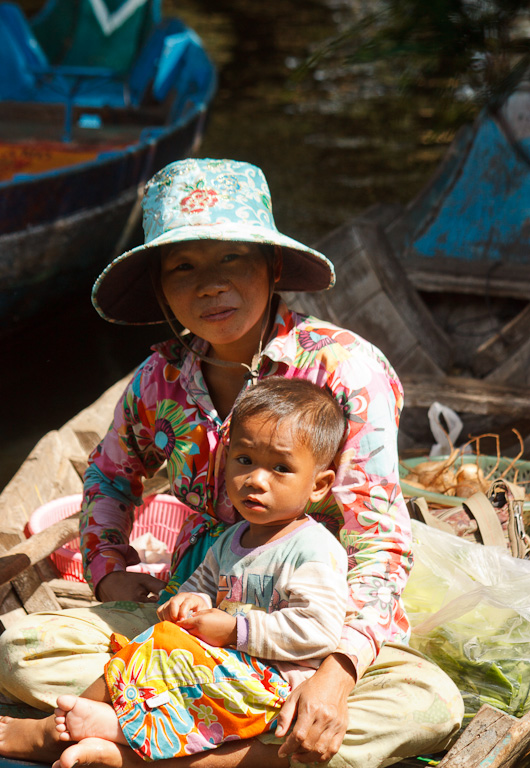
As part of our tour, we visited the village of Kampong Phluck. Located in Ton Le Sap lake, a motorized boat took us to this floating village. Homes here were built on tall stilts or floating foundation. Getting into a boat and going from place to place looked as natural as getting into a bus. Children dressed in uniforms hurried down the steps of the school to reach the waiting boats at the pier below. Our boat buzzed past stilted homes made out of palm frond thatch, monks getting their head shaved by the river edge, and women rowing boats heavy laden with vegetables just purchased from the small market.
Chickens clucked about and pigs lazed around in floating cages. Underneath some homes were large collections of rather small fishing traps. Not surprisingly, most of the 3,500 villagers are fishermen. The collection of stilt buildings soon gave way to scattered ones, after which the mangrove trees became more common - but no where as dense as those in the Sunderbans. After a bit, we were in the main Ton Le Sap lake - the largest freshwater lake in South Asia. Of interesting trivia is that that the Ton Le Sap River flows north for about half the year and south the rest of the year, as dictated by the floods of the monsoon rains.
Monday, February 20, 2012
Apsara Dance Performance
While in Siem Reap, we also attended an Apsara dance performance. Much like the apsara (celestial nymph) dancers we saw depicted on the walls and columns of Angkor structures, these danced with grace and fluidity. Movements, particularly the placement of the hands and pose of the fingers was beautiful, but prescriptive. While the announcer was very difficult to understand (other than the word dance), we did enjoy the performance.
Labels:
Angkor Wat,
architecture,
art,
Asia,
Cambodia,
dance,
Siem Reap
Location:
Siem Reap, Cambodia
Sunday, February 19, 2012
Banteay Srei - save the Best for Last
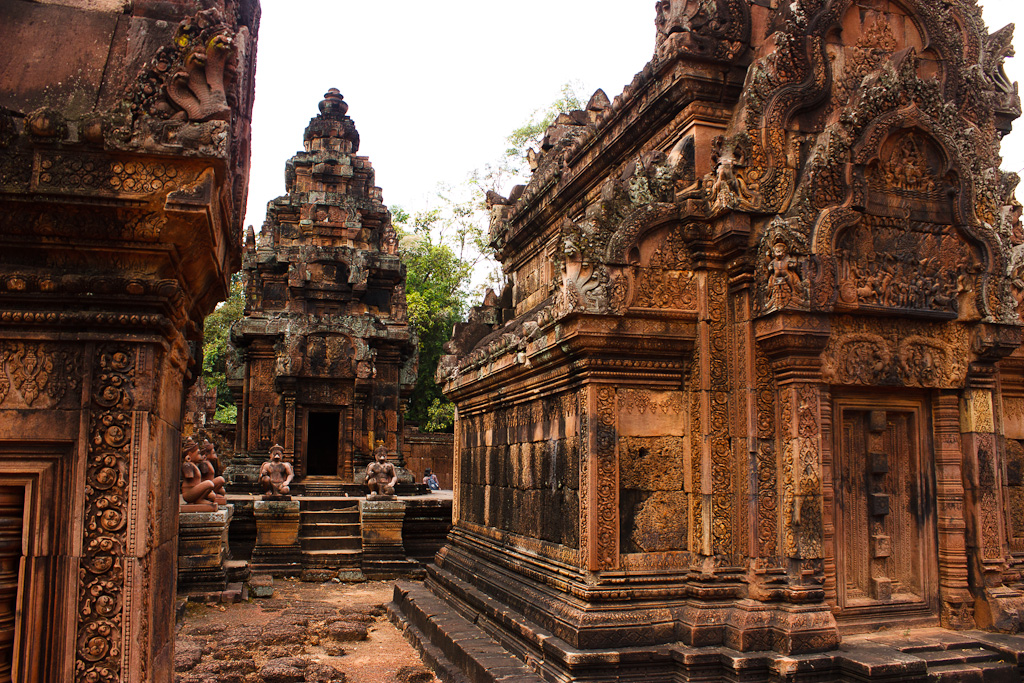
Our last Angkor site was also my favorite - Banteay Srei. Although just a fraction of the size of the Angkor Wat temple, this miniature-sized Hindu temple more than makes up for things with its exquisite carvings. The red sandstone from which most of the structures here are carved was perfect material to achieve and preserve some of the most elaborate, intricate carvings I have ever seen. Consecrated in 967 AD by a counsellor to the king, Banteay Srei was dedicated to the god Shiva. Meaning “Citadel of the Women” or “Citadel of Beauty,” some say such intricate work could only done by the hands of women. Its lintels and pediments were particularly beautiful, but nearly every square inch was covered by carvings or sculptures. A feast for the photographer’s eye! Many of the sculptures found on the site are reproductions, with the originals stored in the National Museum. Additional pieces are housed at the museum in Siem Reap and were easily distinguished from “inferior” carvings from other Khmer sites. Such measures have ensured that at some of this “jewel of Khmer art” will be preserved and safe from the hands of unscrupulous looters. Visit http://en.wikipedia.org/wiki/Banteay_Srei for more detailed explanations and images.
View many more photos of mine on Banteay Srei and the other sites within the Angkor area on my Flickr set .
Labels:
Angkor Wat,
architecture,
Asia,
Cambodia,
Hindu,
museum,
sculpture
Location:
Banteay Srei, Cambodia
Friday, February 17, 2012
River of a Thousand Lingas
Still rather early in the morning, we began our trek through the forest to reach our destination of Kbal Spean - known more popularly as “River of a Thousand Lingas.” The shade of the tall trees shielded us from the bright sun. Roots wiggled across the path like snakes, making it imperative to watch one’s step. Rocks and boulders and provided an extra challenge, but some areas had stairs to make it easier to climb upward. About half an hour later, we arrived at the 9th-12th century Hindu carvings. Clear water glided and over river boulders, some of which contained carved Yoni symbols (womb or sacred temple). Shallow Lingas (representing the male fertility organ) were carved in neat grid rows in the sandstone river bed, reminding me of giant bubblewrap. It was believed that the water was purified as it flowed over the religious sculptures, thus cleansing the king’s sins. On the river bank boulder, a relief carving contained a reclining Vishnu, serpent god Anenta, goddess Lakshmi, and Brahma sitting on a lotus petal. I also spotted a rock containing relief carvings of small figures (depicting Shiva and Uma) riding a bull and other larger figures looking up to them. Additional carvings were found near a waterfall.
Location:
Kbal Spean, Poipet, Cambodia
Thursday, February 16, 2012
Angkor Wedding
Even wedding couples felt the need to visit Angkor Wat and pose for photos there. I wonder how many bobby pins and hairspray was used for her hairdo...
Labels:
Angkor Wat,
Asia,
Cambodia,
celebration,
wedding
Location:
Angkor, Phnom Penh, Cambodia
Wednesday, February 15, 2012
Angkor Wat Temple Complex
Along the outside of the central temple complex is an 800 m long series of beautiful bas-reliefs. One portion depicts a battle scene from the Hindu Mahabarata epic. Another is of a triumphal battle march of Suryavarman II’s army. Our guide pointed out the mercenary Thai army (who wore headdresses, skirts, and carried tridents), the Khmer troops (with breastplates and spears), and the king riding an elephant, shaded by 15 umbrellas and fanned by scores of servants. Part of the south gallery depicts the punishments of hell and rewards of heaven. Another section shows the famous churning of the Ocean of Milk. Some of the relief figures were quite black and shiny, polished by the many hands rubbing their surface. From the top of the temple, we had a panoramic view of the forested area, the libraries with rather intact roofs, gates, and the many tourists walking up the causeway. Despite its popularity, Angkor Wat definitely was not my favorite.
Location:
Angkor, Phnom Penh, Cambodia
Subscribe to:
Posts (Atom)