A quiet canal flanked the sides of the road. To reach the homes and farmsteads, one had to walk across a tiny plank or narrow mud mounded path. Homes and barns were next to each other, with the livestock wandering around. While most structures were roofed with thatch, walls were built with cement or mud. The roof of some homes sported a satellite dish while others had a small solar panel. Such solar panel would provide enough electricity to light a bulb and TV. Saris, blankets, and nets hung out to dry on lines stretched between palm trees. Goats lazed in the shade while women worked.
Melissa Enderle's travelblog on her travels to Mali, Tunisia, Serbia, Eastern Europe, India, South Korea, China, and other places around the world.
Thursday, November 17, 2011
Homes of the Sunderbans
Labels:
architecture,
cow,
farm,
goats,
India,
North India,
rural,
Sunderbans
Location:
Gosaba, West Bengal, India
Monday, November 14, 2011
A Pole With a View
Camera strapped around my shoulder, I instantly had it ready when I spotted these two guys up on what looked like an electrical pole, here on the island of Gosaba in the Sunderbans. They seemed very happy up there, waving and sending me a greeting as I passed by - probably with a rather shocked look on my face. Note the safety harness, hard hat, and protective footwear....
Labels:
Asia,
India,
labor,
North India,
rural,
Sunderbans
Location:
Gosaba, West Bengal, India
Sunday, November 13, 2011
A Bicycle Taxi Through Gosaba Island
Safely ashore on Gosaba Island, we were greeted by two island taxis. We piled on to the flat wooden trailers as the taxi man pedaled on in his large trike. Along with bicycles and the occasional motorcycle, these taxis were the main ways people traversed across the island. Our tricycle taxi man was rather patient, only ringing his bicycle bell when passing or meeting another vehicle on narrow parts of the road. Others depressed their horns or bells as often as drivers in metro Indian cities did. In front of us, a small green covered shelter motored by a tricycle made its way through the narrow path. Schoolchildren cheerfully waved to us through the iron-gridded window in back, enjoying the diversion as they were pedaled home from school.
Labels:
India,
school,
transport,
West Bengal
Location:
Gosaba, West Bengal, India
Thursday, November 10, 2011
Gosaba Island Taxi
No fancy ferries to get to the Sunderbans and the island of Gosaba! Instead, we took this island taxi. For five rupees (about 10 cents) it took all who could crowd onto the boat to and from the island. Most people, including the grannies, sat along the edge of the boat, perched rather precariously on an edge that was about two inches in width. Not wanting to risk my DSLR camera (or embarrassment), I chose to buck the trend and sit inward.
The taxi "driver" steers the boat
Labels:
boat,
India,
North India,
Sunderbans,
transport,
water,
West Bengal
Location:
Gosaba, West Bengal, India
Rice Paddies of West Bengal
Reflecting the West Bengali’s steady diet of rice, the fields leading down to the Sunderbans largely contained the tell-tale green of rice plants. Along with fish, rice is a staple of many residents. Alongside the river in some towns, I saw small plots of marigolds, popular flowers in the area for festive occasions. Tied to posts and tree trucks near the road, goats rested on the edge of the road. Motorists had to watch out for them, lazy dogs, and the ambling cow.
Labels:
Asia,
cow,
fishing,
flowers,
goats,
India,
North India,
rice,
rural,
Sunderbans,
water,
West Bengal
Location:
State Highway 3, West Bengal, India
Tuesday, November 08, 2011
Water - Source of Pleasure and Livelihood
Rural West Bengal seemed to place great importance on water. In some areas, the wide, expansive flat areas edging each side of the road was filled with water. Fishermen stood in waist-deep water, armed with fishing nets and box traps. Narrow, mounded mud served as paths leading to thatched homes and across to other “ponds.” In towns, kids (and adults) happily splashed in the town ponds, playing around or lathering themselves with soap. Women took advantage of the the water to wash clothes and kitchen pots.
Labels:
Asia,
fishing,
India,
labor,
North India,
rural,
West Bengal
Location:
State Highway 3, West Bengal, India
Sunday, November 06, 2011
Vehicles of Rural West Bengal
Once out of the expansive metropolis of Kolkata, the pace relaxed. Multi–story buildings and showrooms gave way to simple huts and shacks. The center of activity for men of the village, such tiny shops were gathering places to purchase goods, drink sweet chai, gossip, and play a few rounds of cards. The iconic yellow taxis of Kolkata were replaced by flat bed trailers pulled by motorcycle–sized vehicles. Others chose to traverse the narrow roads by hanging on to the back of trucks, crowding into battered buses, and the occasional modified auto rickshaw.
Labels:
Asia,
India,
Kolkata,
North India,
rural,
transport,
West Bengal
Location:
State Highway 3, West Bengal, India
Friday, November 04, 2011
Kolkata, West Bengal
I have now posted on Flickr my photos of photos of Kolkata (formerly Calcutta). Includes photos of the Hindu celebration Kali Puja. http://www.flickr.com/photos/melissaenderle/sets/72157628044313254/
Blog posts about Kolkata to follow!
Labels:
festival,
Hindu,
India,
Kolkata,
West Bengal
Location:
Kolkata, West Bengal, India
Monday, October 31, 2011
The Sunderbans - Mangrove Forest
This past week for our October Diwali break, I traveled to West Bengal. The first location I visited was the Sunderbans, situated in both West Bengal (India) and Bangladesh. Famous for its Bengal tigers, the Sunderbans is a UNESCO World Heritage site and is the world's largest tropical Mangrove forest.
See my photos at:
http://www.flickr.com/photos/m
Labels:
animals,
Asia,
India,
nature,
Sunderbans,
West Bengal,
wildlife
Location:
Gosaba, West Bengal, India
Friday, October 28, 2011
Oh, the Secrets I Could Tell
In just the few minutes I paused here, a steady stream of devotees bent down to whisper into the ear of Nandi, located at the Meenakshi Temple in Madurai. It is believed that such whispered prayers will reach the god Shiva.
Location:
Madurai, Tamil Nadu, India
Wednesday, October 26, 2011
Happy Diwali!
As this is posted, I am in Kolkata. I look forward to experiencing Kolkata's version of Diwali - the festival of Lights. Although I doubt I can escape the firecrackers and fireworks, I want to see how this north-eastern city celebrates this major Hindu festival.
For all my friends who partake, happy Diwali!
Labels:
celebration,
Diwali,
festival,
Hindu,
India,
Kolkata,
North India,
religion,
West Bengal
Location:
Kolkata, West Bengal, India
Saturday, October 22, 2011
Potramarai Kualam - Meenakshi Temple
Upon entrance to the temple, devotees would first make a trip around the 50x37 m (165x120ft) sacred pond prior to entering the main shrine. Meaning Pond with the Golden Lotus due to the golden color of the lotus growing there, the pond was devoid of any water when I visited it, due to repairs being done. Despite its empty state, throngs of people still gathered in the pillared corridors. In line with Tamil legends, authors still place their works in the pond which judges its worth, with esteemed ones floating while poorly written doomed to sink. Talk about a critic!
Labels:
architecture,
Asia,
Hindu,
India,
religion,
South India,
Tamil Nadu
Location:
Madurai, Tamil Nadu, India
Weddings -times 4,5,6,7
On the day that I visited the Meenakshi Temple in Madurai, it must have been an auspicious day for getting married. The colonnaded hallway around the Lotus Pond was brimming with wedding couples and their guests. Lots of silk, gold, mehendi, and jasmine here!
Wednesday, October 19, 2011
Of Deities and Yallis
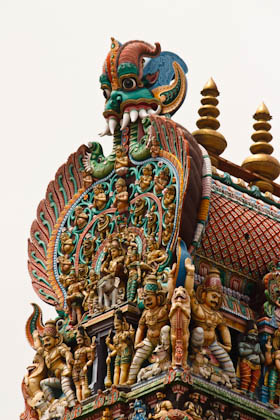
The towering four gateways of the Meenakshi Temple in Madurai are totally covered with protruding statues of brightly painted deities, mythical and real animals, and monsters. On the top, menacing faces of guardian deities known as yallis with their protruding eyes, horns, teeth, and long mustaches stare at those who come near. A feast for the eye, the temple’s twelve gopuras beg for extra viewing and zoom lenses.
Labels:
architecture,
Asia,
Hindu,
India,
religion,
South India,
Tamil Nadu,
temple
Location:
Madurai, Tamil Nadu, India
Tuesday, October 18, 2011
Meenakshi Temple - Heart of Madurai
Located in the southern Indian state of Tamil Nadu, the city of Madurai is synonymous with it fabulous Hindu temples, most notably the Meenakshi Temple. The Meenakshi Sundareshvara Temple was originally built by the Pandas who reigned during the 7th-10th centuries and received extensive additions by succeeding dynasties, particularly during the 14th and 18th centuries. The current structure, mostly rebuilt in 1559 AD, is considered a splendid example of South Indian Dravidian architecture. Surrounded by high walls, the massive temple complex (45 acres) has four entrances - one at each main cardinal point. To enter, visitors walk through one of the massive pyramidal gopuras, each with a height of more than 50 m (164 ft), with the tallest rising to 52 m (170 ft). It is the of the few temples on Tamil Nadu to have entrances at each of the four cardinal points.
Even today, the Meenakshi Temple is both the geographic and religious center of Madurai.
Labels:
architecture,
Asia,
Hindu,
India,
religion,
South India,
Tamil Nadu,
temple
Location:
Madurai, Tamil Nadu, India
Sunday, October 16, 2011
Poondi Matha Basicilica
Our final place of pilgrimage in Tamil Nadu was to the small village of Thiruvaiyaru Taluk. Amidst the emerald green paddy fields rose the large basilica known as Poondi Matha (meaning mother in Tamil). Erected in the late 18th century, this white structure of Gothic and French style was elevated to the status of minor basilica by Pope John II in 1999.
Like other churches along the pilgrimage path with Velankanni, Poondi Matha attracts large numbers of visitors around the time of the festival in Velankanni. The basilica has been enlarged due to donations and even contains an upstairs room that is air conditioned - a definite incentive to meditate! Masses were held on a rotating basis in multiple languages, accommodating the various places of origins for these Indian visitors. More housing and eating facilities have been erected to try to accommodate the swell of visitors. Some still elect to cook and/or sleep outside - which is fine until the downpours come!
The Poondi Matha houses a tiny fragment of what it claims to be a piece of the cross of Christ. People kissed the glass in front of the relic as they walked by, then spending more time in front of the large statue of Mary and infant Jesus. Once again, Mary was clad in a silk sari (several more were draped in front of the display - gifts of devotees), gold chains given by people, and floral garlands. More garlands were tied in front of the display, constantly refreshed by people. Off to the side, a worker took off some still-fresh garlands and began (much to my horror) ripping them apart and tossing the roses and other flowers in what looked like a waste basket.
Like other churches along the pilgrimage path with Velankanni, Poondi Matha attracts large numbers of visitors around the time of the festival in Velankanni. The basilica has been enlarged due to donations and even contains an upstairs room that is air conditioned - a definite incentive to meditate! Masses were held on a rotating basis in multiple languages, accommodating the various places of origins for these Indian visitors. More housing and eating facilities have been erected to try to accommodate the swell of visitors. Some still elect to cook and/or sleep outside - which is fine until the downpours come!
The Poondi Matha houses a tiny fragment of what it claims to be a piece of the cross of Christ. People kissed the glass in front of the relic as they walked by, then spending more time in front of the large statue of Mary and infant Jesus. Once again, Mary was clad in a silk sari (several more were draped in front of the display - gifts of devotees), gold chains given by people, and floral garlands. More garlands were tied in front of the display, constantly refreshed by people. Off to the side, a worker took off some still-fresh garlands and began (much to my horror) ripping them apart and tossing the roses and other flowers in what looked like a waste basket.
Parade by the Pieta
Devotees gather near the chariot of Mary, being paraded past the grotto of Mary and a copy of the Pieta at the Poondi Matha Basilica.
Thursday, October 13, 2011
Coming in With Mary
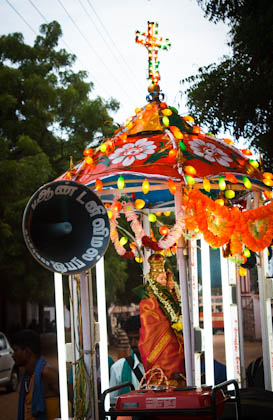
On our way to the Idaikattur Church in Tamil Nadu, we passed by a fair number of religious pilgrims walking alongside the road, all bare-footed. Most carried few possessions - typically what they could carry in a small bag. One group proudly pushed along a religious "chariot." Except for the cross on top, one could at a distance forgive it for being for a Hindu ceremony. Loudspeakers, powered by a large battery, broadcast praises of Mary to Christian and Hindu households alike.
Wearing a silken sari, garlands made of fragrant flowers, and a large crown on her head, the statue of Mary dominated the chariot interior. Struggling to emerge amidst the cloth was the child Jesus.
Now nearing dusk, the colorful decorative lights adorned the roof and cross. People gathering around the chariot began singing in unison, accompanied by drums. The positive energy was strong, evidence of the passion and devotion of all gathered.
Labels:
Christianity,
church,
Hindu,
India,
religion,
South India,
Tamil Nadu
Location:
Kattur, Tamil Nadu, India
Tuesday, October 11, 2011
Kolu gods display
A closeup of a few of the god dolls on display for Kolu, a Hindu festival. Rekha (the hostess) has arranged the figures by size, with the largest on the top stair.
Labels:
Chennai,
festival,
Hindu,
India,
South India
Location:
Besant Nagar, Chennai, Tamil Nadu, India
Sunday, October 09, 2011
Kolu Display and Host
A friend of a colleague of mine invited us to see the kolu display in her flat. Rekha's display of just stone-colored gods was a bit different than the colorful (and sometimes whimsical) figures I had seen in Mylapore. She explained that this more somber style was more representative of the type of display that would be found in a temple. Every year she sets up a different themed display. Imagine the storage needed for such collections!
Thanks again Rekha for being such a gracious hostess!
Location:
Besant Nagar, Chennai, Tamil Nadu, India
Subscribe to:
Posts (Atom)