Since I posted an image related to the "Golden Arches" from the Phillipines the other day, this post deals with a different, but also famous, arch. Here I am (around 2002), pictured sitting under the triumphal arch of Alexander Severus. Erected in 228 AD in honor of of Roman Emperor Alexander Severus, it was one of two arches at the UNESCO World Heritage Site. It functioned as one of the city gates, at the end of a road leading from Carthage to the city of Tebessa.
Through the archway we can see the site's famous Capitol, built in 166 AD.
Tunisia is amazing for its ancient history. Dougga is one of several ancient sites in this small country - very worthwhile visiting.
Ah, Wisconsin! As I zipped up my jacket a little bit higher to shield myself from the arctic air, I surveyed the scene around me.
Powdery snow blew freely, forming ripples reminiscent of those formed in the Sahara Desert. Ducks huddled near the shore, under fallen branches and leaning grasses. My fingers felt awkward as I clumsily tried to manipulate the dials on my camera. How could it be that just a couple of days earlier, Madison residents were strolling about in shorts - and some even complaining about the heat!
Of course, it wouldn't last. Perhaps in a couple of months, spring will try again. For now I'll have to be content with the pillowy rocks and icy ripples.
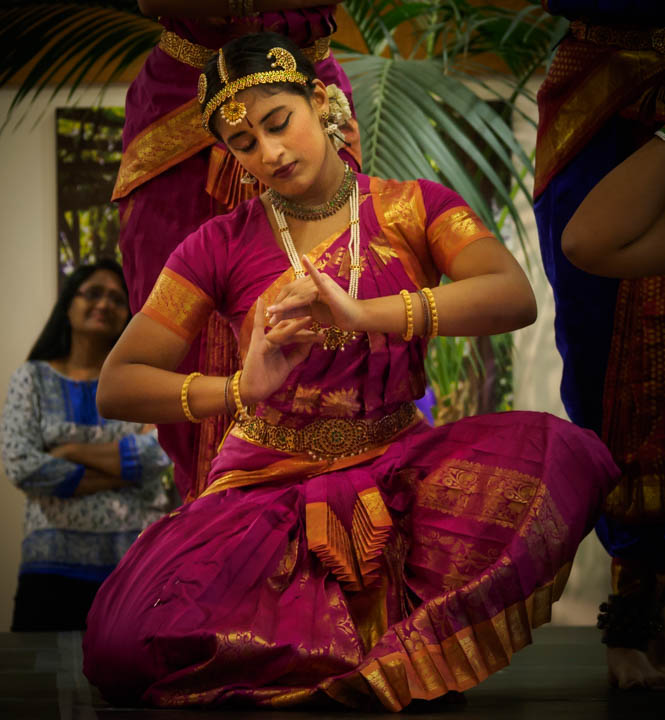
When I read an announcement that Bharatanatyam Dancers were going to be performing at Olbrich Gardens in Madison, I jumped at the opportunity to see this oldest of classical Indian dances, right in my neighborhood. Although it was not hot and sticky like it often was when I attended the performances in Chennai, the unusual spring-like February temperatures were just fine for me.
I arrived around the same time as some of the younger dancers. Unzipped winter jackets revealed the colorful costumes. A mother quickly "painted on" the finger designs with a colored Sharpie in place of customary henna. Artificial jasmine had to suffice instead of the customary fragrant floral strands adorning the plaited hair.
An instructor of the local Bharatanatyam Dance school introduced the girls (ages 5-16) and gave the audience a brief intro to what they were about to see. She explained how the eyes and hands were a highly integral part of conveying emotions in the expressive dances. Some of the younger students
The sophistication of footwork, hand gestures, and eye/neck movements increased with the age levels. Poses hearkened to the gods celebrated at Hindu temples, such as Krishna and Shiva. An enjoyable Saturday morning in Madison!
These last few days, we have been blessed by sunshine (sometimes a rarity in winter). This evening, the clouds were present just enough to create some beautiful sunset effects. This view is from my balcony in Madison.
One of the most enduring symbols of Tunisia is the door. Whether meandering through the old souks or in modern homes, from palaces to rather humble homes, elegant doors can often be found gracing their entrances. The doors of Tunisia serve as a gateway between the private domain and public space. Many are of a horseshoe shape, framed with local marble or stone. Some are rectangular.
Sidi Bou Saïd Door with Bougainvillea - Oil Pastel by Melissa Enderle
Quite often a smaller door is contained within the larger one, enabling further preservation of privacy. Visitors riding on horseback could use the top left door knocker and enter while still mounted. The lower right handle was for the women and children, and the upper right was for the master of the house. Tunisian doors are often studded with decorative nail heads in a symmetrical arrangement, disguising the construction methods and enhancing the appearance. Symbols such as the star, fir tree, and eye are prevalent. Blue is the most popular color (especially in the town of Sidi Bou Saïd), but doors can also be found in yellow, green, or natural wood colors.
See some of my photos of the doors of Sidi Bou Saïd in my Flickr album
With the rather dreary weather and melting snow, I decided to look for some different patterns in nature. While walking over a bridge at Tenney Park, I noticed the intriguing linear patterns created by the ice below.
Having finally spotted the sun, I happily bundled up and went for a photowalk. With the addition of a strong light source, the snow glittered and objects became more dimensional. It also created some wonderful shadows.
Below is the latest artwork I have completed, a color pencil drawing of Teton Ken (formal name of Ken Eddy). I met Ken and his burro Daisy at the Superstition Museum, where he was very willing to pose for me and chat. Gleaning information about Ken was far easier than most of my subjects in foreign countries, where language and/or time was a challenge.
With my grizzly beard, worn leather hat, gun, and mining gear saddled on ‘ol Daisy, I certainly look the part of a gold prospector. Yessiree, I can truthfully say that I have found a nugget or two, but nothing that would make me rich. I admit that I have been amongst the many who have gone up in these here Superstition Mountains searching for the fabled Lost Dutchman mine, but the greatest wealth I gained there revolved around enjoying the spectacular scenery. Leading some adult treasure-hunters and movie crews up the mountain also helped pay some bills and enabled me to purchase several burros including this here Daisy. I even acted as the ghost of the Lost Dutchman in a movie! On weekends, Daisy and I hang out here at the Superstition Museum, giving kids rides on my burros. I’m not sure who has more fun - me or the kiddos!
Despite the overcast skies, I was determined to get out and take some photos featuring the overnight snowfall. With the flat lighting, I would have to focus on other elements. These branches evoked a stark, but beautiful quality with their dynamic, wiggling lines.
These trees provided some nice diagonals, echoed with the opposing diagonal of the open waters at the shoreline.
See more Winter in Wisconsin photos on my Flickr album
In anticipation of an art exhibition, I wrote a short story about each painting, as if written by the person in the painting. These are all real people, and the stories are based on experience, observation, and representative/factual information typical of someone from that region/profession. Some of these paintings are still available, so if you are interested in purchasing one, please contact me.
For eighty-three years I have trod through the narrow lanes of my small village--first to my parents’ home, and then to my azhu's family farm. I loved living with my nai nai; now I get to enjoy the laughter of my grandchildren as they run through the family courtyard or play with the kittens. Even though my son says I don’t have to go to the market to sell vegetables, I quite like it, for it gives me something to do and a chance to chat with the other women. With a basket securely fastened to my cape, I slowly make my way to the tiny market, chatting with friends along the way.
Nearing lunchtime, this squirrel decided to take advantage of the tart, yellow fruit of the barrel cactus. He scrambled up to the plant, deftly (and quickly) climbed up, and began his snack. Those needles didn't seem to bother him at all; neither was he bothered by the people who stopped to snap a photo. In fact, he seemed to enjoy it, switching poses as he grabbed another fruit and chomp away.
While hiking on the Peralta Canyon Trail in Arizona, we spotted these longhorn cattle. Looking at the spread on their horns, I was somewhat happy to see that there were some cactus plants acting as a barrier between us.
Traveling and living overseas has created a heightened sensitivity and awareness of events that happen outside the border of my home country. Not only am I more knowledgeable about where those events are occurring, but there is a personal connection.
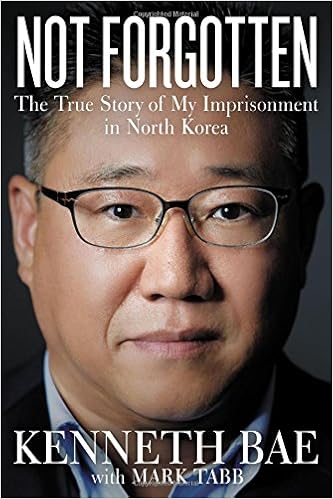
Having lived in South Korea for four years, I have read quite a few books pertaining to the Koreas on both side of the 38th parallel. My collection of read books (and documentaries) on North Korea is getting quite large. Each of the books, such as Barbara Demick's Nothing to Envyand Yeonmi Park's In Order to Live enlightened me on a slightly different aspect of the people and country called North Korea. My latest book I read on the "Hermit Kingdom" was Not Forgotten: The True Story of My Imprisonment in North Koreahad an entirely different perspective. Instead of trying to escape the horrible prison labor camps such as in Escape from Camp 14, Kenneth Bae's true story mainly focuses on the transformations which occurred while a "prisoner of Jesus Christ" in North Korea.
Although I highly encourage you to read the book, here is a basic summary. Kenneth, an American missionary of Korean descent, was arrested after a portable hard drive was discovered in his bag when his tour group arrived in the country from China. Even though he admitted to being a missionary who had made the mistake of accidentally leaving the backup hard drive in his bag, the North Korean government convicted him of the highest level of treason against the country.
Sentenced to 15 years of hard labor, Bae originally prayed and hoped for quick release - even though he knew he was being used as a political pawn. Now he was forced to manual labor from 8am-6pm out in the extreme elements and then subjected to the political brainwashing of the TV in the evening. Prior medical conditions exacerbated the already difficult situation, along with isolation and uncertainty. It wasn't until he asked the Lord to do His bidding and use Bae while "in chains" that things turned around for Bae. This was such a parallel with the Apostle Paul, who while imprisoned for witnessing about Christ, shared the Gospel with the prison guards. A sense of peace enveloped Bae, known as Prisoner 103; "Once I accepted this place as God's will for my life, and I started praying, God use me, instead of God, save me, doors opened". The guards took note and asked why he was so happy and where his hope came from, to which he responded, "God has me in here because he cares for you and all of North Korea. He wants to you to know who he is and how much he loves you."
A citizen of the US but a native South Korean, Bae had a unique opportunity. He was able to communicate directly to the guards and develop special insight. "My two years in North Korea also taught me what it means to have compassion for those who live in darkness. People in North Korea have no access to information from the outside world, no freedom to travel, no freedom to speak their minds, and now way to choose their own religions."
He realized that there was a special sense of safety within a totalitarian regime, and that those who raise questions about the societal structures is a direct threat to the nation. In North Korea, the Kim Jun family is their god.
Kenneth Bae recounted multiple instances of where God seemed to directly intervene or send strong messages that He had not forgotten His missionary. For example, there were times when Bae was at a low point in the hospital when he was craving and had prayed for a particular food; for the next meal, that exact food was brought in from a special restaurant, even though he had not verbalized any request. This happened over 40 times. At the prison, Bae's planted field was spared the flooding that affected all the other fields. When initially held in a cold detention room, his left hand suddenly became warm and the Spirit's presence was felt. At another low point while in the hospital, the Disney movie "Finding Nemo" was on instead of the usual shows venerating the Kim family, providing Bae a connection with America. Also, since it was known that Bae was a pastor and the government wanted to convey to the world that they were being merciful, he was allowed to keep his Bible. Two years after he was arrested, Bae woke much earlier than usual and heard the Spirit of God direct him to open the Bible to Zephaniah 3:20 (Bae had no idea what it would be) - and read: At that time I will gather you; at that time I will bring you home. Four days later, Bae was released.
In the end, Kenneth Bae spent 735 days in detainment - the longest held of any American since the Korean War.
Some interesting things I learned:
In 1907, Pyongyang was known as the "Jerusalem of the East" for having more churches than anywhere else in Asia. Now, there is only one "token church" that is under total control of the government. North Koreans have no knowledge of Jesus. One guard said he had heard of a God, but not this Jesus, asking where Jesus lived - China or North Korea.
The Bible is viewed as a dangerous weapon. North Korea even has a Bible on display at an anti-American propaganda museum that is filled with weapons the US has used against them in the Korean War.
Everyone is expected to contribute to the common good, including manual labor. For instance, Bae witnessed tens of thousands of people (including women with children on their backs) clearing the 200 mile long highway to Pyongyang with snow shovels. Even at the labor camp, the guards had to plant and tend their own fields for their food.
The guards had no conception of how families in South Korea or the USA could own both a car and a home. Years ago, the North Korean government provided families with a modest home, but now that is not typical.
I was amazed how Bae did not hold animosity towards the North Korean government. With a reframing of his outlook, he saw the period of detainment as a wonderful opportunity to witness for Christ, to a nation in the dark about their Savior. Bae continues to pray for the people of North Korea and hopes that one day, the spiritual wall that surrounds the country will fall. "More than a billion people worldwide still have not heard the gospel. We must remember them, pray for them, and build a bridge to them through which we can share God's love and compassion. May God be their God, and may they be his people."
While walking through the Desert Botanical Gardens in Phoenix, this saguaro demanded my attention. On the top of the main trunk was a fan-like protuberance. It stood so regally amongst the other plants in this desert landscape. When one of the garden volunteers came by, I asked him about this formation.
This cactus, he said, was known as a crested saguaro. This beautiful, but rare occurrence, is still a bit of a mystery to scientists. Some say the cresting is due to a genetic formation; others suggest that it is a result of frost or lightning strike. Inquiring online, I found that there even is a Crested Saguaro Society. Its members have been documenting each crested cactus it finds. One passionate veteran of the society theorizes that the cresting is due to a hormone that causes the number of pleats on a cactus to go out of control, observing that some return to normal after years of cresting. Through the society's diligent tracking, they claim to have found over 2, 200 crested saguaros.
Susceptible to frost and poaching, the crested saguaros are highly protected by the Arizona Department of Architecture.
During my time in Arizona, I spotted only one other crested saguaro, located on a trail in Apache Junction near Meridian Drive.